











1.png)
If you've ever looked at an export carton and wondered why it has a collection of letters, numbers, symbols, arrows, barcodes, or handling instructions, you've probably seen a shipping mark.
In simple terms, a shipping mark helps identify and manage a package while it moves through the supply chain. It can connect a physical carton, crate, pallet, or other cargo unit with the shipment documents that describe it. In international trade, this seemingly small detail can make a big difference.
A well-designed shipping mark can help warehouse staff, freight forwarders, carriers, customs personnel, and receivers distinguish one shipment from another.
For example, a manufacturer may send hundreds of cartons to several customers at the same time. Clear marks can help ensure that the right cartons reach the right destination.
Modern logistics also increasingly uses standardized identification systems. GS1, for example, explains that a logistics unit can be identified using a unique Serial Shipping Container Code, or SSCC, which can be scanned and connected with electronic supply-chain information.
So, what exactly is a shipping mark, what information should it contain, and how should you use one?
Let's break it down.
Understanding Shipping Marks
What Is a Shipping Mark?
A shipping mark is a visible identification or handling marking placed on a package or cargo unit to help identify, sort, handle, transport, or receive the goods.
Shipping marks can contain letters, numbers, symbols, barcodes, names, references, destinations, package counts, or handling instructions. The exact information depends on the shipment, customer, carrier, destination, and applicable regulations.
For example, an export carton might display:
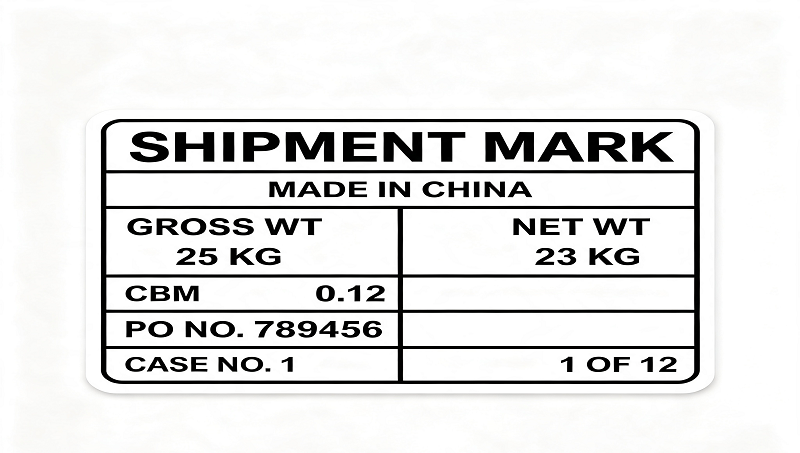
This information doesn't necessarily represent every possible requirement. Instead, it provides an easy-to-read reference that can help people identify the cargo.
Shipping marks are especially useful when many packages look similar. Imagine a warehouse containing 500 nearly identical cartons. Without reliable identification, separating shipments could become a headache.
That's why shipping marks are more than decoration. They're part of the information layer surrounding physical cargo.
Why Are Shipping Marks Important?
The supply chain involves many handoffs. Goods may move from a manufacturer to a warehouse, then to a freight forwarder, port, carrier, customs facility, distribution center, and final receiver.
At each stage, someone needs to know what a particular package is and where it belongs.
Clear shipping marks can make logistics operations more efficient by helping with package identification, shipment sorting, and warehouse receiving. They also support cargo consolidation, delivery coordination, and accurate order matching, while making handling instructions easier to follow.
In addition, clear shipping marks help connect physical packages with shipment documentation, improve cargo traceability, and reduce the risk of identification and delivery errors.
Maersk describes the "marks and numbers" field as a way to identify different pieces of cargo so they can be identified at the port and handed over to the appropriate parties.
Similarly, FedEx recommends clear and descriptive marking and labeling for freight shipments and notes that properly marked shipments are less likely to be delayed or lost.
In other words, good markings help turn an anonymous box into an identifiable shipment unit.
Shipping Marks vs. Shipping Labels
These terms are sometimes used interchangeably, but they don't always mean exactly the same thing.
A shipping mark generally refers to identification, reference, or handling information physically marked on the cargo or its packaging.
A shipping label is often a more structured label containing information used by a carrier or logistics system. It may include an address, tracking number, barcode, routing information, and other data.
For example:
| Feature | Shipping Mark | Shipping Label |
|---|---|---|
| Main purpose | Identify or distinguish cargo | Process and route shipment |
| Format | Text, numbers, symbols, or labels | Often standardized label format |
| May be handwritten | Sometimes | Usually printed |
| May contain barcode | Yes | Common |
| Used on export cartons | Very common | Very common |
| May include handling symbols | Yes | Sometimes |
| May contain tracking information | Sometimes | Common |
The two can appear together on the same package.
A modern logistics operation may also use a standardized logistics label. GS1 explains that its logistics label is designed to physically identify logistics units, with the SSCC serving as the unique identifier.
Common Information on Shipping Marks
There isn't one universal shipping mark that applies to every shipment. Requirements can vary considerably.
Common information includes:
| Information | Purpose |
|---|---|
| Shipper or Exporter Reference | Identifies the company or party sending the shipment. |
| Consignee or Buyer Reference | Identifies the customer or recipient of the goods. |
| Purchase Order Number | Connects the package to a specific customer order. |
| Shipment Number | Helps identify and track the overall shipment. |
| Destination | Shows where the goods are being delivered. |
| Country or Port | Identifies the relevant destination country or shipping port. |
| Carton or Package Number | Shows the sequence and total number of packages, such as “1 of 20.” |
| Product Reference | Identifies the product, item, or SKU inside the package. |
| Handling Instructions | Provides guidance such as “Fragile,” “Keep Dry,” or “This Side Up.” |
| Gross or Net Weight | Indicates the weight of the package or its contents. |
| Dimensions | Provides the package's length, width, and height when required. |
| Special Identification Numbers | Includes relevant reference or identification numbers required for the shipment. |
| Barcode or Logistics Identifier | Enables automated scanning, tracking, and identification of the package. |
For export shipments, it's particularly important to make sure the information on the package agrees with the relevant shipping and commercial documents.
FedEx notes that an export packing list can contain package markings along with package types, weights, measurements, buyer and seller references, and other shipment information.
Marks and Numbers
The phrase "marks and numbers" appears frequently in international shipping documentation.
It generally refers to the identifying marks or numbers placed on packages so that individual cargo pieces can be distinguished.
For example, suppose a shipment contains 30 cartons. You might identify them as:
.png)
This simple system makes it easier to verify whether all cartons belonging to a shipment have arrived.
Types of Shipping Marks
Not every shipping mark serves the same purpose. In practice, marks can be grouped into several broad categories.
Identification Marks
Identification marks tell people what shipment or cargo unit they're looking at.
They may include:
- Customer name
- Consignee reference
- Purchase order number
- Product code
- Shipment number
- Carton sequence
- Destination
- Internal reference number
These marks are especially useful when several customers have similar products moving through the same warehouse or transport network.
Handling and Warning Marks
Some markings communicate how cargo should be handled.
Common examples include:
- THIS SIDE UP
- FRAGILE
- HANDLE WITH CARE
- KEEP DRY
- DO NOT STACK
Symbols may also be used alongside words.
However, a handling mark shouldn't be treated as a guarantee that every person in the logistics chain will follow the instruction. FedEx specifically notes that markings such as "This End Up" can increase the likelihood of correct orientation, but carriers cannot necessarily guarantee compliance with every marking.
Therefore, handling marks should complement good packaging rather than replace it.
Transport and Logistics Marks
Transport-focused marks help move cargo through distribution systems.
These can include:
- Routing information
- Destination codes
- Carrier references
- Consignment numbers
- Shipment numbers
- Barcodes
- SSCC identifiers
GS1's logistics-label guidance identifies transport information such as ship-to postal code, consignment number, carrier routing information, and customer information as useful data for logistics operations.
This is where traditional shipping marks increasingly overlap with digital logistics.
Regulatory and Dangerous Goods Marks
Certain products require specific regulatory markings.
Dangerous goods are a particularly important example. These shipments may require specialized package markings and labels based on the applicable transportation regulations.
For example, FedEx states that dangerous-goods package markings must be permanently affixed to the package by the shipper and describes specific requirements for certain air shipments.
This is an important distinction:
A normal shipping mark is not a substitute for a legally required dangerous-goods marking.
If you're shipping chemicals, batteries, infectious substances, radioactive materials, or other regulated goods, you should follow the rules applicable to the specific commodity and mode of transport.
Shipping Marks for Export Cartons
Export cartons often need clear identification because they can pass through multiple logistics environments.
A basic export carton might look like this:
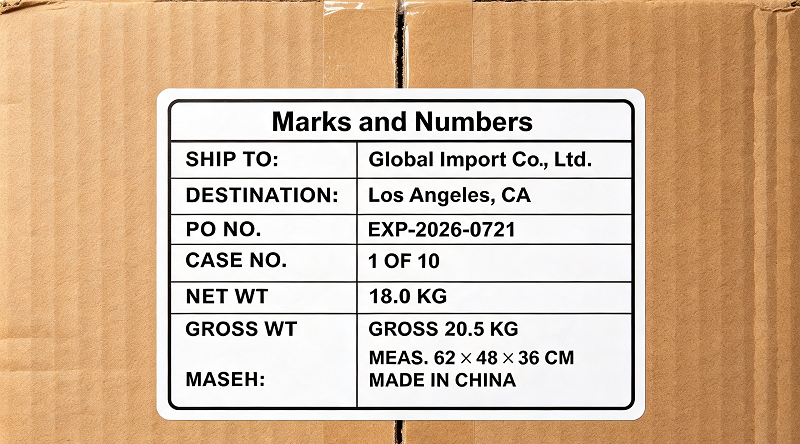
Additional information may be added depending on the buyer's instructions, carrier requirements, customs rules, or product characteristics.
The goal is straightforward: make the package identifiable without making the markings unnecessarily complicated.
How to Create Effective Shipping Marks
Creating a useful shipping mark doesn't have to be difficult. A systematic process can prevent many avoidable mistakes.
Step 1: Gather Shipment Information
Start with the documents before creating your shipping marks. Review the purchase order, commercial invoice, packing list, and booking information to ensure that all shipment details are accurate and consistent.
You should also check the customer’s instructions, carrier requirements, export documentation, import requirements, and any product-specific regulations. Reviewing these documents first helps you create accurate shipping marks and reduces the risk of errors, delays, or confusion during transportation.
Don't simply copy information from memory.
A single incorrect digit in a purchase order or carton reference can cause confusion later.
Step 2: Choose Clear Package Markings
Keep the most important information easy to see by using large, readable text and high contrast between the markings and the package surface. Use consistent terminology throughout your shipment and arrange the information with logical spacing so it can be understood quickly.
Choose durable labels or printing that can withstand handling and transportation, and use standard symbols where appropriate to communicate handling instructions clearly and efficiently.
Avoid unnecessary decoration.
A shipping mark isn't a marketing poster. Its job is to communicate information quickly.
Step 3: Position the Marks Correctly
Marks should be placed where logistics personnel can see them easily.
For palletized freight, consider the sides that are accessible to warehouse and handling equipment.
FedEx recommends placing freight labels on forklift-accessible sides and removing or marking through old labels and tags.
For larger shipments, it may make sense to place key identification information on more than one side.
Step 4: Match Marks With Documents
This step is critical.
The information on your packages should correspond with your packing list and other shipping documents.
For example, if the packing list states:
40 cartons
Cartons 1–40
PO 45821
the physical cargo should use a compatible identification system.
This makes reconciliation much easier.
Step 5: Inspect Before Dispatch
Before the shipment leaves the warehouse, conduct a final check.
Ask:
- Is every carton marked?
- Are carton numbers complete?
- Does the PO number match?
- Does the destination match?
- Are old labels removed?
- Are handling marks visible?
- Are regulatory markings present where required?
- Do barcodes scan correctly?
- Does the packing list agree with the physical cargo?
- Are labels securely attached?
Five minutes spent checking the cargo can save hours of troubleshooting later.
Shipping Marks Example
Consider a company exporting 100 cartons of machine components.
The buyer provides a purchase order number: PO-78452.
The exporter could use a shipping mark such as:

If the products have special handling requirements, appropriate handling markings could also be added.
For a modern logistics operation, the shipment could additionally carry a barcode-based logistics identifier.
GS1 explains that an SSCC identifies an individual logistics unit and can be used to connect physical movement with electronic business messages.
Shipping Marks and Packing Lists
Shipping marks and packing lists work closely together.
The packing list provides detailed information about the shipment, while the marks on the physical packages help users identify which physical package corresponds to that information.
For example:
| Carton | Product | Quantity | Shipping Mark |
|---|---|---|---|
| 1/3 | Product A | 50 | PO-5001 / 1 of 3 |
| 2/3 | Product B | 40 | PO-5001 / 2 of 3 |
| 3/3 | Product C | 30 | PO-5001 / 3 of 3 |
This relationship becomes particularly valuable during receiving.
A warehouse employee can look at the carton, identify its mark, and compare it against the packing list or electronic receiving record.
Benefits of Proper Shipping Marks
Well-designed package identification provides several practical benefits.
Fewer Identification Errors
Clear marks reduce ambiguity between similar cartons and shipments.
This is particularly useful for:
- Consolidated cargo
- Mixed shipments
- Large purchase orders
- Multiple destinations
- Contract manufacturing
- International exports
Faster Receiving and Distribution
Warehouse workers don't want to decode mysterious boxes.
A clear carton number, order reference, and destination can make receiving and sorting much more straightforward.
Standardized logistics labels can take this further by allowing automated scanning. GS1 states that scanning the SSCC can connect the physical movement of a logistics unit with related electronic business messages.
Better Shipment Traceability
Traceability means being able to understand where a shipment or logistics unit belongs within the supply chain.
A unique identifier can make that process much easier.
GS1 notes that the SSCC can individually identify logistics units such as cases, pallets, or parcels and support tracking throughout the supply chain.
Common Shipping Mark Mistakes
Using Inconsistent Information
One of the biggest problems is inconsistency.
For example:
- Carton says PO-12345
- Packing list says PO-12354
- Commercial invoice says PO-12345
That small discrepancy can create unnecessary questions.
Always verify references before dispatch.
Covering Old Marks
Reusing boxes can create confusion when old labels remain visible.
A carton might have:
- An old customer name
- An old destination
- An old tracking number
- An old product code
Remove, cover, or clearly mark obsolete information before reuse.
FedEx similarly advises shippers to remove or mark through old labels, tags, and markings.
Making Marks Too Small
A mark that looks readable on a computer screen might be difficult to read on a warehouse floor.
Think about the real environment.
Packages may be:
- Several meters away
- Wrapped in stretch film
- Stacked on pallets
- Stored in dim areas
- Viewed quickly during unloading
Readability matters.
Frequently Asked Questions About Shipping Mark
Is a shipping mark mandatory?
Not every shipment has one universal shipping-mark requirement. Whether specific marks are required depends on the shipment, destination, commodity, carrier, customer instructions, and applicable regulations.
Some transport systems or customs processes may require specific information, while other marks may simply be useful identification aids.
Therefore, don't assume that one generic shipping-mark template works everywhere.
What should a shipping mark contain?
A shipping mark may contain a customer or consignee reference, purchase order number, destination, package number, product reference, shipment number, or handling information.
The exact contents should be based on the shipment requirements.
A good rule is to include enough information to identify the package accurately without cluttering the carton with unnecessary data.
Are shipping marks the same as shipping labels?
Not necessarily.
A shipping mark is generally a physical identification or handling marking, while a shipping label is often a more structured label used for routing and transportation.
They can overlap, and both can appear on the same package.
What are marks and numbers in shipping?
"Marks and numbers" is a common shipping-document term for information used to identify individual cargo pieces.
For example, cartons could be numbered 1/20, 2/20, 3/20, and so forth, alongside a customer or purchase-order reference.
Maersk describes the marks-and-numbers field as an identification method for distinguishing cargo pieces within a shipment.
Can shipping marks be handwritten?
In some situations, markings can be handwritten, provided they satisfy the applicable requirements and remain clear and durable.
However, printed labels are generally easier to standardize and scan.
For regulated goods, specific marking rules may apply. For example, FedEx states that dangerous-goods package markings must meet particular requirements and be permanently affixed.
What is an SSCC?
SSCC stands for Serial Shipping Container Code.
It is an 18-digit GS1 identification key used to uniquely identify a logistics unit.
A logistics unit could be a carton, pallet, parcel, or other grouping of goods prepared for transportation or storage. GS1 states that the SSCC enables individual logistics units to be identified and tracked through the supply chain.
Businesses interested in standardized logistics identification can consult the GS1 Logistics Label guidance for more detailed information.
Can one shipment have different shipping marks?
Yes. Different packages within the same shipment can have different sequential numbers or product references.
However, the markings should follow a logical and documented system.
For example:
PO-5000
CARTON 1/10
through:
PO-5000
CARTON 10/10
This helps the receiver understand the relationship between individual cartons.
Do shipping marks replace customs documents?
No.
A shipping mark identifies or provides information about physical cargo, but it doesn't automatically replace documents such as commercial invoices, packing lists, certificates, permits, or other required customs documentation.
The exact documentation requirements depend on the shipment and jurisdiction.
Where should shipping marks be placed?
They should generally be positioned where they are visible and practical to read during handling.
For palletized freight, accessible sides are often useful. Multiple visible sides may also be appropriate for large or frequently handled cargo.
The key principle is simple: don't put essential identification somewhere that is likely to be hidden by wrapping, strapping, another carton, or handling equipment.
Conclusion
A shipping mark is a simple but important part of logistics. It gives physical cargo an identity that people and, increasingly, automated systems can understand.
Whether you're shipping a few cartons or managing international containerized freight, clear package identification can support smoother handling, receiving, sorting, documentation, and traceability.
The most effective approach is to keep your marks clear, consistent, durable, visible, and synchronized with your shipping documents.
For traditional cargo, this might mean a purchase-order number, consignee reference, destination, and carton sequence. For modern supply chains, it can also involve barcodes and standardized identifiers such as the SSCC.
The bottom line is straightforward: a well-designed shipping mark helps the right package remain identifiable from the warehouse to the final destination.
When the physical information on the box agrees with the information in your logistics systems and documents, everyone involved has a clearer picture of what is moving, where it belongs, and how it should be handled.
That may seem like a small detail, but in global logistics, small details can make a big difference.

.png)