








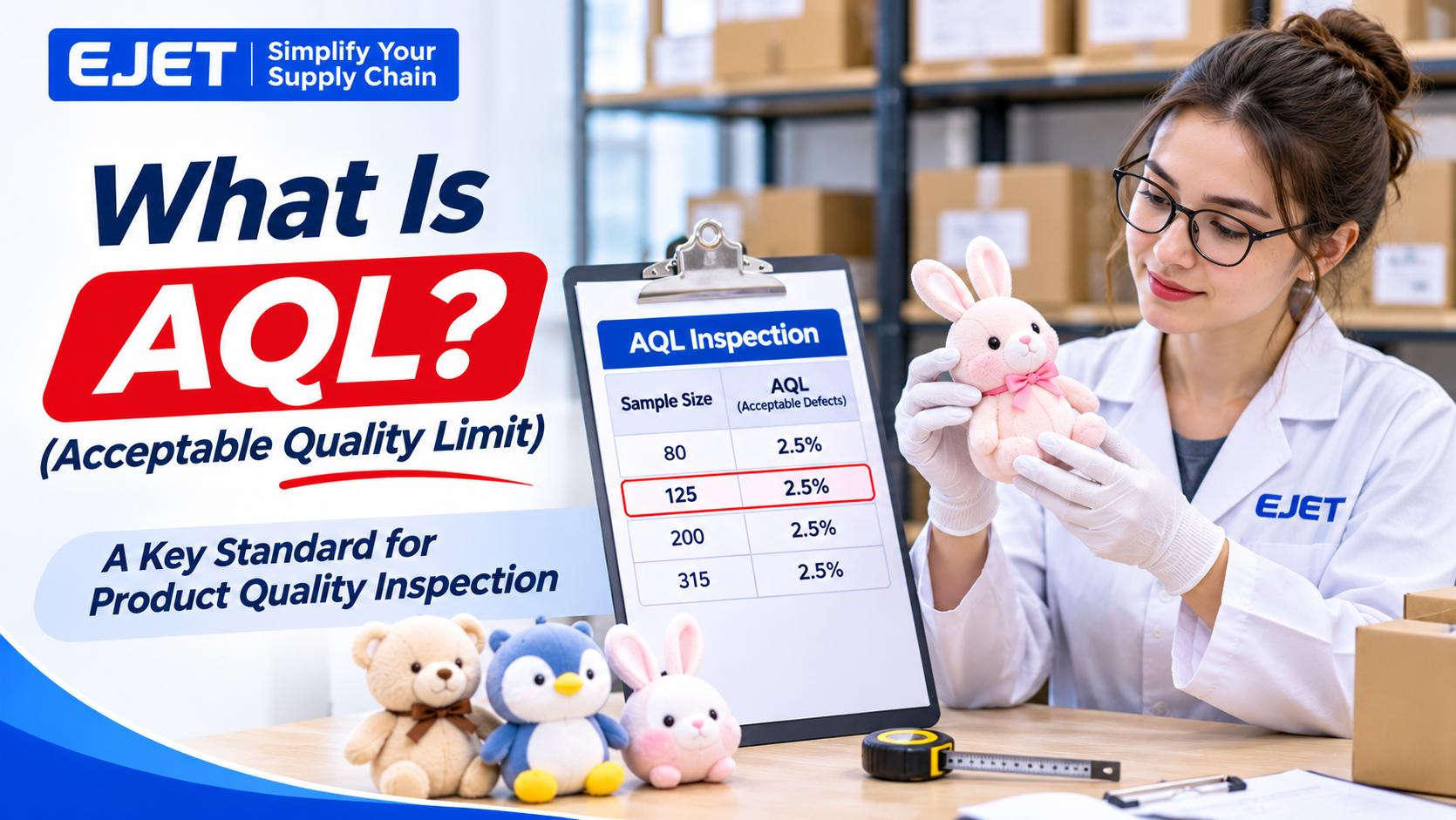
AQL (Acceptable Quality Limit), formally called Acceptance Quality Limit in major sampling standards, helps organizations establish rules for accepting or rejecting production lots through sample inspection.
It supports consistent quality control without requiring every item to be examined, but it does not guarantee a defect-free shipment. Understanding its terminology, sampling rules, and limitations helps buyers, suppliers, and quality teams make better inspection decisions.
What is AQL, and what does it actually mean?
A practical AQL definition is the quality level used as the limit of a satisfactory process average when a continuing series of lots undergoes acceptance sampling. It is a parameter for selecting a sampling scheme, not a direct measurement of the quality of one shipment.
ASQ emphasizes the continuing-series context because AQL-based systems work alongside rules for changing inspection severity over time.
That distinction prevents a common misunderstanding: an AQL of 1.0 does not mean every accepted lot contains no more than 1% nonconforming items. Sampling involves uncertainty, so some lots with worse quality can pass, while some better lots can fail.
Nor should AQL be treated as a production yield calculation; subtracting it from 100 does not establish expected yield.
Think of AQL as part of a decision framework. The operational questions remain separate: what counts as a nonconformity, how will items be selected, and what evidence will determine acceptance? Document those answers before inspection begins.
The terminology behind an inspection decision
Several terms connect the quality requirement to the final lot decision. Keeping them separate makes inspection instructions easier to follow and results easier to audit. In particular, avoid using “AQL,” “sample size,” and “acceptance number” as interchangeable labels.
|
Term |
Meaning in practice |
|---|---|
|
Lot |
The defined group of items subject to an acceptance decision. |
|
Sample size |
The number of items selected for inspection. |
|
Nonconforming item |
An item that fails one or more specified requirements. |
|
Nonconformity |
An individual failure to meet a requirement; one item can have several. |
|
Acceptance number |
The maximum permitted count under the selected sampling plan. |
|
Rejection criterion |
The result that requires the lot to be rejected under the plan. |
These distinctions matter because attributes sampling can assess either nonconforming items or nonconformities per 100 items. A unit with several problems should not automatically be counted several times when the plan measures nonconforming units. Specify the counting method in the inspection procedure and apply it consistently.
How does AQL sampling work?
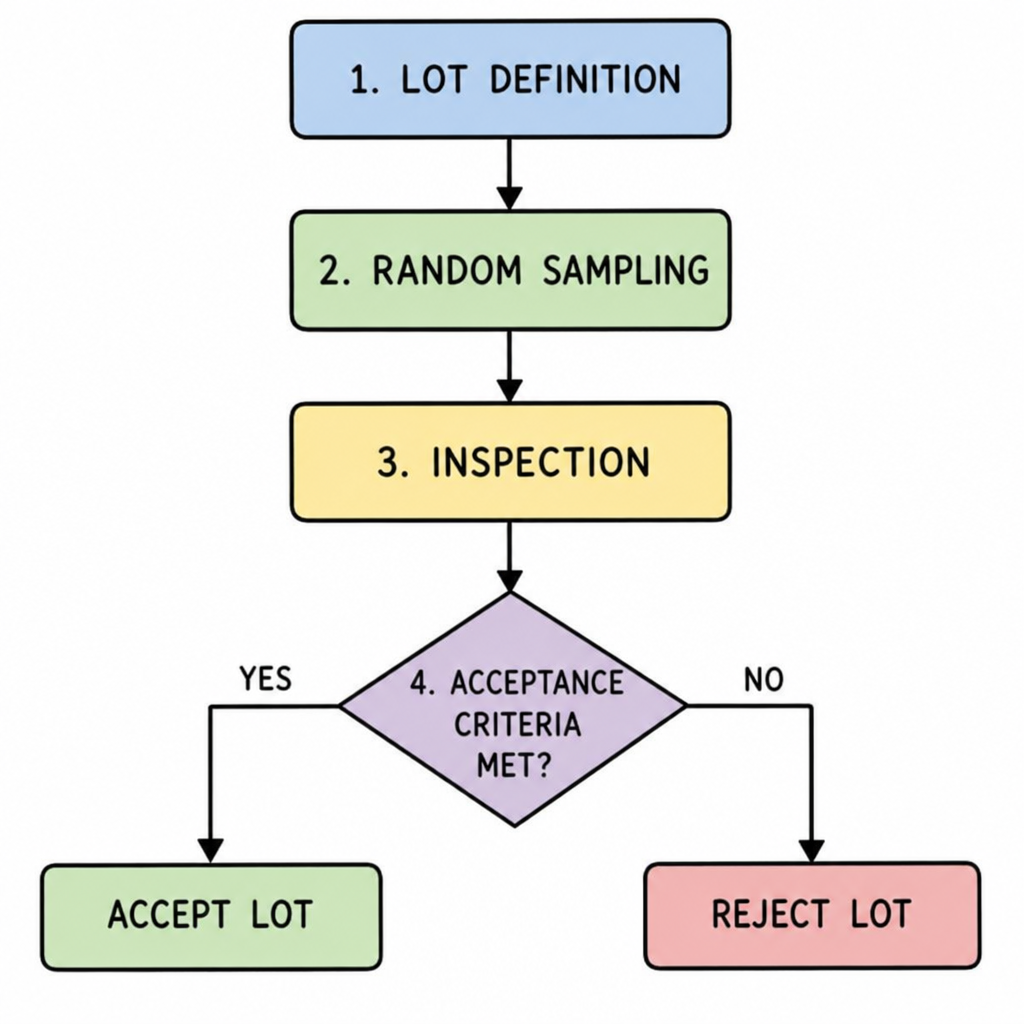
AQL sampling uses a defined sampling scheme to select items, inspect them against requirements, and compare the findings with acceptance criteria. For a single-sampling plan, the team inspects one randomly selected sample and makes the lot decision from that result. Other plans can require additional samples according to predetermined rules.
A practical workflow looks like this:
- Define the lot and requirements. Identify the items covered and specify the characteristics inspectors must check.
- Choose the applicable scheme. Record the governing standard, inspection level, AQL, and inspection severity.
- Determine the sample and decision criteria. Use the applicable tables and instructions rather than an informal percentage of the shipment.
- Select items randomly. Give units a valid opportunity for selection instead of choosing only convenient or accessible products.
- Inspect and record findings. Apply the agreed methods and counting rules without changing definitions midway through inspection.
- Make and document the decision. Compare results with the selected plan, then follow the agreed disposition procedure.
Random selection deserves particular attention. Ask how the sample will cover the defined lot when products occupy multiple pallets or cartons. A sample drawn only from the nearest open box may introduce selection bias, undermining the basis for the decision.
An illustrative acceptance decision
Suppose a hypothetical single-sampling plan requires inspecting 80 items and allows no more than two nonconforming items. Finding two would meet that acceptance criterion; finding three would not. These numbers illustrate the decision mechanism only—they are not a recommended plan or a claimed table lookup.
The acceptance number comes from the selected plan, not from multiplying the sample size by the AQL. Likewise, passing the sample does not establish the exact number of nonconforming items remaining in the lot. The decision is acceptance under a specified sampling rule, not certification that every uninspected unit conforms.
AQL standards provide a complete system
Two important references are ISO 2859-1, covering AQL-indexed sampling schemes for lot-by-lot attributes inspection, and ANSI/ASQ Z1.4, an attributes acceptance sampling system. Both address more than a sample-size lookup: the scheme includes rules governing inspection across a continuing stream of lots. ISO identifies ISO 2859-1:2026 as its published edition.
Inspection severity and inspection level are different concepts. Under AQL standards, normal, tightened, and reduced inspection form part of the system for responding to quality history. Do not treat reduced inspection as an informal shortcut or assume that an inspection level alone fully defines a sampling plan. Apply the selected standard's instructions and switching rules.
Also distinguish attributes inspection from variables inspection. Attributes methods classify or count conformity outcomes; variables methods use measured values, such as dimensions.
ANSI/ASQ Z1.9 addresses variables sampling and has its own applicability conditions, including distributional assumptions. Choose the method around the data and requirements rather than treating the standards as interchangeable.
Choosing criteria that reflect product risk
Start with the consequence of a failure, not a familiar AQL value. Ask what the customer needs the product to do, what could prevent that use, and which characteristics require separate treatment. When evaluating a sampling plan, consider both the quality level regarded as satisfactory and the risk of accepting poorer quality.
For your inspection specification, consider separating findings into clearly defined categories:
- Safety-related failures: Identify characteristics requiring escalation or controls beyond ordinary lot acceptance.
- Functional failures: Describe problems that prevent intended use, assembly, or performance.
- Appearance or workmanship failures: Set observable boundaries so inspectors can distinguish an acceptable variation from a reportable problem.
Treat these as prompts for building a product-specific classification system, not universal definitions. For example, a missing label could be an appearance issue in one context and essential to correct use in another. Write the requirement and consequence explicitly instead of relying on a category name alone.
Avoid assuming that a zero acceptance number proves zero risk. It means no nonconforming items are permitted in the inspected sample under that criterion; uninspected items remain uncertain. Evaluate whether the chosen sampling approach provides appropriate protection for the characteristic concerned.
What risks remain when a lot passes inspection?
A passing result leaves sampling risk: the sample may satisfy the acceptance rule even when the lot's underlying quality is unsatisfactory. Conversely, a satisfactory lot can be rejected. These possibilities are commonly discussed as consumer's risk and producer's risk, respectively, at specified quality levels.
An operating characteristic, or OC, curve shows how a plan's probability of acceptance changes with the proportion nonconforming. It makes the trade-off more informative than an AQL value alone. When protection against poor lots matters, review the plan's behavior at an unacceptable quality level as well as at the AQL.
Acceptance sampling also has a specific purpose: deciding the disposition of lots. It is not primarily a tool for estimating a lot's exact quality or controlling the production process.
NIST presents it as a middle-ground approach between no inspection and complete inspection, particularly when examining every item would be impractical or destructive.
Applications across the product journey
AQL-based inspection can support decisions involving finished products, subassemblies, materials, and other defined outputs. ISO 2859-1 also describes applications extending beyond physical products, including records and operations. The essential requirement is to define what is being inspected and how conformity will be judged.
Consider these illustrative applications when designing your own procedure:
Incoming components: Define a supplier lot and assess selected components against agreed requirements before release to production.
Finished goods: Inspect a randomly selected sample for specified construction, function, or packaging requirements before shipment.
Records review: Define the population of records and the missing or incorrect information that counts as nonconformity.
For each application, make the sampling unit unambiguous. A “unit” might mean one component, one packaged product, or one record—not whichever interpretation is most convenient during inspection. Record that choice alongside the lot boundary, inspection method, and decision criteria.
Connecting quality control with quality assurance
AQL inspection fits within quality control, which focuses on fulfilling quality requirements through operational activities such as inspection.
Quality assurance has a broader confidence-building role, encompassing planned and systematic activities within the quality system. The two are related, but an accepted shipment alone does not demonstrate that the entire production system is effective.
Use inspection findings as inputs to that wider system. For example, when a recurring failure appears, ask whether the specification is clear, the production method needs attention, or inspectors need better examples.
Keep the acceptance decision separate from the investigation so an immediate shipping decision does not replace longer-term corrective work.
For a practical review dashboard, consider these quality metrics:
- Lot acceptance rate: Show accepted lots alongside the number inspected and the sampling scheme used.
- Observed nonconforming-item rate: Report the sample count and denominator, rather than presenting it as an exact shipment-wide rate.
- Recurring failure categories: Group findings consistently so repeated problems become visible.
- Corrective-action follow-up: Record the action owner and evidence reviewed to assess whether the problem recurs.
Keep comparisons meaningful by noting changes in inspection severity, sample selection, or acceptance criteria. A change in pass rate may reflect a different decision rule, not simply better manufacturing. Acceptance results and process-performance evidence answer different questions, so review them together rather than substituting one for the other.
Make AQL a decision tool, not a quality target
AQL is most useful when the requirements, random-selection method, sampling scheme, and decision rules are explicit. Its role is to support lot acceptance under known sampling limitations—not to promise perfect shipments or define expected production yield. Standards-based schemes also use inspection history to guide subsequent inspection decisions.
Before your next inspection, check that your team can identify the lot, explain the counting method, locate the applicable plan, and describe what happens after rejection. If those answers are unclear, improve the procedure before collecting more samples. A well-documented decision is easier to apply consistently—and easier to learn from afterward.
Frequently Asked Questions About AQL (Acceptable Quality Limit)
What is AQL and why is it important?
AQL, or Acceptable Quality Limit, is a statistical measurement used in quality control to determine the maximum number of defective items allowed in a sample before a lot is rejected. It is essential for ensuring consistent product quality while minimizing inspection costs.
How is AQL calculated and what factors influence it?
AQL is typically defined as a percentage and is influenced by several factors, including the type of product, production processes, and customer expectations. It is calculated by determining the maximum acceptable number of nonconformities in a sample size based on established standards.
What is the difference between AQL and quality assurance?
AQL focuses on the acceptance of sampled items based on their conformity to specified standards, while quality assurance encompasses a broader range of activities and processes aimed at ensuring overall quality throughout production. Quality assurance includes preventive measures, while AQL is a reactive inspection method.
How does AQL sampling work in practice?
AQL sampling involves selecting a random sample from a lot, inspecting it against predetermined criteria, and deciding whether to accept or reject the entire lot based on the number of nonconforming items found. Different sampling plans can dictate the sample size and acceptance criteria.
What are the risks associated with using AQL?
The primary risks of using AQL include the potential for both consumer's risk (rejecting a satisfactory lot) and producer's risk (accepting a defective lot). AQL does not guarantee that all items in a lot are defect-free and is subject to sampling errors, which can lead to decisions based on incomplete information.