PVD coatings are thin, engineered surface layers used to improve wear resistance, surface performance, or appearance. Five useful types to understand are titanium nitride, titanium carbonitride, chromium nitride, aluminum titanium nitride, and zirconium nitride.
Comparing these materials helps narrow the options for cutting tools, molds, industrial components, and decorative products—but the right choice depends on the complete application, not simply the coating name.
What is physical vapor deposition?
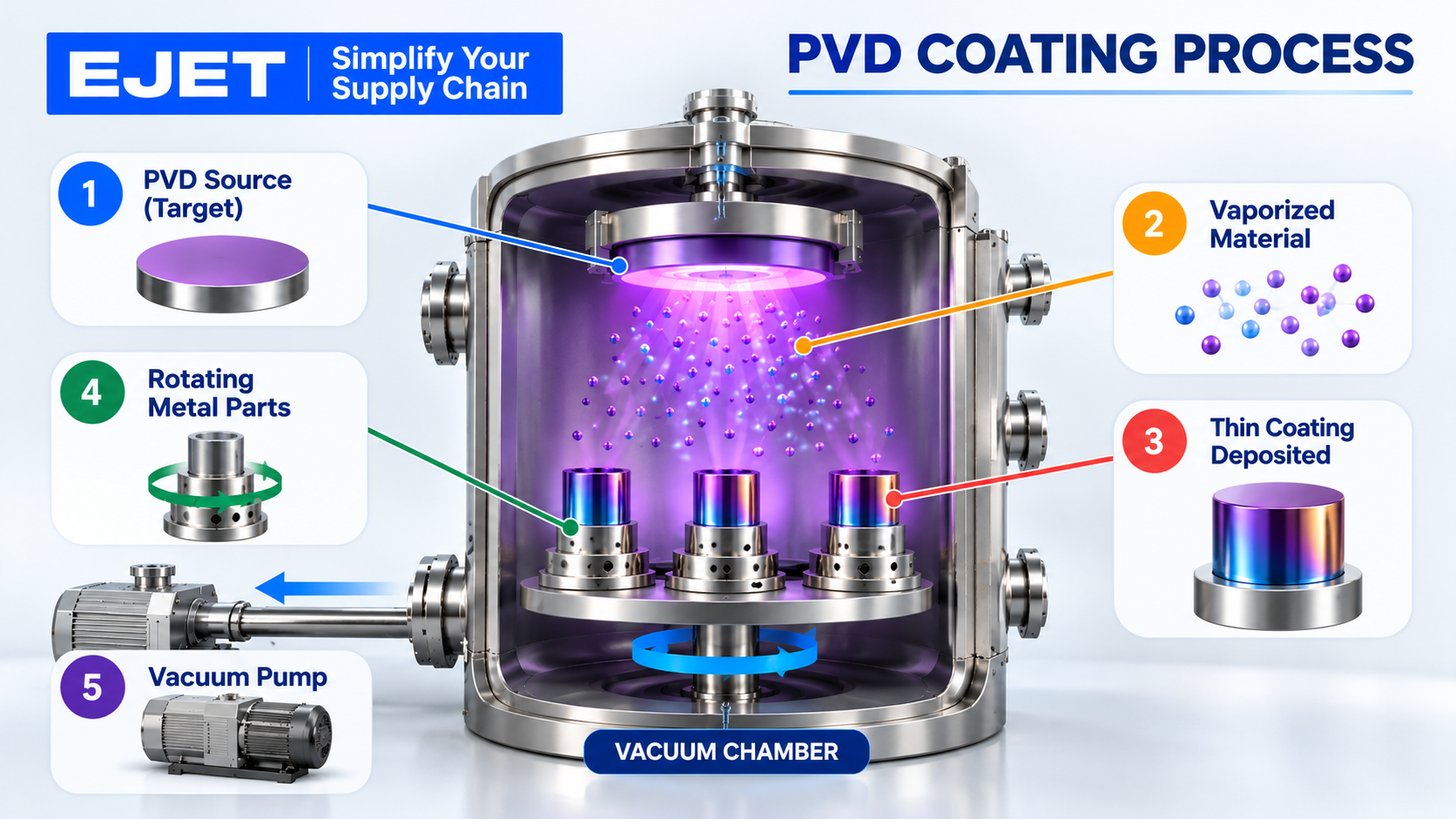
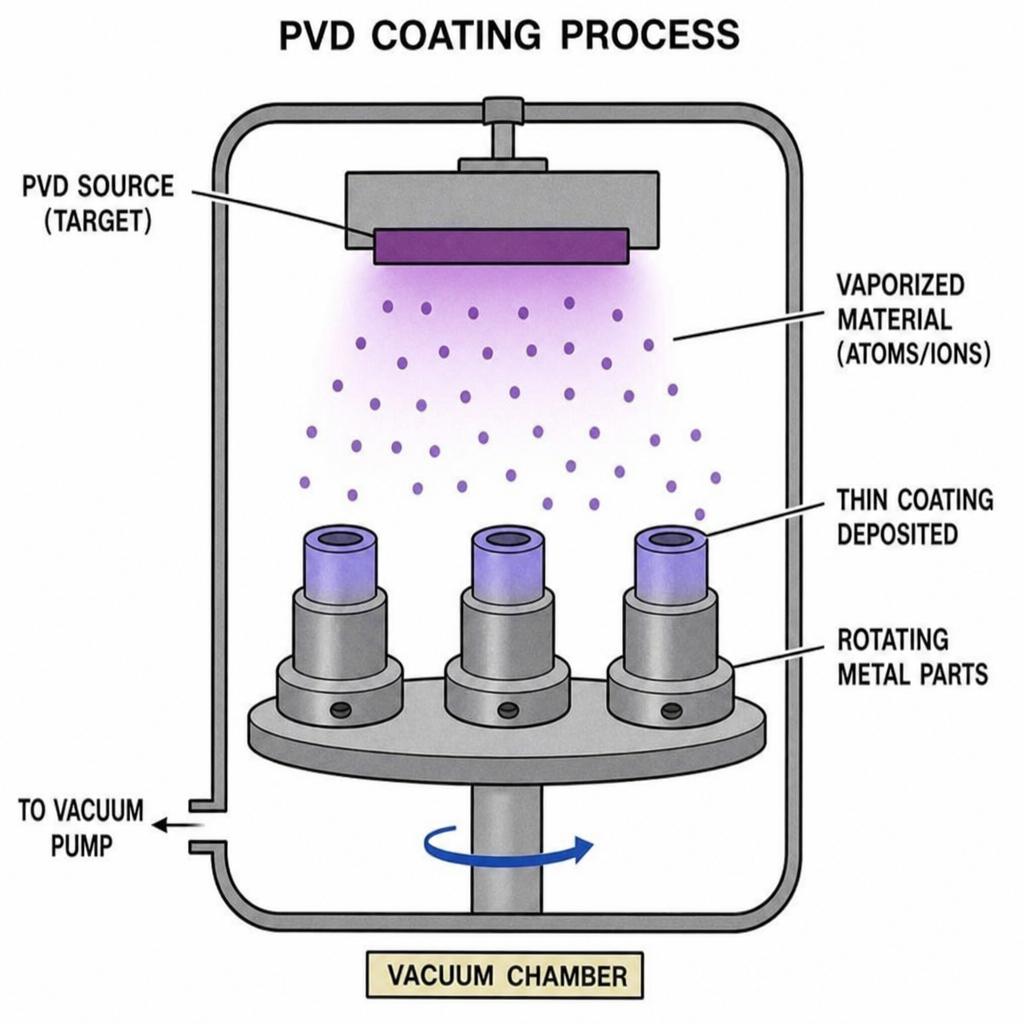
Physical vapor deposition, or PVD, is a family of vacuum-based processes that transfers material from a solid source onto a component as a thin film. For hard compound coatings, the deposited material can react with gases such as nitrogen to create the desired surface chemistry. The result is an engineered outer layer rather than a replacement for the underlying component.
A useful distinction separates coating materials from deposition methods. Titanium nitride describes what the coating contains; cathodic arc deposition and magnetron sputtering describe ways to deposit it. Discussions about “types of PVD” sometimes mix these categories, so clarify whether a specification concerns chemistry, manufacturing process, or both.
PVD coating materials include nitrides, carbides, and carbonitrides based on metals such as titanium, chromium, and zirconium. Suppliers also engineer multilayer and more complex compositions to balance performance requirements. Consequently, two products carrying a similar material label need not have identical structures or behavior.
Think of the material name as the starting point for a technical discussion. Before comparing quotations, ask each supplier to identify the actual coating product, deposition process, and intended operating conditions. That makes the comparison more meaningful than choosing between abbreviations alone.
How the coating process builds the surface
Preparation comes first. Components must be appropriately cleaned because oils, residues, and other contamination can interfere with adhesion. PVD films generally follow the existing surface rather than filling scratches or leveling machining marks, so preparation also establishes much of the final appearance.
Inside the vacuum chamber, the equipment releases material from a solid source. Cathodic arc systems use an electric arc, while sputtering systems use ion bombardment to eject material from a target. The deposited species form the coating on exposed component surfaces under controlled process conditions.
Temperature compatibility deserves attention before any parts enter the chamber. PVD is not one fixed-temperature treatment: suitable deposition conditions depend on the substrate and required coating performance. Ask for the proposed process temperature and have it checked against the component’s material and heat-treatment requirements.
For a first order, request a written process outline covering preparation, coating, any finishing treatment, and inspection. This creates a clear boundary between what the coating supplier will do and what your team must complete beforehand.
Which five types of PVD coating should you compare?
The five types of PVD coating covered here are TiN, TiCN, CrN, AlTiN, and ZrN. Together, they illustrate several important selection priorities: general-purpose wear protection, abrasive wear resistance, resistance to material pickup, elevated-temperature cutting performance, and decorative appearance. They are useful examples, not an exhaustive list of available coatings.
|
Coating material |
Typical appearance |
Common selection priority |
|---|---|---|
|
Titanium nitride, TiN |
Gold |
Versatile wear protection |
|
Titanium carbonitride, TiCN |
Blue-gray to brown, depending on composition |
Abrasive wear resistance |
|
Chromium nitride, CrN |
Silver or silver-gray |
Forming, molding, and galling resistance |
|
Aluminum titanium nitride, AlTiN |
Anthracite or dark gray |
Cutting performance at elevated temperatures |
|
Zirconium nitride, ZrN |
Pale gold |
Nonferrous machining and decorative finishes |
These appearances and applications are representative rather than universal specifications. Supplier formulations differ, particularly for TiCN, and published product data should guide the final comparison. Treat the table as a shortlist builder, not an acceptance standard.
1. Titanium Nitride (TiN)
Titanium nitride is a gold-colored hard coating used across machining, forming, and component applications. Its appeal is versatility: it offers a practical starting point when the requirement is broad wear protection rather than a highly specialized operating condition. Common applications include drilling, reaming, milling, and sawing.
TiN also connects functional and decorative requirements. Its recognizable metallic gold appearance can be relevant where a visible surface must provide both color and wear resistance. However, the finished surface should be evaluated on the actual substrate and preparation method rather than selected from a generic color photograph.
For a general-purpose tooling project, consider TiN as a comparison baseline. Ask the supplier why a more specialized option would better address the observed failure mode. The answer should connect a material property to your operation, not merely describe another coating as “premium.”
Temperature is one important boundary. TiN is not automatically the best option for increasingly hot cutting conditions, because oxidation changes its protective surface behavior. Where elevated-temperature performance is central to the application, compare it with an appropriate aluminum-containing coating instead of assuming all hard coatings behave alike.
Practical selection question: Is the project seeking dependable general-purpose protection, or does it have a specific thermal, friction, or chemical challenge? Use that distinction to decide whether TiN deserves a trial or whether the shortlist needs a more specialized candidate.
2. Titanium Carbonitride (TiCN)
Titanium carbonitride combines titanium, carbon, and nitrogen. It can provide greater hardness and abrasive wear resistance than TiN, making it relevant to cutting and metalworking applications where abrasion is a significant concern. Its exact composition and structure vary between suppliers, so TiCN is better understood as a coating family than a single standardized recipe.
That variability affects appearance as well as performance. Changes in the carbon-to-nitrogen ratio can produce different colors, including brown, violet, and gray tones. A difference in shade therefore does not, by itself, establish whether one TiCN coating is better or worse than another.
TiCN appears in supplier recommendations for cutting, threading, stamping, punching, and forming. For a tool showing abrasive wear, it is worth asking whether a TiCN product matches the workpiece material, contact conditions, and lubrication strategy. Have the supplier explain the expected advantage over the current coating.
Hardness alone should not decide the purchase. TiCN compositions can involve trade-offs in brittleness and oxidation resistance, so a harder film is not automatically the most reliable choice for every edge or loading condition. Compare the complete coating design and its application history rather than ranking products by one hardness value.
For a trial, define what improvement would justify adoption: acceptable tool condition after a production run, consistent part finish, or another measurable operating result. Keep the evaluation tied to the problem that prompted the coating change.
3. Chromium Nitride (CrN)
Chromium nitride is a silver-colored coating used in metal forming, plastic injection molding, and other demanding contact applications. Supplier-developed CrN coatings can combine toughness, wear resistance, and resistance to galling—the unwanted adhesion or transfer of material between contacting surfaces. These qualities make CrN worth considering when material pickup is part of the problem.
Its suitability extends beyond a simple hardness comparison. For example, Ionbond describes CrN applications involving several steel categories and copper alloys, as well as plastic processing environments where corrosive attack matters. Those examples illustrate why the workpiece and operating environment belong in the selection brief.
If a forming tool repeatedly develops buildup, ask the supplier to review CrN alongside the existing surface condition and operating setup. Provide photographs of the affected areas and explain when the buildup appears. This gives the discussion a specific target instead of treating “wear” as one undifferentiated issue.
CrN can also be considered in some applications otherwise associated with chrome plating, but it should not be specified as an automatic drop-in replacement. Some suppliers recommend particular CrN systems for particular environments; that is different from establishing universal interchangeability.
Practical selection question: Does the proposal address adhesive wear, abrasive wear, chemical exposure, or several of these together? Require a clear explanation of the expected benefit, then validate the result on a representative component before changing the production specification.
4. Aluminum Titanium Nitride (AlTiN)
Aluminum titanium nitride is associated with cutting applications that demand elevated-temperature hardness and oxidation resistance. Related TiAlN coatings use the same principal elements but differ in aluminum content; exact compositions depend on the supplier. The names should therefore not be treated as a guarantee of identical performance.
At elevated temperatures in air, aluminum in the coating can form a protective aluminum oxide surface layer. This helps explain why AlTiN-based coatings are relevant to demanding machining conditions rather than simply offering a different color or room-temperature hardness value. The complete composition and operating conditions still matter.
Supplier portfolios recommend AlTiN products for operations such as milling, drilling, reaming, and sawing. Their typically dark appearance makes them visually distinct from gold TiN, but appearance is secondary to the thermal and mechanical requirements of the cutting process.
When assessing AlTiN, describe the workpiece material, cutting operation, coolant practice, and current failure pattern. Ask the supplier to explain why the proposed product suits that combination. Avoid approving a coating merely because its published temperature capability is higher than another option’s.
Likewise, do not interpret an elevated-temperature coating recommendation as permission to remove coolant or change cutting parameters without review. Treat those changes as separate trial variables. A useful evaluation establishes whether the proposed coating solves the actual production problem under an agreed operating setup, rather than testing several uncontrolled changes simultaneously.
5. Zirconium Nitride (ZrN)
Zirconium nitride is a pale-gold coating used in both functional and decorative applications. It is particularly relevant to nonferrous machining: suppliers identify aluminum machining, copper machining, and related cutting operations among its uses. This makes ZrN a useful candidate when selecting solely from coatings associated with steel cutting would overlook the workpiece material.
ZrN also demonstrates why appearance should not obscure engineering differences. It may resemble other gold-colored PVD finishes, yet its chemistry and application recommendations differ from TiN. Two visually similar samples are not necessarily interchangeable in service.
For a nonferrous cutting project, ask the supplier to connect the ZrN recommendation to the required surface finish and contact conditions. Include the exact alloy rather than writing only “aluminum” or “copper” in the request. Make clear whether the priority is tool condition, finished-part appearance, or another acceptance criterion.
For decorative work, request samples on the intended base material with the specified polishing or texturing treatment. Approve color and surface texture together, and establish the viewing conditions used for inspection. A named shade without an approved sample leaves too much room for interpretation.
ZrN also appears in specialized food-contact and medical coating portfolios, but those uses involve application-specific products and requirements. Do not infer that an arbitrary ZrN coating is suitable for every regulated use simply because the material appears in such a portfolio.
PVD coating benefits depend on the application
Useful PVD coating benefits include improved wear behavior, reduced friction in suitable systems, and engineered appearance. These are potential outcomes of a matched coating system, not automatic results of adding any PVD film. Surface preparation, coating structure, substrate condition, and the operating environment all influence performance.
Wear protection should address a recognizable failure mode. Ask whether the proposal targets abrasion, adhesive wear, or elevated-temperature degradation. A supplier should be able to connect the selected chemistry to the issue rather than promise unspecified “longer life.”
Thin films support precision applications, but thickness still matters. PVD coatings add material to the component, even when the layer is small. Tight bores, threads, bearing fits, and other mating features need an explicit dimensional review before coating.
Decorative and functional goals can overlap. A coating may supply a metallic color while also providing a hard surface. Nevertheless, the underlying finish remains important because PVD generally conforms to the surface rather than concealing its defects.
For purchasing decisions, define the benefit in terms your team can inspect or measure. “Better coating” is too vague; “acceptable appearance after the agreed handling test” or “tool condition meeting the trial criteria” gives everyone a usable target. Establish the target before reviewing results, not afterward.
How do you choose the right PVD coating?
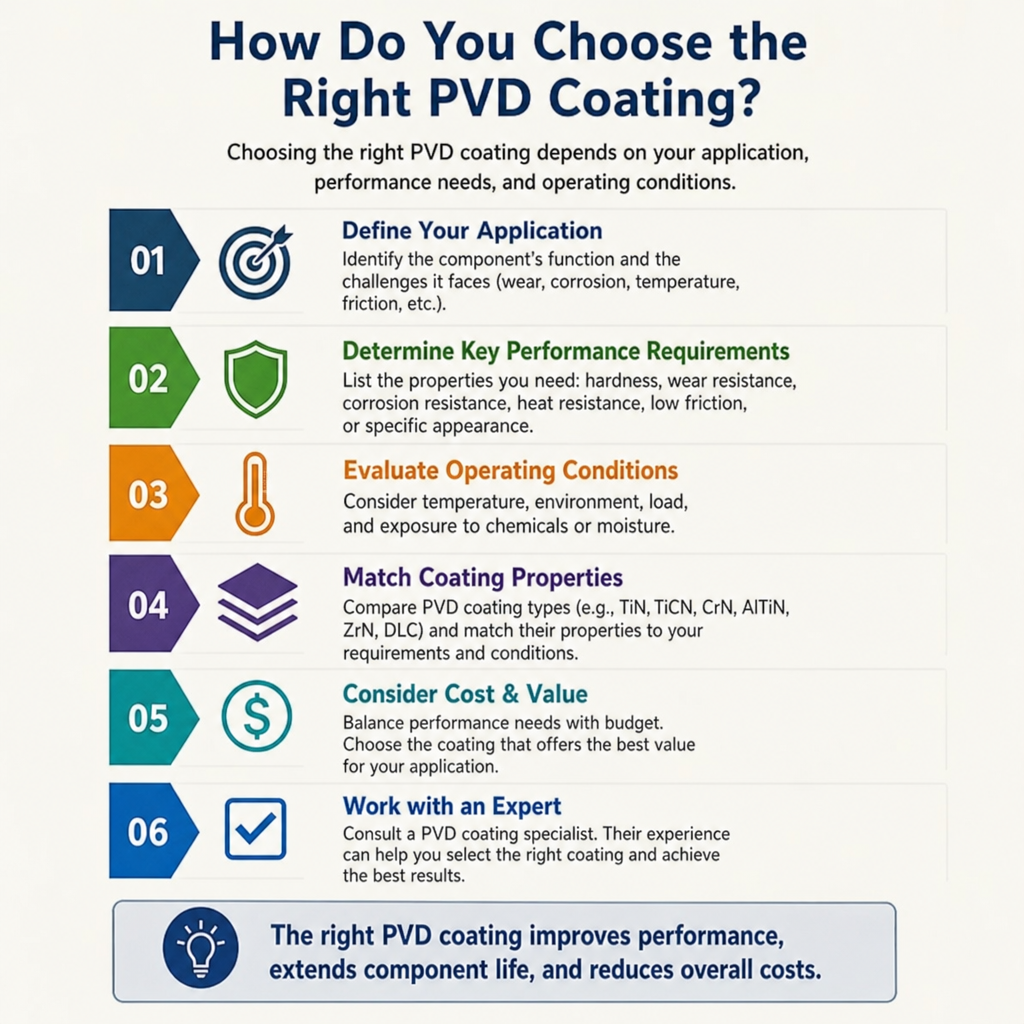
Choose the right PVD coating by matching the failure mechanism, substrate, operating conditions, and acceptance requirements to a specific supplier product. Use the material family to create a shortlist, then verify compatibility and performance on representative parts. Published coating properties alone do not reliably predict every production outcome.
Start with a concise application brief:
- Describe the component and substrate. Supply the alloy, heat-treatment condition, existing treatments, and drawing. Ask the coater to confirm what additional information is necessary.
- Document the current problem. Provide photographs, inspection notes, and the locati0n of damage. Distinguish observed symptoms from your proposed explanation.
- Describe the operating environment. Include contact materials, lubrication, cleaning exposure, and relevant temperature information. Mark uncertain values as estimates.
- Identify critical surfaces. Highlight working faces, cosmetic areas, tight fits, and locations that must remain uncoated. Request a review of accessibility and fixturing.
- Define acceptance criteria. State the required appearance, dimensional checks, and functional trial outcome. Agree on how disputes or borderline results will be assessed.
This brief is also useful when comparing suppliers. Send the same information to each one and request explanations for any differences in their proposals. Avoid comparing a fully specified coating system with a quotation that gives only a material abbreviation.
Compare complete proposals, not isolated numbers
Hardness, friction, and temperature ratings are helpful only when their context is understood. Thin-film properties depend on deposition conditions, substrate, preparation, environment, and measurement conditions. A laboratory result is therefore supporting information, not a substitute for application testing.
Ask what the quoted temperature represents: deposition temperature or service temperature. Supplier data can list both, and they answer different questions. The first concerns processing compatibility; the second concerns the coating’s intended operating capability.
Also ask whether the proposed product includes multiple layers, a supporting surface treatment, or post-coating finishing. These details belong in the comparison because suppliers offer engineered systems, not just elemental recipes. Record the approved product designation so future orders do not depend on an informal description.
Validate the shortlist with a controlled trial
Use representative production parts and agree on a manageable trial before committing an entire batch. Record the starting condition, operating setup, inspection method, and stopping criteria. Where practical, change only the coating so the results remain interpretable.
Evaluate more than whether the coated part “lasted longer.” Consider accepted output, surface quality, maintenance effort, and any new failure pattern. For decorative components, include sample approval and inspection of difficult edges or recessed areas. Keep the trial record with the final specification so later purchasing decisions retain the original reasoning.
Preparation and geometry set practical limits
PVD is generally a line-of-sight process, so exposed external surfaces are easier to coat than deep recesses or internal channels. Part rotation helps distribute the coating, but it does not eliminate every accessibility problem. Have the supplier review complex geometry before assuming the whole component will receive equivalent coverage.
Surface condition creates another boundary. Scratches, pits, burrs, oxidation, and contamination can remain visible or undermine coating performance. Resolve preparation responsibilities in advance, including who removes existing treatments and who approves the incoming surface condition.
Before releasing parts, use this final checklist:
- Confirm the exact coating product and intended application.
- Approve the substrate and process-temperature compatibility.
- Mark masking areas and critical dimensions on the drawing.
- Agree on surface preparation and packaging instructions.
- Approve representative finish samples where appearance matters.
- Define inspection, trial, and acceptance requirements in writing.
Treat these checks as part of coating selection, not administrative work after the technical decision. They help turn a promising material choice into a reproducible specification. If a supplier cannot confirm a requirement, resolve it before shipment rather than relying on an assumption.
Match the surface to the job
TiN, TiCN, CrN, AlTiN, and ZrN provide useful starting points for understanding types of PVD coating. Their differences matter, but no material name replaces an application review. The most effective selection process begins with the problem, narrows the candidate coatings, and tests a clearly specified product.
For your next project, assemble the drawing, substrate details, operating conditions, and examples of current damage before requesting recommendations. Then ask suppliers to explain their choices against your acceptance criteria. That keeps the decision focused on useful performance rather than color, abbreviations, or an impressive isolated number.
Frequently Asked Questions Related to PVD Coating
What is PVD coating and how does it work?
PVD (Physical Vapor Deposition) coating is a vacuum-based process that involves transferring material from a solid source onto a component in the form of a thin film. This is achieved through various deposition methods, such as cathodic arc deposition or magnetron sputtering, allowing for the creation of engineered surface layers that enhance properties like wear resistance and appearance.
What are the different types of PVD coatings?
The main types of PVD coatings include Titanium Nitride (TiN), Titanium Carbonitride (TiCN), Chromium Nitride (CrN), Aluminum Titanium Nitride (AlTiN), and Zirconium Nitride (ZrN). Each type has distinct characteristics suited for specific applications, such as improved wear protection, elevated-temperature performance, or decorative finishes.
What are the benefits of using PVD coatings?
PVD coatings offer numerous benefits, including enhanced wear resistance, reduced friction, improved surface hardness, and an engineered appearance. They can be tailored to specific applications, helping to prolong the lifespan of components and improve overall performance in various industrial environments.
How do I choose the right PVD coating for my application?
Selecting the appropriate PVD coating involves matching the coating material to the specific failure mechanisms, substrate properties, and operating conditions. It is essential to consult with suppliers, provide detailed application briefs, and evaluate performance based on representative parts.
What factors affect the performance of PVD coatings?
The performance of PVD coatings is influenced by various factors, including surface preparation, coating structure, substrate compatibility, and operating environment. Proper cleaning and preparation of components prior to coating application are crucial to achieving optimal adhesion and functionality.