










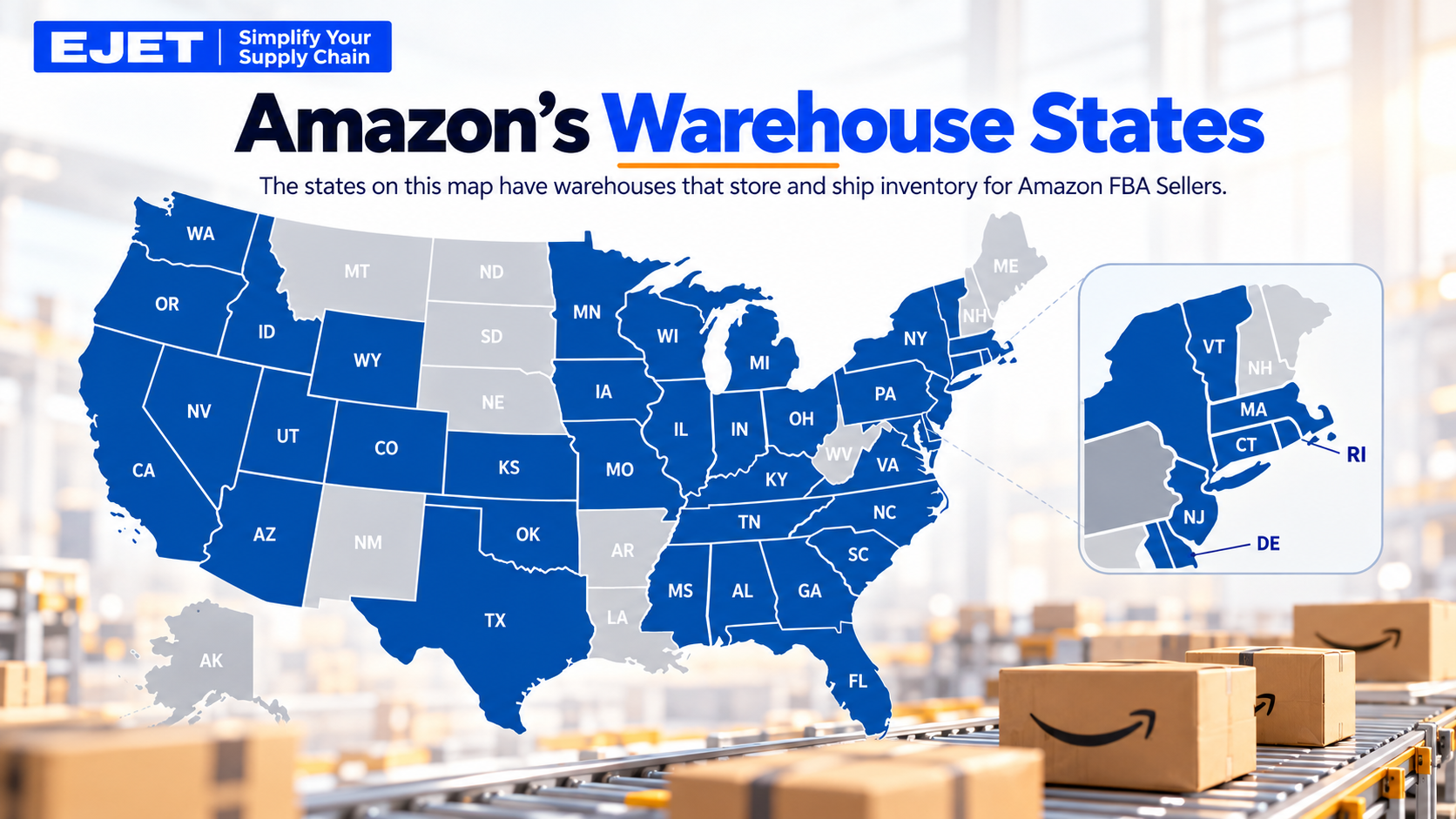
Amazon’s largest warehouses contain millions of square feet of space for storing products, moving inventory, and preparing orders. Some rise several floors above the ground, with robots and conveyors helping employees manage a steady flow of goods.
However, comparing the largest Amazon warehouse locations in the USA takes more than finding the biggest number online. One source may list a building’s ground-floor footprint. Another may count every operating floor. Those figures can differ by millions of square feet.
Ontario, California, stands out among publicly reported Amazon mega-sites. Yet a large group of facilities across the country also report about 3.8 million square feet of total floor area. Several therefore belong in the same size tier.
This guide explains those differences, compares 15 major locations, and explores what their scale means for shoppers, importers, and Amazon sellers.
Research date: October 22, 2026. Figures are approximate. Geographic observations below explain location advantages; they don’t establish each building’s exact delivery territory.
Comprehensive article outline
| Level | Heading | Coverage |
|---|---|---|
| H1 | Top 15 Largest Amazon Warehouse Locations in the USA Ranked: The Ultimate 2026 Guide | Main article |
| H2 | 1. Understanding the Largest Amazon Warehouse Locations in the USA | Ranking method and size comparison |
| H3 | What counts as warehouse size? | Footprint versus total floor area |
| H3 | How this ranking handles ties | Shared size tiers |
| H3 | The 15-location comparison table | Reported sizes |
| H3 | Why warehouse types matter | Fulfillment, sorting, and delivery |
| H2 | 2. Ranked Warehouse Profiles: 15 Major Amazon Locations | Individual location profiles |
| H3 | 1. Ontario, California | Largest reported size range in this selection |
| H3 | 2. North Andover, Massachusetts | Large multilevel facility |
| H3 | 3–12. The approximately 3.8-million-square-foot group | Ten major sites |
| H3 | 13. Colorado Springs, Colorado | Mountain-region location |
| H3 | 14. Mount Juliet, Tennessee | Nashville-area facility |
| H3 | 15. Loveland, Colorado | Recent opening |
| H2 | 3. What Amazon’s Largest Warehouses Mean for Sellers and Importers | Practical supply-chain implications |
| H3 | Why Amazon builds large facilities | Inventory and operating scale |
| H3 | How geography shapes the network | Ports, roads, and population |
| H3 | What sellers should check before shipping | Destination and shipment preparation |
| H3 | How to compare logistics options | Costs and service needs |
| H2 | Frequently Asked Questions | Eight common questions |
| H2 | Conclusion | Main findings |
1. Understanding the Largest Amazon Warehouse Locations in the USA
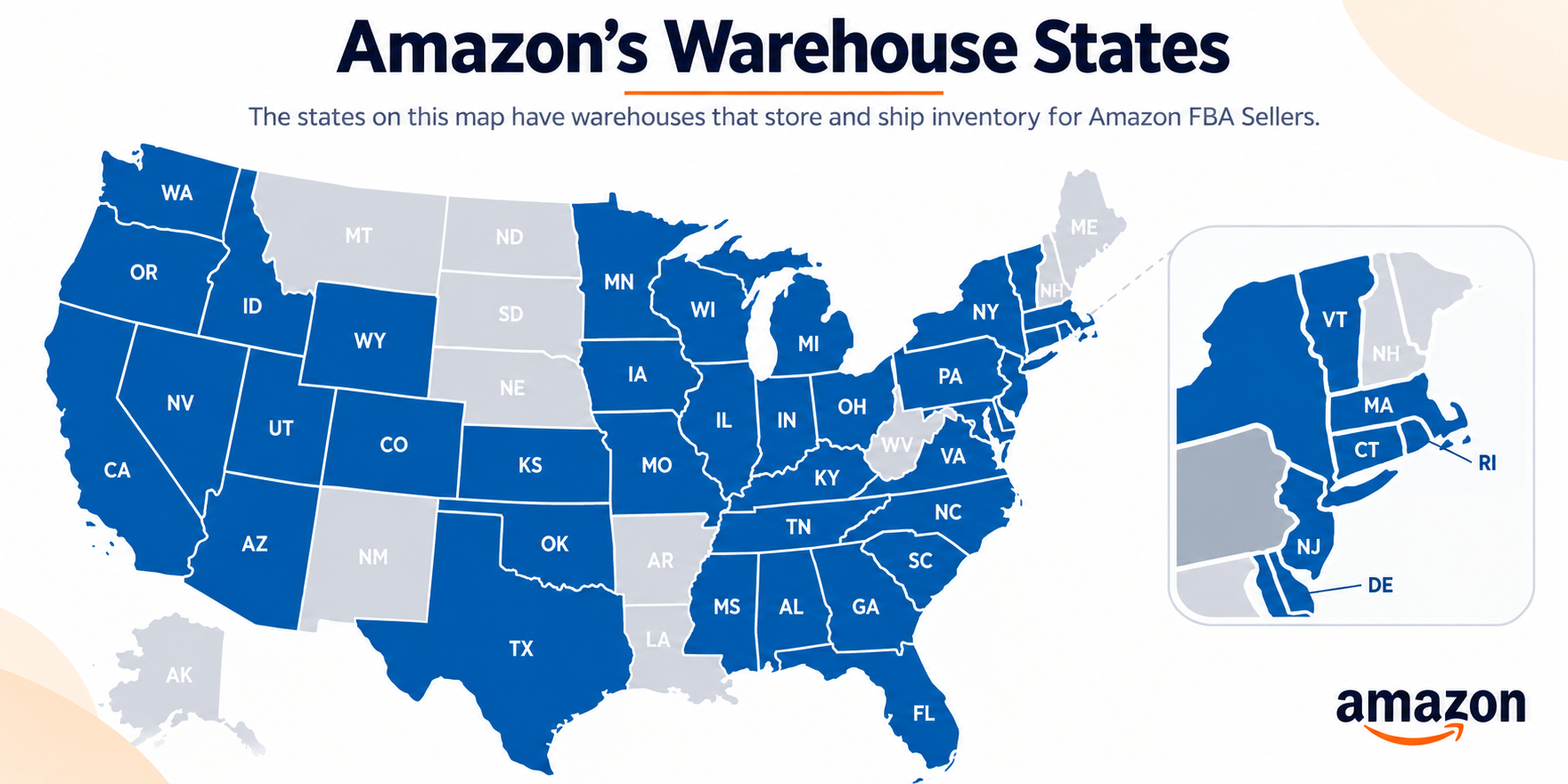
A warehouse ranking is useful only when the measurements mean roughly the same thing. This sounds simple, but large industrial buildings can have several valid size figures.
For example, a property description may show the land area, the building footprint, and the combined area of all floors. Each number answers a different question. Mixing them creates a misleading comparison.
What Counts as Warehouse Size?
This article uses reported total floor area wherever that basis is clear.
The main measurements are:
- Site area: The full property, including roads, parking, landscaping, and truck yards.
- Building footprint: The area covered by the building at ground level.
- Total floor area: The combined area across the building’s floors.
- Storage capacity: The amount of inventory a facility can hold.
- Throughput: The volume of goods it can process within a period.
The last two are operating measures. They can’t be reliably calculated from floor area alone.
Bristol, Indiana, provides a clear example. Developer Ambrose reports an approximately 823,000-square-foot first floor and 3.8 million square feet across the entire building. Both figures describe the same project, but only the larger figure reflects its combined floor area.
Consequently, a multilevel warehouse may look similar in an aerial photo to a much smaller single-story building. Its extra operating floors are hidden from that view.
How This Ranking Handles Ties
Many Amazon facilities share a rounded size of about 3.8 million square feet. Public information doesn’t support placing those buildings in a precise order based on minor differences.
This guide therefore uses numbered entries for easy reading while marking those facilities as a shared size tier.
North Andover is reported as exceeding 3.8 million square feet. However, that description doesn’t establish an exact margin over every warehouse rounded to the same figure. Its position should be read with that limit in mind.
Similarly, Ontario has several published measurements. Reporting places it at roughly 4.1 million to 4.5 million square feet. This article preserves that range rather than presenting one disputed figure as exact.
The 15-Location Comparison Table
The table ranks these selected, documented sites by their reported area. It doesn’t claim that every Amazon property nationwide has been assessed.
| Entry | Amazon warehouse location | Approximate reported total floor area | Comparison note |
|---|---|---|---|
| 1 | Ontario, California | 4.1–4.5 million sq. ft. | Measurements vary by source |
| 2 | North Andover, Massachusetts | More than 3.8 million sq. ft. | Exact difference from the next tier is unclear |
| 3 | Bristol, Indiana | 3.8 million sq. ft. | Shared size tier |
| 4 | Clay/Liverpool area, New York | 3.8 million sq. ft. | Shared size tier |
| 5 | Detroit, Michigan | 3.8 million sq. ft. | Shared size tier |
| 6 | Johnston, Rhode Island | 3.8 million sq. ft. | Shared size tier |
| 7 | Pflugerville, Texas | 3.8 million sq. ft. | Shared size tier |
| 8 | Pontiac, Michigan | 3.8 million sq. ft. | Shared size tier |
| 9 | Suffolk, Virginia | 3.8 million sq. ft. | Shared size tier |
| 10 | Wilmington, Delaware | 3.8 million sq. ft. | Shared size tier |
| 11 | Windsor, Connecticut | 3.8 million sq. ft. | Shared size tier |
| 12 | Woodburn, Oregon | 3.8 million sq. ft. | Shared size tier |
| 13 | Colorado Springs, Colorado | 3.7 million sq. ft. | Reported multilevel facility area |
| 14 | Mount Juliet, Tennessee | 3.6 million sq. ft. | Reported project area |
| 15 | Loveland, Colorado | 3.5 million sq. ft. | Operating opening reported in September 2026 |
Sources supporting each location appear in the individual profiles below.
Why Warehouse Types Matter
Amazon’s network contains different kinds of buildings. Their roles affect both their layout and their size.
Fulfillment centers hold inventory and support order picking, packing, and shipping. Amazon distinguishes between facilities handling smaller sortable goods and those handling larger products.
Sortation centers organize packages by destination. Delivery stations support the final stage before local delivery. Other buildings receive and distribute inventory within the wider network.
Amazon explains these functions in its official guide to facilities and warehouses.
For that reason, a small delivery station may be essential to fast service in a neighborhood even though it doesn’t appear in a list of giant warehouses.
Why Size Doesn’t Equal Performance
Floor area shows physical scale. It doesn’t reveal every operating strength.
Two equally large buildings may use different storage systems, process different products, or handle different order patterns. Staffing, equipment reliability, inventory availability, and transport connections also affect results.
Think of it this way: a bigger kitchen doesn’t automatically serve meals faster. The workflow still matters.
The same applies to fulfillment. Warehouse size is a useful starting point, but it should be read alongside building function and the quality of the available evidence.
2. Ranked Warehouse Profiles: 15 Major Amazon Locations
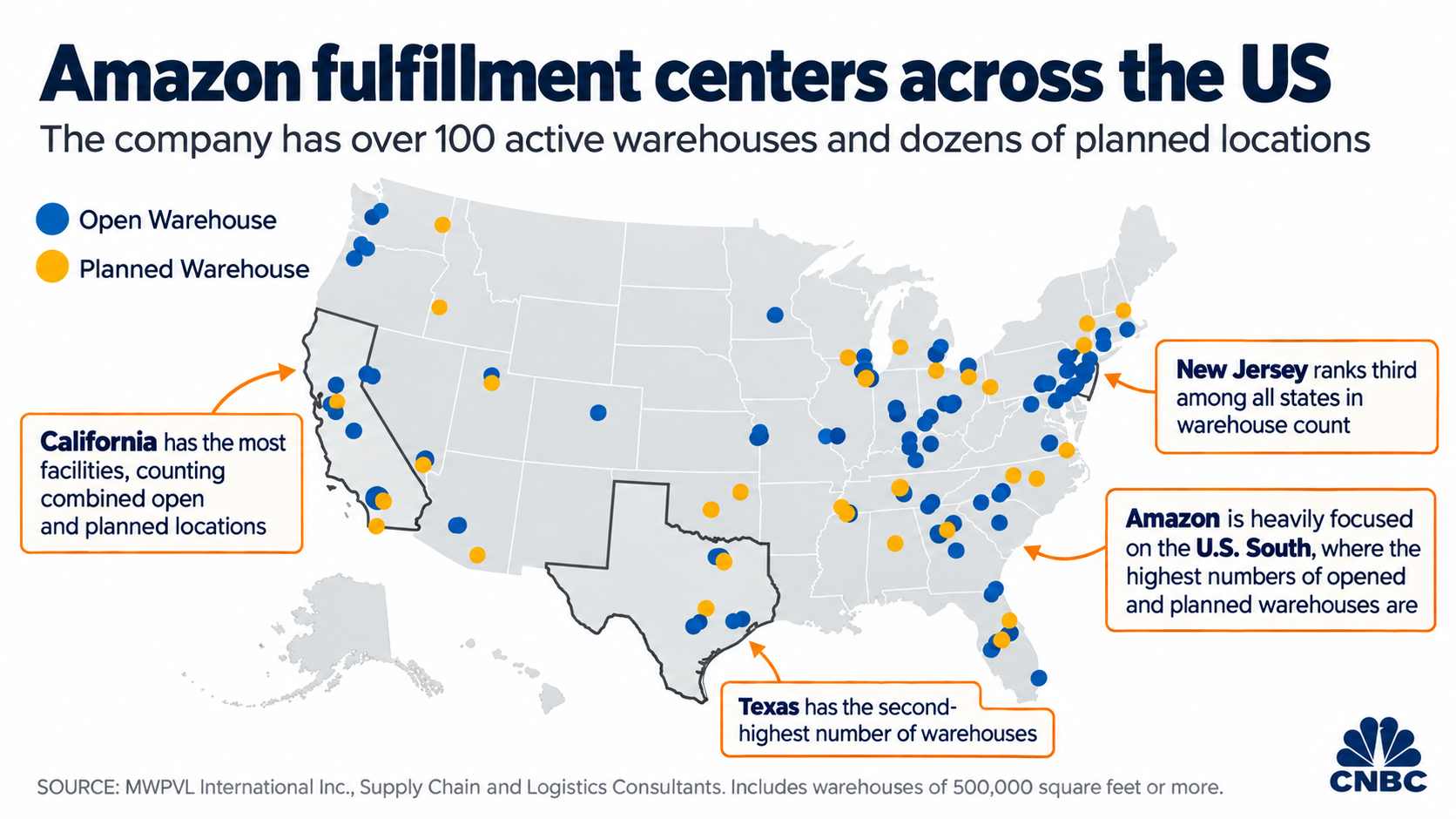
These profiles explain the reported measurements and the geographic setting of each site. Regional observations are location-based analysis, rather than claims about exclusive service areas.
1. Ontario, California
Reported area: Approximately 4.1–4.5 million square feet.
Ontario leads this selection. Earlier reporting described a five-story building of about 4.1 million square feet, while later industry coverage cited roughly 4.5 million square feet and six stories. The difference makes a range more responsible than a single exact number.
Its Inland Empire setting places it within a major Southern California logistics region. For readers studying imports, this is a useful example of how large inland facilities fit into a wider port-and-highway system.
2. North Andover, Massachusetts
Reported area: More than 3.8 million square feet.
Reporting on Amazon’s BOS3 facility describes a five-story building exceeding 3.8 million square feet. The same account identifies a March 2024 opening.
Its size places it alongside the largest documented Amazon facilities in New England. However, the available rounded figures don’t establish a precise gap between North Andover and every building in the following tier.
3. Bristol, Indiana
Reported area: Approximately 3.8 million square feet.
Ambrose’s project record describes a five-story fulfillment center in Bristol, within the Elkhart area. It explicitly separates the first-floor measurement from total building area.
That clear distinction makes Bristol especially useful for understanding warehouse comparisons. A reader using only its ground-floor area would greatly understate the scale of the completed building.
4. Clay/Liverpool Area, New York
Reported area: Approximately 3.8 million square feet.
The Town of Clay identifies the Amazon development as a 3.8-million-square-foot distribution center. Project engineer Langan also describes a five-story facility of that size on the former Liverpool golf-course site.
The location illustrates why city names require care. References to Clay and Liverpool can describe the same major project, rather than two separate mega-warehouses.
5. Detroit, Michigan
Reported area: Approximately 3.8 million square feet.
Amazon’s DET6 facility occupies the former Michigan State Fairgrounds site. Conveyor contractor Dearborn Mid-West reports approximately 3.8 million square feet across five floors.
Detroit also offers a clear redevelopment example: a large former event site became a major logistics property. Its inclusion should remain separate from Pontiac, another large Amazon location in the wider metropolitan region.
6. Johnston, Rhode Island
Reported area: Approximately 3.8 million square feet.
Rhode Island’s General Assembly documented the July 2025 grand opening of Amazon’s PVD2 facility. Its announcement describes a five-story building with about 3.8 million square feet.
Johnston shows that a small state can host an exceptionally large logistics investment. Warehouse scale depends on wider network needs, available land, and transport access—not simply the population of the host town.
7. Pflugerville, Texas
Reported area: Approximately 3.8 million square feet.
Pflugerville’s economic-development organization reports a 3.8-million-square-foot Amazon fulfillment center. The Austin Chamber also documented its opening.
Located in the Austin metropolitan area, the site belongs in any serious discussion of Amazon’s large Texas facilities. It also demonstrates why searching only for “Austin warehouse” can overlook the municipality where a building actually stands.
8. Pontiac, Michigan
Reported area: Approximately 3.8 million square feet.
CBS Detroit reported a 3.8-million-square-foot Amazon facility in Pontiac.
Pontiac and Detroit are distinct locations. Readers comparing warehouse lists should check that the two haven’t been merged under a broad “Detroit area” label.
9. Suffolk, Virginia
Reported area: Approximately 3.8 million square feet.
Suffolk’s official economic-development materials identify Amazon’s ORF3 property at about 3.8 million square feet.
The city’s Hampton Roads setting makes Suffolk relevant to discussions of port-linked logistics. Still, a facility’s proximity to a port doesn’t mean a seller can automatically route an import shipment there.
10. Wilmington, Delaware
Reported area: Approximately 3.8 million square feet.
Commercial property reporting identifies Amazon’s Wilmington facility as approximately 3.8 million square feet.
Wilmington sits within the busy northeastern corridor. Its location helps explain the appeal of large logistics buildings in relatively small states with access to nearby metropolitan markets.
11. Windsor, Connecticut
Reported area: Approximately 3.8 million square feet.
Amazon’s own Connecticut investment coverage identifies BDL4 in Windsor as a 3.8-million-square-foot robotics-powered fulfillment center.
Windsor reinforces a broader finding: New England has several giant facilities. Claims that one site is the region’s largest should therefore include a date and a clear measurement basis.
12. Woodburn, Oregon
Reported area: Approximately 3.8 million square feet.
Design firm Mackenzie describes the Woodburn project as a five-story facility with 3.8 million square feet on a 90-acre site beside Interstate 5.
The distinction between land area and floor area is especially clear here. The site accommodates the building plus the surrounding space needed for vehicle movement and other property uses.
13. Colorado Springs, Colorado
Reported area: Approximately 3.7 million square feet.
The Gazette reports that Amazon’s 3.7-million-square-foot fulfillment center near Colorado Springs Airport opened in July 2021.
Its position highlights the need for large facilities beyond coastal markets. Inland population centers also require substantial inventory and transport infrastructure to support online shopping.
14. Mount Juliet, Tennessee
Reported area: Approximately 3.6 million square feet.
Project engineer Pape-Dawson identifies a 3.6-million-square-foot office and distribution-center warehouse project in Mount Juliet. Developer Panattoni also reports that size in its coverage of the Amazon development.
The Nashville-area location provides another example of a large facility outside a central city. Surrounding municipalities often supply the land needed for projects of this scale.
15. Loveland, Colorado
Reported area: Approximately 3.5 million square feet.
BizWest reported in September 2026 that packages had begun moving through Amazon’s 3.5-million-square-foot Loveland building during the summer.
Loveland shows why publication dates matter. An older article may describe a warehouse as planned or delayed even after operations have begun. A useful ranking needs to review both size and development status.
3. What Amazon’s Largest Warehouses Mean for Sellers and Importers
For shoppers, a giant fulfillment center is usually invisible. They see a product page, an estimated delivery date, and a package at the door.
For businesses, the picture is more complex. Inventory must arrive in the correct place, in the correct condition, with the correct shipment information. Understanding warehouse geography can help with planning, but a size ranking alone won’t tell a seller where to send goods.
Why Amazon Builds Large Facilities
A large building can provide room for extensive inventory, storage systems, packing areas, and internal transport equipment.
However, those spaces must work together. A product that is difficult to locate, poorly packaged, or held up during receiving can create delays regardless of building size.
Modern automation is part of that wider operating system. Amazon’s account of its Shreveport facility describes a building spanning five floors and more than 3 million square feet, with multiple robotics systems supporting fulfillment tasks. Although Shreveport isn’t included in this selected 15-location table, it demonstrates why technology deserves attention alongside floor area.
For sellers, the practical lesson is straightforward: prepare inventory for the receiving process, not merely for the journey to the warehouse.
A well-protected product still needs accurate labels and shipment records.
How Geography Shapes the Network
The locations above reveal several broad geographic patterns.
Southern California offers access to a large consumer market and a major import logistics region.
The Northeast contains several closely spaced metropolitan areas. This helps explain the presence of large facilities in Massachusetts, Connecticut, Rhode Island, Delaware, and New York.
The Midwest combines substantial consumer markets with extensive road connections and industrial land.
Texas and the Southeast offer major inland markets and transport corridors.
Colorado and the Pacific Northwest demonstrate the importance of maintaining logistics capacity across a country with long travel distances.
These are geographic interpretations of the locations, rather than verified descriptions of each facility’s assigned customer territory.
That distinction matters. A warehouse’s location can suggest a strategic advantage without proving exactly which orders it handles.
Can Sellers Choose the Largest Warehouse?
Businesses shouldn’t treat this list as a menu of shipping destinations.
Before booking freight, check the destination details and requirements shown in the current Amazon shipment workflow. A warehouse address copied from an online article may be unsuitable for a particular shipment.
The appropriate receiving point can depend on the shipment arrangement and the instructions provided for the inventory.
For example, imagine an importer buying kitchen organizers from China. Ontario might appear attractive because of its scale and Southern California location. However, that doesn’t establish that the importer’s shipment should be delivered there.
The shipment’s actual instructions must guide the booking.
This simple check helps keep research separate from execution.
What to Check Before Shipping Inventory
A practical preparation review should cover the product, cartons, paperwork, and delivery plan.
| Check | Question to resolve | Business purpose |
|---|---|---|
| Product identity | Do the goods match the intended listing and shipment records? | Reduce inventory errors |
| Labels | Are the required labels correct and readable? | Support identification |
| Packaging | Can the packaging protect the product during handling? | Reduce damage |
| Carton contents | Do carton quantities match the records? | Improve receiving accuracy |
| Dimensions and weight | Are the recorded measurements accurate? | Support freight planning |
| Destination | Does the booking match the current shipment instructions? | Avoid incorrect delivery |
| Carrier arrangements | Have delivery requirements been confirmed? | Reduce preventable disruption |
| Supporting records | Can the supplier provide the agreed documents? | Improve traceability |
The exact requirements should be checked for the relevant product and shipment. A general checklist is a starting point, not a substitute for those instructions.
Why the Largest Warehouse May Not Mean the Lowest Cost
A building’s size doesn’t reveal the total cost of getting goods into saleable inventory.
Businesses should compare the full route. That includes the supplier’s location, transport to the export point, international freight, receiving arrangements, storage needs, and possible additional handling.
For instance, a low freight quote may lose its appeal if it creates extra transfers or leaves no room to correct packaging problems.
Likewise, moving every unit at once may appear efficient but can reduce flexibility when demand is uncertain.
The better question is: Which plan fits the product, expected sales, and current receiving requirements?
That question leads to a more useful decision than choosing the largest building on a map.
When a U.S. Preparation Warehouse Can Help
Some importers need an intermediate location to inspect, organize, or prepare goods before the next delivery stage.
Possible tasks include:
- Checking a sample of the arriving inventory.
- Replacing damaged outer cartons.
- Applying or correcting labels.
- Combining products into agreed sets.
- Holding reserve inventory.
- Separating goods for different sales channels.
However, another handling step also adds cost and time. Compare that extra work with the problems it is meant to solve.
A small, well-run preparation operation may be more useful to a seller than direct access to a much larger building.
Build a Flexible Replenishment Plan
Large warehouses don’t remove uncertainty from product demand.
A useful replenishment plan should connect sales expectations with supplier lead time and transport time. It should also leave room for delays and quality checks.
For a new product, a staged launch can provide evidence before a larger reorder. For a proven product, a clear reorder point can help prevent stock gaps.
Keep the plan easy to review:
- Estimate demand using available sales evidence.
- Confirm production and shipping lead times.
- Set a reserve that fits the business’s risk tolerance.
- Review inventory regularly.
- Adjust the next order when the evidence changes.
The goal is steady inventory flow. Warehouse scale supports that flow, but planning determines whether the right goods are available when customers want them.
Conclusion
The largest Amazon warehouse locations in the USA show how large and geographically varied the company’s fulfillment infrastructure has become.
Ontario leads this selected comparison by reported floor area. North Andover and the substantial group of approximately 3.8-million-square-foot facilities demonstrate that Amazon’s mega-sites extend well beyond California.
For readers comparing buildings, the key is to use consistent measurements and recognize ties. For sellers and importers, the practical priority is accurate shipment preparation, a confirmed destination, and a replenishment plan that fits demand.
Post-article note: Before publishing future updates, recheck reported floor areas and opening status. Keep the shared size tier visible so rounded figures don’t imply a level of ranking precision the sources cannot support.
Frequently Asked Questions Largest Amazon Warehouse in the USA
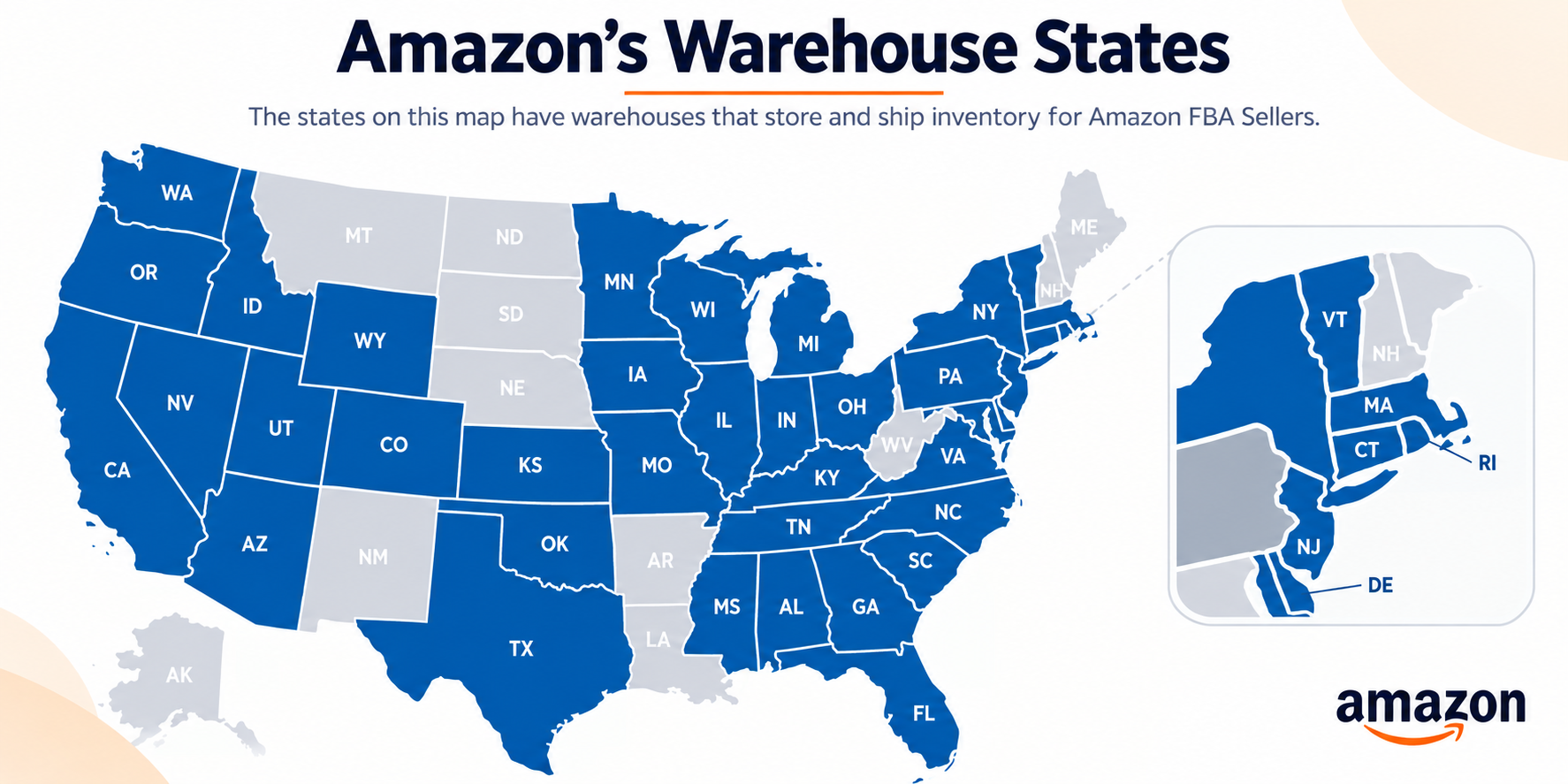
1. Where Is the Largest Amazon Warehouse in the USA?
Ontario, California, is widely reported as Amazon’s largest warehouse location. Published measurements range from roughly 4.1 million to 4.5 million square feet. Because sources use different figures, the range is more useful than an unsupported exact measurement.
2. Is This an Official Ranking of Amazon Warehouses?
No. It is a researched comparison of 15 documented large facilities. The sources reviewed don’t establish a complete, consistently measured national ranking. Numbered entries make the article easier to follow, while the shared size tier identifies rounded ties.
3. Why Do So Many Warehouses Measure About 3.8 Million Square Feet?
Several documented projects use large multilevel designs. Their published sizes are also rounded. As a result, the public figures don’t provide enough detail to separate every building within the 3.8-million-square-foot group. Bristol’s developer, for example, reports a five-story building totaling that area.
4. Are Warehouse Footprint and Total Floor Area the Same?
No. The footprint measures the ground covered by a building. Total floor area combines space across its floors. Bristol illustrates the difference: its first floor is about 823,000 square feet, compared with 3.8 million square feet across the building.
5. Is Wilmington Still Amazon’s Largest Warehouse?
Wilmington is a major facility, but its reported 3.8 million square feet falls below the published Ontario range. Older articles describing Wilmington as the largest should be read in the context of their publication dates.
6. Has Amazon’s Loveland Warehouse Opened?
Yes. September 2026 reporting states that inventory had begun moving through the 3.5-million-square-foot Loveland facility during the summer. Earlier reports describing it as unopened or delayed are therefore outdated.
7. Does a Larger Amazon Warehouse Guarantee Faster Delivery?
No. Floor area alone doesn’t establish delivery speed. Inventory availability, order processing, transport, and the final delivery stage all matter. Amazon’s own facility guide explains that fulfillment centers, sortation centers, and delivery stations perform different roles within the network.
8. Should Importers Ship to the Closest Amazon Warehouse?
They should follow the destination and receiving instructions for their actual shipment. Distance is useful for estimating transport costs, but a nearby warehouse isn’t automatically the correct receiving location. Confirm the details before arranging pickup or international freight.