Sourcing jewelry wholesale from China starts with defining your products, verifying suppliers, approving samples, and calculating the full cost of getting sellable stock into your business.
This sourcing guide explains how to compare manufacturers, assess wholesale fashion jewelry, plan packaging, and prepare shipments for the USA, UK, and EU.
Use it to build a repeatable purchasing process rather than choosing on catalog price alone.
How do you find reliable jewelry suppliers in China?
Find reliable suppliers by comparing their documented capabilities with your product requirements, then checking those claims through samples, business records, and independent inspection where appropriate.
Supplier badges can support your research, but they should not replace it. Alibaba, for example, provides third-party assessment reports for Verified Suppliers while explicitly disclaiming guarantees about product and certificate authenticity.
Before searching, decide whether you need existing designs, customized pieces, or an original collection. Ask each candidate which processes it handles directly and which it outsources. Your goal is to understand who controls production, not simply who has the largest catalog.
Match the supplier to your purchasing model
Use these priorities when evaluating potential partners:
- Existing-design orders: Ask about available stock, mixed-style purchasing, minimum quantities, and whether repeat orders use the same specifications.
- Customized collections: Check logo placement, finish options, sample approval procedures, and minimum quantities for each variation.
- Original designs: Discuss drawings, tooling ownership, development charges, confidentiality, and responsibility for revisions.
- Consolidated sourcing: If one company coordinates several workshops, request a clear explanation of inspection, traceability, and claims handling.
When searching for jewelry manufacturers in China, describe the material and production requirement alongside the product category. “Manufacturer of plated brass pendant necklaces” gives you a more focused starting point than “jewelry factory.”
Verify the company behind the quotation
Request the supplier’s legal business name, registration details, production address, and the name of the entity receiving payment. Investigate unexplained differences before sending funds. Ask for a live walkthrough focused on your production requirements rather than relying entirely on promotional footage.
If using Alibaba Trade Assurance, put specifications, quantities, shipping arrangements, and supporting attachments into the protected order. Follow the platform’s payment instructions and preserve communications there; Alibaba recommends these steps so the order record can support a dispute. Read the applicable protection terms before relying on them.
Build a buying brief before requesting prices
A useful buying brief makes quotations comparable. Send the same requirements to every shortlisted supplier, and ask them to identify anything they cannot meet. Otherwise, one attractive price may describe a materially different product.
For each item, specify:
- Construction: Base metal, component materials, dimensions, weight expectations, clasp type, and earring-post material.
- Finish: Plating metal, requested thickness, color reference, surface texture, and any protective coating.
- Decoration: Stone or bead type, dimensions, setting method, and acceptable visual variation.
- Commercial terms: Quantity by design and color, packaging, customization, production schedule, and reorder requirements.
- Verification: Destination market, intended age group, required testing, inspection criteria, and documentation.
Ask suppliers to separate sample charges, tooling, packaging, testing, and freight from the product price. Request minimum order quantities by individual design and finish, not just for the total order. Record how long the quotation remains valid and what would trigger repricing.
For your first wholesale jewelry purchase, prioritize a coherent assortment you can evaluate carefully. Keep speculative styles separate from core designs so you can make deliberate decisions about where to commit inventory funds.
What should you check before approving jewelry quality?
Before approving jewelry quality, check whether the sample matches your written specification, functions properly, and has evidence supporting its material and marketing claims.
Visual inspection is useful for workmanship, but it is not a substitute for relevant laboratory testing. In the United States, the FTC’s Jewelry Guides address truthful representations about metallic content, gemstones, treatments, quality, and other product characteristics.
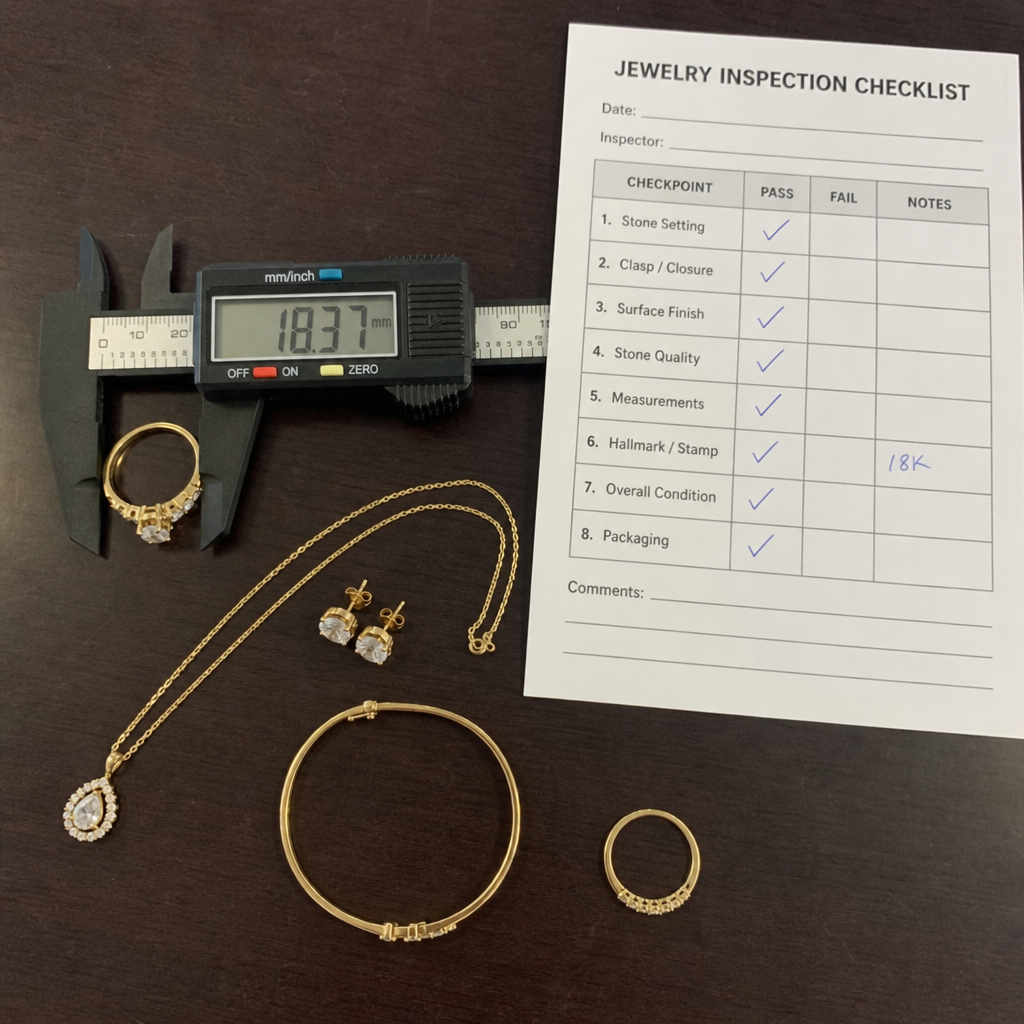
Treat samples as an approval exercise, not just a style preview. Photograph each piece, record measurements, and note anything that needs correction. Keep an approved reference sample so the supplier and inspector have a shared comparison point.
Use a practical inspection checklist:
- Finish: Examine edges, recessed areas, solder points, and surfaces for roughness, visible defects, and inconsistent color.
- Function: Operate clasps, hinges, adjustable sections, and earring backs repeatedly; document looseness or sticking.
- Assembly: Inspect stone settings, chain connections, jump rings, and component alignment.
- Consistency: Compare matching earrings and multiple samples for size, finish, and decoration.
- Evidence: Match reports to the product, materials, components, and requirements being assessed.
Do not turn a supplier’s informal reassurance into an unsupported customer promise. Ask what evidence supports descriptions such as “hypoallergenic,” “waterproof,” or “tarnish-free,” and define any agreed performance testing in writing. Keep your eventual product descriptions within what you can substantiate.
If you are exploring cheap jewelry wholesale, ask which specification changes would reduce the price and assess each proposal separately. Do not authorize an undefined “cheaper version.” Keep component substitutions subject to written approval so cost negotiations do not quietly change the product.
Plan compliance around the destination market
Start compliance planning before production, using the product’s composition, intended user, and sales destination. U.S. Customs and Border Protection recommends identifying applicable entry and agency requirements before importing.
EU guidance likewise makes clear that businesses have responsibilities throughout manufacturing, importing, distribution, and sale.
United States
Confirm customs classification, valuation, applicable duties, and country-of-origin marking arrangements with your broker. Provide complete descriptions and material information rather than relying on the supplier’s suggested code without review. CBP offers classification guidance and a binding-ruling process when additional certainty is needed.
Children’s jewelry requires particular attention. Applicable children’s product rules can require testing by a CPSC-accepted laboratory and a Children’s Product Certificate; lead in children’s metal jewelry has specific third-party testing requirements. Also check relevant state requirements, including California’s metal-containing jewelry rules when selling into that market.
United Kingdom
For precious-metal products, check whether hallmarking is required before offering them for sale. UK guidance states that articles described as gold, silver, platinum, or palladium above specified weight thresholds need a legally recognized hallmark. Confirm the rules for your product rather than treating a supplier’s metal stamp as sufficient evidence.
European Union
Check applicable REACH restrictions, including those addressing nickel, cadmium, and lead in jewelry. Also review General Product Safety Regulation obligations, including the requirement for an EU-established responsible economic operator and associated contact information. Chemical testing alone does not address every product-safety or traceability obligation.
Ask your laboratory or compliance adviser to define the testing scope for the actual product and market. For U.S. children’s products, CPSC specifically advises confirming that the laboratory is accepted for each required test method. Keep the resulting documentation connected to identifiable products.
Source packaging alongside the jewelry
Treat packaging as a separate specification. When researching China jewelry packaging wholesale options, request dimensions, insert materials, print details, assembly requirements, and minimum quantities. Test the jewelry inside the proposed packaging before approving the combined presentation.
Check whether earrings remain secure, necklaces stay separated, and delicate elements avoid pressure during handling. Ask for a packed sample, not just an empty box. Include barcode placement, care cards, batch identification, and any required information in the approval process.
Compare compact packaging with presentation boxes using actual packed dimensions. DHL explains that chargeable weight can depend on dimensional weight rather than actual weight, so a larger lightweight carton can change the freight calculation. Request shipping estimates after packaging decisions, not only before them.
How much does shipping wholesale jewelry from China cost in 2026?
China-to-USA wholesale jewelry international shipping costs in 2026 require a shipment-specific quote, not a universal per-piece estimate. Origin, destination, packed weight, carton dimensions, service level, and additional charges all affect the total. DHL’s guidance identifies these factors and notes that duties, taxes, fuel, and other surcharges may also affect the final cost. (dhl.com)
For boutique buyers comparing China wholesale jewelry suppliers, shipping to the USA, UK, and EU should be quoted separately by destination. Give each logistics provider the same shipment details so the proposals are comparable. Ask whether the estimate covers collection, export handling, main transport, customs clearance, and final delivery.
Request written answers to these questions:
- Which service and route does the quotation cover?
- What actual and dimensional weights were used?
- Which surcharges are included, excluded, or subject to adjustment?
- Who handles customs clearance and pays duties or taxes?
- Does the carrier accept the specific jewelry and shipment value?
- What loss or damage protection applies, and what exclusions remain?
Do not assume a delivery quote includes full-value protection. DHL’s terms describe liability limits and separate shipment-protection arrangements. Confirm acceptance and coverage for your particular goods before booking, especially when shipping precious-metal pieces or other high-value stock.
Keep customs estimates separate from freight unless the quotation explicitly includes them. For U.S. imports, verify classification and applicable duty treatment close to shipment rather than recycling an earlier order’s assumptions. CBP recommends staying current with entry requirements and supplying detailed product information when seeking guidance.
Compare landed cost, not the lowest unit price
Build a purchasing worksheet that combines product cost with every quoted or reasonably budgeted expense. Include samples, tooling, packaging, testing, inspection, transport, clearance, duties, and nonrecoverable taxes where applicable. Ask your accountant how recoverable import taxes should be treated in your own costing.
For internal planning, use:
Estimated landed cost per sellable unit = total attributable purchasing and import costs ÷ expected sellable units.
Keep the denominator realistic. Model a clearly labeled allowance for damaged, defective, or otherwise unsellable pieces, then replace that assumption with actual results after receiving the order. Do not present a planning allowance as an established supplier defect rate.
Compare quotes only after aligning specifications and delivery scope. If one supplier includes individual packaging and another quotes loose goods, adjust the worksheet before judging the difference. Repeat the comparison whenever you change materials, order quantity, or packaging.
Make the first order a controlled pilot
Use the first production order to test the entire buying process, not just the designs. Choose a manageable assortment, establish inspection arrangements, and agree on what happens if goods fail acceptance criteria. Put correction procedures and claim deadlines into the order before paying.
Before shipment, confirm:
- The approved specifications and reference samples are recorded.
- Any material or component changes have written approval.
- Required reports and product identifiers match the order.
- Inspection findings have been reviewed and unresolved issues addressed.
- Packaging, quantities, invoices, and shipping instructions agree.
- Responsibility for clearance, charges, and delivery is documented.
After arrival, count stock, inspect against your acceptance criteria, and record discrepancies promptly. Track actual costs, defects, customer feedback, and reorder communication. Use that evidence to decide whether to increase quantities, revise specifications, or choose another supplier.
Build a repeatable sourcing process
Successful jewelry wholesale purchasing starts with clear requirements and ends with verified, sellable inventory. Shortlist carefully, approve representative samples, plan destination-specific compliance, and compare complete landed costs. Scale only when the first order gives you a documented reason to trust the next one.
Frequently Asked Questions About Sourcing Jewelry Wholesale from China
How do I find reliable jewelry suppliers in China?
To find reliable jewelry suppliers in China, research and compare suppliers on platforms like Alibaba, verify their business licenses and certifications, request samples, and consider visiting the manufacturing facility if possible. Look for verified suppliers and read reviews from other buyers to assess their credibility.
What should I include in my buying brief when sourcing jewelry?
Your buying brief should include specific details such as product specifications (materials, dimensions, weight), finish requirements, decoration preferences, quantity, packaging, and any customization needs. This ensures that suppliers provide comparable quotes and understand your exact requirements.
How can I ensure the quality of the jewelry I purchase?
To ensure quality, request samples from potential suppliers and perform a thorough inspection against your specifications. Use a practical inspection checklist to assess aspects like finish, function, assembly, and consistency. It’s essential to document any discrepancies and have clear quality assurance measures in place.
What are the shipping costs involved in importing jewelry from China?
Shipping costs for importing jewelry from China can vary significantly based on factors such as the size and weight of the shipment, chosen logistics provider, shipping speed, and destination. Always request detailed shipping quotes from multiple providers to compare costs and clarify what is included.
How do I calculate the total landed cost of my jewelry order?
To calculate the total landed cost, add together all expenses associated with your jewelry purchase, including product cost, shipping fees, insurance, tariffs, and any additional charges. This will give you a comprehensive understanding of what each unit costs when it arrives at your locati0n.