


Customizing products in China starts with a clear manufacturing brief: what changes, how the finished item should perform, and what the supplier must deliver.
This article explains how to coordinate OEM production, packaging, logos, and minimum order quantities without relying on vague promises. Use it to build your specifications, compare quotations, approve samples, and decide which customizations deserve your budget.
How do you customize products in China without overcomplicating the order?
Start by separating branding changes from changes to the product itself. For a first launch, consider an existing product with your logo and packaging before commissioning a new structure.
If your competitive advantage requires different dimensions, components, or performance, define those requirements before requesting manufacturing proposals. In sourcing terminology, OEM generally means production to a buyer’s design or specifications, while ODM involves supplier-provided design capability or an adaptable existing design.
Do not let the label replace the scope. Ask suppliers to explain exactly what they will design, source, manufacture, decorate, assemble, and pack. A quotation for “OEM service” is not enough to establish those responsibilities.
Use this decision framework:
|
Customization route |
Choose it when |
Confirm before proceeding |
|---|---|---|
|
Existing product with branding |
You want to test positioning without redesigning the item |
Logo method, placement, packaging options, and sample quality |
|
Modified existing product |
An available design is close, but needs specific changes |
Engineering feasibility, component changes, testing, and revised costs |
|
New product development |
Your offer depends on a distinctive structure or function |
Design responsibilities, tooling, validation, ownership, and production readiness |
Write down the customer benefit behind each requested change. If a modification does not improve usability, protection, recognition, or differentiation, consider postponing it.
Build product specifications before requesting prices
Prepare one controlled specification pack and send the same version to every shortlisted supplier. Alibaba’s sourcing guidance recommends identifying the product specification, quantity, destination, packaging requirements, and target delivery date before comparing supplier responses.
Replace subjective descriptions with requirements someone can check. Instead of asking for a “premium finish,” identify the finish you want and provide an approved reference. Instead of “strong packaging,” describe the product, shipping route, packing arrangement, and protection you need the supplier to propose.
Your brief should cover:
- Product identity: Model reference, intended use, drawings, dimensions, and relevant tolerances.
- Materials and construction: Material grades, component requirements, surface finish, and prohibited substitutions.
- Colors and appearance: Color references, visible surfaces, texture, and acceptable variation.
- Branding: Logo dimensions, locati0n, orientation, application method, and durability expectations.
- Packaging: Internal fit, inserts, printed content, accessories, instructions, and shipping cartons.
- Acceptance criteria: Functional checks, appearance requirements, inspection methods, and defect handling.
- Commercial scope: Order quantities, variants, destination, requested delivery milestone, and quotation assumptions.
Give each document a revision identifier. Ask the supplier to list exceptions rather than silently changing requirements to fit existing production. For example, if your requested material is unavailable, require a separately identified alternative with its own sample and price. Treat that alternative as a new decision, not an automatic substitution.
Select suppliers by capability, not search visibility
When researching packaging manufacturers in China, shortlist businesses that can explain their proposed process and show relevant work. Ask whether they manufacture the product, manufacture the packaging, coordinate subcontractors, or act as a trading company. Your objective is to identify who controls each critical operation and who answers when something fails.
Use due diligence alongside samples and quotations. The USPTO recommends investigating potential overseas partners and developing detailed intellectual property provisions for licensing and subcontracting arrangements.
For your shortlist, request evidence matched to the project: comparable samples, a walkthrough of relevant production steps, the inspection process, and the identity of any subcontractor handling important work. Ask the supplier to explain how your specification would move from sales to engineering, purchasing, production, and quality control.
For China packaging solutions, ask specifically who checks structural fit, prepares print files, approves color, and performs final assembly. If product and packaging come from different suppliers, assign one party to coordinate the packing trial. Do not leave either business assuming the other has confirmed compatibility.
Across the China packaging industry, keep your assessment focused on the proposed facility and process rather than broad claims about the market. A polished catalog is useful for discovery; your decision should rest on evidence relevant to the order.
What determines Logos & MOQ requirements?
Minimum order quantity, or MOQ, is the smallest order a supplier agrees to accept under specified conditions. There is no universal minimum for customized products: quantities depend on materials, production processes, setup, tooling, and supplier economics. Ask about prototypes, pilot runs, full production, and reorders separately.
Request a breakdown rather than accepting one unexplained number. Ask whether minimums apply to the total order, each model, each color, each logo treatment, or each packaging design. Obtain written confirmation of which variants can share a production run.
For custom packaging in China, the printing method and package structure also matter. Alibaba’s packaging guidance identifies setup and tooling as important factors behind packaging minimums, with different processes supporting different production quantities. Treat published ranges as background, not a promise for your project.
If the proposed MOQ exceeds your budget, request alternatives:
- Keep the product standard and customize the outer packaging first.
- Reduce the number of launch colors or printed designs.
- Ask whether a standard box with a separate branded label is feasible.
- Request a smaller pilot quotation with setup charges shown separately.
- Explore shared packaging across variants, using clearly differentiated labels where appropriate.
Compare the complete proposal after each change. Do not assume that negotiating a lower quantity preserves the original unit price, delivery schedule, or production method. Ask the supplier to reissue the quotation so the compromise is explicit.
Match logo methods and colors to the actual surface
Treat the logo as a production requirement, not simply a graphic attachment. Ask the supplier to recommend a method for your chosen material and explain its limitations. Provide the intended logo size and position before requesting a decorated sample.
Use sample review to check legibility, alignment, contrast, and appearance on the actual surface. For printed or decorated packaging, testing can include label durability, abrasion resistance, and color or gloss evaluation; agree which checks are relevant instead of assuming a visual approval covers durability.
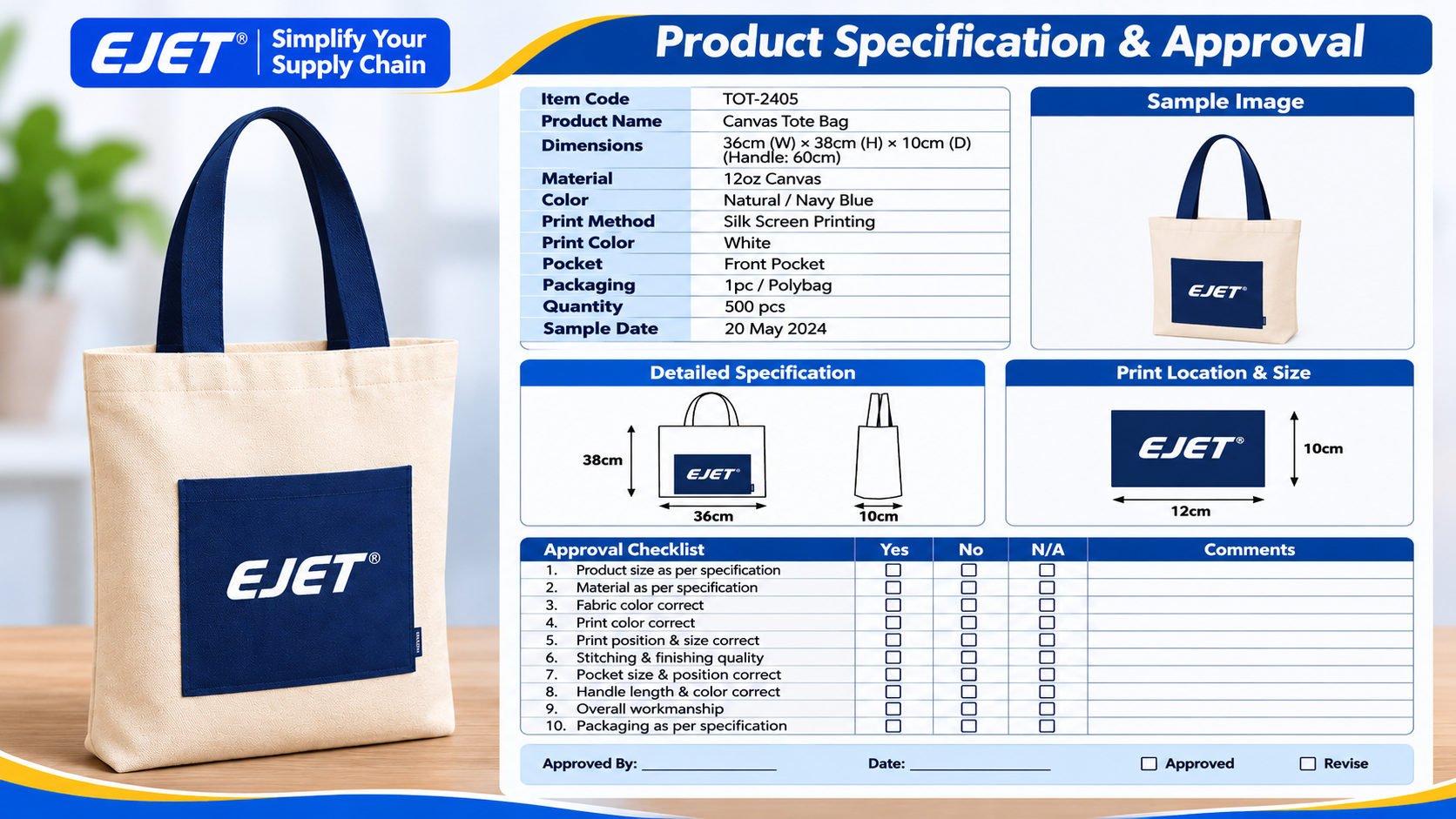
Create a branding approval sheet containing:
- The approved logo file and version.
- Placement drawings with dimensions and orientation.
- The chosen application method and finish.
- The color reference and approved physical sample.
- Any agreed adhesion, rubbing, washing, or handling checks.
Ask whether product and packaging colors will be evaluated separately. Review each on its intended material, then place the samples together to judge the overall brand presentation. Approve an intentional relationship between them rather than demanding an undefined “perfect match.”
For a first order, prioritize a clearly reproduced logo over decorative complexity. Request separate quotations for extra finishes so you can decide whether they justify the added expense and approval work.
Design packaging around protection and fulfillment
Begin with the packed product, not an attractive empty box. Establish its dimensions, weight, accessories, vulnerable areas, and intended orientation. Then ask for a proposed structure and packing method before commissioning finished graphics.
Packaging evaluation can address package integrity, drop and impact performance, compression, vibration, and environmental conditions. Select an appropriate test plan with a packaging specialist or laboratory based on the product and distribution route. A presentation sample alone does not establish shipping performance.
When sourcing China custom boxes, request a blank structural sample first. Place the actual product and all accessories inside it. Check whether the item moves, whether an insert contacts delicate surfaces, and whether someone can remove the product without damaging it.
Separate three requirements in your brief:
- Presentation: How the product appears when opened, including instructions and accessory placement.
- Protection: How the pack holds and cushions the product during handling and transport.
- Fulfillment: How the finished pack is assembled, labeled, counted, stored, and shipped.
For wholesale packaging from China, compare the delivered packing arrangement as well as the box price. Ask for assembled dimensions, shipment configuration, carton quantities, and any assembly required at your destination. Request an alternative structure if the proposed package creates unnecessary space or handling work.
Choose materials and finishes deliberately. Ask what each option changes about protection, appearance, assembly, and end-of-life handling. Avoid adding a finish solely because it appears in the supplier’s premium range.
Prepare artwork files on the approved dieline
Obtain the packaging supplier’s current dieline and written artwork requirements before completing the design. A dieline is the flat technical layout showing cuts, creases, folds, and assembly features. Bleed, safe areas, image requirements, and accepted file formats vary by supplier, structure, material, and printing process.
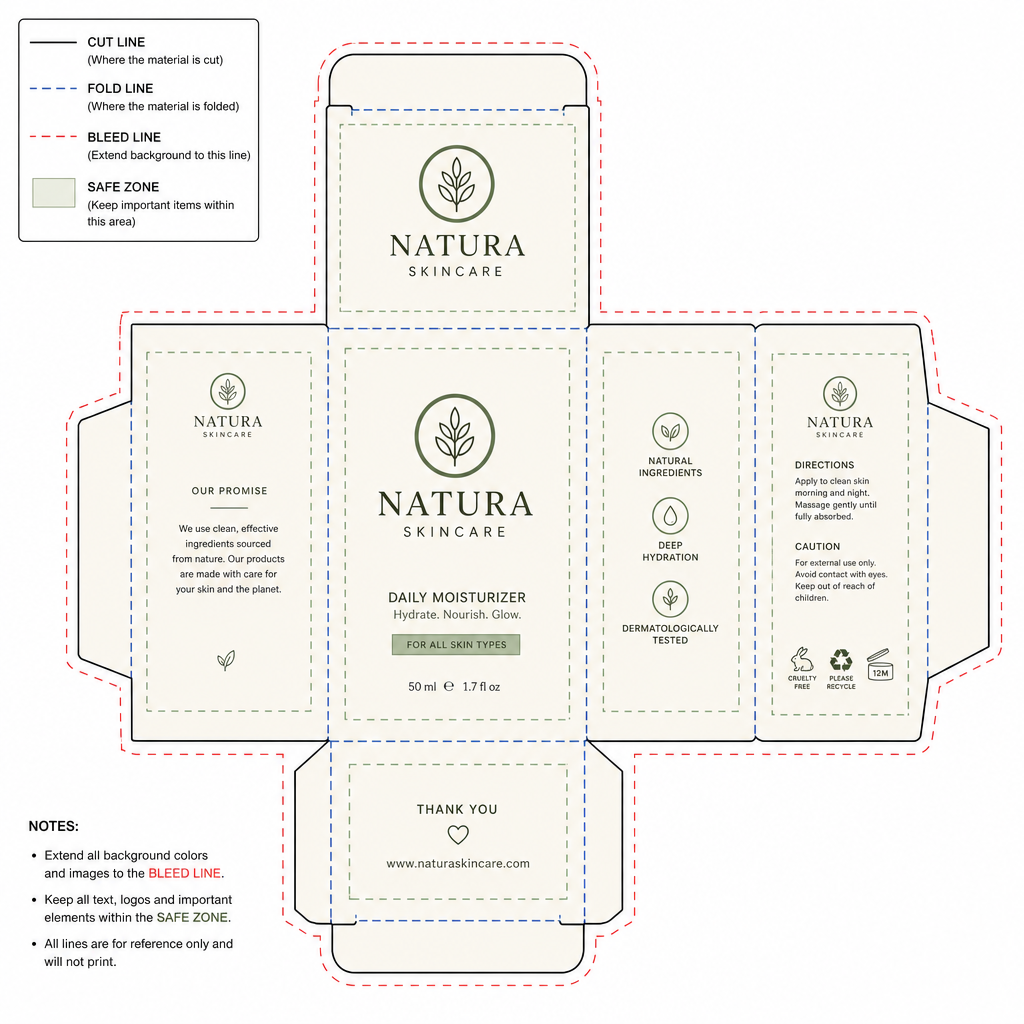
Ask your designer to prepare artwork files against those requirements, not against a generic online template. Request a preflight review from the printer before paying for production setup.
Your file handover checklist should include:
- Artwork at the required size on the approved dieline.
- Separate, clearly identified technical and printable layers.
- Background artwork extended to the specified bleed.
- Important text and logos kept within the specified safe area.
- Fonts, images, and color settings prepared as the printer requests.
- Separate instructions or layers for special finishes.
- A clearly named final export and a visual reference PDF.
These preparation steps should follow the printer’s project-specific instructions rather than assumed universal settings.
Proofread product names, quantities, instructions, language versions, and variant identifiers independently of the design review. Ask someone who did not create the artwork to compare it against the approved content. Keep one person responsible for releasing the final file, and withdraw superseded versions from the active production folder.
Control molds, tooling, and design rights early
Before authorizing molds or other custom tooling, document who owns them and what access you receive. Ask the supplier to identify each tool, its purpose, storage locati0n, maintenance responsibility, and any conditions governing transfer. Have qualified counsel review the relevant manufacturing and ownership terms.
Intellectual property protection needs its own plan. U.S. rights do not automatically provide equivalent protection overseas; the USPTO recommends an international protection strategy, partner due diligence, and appropriate contractual provisions. IP Australia likewise advises businesses manufacturing in China to consider registration, searches, due diligence, and well-drafted contracts early.
Discuss the following before sharing sensitive development information:
- Existing designs and knowledge contributed by each party.
- Ownership and permitted use of newly developed work.
- Access to drawings, production files, and agreed tooling records.
- Restrictions on subcontracting, disclosure, and unauthorized production.
- Procedures for returning information and transferring agreed assets.
Tailor confidentiality provisions to the information being shared. The European Commission’s China IP guidance emphasizes using contracts suited to the specific intellectual property and protecting confidential information and trade secrets in third-party relationships. Do not treat a generic confidentiality form as a substitute for a project-specific agreement.
Make prototype approval a documented production gate
Use prototype approval to record what has been accepted, what remains unresolved, and what must change before production. Ask how the sample was made and which materials, tools, decoration methods, or assembly steps differ from the intended production process. Do not approve an unexplained difference simply because the sample looks convincing.
Create a sample review record with photographs, measurements, functional results, packaging observations, and a clear decision. Mark the decision as approved, rejected, or approved only for a stated purpose. A sample accepted for shape should not accidentally become approval for final color or printed content.
For packaging, consider whether laboratory work is needed alongside your own review. QIMA’s packaging testing scope includes construction, performance, integrity, and labeling review, allowing the assessment to address more than appearance.
Keep an approved reference sample and provide the manufacturer with an equivalent reference. Associate it with the current specification and artwork revisions. Write down any remaining deviations, who must resolve them, and what evidence will close the issue.
Before releasing the order, ask the supplier to confirm that production will follow the approved documents and agreed reference. Require written approval for subsequent changes. This gives both teams a practical way to distinguish an authorized revision from an unapproved substitution.
Compare unit costs against the complete order
Request quotations in a format that separates recurring costs from one-time charges. Your comparison should show the product, decoration, packaging, assembly, samples, tooling, inspection, and shipping scope separately. Ask suppliers to identify exclusions and state how long their quotations remain valid.
Use a worksheet with these rows:
|
Cost area |
What to clarify |
|---|---|
|
Product and decoration |
Exact specification, quantity, variants, and included branding |
|
Packaging and packing |
Boxes, inserts, labels, instructions, cartons, and assembly |
|
Development and tooling |
Sample rounds, setup, molds, revisions, and ownership terms |
|
Quality and delivery |
Testing, inspection, transport scope, and destination handling assumptions |
Ask for pricing at your intended launch quantity and realistic reorder quantities. Keep the specifications identical across those comparisons. If a supplier offers a cheaper alternative, place it in a separate column rather than allowing it to replace the original request.
Review your cash commitment alongside unit costs. Include inventory you must buy but do not expect to sell immediately, such as surplus packaging for a later run. Before accepting that arrangement, agree how unused materials will be identified, stored, counted, and released.
How should you plan production lead times and launch dates?
Plan backward from the date inventory must be available for sale, using supplier-confirmed milestones rather than a single headline estimate. Ask for separate dates for development, samples, approvals, material readiness, production, inspection, shipment, and arrival. Clarify exactly which event starts the quoted production lead times.
Make dependencies visible in a shared schedule. For example, ask whether packaging production can start before the product sample is approved, or whether final dimensions remain dependent on tooling trials. Have the supplier identify decisions that would restart work or change the delivery commitment.
Build your launch checklist around release gates:
- Specification and commercial scope accepted.
- Required samples, artwork, and packaging approved.
- Materials and production readiness confirmed.
- Production and inspection completed against agreed criteria.
- Shipping documents and destination arrangements checked.
- Goods received and accepted before making firm availability promises.
For U.S. imports, review country-of-origin marking and any applicable product-specific labeling before locking artwork. CBP’s importing guidance explains that marking obligations can depend on the article, its container, and repacking circumstances. Obtain advice appropriate to your product rather than assuming a logo or generic packaging label satisfies the requirements.
Leave room for a correction cycle. A schedule that works only if every sample and inspection passes immediately gives you little flexibility when a legitimate issue needs attention.
Start with a controlled order, then expand
The strongest first order is not necessarily the most customized one. It is the order whose requirements, costs, approvals, responsibilities, and acceptance criteria you understand.
Choose the modifications that support your customer promise, document them clearly, and approve physical evidence before expanding the scope. Once the product and supplier process are validated, revisit additional colors, packaging finishes, or structural changes with a clearer basis for investment. That approach keeps branding ambitious while making execution easier to control.
Frequently Asked Questions About Customizing Products in China
What is OEM and how does it differ from ODM in product customization?
OEM (Original Equipment Manufacturer) refers to production based on a buyer's specific designs or specifications, while ODM (Original Design Manufacturer) involves suppliers providing design capabilities or using adaptable existing designs. Understanding these terms helps businesses decide their customization strategy.
How can I ensure the quality of my packaging when sourcing from China?
To ensure quality, it's essential to prepare detailed product specifications, request samples, and clearly communicate your requirements regarding materials, dimensions, and durability. Conducting due diligence on suppliers and performing factory audits can further assure quality.
What factors determine the minimum order quantity (MOQ) from suppliers in China?
MOQs are influenced by factors such as production processes, materials, tooling setup, and the economic considerations of the supplier. Always ask for a detailed breakdown of MOQs for each variant and explore options for reducing them if needed.
How can I customize my product's logo and packaging without exceeding my budget?
Start by opting for a standard product with customized outer packaging first. Consider reducing the number of printed designs or colors, and request quotations for pilot runs to test the market before committing to larger orders.
What steps should I take to protect my intellectual property when manufacturing in China?
Document ownership of designs and tooling, include confidentiality agreements in contracts, and consider registering your intellectual property both locally and internationally. Conduct thorough due diligence on potential partners to mitigate risks effectively.