
Chinese New Year falls on February 6, 2027, but factory disruption can extend beyond the official holiday.
To plan orders around Chinese New Year 2027 factory closures, confirm each supplier’s production calendar and work backward from your required warehouse delivery date—not simply the holiday itself.
The goal is to cover the gap until reliable replenishment resumes, including production, inspection, and freight.
When will Chinese factories close for Chinese New Year 2027?
China’s official Spring Festival holiday runs from February 5–13, 2027, with make-up working days on January 31 and February 14. However, this national calendar is not a factory shutdown schedule: individual manufacturers may stop earlier or restart later.
Ask each supplier for its own written closure and recovery dates before committing to customer deliveries.
Separate these milestones in your purchasing calendar:
|
Milestone |
What to confirm |
|---|---|
|
Last order acceptance |
Final date for accepting orders intended for pre-holiday shipment |
|
Last production completion |
When your specific goods must leave the production line |
|
Last inspection and dispatch |
When goods can be checked, released, and collected |
|
Factory reopening |
When staff and production activities begin returning |
|
Reliable production recovery |
When your order can realistically move through the line |
Treat the make-up working days as calendar information, not proof that your supplier, inspection company, or trucking provider will operate normally. Request confirmation from each party responsible for your shipment.
Why the disruption extends beyond the public holiday
Chinese New Year closures affect more than the days when a factory’s doors are locked.
UPS describes production slowdowns before the holiday and a gradual recovery afterward, while DHL highlights staggered worker returns and the time needed to restart machinery and supporting supply chains. A reopening notice therefore does not establish when your order will be finished.
Your finished product also depends on upstream suppliers. An assembly factory might reopen while it is still waiting for packaging, components, or processing from another business. DHL identifies this mismatch between a factory’s readiness and its suppliers’ readiness as a post-holiday complication.
For planning purposes, ask your manufacturer to distinguish between materials already on site and materials merely ordered. Request the status of any subcontracted work separately. Record unresolved dependencies next to the promised completion date so that an optimistic headline date does not hide an unfinished critical step.
Avoid applying one shutdown assumption across your entire supplier base. Build the schedule around the businesses and materials involved in each purchase order.
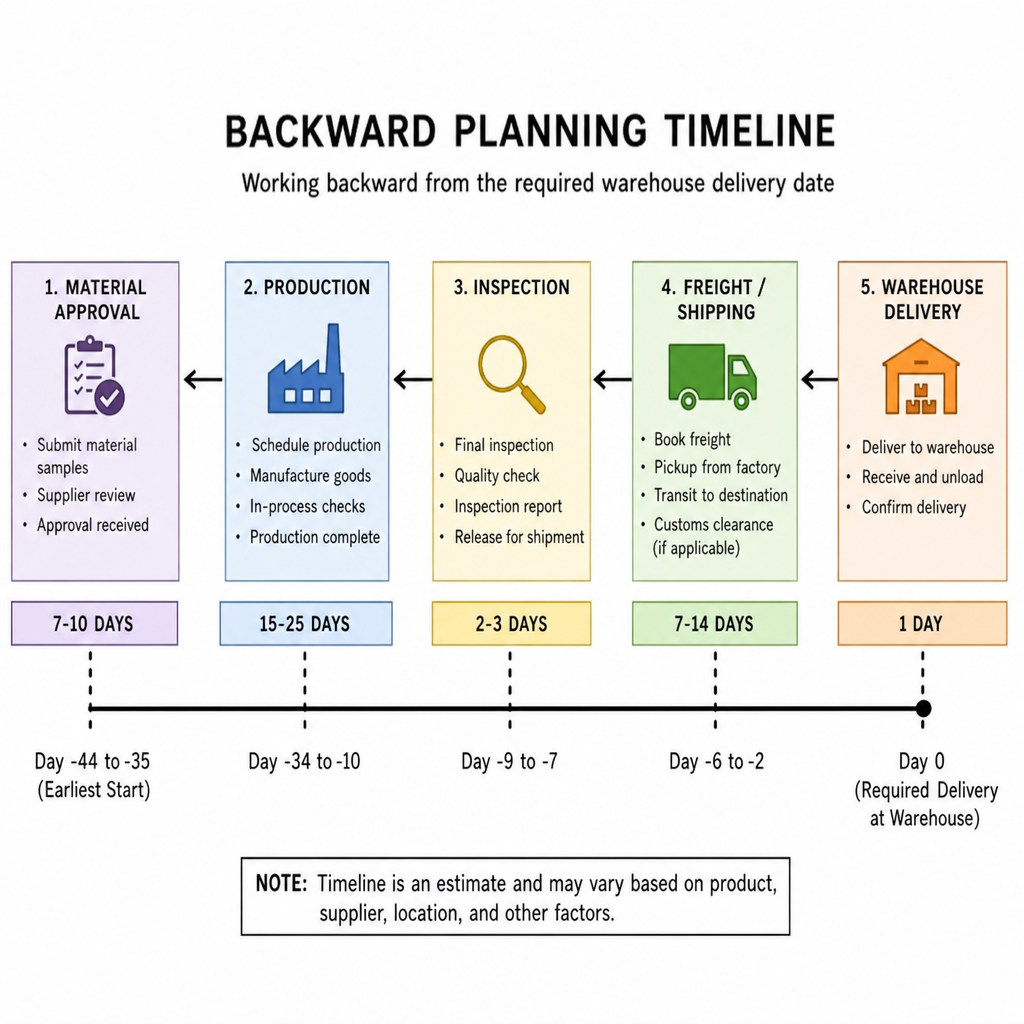
Work backward from your required delivery date
Start with the date goods must be available for sale or use. Then subtract each stage between your warehouse and the factory’s production start. Include an explicit contingency allowance rather than assuming every handoff will happen immediately.
Use this backward-planning sequence:
- Required availability: Set the date inventory must be usable, not merely delivered to a port.
- Destination handling: Allow for clearance, delivery, receiving, and any internal checks.
- International freight: Use a current estimate for your actual route and service.
- Origin handling: Include collection, consolidation where applicable, and carrier cutoffs.
- Quality release: Reserve inspection time and a realistic opportunity to correct problems.
- Production and materials: Confirm the manufacturing slot, material readiness, and outstanding approvals.
- Contingency: Add a separate buffer appropriate to the order’s uncertainty.
Ask your forwarder to validate the transport stages before treating this as a committed schedule. Maersk’s 2027 guidance specifically recommends coordinating production schedules, cargo-ready dates, and transport arrangements ahead of the holiday.
For example, if your backward plan requires production to begin before materials can arrive, the schedule is not feasible as written. Change the quantity, delivery promise, or shipment approach instead of leaving the conflict unresolved.
Build a practical November-to-March action plan
Use the following as a proposed working schedule, not a prediction of every factory’s operating dates. Replace the suggested timing with confirmed supplier milestones wherever possible. Keep one shared version for purchasing, logistics, sales, and inventory teams.
November and December: resolve the major commitments
Request closure calendars, identify stock exposure, and review open purchase orders. Approve specifications, samples, packaging, and quantities wherever you are ready to commit. For anything unresolved, name an owner and decision deadline rather than leaving it marked “pending.”
Ask suppliers which orders have confirmed production slots and which remain provisional. Record what secures the slot under your agreed commercial terms. Do not confuse a quotation or forecast acknowledgment with an order-specific production commitment.
January: verify execution and handoffs
Review progress against the agreed schedule, including material receipt, production completion, inspection, and collection. Maersk identifies mid-to-late January 2027 as a period of increased production and shipping activity ahead of closures. Coordinate any changes with both your supplier and forwarder.
Set an internal escalation date before your final shipping opportunity. At that point, decide whether to ship a completed portion, revise the delivery promise, or move the order into the post-holiday plan.
February and March: manage recovery by evidence
Ask for order-specific progress rather than accepting “factory reopened” as the final update. Confirm which materials and production stages remain outstanding. Use actual inspection and cargo-ready milestones to update customer commitments; DHL likewise advises checking capacity and specific order timelines after reopening.
How much inventory should you order before the shutdown?
Order enough to cover forecast demand until your next dependable replenishment, plus an appropriate safety allowance, after subtracting usable stock and confirmed incoming supply. Do not base the calculation solely on the official holiday’s length. Your worksheet should cover the full interval between the last dependable receipt and the next one.
A practical planning formula is:
Pre-holiday purchase requirement = forecast demand through the replenishment gap + safety stock − usable inventory − confirmed receipts within that period.
For illustration, suppose you expect to sell 100 units weekly across an eight-week planning window. With a chosen safety allowance of 150 units, 300 usable units on hand, and 200 confirmed incoming units, the calculated requirement is 450 units. These are illustrative inputs, not a recommended coverage period or safety-stock level.
Apply the calculation by SKU, then review the commercial trade-offs:
- Core products: Prioritize items whose absence would interrupt important sales or operations.
- Volatile products: Test a higher-demand scenario before approving the final quantity.
- Seasonal products: Check whether delayed arrival would leave you holding inventory after its selling window.
- Slow movers: Challenge additional purchases that lack a clear demand justification.
Finally, check cash requirements, storage capacity, and product life before approving the order. Set a spending ceiling for the holiday plan so that protecting availability does not become an open-ended purchasing decision.
Get a written supplier commitment that is useful
Replace “Can you ship before Chinese New Year?” with questions tied to a specific purchase order. Request quantities, dates, dependencies, and the person responsible for the next update. Keep the response with the order record so purchasing and logistics work from the same assumptions.
A useful supplier confirmation should cover:
- Order scope: SKU, quantity, specification revision, and packaging version.
- Materials: What is available, what is outstanding, and the expected receipt date.
- Production: Scheduled start, completion, and any subcontracted stages.
- Quality: Inspection date, acceptance requirements, and the proposed correction window.
- Dispatch: Cargo-ready date, collection arrangements, and outstanding documents.
- Recovery: Reopening date and the expected timing for your particular unfinished order.
Ask the supplier to flag any commitment that depends on another business. For example, distinguish finished packaging held at the factory from packaging expected from a printer. This gives your team a specific dependency to monitor rather than another general assurance.
Agree on an update frequency and escalation contact. Make each update answer what changed, what is at risk, and what decision is needed.
Protect freight arrangements and quality checks
Production completion and shipment departure belong on separate lines in your plan. DHL Freight notes that pre-holiday transport demand can constrain availability and recommends arranging transportation well before the celebrations. Validate the full handoff with your logistics provider rather than assuming finished goods can leave immediately.
Ask for collection deadlines, warehouse receiving cutoffs, documentation requirements, and the next available service if the intended departure is missed. If you are importing into the United States, include your receiving warehouse and customs broker in the schedule review. Request confirmation of their responsibilities and operating arrangements instead of assuming availability.
Keep the quality-release deadline separate from the dispatch deadline. Define who can authorize release, what evidence they need, and how a failed inspection changes the shipment plan. Do not quietly remove agreed checks to preserve an unrealistic departure date.
For urgent goods, consider whether a smaller priority shipment is justified. UPS identifies split shipments and air freight for time-sensitive items as possible holiday contingency measures. Compare the quoted incremental cost with the business consequence of waiting before approving that option.
Prepare a fallback before the last shipping opportunity
Write a short contingency plan for your most important orders. Give each action a trigger, an owner, and an approval limit. That way, the team knows when to act without reopening the entire purchasing discussion.
For example:
|
Trigger |
Proposed response |
|---|---|
|
Only part of the order passes inspection |
Evaluate releasing the accepted quantity separately |
|
Materials miss the agreed readiness date |
Request a revised production plan and reassess customer promises |
|
Planned departure becomes unavailable |
Ask the forwarder to compare the next feasible services |
|
Forecast demand exceeds available cover |
Allocate stock by agreed customer or product priorities |
|
No credible completion date is available |
Stop promising an unsupported delivery date and escalate |
Do not label an untested supplier an immediate backup. Before relying on an alternative, establish what approvals, specifications, capacity confirmations, and commercial arrangements your business requires. Treat any unfinished qualification work as part of the fallback timeline.
During the closure, keep one exception log rather than collecting disconnected email updates. Record the latest confirmed milestone, the unresolved issue, and the next decision date for each affected order.
Make the holiday plan reusable
After normal replenishment resumes, compare your original schedule with actual material receipt, production completion, inspection, dispatch, and warehouse receipt dates. Separate supplier delays from internal approval delays and transport changes. Use that review to adjust future planning assumptions without automatically adding the same buffer everywhere.
For your China New Year planning, the key takeaway is straightforward: manage the complete replenishment gap, not just the holiday dates. Start by obtaining written factory calendars, then connect each order to an inventory requirement and a feasible delivery schedule.
A clear plan should show what is confirmed, what remains uncertain, and exactly when your team must make the next decision.
Frequently Asked Questions About Chinese New Year 2027
What dates should I be aware of for Chinese New Year 2027 factory closures?
Chinese New Year officially runs from February 5 to 13, 2027, with make-up working days on January 31 and February 14. However, each factory may have different closure dates, so it’s essential to confirm with your suppliers.
How do I plan my orders around the Chinese New Year closures?
Start by determining your required availability date and work backward through the stages of production, inspection, and freight to identify necessary deadlines and contingency plans.
Why do factory closures extend beyond the official holiday dates?
Factories typically experience slowdowns before the holiday and gradual recoveries afterward. Worker returns and machinery restarts can create delays, so it's vital to communicate with suppliers for accurate timelines.
How much inventory should I order before the Chinese New Year?
Calculate your pre-holiday purchase requirement based on forecast demand during the replenishment gap, plus a safety stock, while considering your current usable inventory and confirmed incoming supplies.
What should I include in my supplier commitments regarding Chinese New Year orders?
Request specific details about order scope, material availability, production schedules, quality inspection dates, dispatch arrangements, and recovery timelines to ensure clarity and accountability in your supplier agreements.