


Buying from China involves choosing a suitable seller, checking the product, agreeing on payment and shipping, and understanding the import requirements before you order.
These 10 steps walk you through that process, whether you want one item for personal use or stock for a business. The goal is to compare the complete purchase—not just the attractive price on a listing.
For business buyers, treat your first order as a controlled trial rather than a reason to commit to a large shipment. Use the checks below to decide what to ask, what to document, and when to pause.
Customs examples focus on the United States; buyers elsewhere should check their destination country's requirements.
Step 1: What should you check before buying from China?
Before you buy from China, define the product, its intended use, your quantity, and the requirements it must meet in your country. Decide whether you are making a personal purchase, buying existing stock for resale, or commissioning a customized product.
That distinction should guide your supplier search and the level of checking you do before payment.
Write a short product brief with these details:
- Product and purpose: Describe what it should do and who will use it.
- Specifications: Record dimensions, materials, colors, compatibility, and acceptable variations.
- Quantity: Separate your trial order from a possible reorder.
- Budget: Set a maximum delivered cost, not just a product-price target.
- Deadline: State when the goods must arrive, allowing time for checking them.
- Documentation: Identify any safety, labeling, testing, or import requirements.
Check compliance before choosing a supplier. For example, U.S. consumer products subject to applicable CPSC rules may require testing and certification; children's products have additional testing requirements. A supplier's statement that an item is “certified” is not enough to establish which rules apply to your exact product.
If you arrived here searching for “how to buy reps from China,” distinguish lawful alternatives from counterfeit branded goods. Do not assume that calling an item a replica makes it acceptable to import: CBP targets and seizes counterfeit imports.
Choose original designs, legitimate unbranded products, or goods you can verify are authorized.
Step 2: Choose a purchasing route that fits your order
Start by deciding how much of the purchasing process you want to manage yourself. For a straightforward personal purchase, prioritize a clear listing, a manageable quantity, understandable delivery terms, and a documented problem-resolution process.
For sourcing from China for a business, prepare to discuss specifications, samples, production, inspection, and repeat orders.
Use the following comparison as a decision framework rather than a ranking:
|
Purchasing route |
Consider it when |
Check before committing |
|---|---|---|
|
Retail-style online checkout |
You want a finished item in a small quantity |
Exact variant, seller identity, delivery charges, and return terms |
|
Business-to-business marketplace |
You need quotations, samples, or a larger order |
Minimum order quantity, written specifications, and eligible payment protection |
|
Direct supplier relationship |
You need ongoing production or customization |
Company identity, production arrangements, inspection access, and contract terms |
|
Sourcing agent |
You want help coordinating suppliers and orders |
Fees, responsibilities, conflicts of interest, and ownership of records |
Alibaba.com, for example, provides a sourcing process that includes contacting suppliers, requesting samples, recording order details, and using eligible Trade Assurance transactions. Its protection depends on following the applicable ordering and payment requirements. Read those requirements rather than assuming every transaction on the marketplace is covered.
For China shopping online, keep a simple shortlist instead of opening dozens of listings without recording differences. Save the product link, selected variant, quoted quantity, shipping destination, and questions still unanswered. This turns browsing into a comparison you can act on.
Step 3: Verify the supplier before discussing a large order
Ask each shortlisted seller for its legal company name, business address, and a clear explanation of its role in fulfilling your order. Establish whether you are dealing with the manufacturer, a trading company, or another intermediary. Treat that answer as something to investigate, not as an automatic reason to accept or reject the seller.
Make your checks specific to the purchase:
- Request current photos or a video showing the actual product and relevant production or packing arrangements.
- Ask who will manufacture, inspect, invoice, and ship your order.
- Compare company details across the quotation, invoice, order, and proposed payment instructions.
- Request relevant test reports where needed, checking the product identification and scope rather than just the document's cover page.
- For a substantial order, consider an independent company check or site assessment before committing funds.
Use a short conversation to test how the supplier handles detail. Ask about one dimension, one material requirement, and one packaging concern. Record whether the answers address your questions directly, and ask for clarification wherever the response is vague.
When comparing Chinese suppliers, score the evidence you receive rather than the confidence of the sales pitch. A useful scorecard can cover specification accuracy, sample quality, documentation, communication, and willingness to allow inspection. Leave unknown items marked “unverified” instead of filling the gaps with assumptions.
Do not let a promising price override unresolved identity or payment questions. If the company name changes between documents, pause and request a written explanation. Your objective is a transaction whose participants and responsibilities you can clearly identify.
Step 4: Request quotations using the same specifications
Send the same request for quotation to every shortlisted supplier. Include your product brief, trial quantity, delivery destination, packaging needs, and required date. Ask suppliers to identify exclusions and assumptions so you can compare offers on the same basis.
A practical message could read:
Please quote the attached product specification for a trial order. State the minimum order quantity, unit price, sample charge, customization costs, packaging details, production lead time, and shipping basis. Please identify any specification you cannot meet and list charges excluded from your quotation.
Request separate figures for the trial order and any larger quantity you are considering. Do not increase your commitment solely to reach a lower unit price. First establish whether the smaller order can answer your questions about quality, service, and delivery.
Ask each supplier to clarify:
- Whether the quotation covers the exact material, finish, and dimensions requested.
- Whether minimum quantities apply per design, color, size, or entire order.
- Whether tooling, artwork, labeling, or packaging carries a separate charge.
- What must happen before production time starts, such as sample approval or receipt of payment.
- How long the quotation remains valid and what could change the price.
Record shipping terms alongside the price. Incoterms allocate important transport-related tasks, costs, and risks, but they do not replace a complete sales agreement or establish payment terms and product specifications. Include the named locati0n and agreed Incoterms version where applicable.
Resolve differences before selecting the apparent lowest bidder. Ask for a revised written quotation whenever a discussion changes what is included.
Step 5: Order samples and document your approval
Request a sample before committing to a production order. Specify whether you need an existing stock sample or one made to your proposed materials, dimensions, branding, and packaging. Alibaba.com's buyer guidance recommends samples and detailed purchase orders as part of preparing an order.
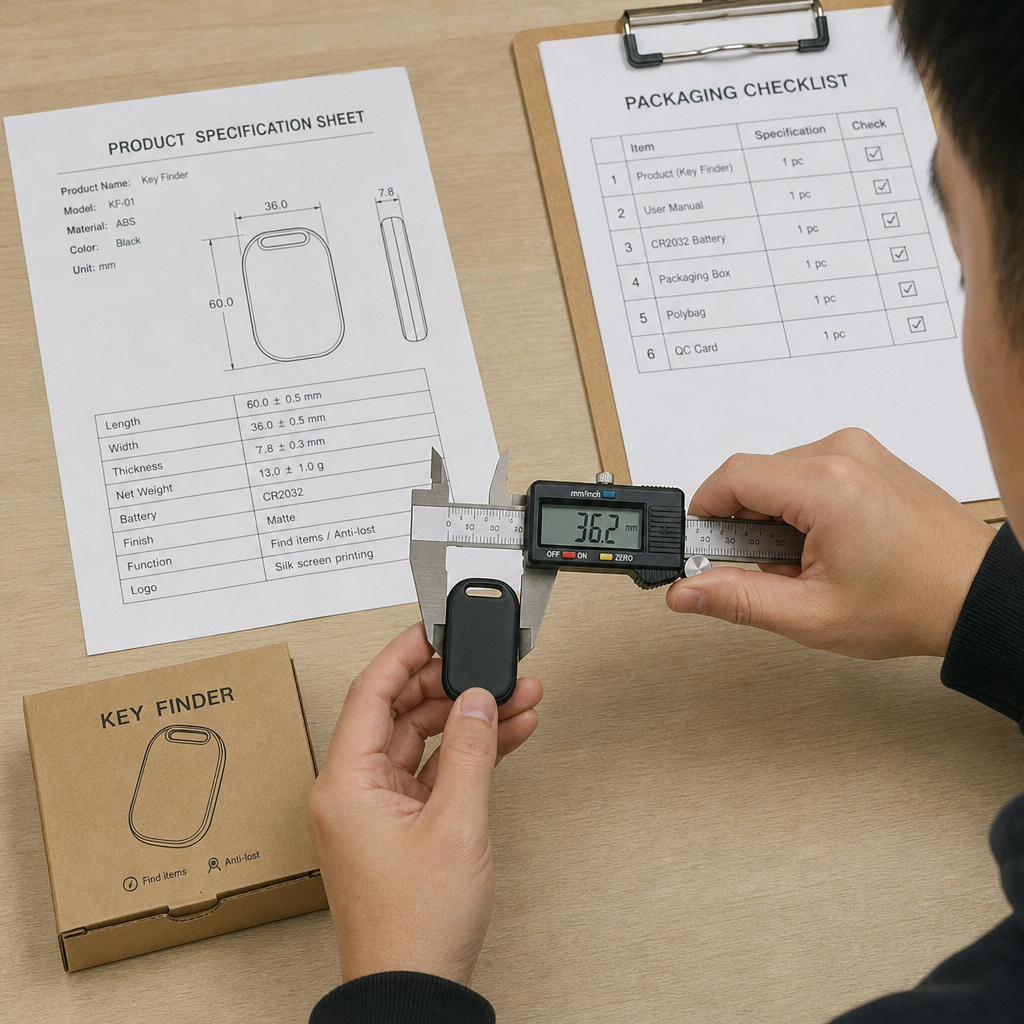
Build a sample checklist from the product brief rather than judging the item only by its appearance:
- Dimensions and fit: Measure important points and check compatibility with the intended application.
- Materials and finish: Examine surfaces, edges, stitching, printing, or assembly as relevant.
- Function: Test the intended use without exceeding safe operating conditions.
- Packaging: Check protection, labels, instructions, and product identification.
- Consistency: Where practical, compare multiple units rather than relying on one.
Photograph the sample beside a ruler or another appropriate reference. Write down what passes, what fails, and what needs clarification. Replace subjective feedback such as “make it better” with an observable requirement the supplier can acknowledge.
For example, if a storage box does not fit the intended shelf, record the required external dimensions rather than asking for a “slightly smaller” version. If you change the specification after reviewing the sample, update the product brief and request confirmation of any price or timing effect.
Keep the approved sample and give it an identifier in your order documents. Ask the supplier to retain a matching reference where practical. For regulated products, keep sample approval separate from compliance verification: testing and certification obligations depend on the applicable requirements, not simply on whether a sample looks satisfactory.
Step 6: Calculate the complete landed cost
Calculate what the order will cost when it reaches its intended destination. Landed cost includes the product price, insurance, freight, tariffs, taxes, and other applicable fees. Comparing that total helps you avoid choosing an offer based on a unit price that excludes essential expenses.
Build a worksheet with a separate line for each cost:
- Goods, customization, tooling, and packaging.
- Samples, relevant testing, and inspection.
- Collection and transport within China, where applicable.
- International shipping and insurance.
- Customs duties, applicable tariffs, taxes, and clearance charges.
- Destination handling, storage, and final delivery, where applicable.
- Payment-provider and currency-conversion charges.
Mark each line confirmed, estimated, or not yet quoted. Ask who receives the payment and when it becomes due. This makes uncertainty visible instead of hiding it inside a single “shipping included” figure.
For your own comparison, divide the expected total by the number of usable units you expect to receive. Run a second calculation using a less favorable outcome, such as additional inspection work or fewer sellable units. Treat this as a planning exercise, not a prediction of defects.
For U.S. orders, do not rely on older advice that purchases under $800 automatically enter duty-free. CBP states that duty-free de minimis treatment for low-value shipments from all countries was suspended effective August 29, 2025. Confirm the treatment applicable to your shipment before paying.
If you plan to import from China for resale, compare the resulting cost with your realistic selling price after fulfillment, returns, and other business expenses. Set your walk-away limit before negotiating the final order.
Step 7: Put the agreement in writing and protect payment
Create an order document that captures the complete agreement. Include the product specification, approved sample reference, quantities, packaging, price, production milestones, inspection arrangements, shipping responsibilities, and agreed remedies for nonconforming goods. Resolve contradictions between the quotation, invoice, messages, and marketplace order before paying.
Where Alibaba.com Trade Assurance applies, use the designated ordering and payment process. Its guidance ties coverage to the order agreement and directs buyers to pay through the platform's supported process or designated account. A payment arrangement sent separately by a seller should not be assumed to preserve protection.
Before authorizing payment:
- Match the invoice and order to the supplier you verified.
- Review the beneficiary information through the official payment channel.
- Independently confirm any unexpected change in payment instructions.
- Save the agreed specifications, messages, invoices, and payment records.
- Read the applicable protection terms, exclusions, evidence requirements, and claim deadlines.
For a production order, propose payment milestones that fit the work and the risk you are taking. Ask whether inspection can occur before the final balance is released, and record whatever arrangement both parties accept. Do not assume a familiar deposit percentage is mandatory or suitable for every transaction.
Write remedies in practical terms. Establish what happens if inspection finds the wrong material, missing quantities, or unacceptable workmanship: correction, replacement, another inspection, or an agreed refund process. Keep these terms separate from shipping terminology, because Incoterms do not provide a complete dispute-resolution agreement.
If important terms remain unresolved, delay payment rather than relying on a promise to settle them later.
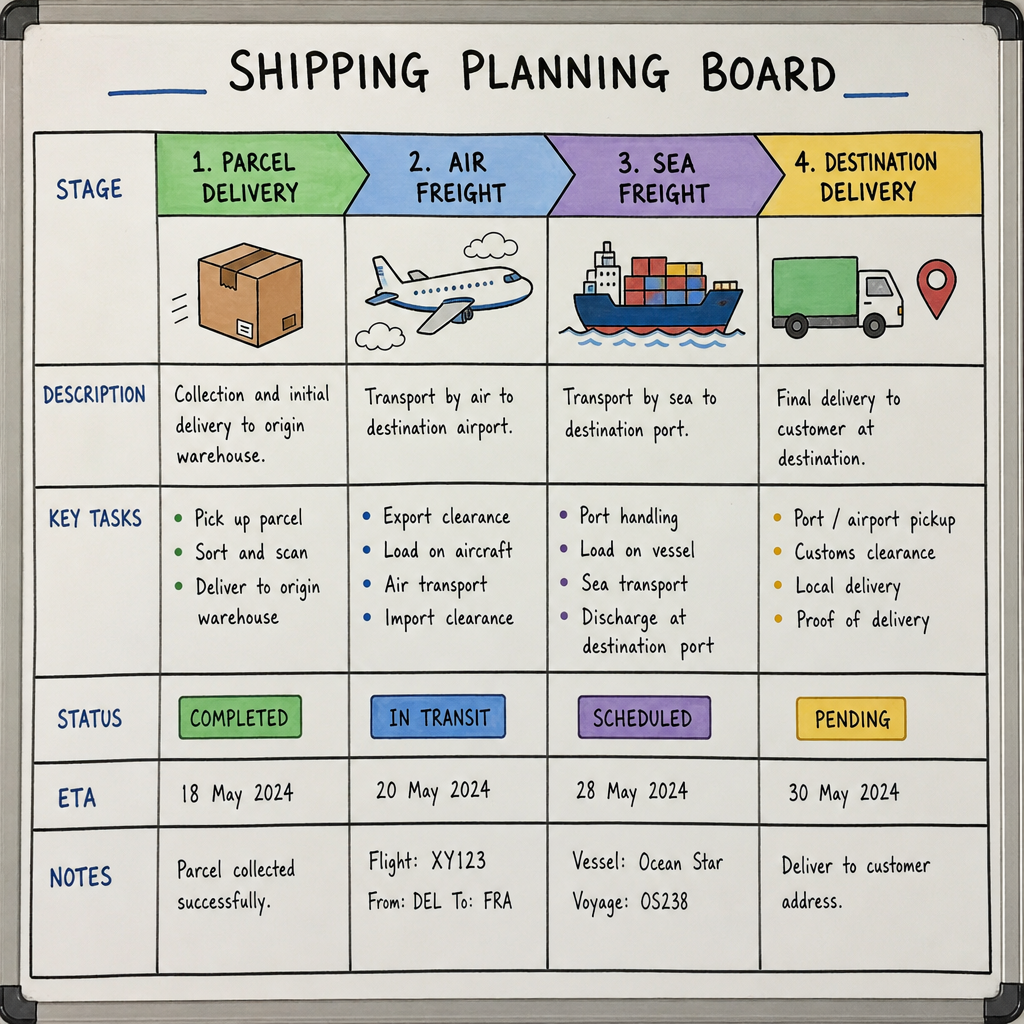
Step 8: Which shipping arrangement fits your purchase?
The right shipping arrangement is the one that meets your delivery needs at an acceptable total cost, with clear responsibility for transport, clearance, insurance, and final delivery. Request comparable quotations using the same shipment details. Choose only after you understand what each quote includes and what you must arrange separately.
Ask the supplier for carton count, packed dimensions, gross weight, collection locati0n, and any relevant cargo characteristics. Give that same information to each logistics provider. Request an explanation of the charging basis and any assumptions that could change the final invoice.
Use these questions when reviewing options:
|
Arrangement to investigate |
Questions to ask |
|---|---|
|
Courier or parcel delivery |
Is customs handling included, who pays import charges, and is delivery to my address covered? |
|
Air freight |
Who handles collection, airport processing, clearance, and onward delivery? |
|
Sea freight |
What origin, destination, handling, storage, and delivery charges are excluded? |
|
Consolidated shipment |
Who checks combined orders, manages paperwork, and records shortages or damage? |
Confirm the Incoterm and named location in writing. Do not treat phrases such as “door-to-door” or “all-inclusive” as substitutes for a detailed scope. Incoterms clarify allocation of transport-related responsibilities and risks, but you still need the rest of the commercial agreement.
Ask for separate estimates for production completion, collection, transit, clearance, and final delivery. Build your own deadline around the full sequence rather than treating a transit estimate as an arrival guarantee. If insurance is offered, request the coverage details and claims procedure before accepting it.
Step 9: Inspect the order before dispatch
Arrange inspection while there is still an opportunity to address problems before shipment. For a business order, give the inspector the latest specification, approved sample reference, quantity breakdown, and packaging instructions. Alibaba.com's sourcing guidance includes production monitoring and inspection among the measures buyers can consider.
Set the inspection scope in advance. Ask for checks covering product identification, quantities, important dimensions, workmanship, agreed functional tests, packaging, labels, and shipping marks as relevant. Define which findings require a shipment hold and who has authority to approve release.
Request a report that connects findings to your requirements. Useful evidence includes photographs, measured results, quantities checked, and a clear description of each discrepancy. Ask the inspector to identify anything outside the agreed scope rather than leaving you to assume it was checked.
If the report finds a problem, send a written correction request tied to the specification. State the required action and ask how completion will be verified. Decide whether you need a second inspection before approving dispatch or the next payment milestone.
For a small personal purchase, use a proportionate version of this process: confirm the exact variant and request current product or packing photos where appropriate. Keep those records with the listing and order confirmation. Do not treat a photo review as a substitute for any required safety testing or certification.
Record your release decision explicitly. A short written approval identifying the order, inspection report, and remaining agreed actions is clearer than an informal message saying everything looks fine.
Step 10: Prepare customs documents and check the delivery
Confirm the customs arrangements before the goods leave China. Identify who will act as importer of record and who will prepare the entry. CBP's guidance places responsibility on the importer of record to exercise reasonable care in entering, classifying, and valuing goods; appointing a service provider does not remove the need to understand the transaction.
Ask your broker, carrier, or other responsible provider which records your shipment needs. Check the commercial invoice, packing information, transport document, product description, value, origin, and any applicable permits or compliance records for consistency. Requirements vary by product, and some goods require an import license or permit.
For regulated U.S. consumer products, confirm current CPSC certificate-filing obligations as part of that preparation. CPSC's eFiling requirements took effect for most affected imports on July 8, 2026. Check applicability to your product rather than assuming a supplier's attached certificate completes the import process.
At delivery, photograph the outer packaging, record visible damage, and count the cartons. Then compare the contents with your order and inspection records. Keep the packaging while you investigate any shortage, damage, or specification issue.
If something is wrong, contact the relevant seller, platform, or carrier promptly with a concise evidence package: order reference, description of the issue, photographs, and the resolution requested. Follow the applicable claims procedure and deadline.
Finish with a brief supplier review. Record actual delivered cost, product quality, communication, and unresolved issues before deciding whether to reorder.
The takeaway: Start with a precise product brief, verify the seller, approve samples, and compare complete delivered costs. Put responsibilities in writing and keep evidence through delivery. Your first order should establish whether the product and purchasing process work before you commit to more.
Frequently Asked Questions About Buying from China
What do I need to consider before buying from China?
Before making a purchase, you should define your product specifications, intended use, quantity, budget, deadline for arrival, and any necessary documentation or compliance requirements for your country.
How can I verify the legitimacy of a Chinese supplier?
To verify a supplier, you should request their legal company name and address, ask for current photos or videos of the product and production process, review company details in all documents, and consider conducting an independent check or site assessment.
What are the different purchasing routes for buying from China?
You can choose from various purchasing routes such as retail-style online checkout, business-to-business marketplaces, direct supplier relationships, or using a sourcing agent, depending on your needs and the size of your order.
How do I calculate the total cost of importing goods from China?
The total cost, also known as the landed cost, includes the product price, insurance, freight, tariffs, taxes, and any additional fees. It's important to account for all these expenses to compare offers accurately.
What steps should I take for customs clearance when my order arrives?
Ensure you have all necessary documents such as the commercial invoice, packing list, and any required permits. You also need to confirm who will act as the importer of record and be responsible for customs clearance and duties.