











.png)
In modern supply chain management, businesses increasingly rely on specialized logistics partners to improve transportation, warehousing, inventory management, order fulfillment, and overall supply chain performance. Two of the most widely used models are Third-Party Logistics (3PL) and Fourth-Party Logistics (4PL).
Although the terms sound similar, 3PL and 4PL represent significantly different approaches to logistics management. A 3PL provider typically performs operational logistics activities on behalf of a business, while a 4PL provider takes a broader role by coordinating multiple logistics providers and managing the supply chain at a strategic level.
Understanding the distinction between 3PL vs 4PL is important when designing a logistics strategy, outsourcing supply chain activities, or determining how much control should remain within an organization.
What Is 3PL?
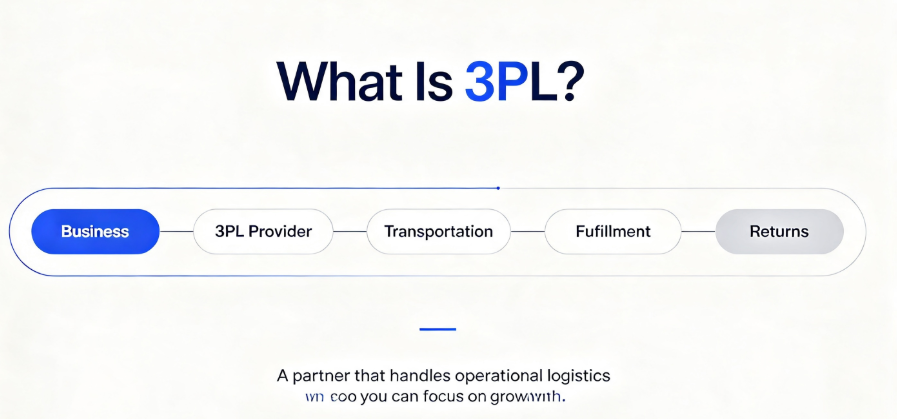
Third-Party Logistics (3PL) refers to the outsourcing of specific logistics activities to an external provider. A 3PL company may manage transportation, warehousing, distribution, inventory, order fulfillment, freight forwarding, or other operational functions.
Rather than maintaining every logistics capability internally, a company contracts with a 3PL provider to perform selected activities. The provider generally operates within an agreed scope, service-level agreement, pricing structure, and set of performance requirements.
For example, an e-commerce company may own its inventory and customer relationships while outsourcing warehouse operations, picking and packing, shipping, returns processing, and transportation coordination to a 3PL.
A 3PL can therefore function as an extension of the company's logistics department without requiring the company to build and operate every physical and technological capability itself.
What Services Does a 3PL Provide?
| Category | Services |
|---|---|
| Core Fulfillment | Order fulfillment, Pick-and-pack operations |
| Storage & Inventory | Warehousing and storage, Inventory management |
| Transportation & Delivery | Transportation management, Freight forwarding, Distribution, Last-mile delivery coordination, Shipment tracking |
| Specialized Operations | Cross-docking, Reverse logistics, Returns management |
| Compliance & Support | Customs-related logistics services, Packaging and labeling |
Some 3PL providers specialize in particular industries, such as retail, healthcare, automotive, food and beverage, or e-commerce. Others provide broader logistics capabilities across multiple transportation modes and geographic markets.
What Is 4PL?
Fourth-Party Logistics (4PL) is a broader supply chain management model in which an external organization takes responsibility for coordinating and optimizing multiple logistics resources and providers.
Instead of simply performing logistics operations, a 4PL provider generally acts as a strategic supply chain integrator. It may coordinate 3PL companies, transportation providers, warehouses, technology platforms, carriers, and other supply chain partners.
The 4PL model is therefore less focused on operating a particular warehouse or transporting a particular shipment and more focused on designing, managing, integrating, and optimizing the overall supply chain.
A 4PL provider may oversee several 3PLs simultaneously. It can establish performance standards, analyze supply chain data, coordinate providers, identify inefficiencies, manage technology integration, and provide centralized visibility.
3PL vs 4PL: The Core Difference
The simplest distinction is that 3PL generally performs logistics activities, whereas 4PL generally manages and coordinates the broader logistics ecosystem.
A 3PL might operate a warehouse and fulfill customer orders. A 4PL might manage that 3PL while also coordinating transportation providers, freight forwarders, technology systems, and other logistics partners.
The difference can be summarized as follows:
| Factor | 3PL | 4PL |
|---|---|---|
| Primary role | Logistics service provider | Supply chain integrator |
| Main focus | Operational execution | Strategic coordination and optimization |
| Warehousing | Often directly provided | Usually managed through providers |
| Transportation | Often directly managed or provided | May coordinate multiple transportation providers |
| Multiple logistics providers | Limited or specific | Commonly coordinated centrally |
| Technology integration | Provider-specific | Often broader, multi-provider integration |
| Strategic supply chain management | Limited to defined scope | Central component |
| Operational control | High within outsourced activities | High at coordination and governance level |
| Relationship model | Service provider | Strategic partner/integrator |
| Typical complexity | Moderate to high | High to very high |
How a 3PL Works
In a typical 3PL arrangement, the business identifies logistics activities that it wants to outsource. The 3PL provider then supplies the required infrastructure, people, systems, and operational expertise.
Consider a retailer that sells products across several countries. Instead of leasing warehouses in every market, hiring warehouse employees, purchasing fulfillment equipment, and developing local distribution capabilities, the retailer could partner with a 3PL.
The 3PL could receive inbound inventory, store products, process orders, prepare shipments, coordinate transportation, and manage returns.
The retailer remains responsible for its broader commercial strategy, product assortment, customer relationships, and other core functions, while the 3PL manages the agreed logistics operations.
How a 4PL Works
A 4PL relationship operates at a different level.
Suppose the same retailer works with several warehouses, parcel carriers, freight companies, customs specialists, and regional logistics providers. Managing these relationships independently can create fragmented systems, inconsistent performance measurements, duplicated processes, and limited visibility.
A 4PL can serve as a central coordinating layer.
The 4PL may establish common performance indicators, consolidate data, coordinate providers, analyze transportation costs, identify capacity problems, manage logistics technology, and oversee continuous improvement.
In this model, the business does not necessarily rely on one company to physically perform every logistics function. Instead, it relies on the 4PL to orchestrate the network.
Key Differences Between 3PL and 4PL
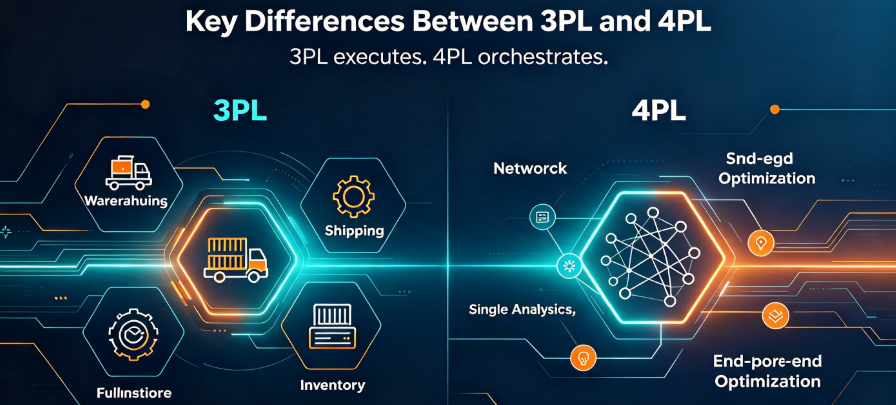
1. Operational Execution vs Strategic Management
The most important distinction concerns the level at which each model operates.
A 3PL is primarily operational. It executes defined logistics activities such as warehousing, transportation, fulfillment, or distribution.
A 4PL is primarily managerial and strategic. It coordinates the activities of multiple logistics participants and seeks to improve the performance of the overall supply chain.
This distinction does not mean that every 3PL is purely operational or that every 4PL avoids operational responsibilities. Logistics providers frequently offer overlapping services. However, the traditional difference lies in the scope of responsibility and level of supply chain integration.
2. Single Provider vs Multiple Providers
A company using a 3PL may outsource logistics to one provider for a particular region or function.
A 4PL model is particularly useful when the supply chain involves multiple logistics providers.
The 4PL can act as a central point of coordination between warehouses, carriers, freight forwarders, customs providers, technology platforms, and other partners.
This structure can reduce the administrative burden associated with managing numerous logistics relationships independently.
3. Tactical Focus vs End-to-End Optimization
A 3PL generally optimizes the activities included within its contracted scope.
For example, a warehouse-focused 3PL may improve picking efficiency, storage utilization, labor productivity, and order accuracy.
A 4PL can look beyond an individual operation and examine how different components interact. Transportation costs, warehouse locations, inventory positioning, delivery performance, technology integration, and supplier relationships can be analyzed as parts of the same system.
This creates a stronger emphasis on end-to-end supply chain optimization.
4. Technology and Data Integration
Technology plays an important role in both models, but the scope can differ considerably.
A 3PL may provide warehouse management systems, transportation management tools, shipment tracking, inventory portals, or electronic data integration.
A 4PL may integrate information from multiple 3PLs and other supply chain systems into a broader management environment.
This can provide organizations with centralized reporting and visibility across logistics operations that would otherwise remain separated by provider.
5. Commercial and Contractual Structure
A 3PL contract commonly specifies operational services, pricing, service levels, storage requirements, transportation rates, fulfillment standards, and other measurable obligations.
A 4PL agreement can include these elements but often places greater emphasis on governance, performance management, transformation initiatives, integration, and strategic objectives.
The commercial model may therefore involve management fees, performance-based components, project fees, or other structures depending on the complexity of the relationship.
Advantages of Using a 3PL

A 3PL can provide several practical benefits.
Reduced Infrastructure Requirements
Businesses can access warehouses, transportation networks, equipment, technology, and logistics personnel without developing all of these capabilities internally.
Scalability
A 3PL can help businesses manage seasonal demand, geographic expansion, product launches, and changes in order volumes.
Specialized Expertise
Established logistics providers possess operational knowledge, processes, technology, and industry experience that may take significant time and investment to develop internally.
Faster Market Expansion
Businesses entering new geographic markets may use established logistics networks instead of building local operations from the ground up.
Operational Flexibility
Outsourcing selected logistics functions can allow companies to adjust capacity as business requirements change.
Advantages of Using a 4PL
A 4PL becomes particularly relevant when supply chains become highly complex.
Centralized Supply Chain Management
A 4PL can create a central management structure across multiple logistics providers.
Greater Visibility
By integrating data from different providers and systems, a 4PL can provide a broader view of supply chain performance.
Provider Coordination
Instead of managing numerous logistics partners independently, the business can establish a central governance relationship.
Strategic Optimization
A 4PL can analyze the entire logistics network rather than optimizing individual activities in isolation.
Continuous Improvement
Because the 4PL is responsible for broader supply chain performance, the relationship can incorporate ongoing optimization, network redesign, technology improvements, and process transformation.
When Should a Business Choose a 3PL?
A 3PL model may be appropriate when a company needs assistance with specific logistics activities but does not require a separate organization to manage the entire supply chain.
A business may consider 3PL outsourcing when it needs:
- Additional warehouse capacity
- Outsourced order fulfillment
- Transportation management
- Freight forwarding
- Distribution services
- Specialized logistics expertise
- Support for geographic expansion
- Seasonal logistics capacity
- Reverse logistics capabilities
For many businesses, 3PL outsourcing provides a practical balance between external expertise and internal control.
When Should a Business Consider a 4PL?
A 4PL model becomes more relevant when logistics operations involve numerous providers, markets, systems, and interconnected processes.
Organizations may consider a 4PL approach when they experience:
- Complex multi-provider logistics networks
- Fragmented supply chain data
- Multiple warehouses and transportation partners
- Difficulty coordinating logistics suppliers
- Limited end-to-end visibility
- Complex international supply chains
- Significant logistics transformation requirements
- Need for centralized performance management
- Supply chain technology integration challenges
The decision should be based on the organization's operational structure, strategic objectives, technology environment, geographic footprint, and desired level of outsourcing.
3PL vs 4PL for E-Commerce
E-commerce businesses frequently use 3PL services because fulfillment speed and operational scalability are critical.
A growing online retailer may outsource inventory storage, order processing, packing, shipping, and returns to a 3PL. This enables the retailer to focus on merchandising, customer acquisition, product development, and customer experience.
As the organization grows, however, its logistics network may become more complicated. It might operate several fulfillment centers while using different parcel carriers, freight companies, international logistics providers, and technology platforms.
At that stage, a 4PL structure can provide centralized coordination across the broader network.
Therefore, 3PL and 4PL are not necessarily competing models. A 4PL may actually manage several 3PL relationships as part of a larger supply chain strategy.
3PL vs 4PL in International Logistics
International supply chains introduce additional complexity through customs requirements, different transportation modes, regional distribution centers, regulatory requirements, currencies, taxes, lead times, and local logistics providers.
A 3PL can provide valuable regional or international operational services, including warehousing, freight forwarding, transportation, and customs-related logistics support.
A 4PL can provide an additional management layer by coordinating different providers across countries and regions.
For multinational organizations, this distinction can become particularly important because local operational expertise and global supply chain coordination may both be required.
Can a Company Use Both 3PL and 4PL?
Yes. The two models can operate together.
A company might appoint a 4PL as its overall supply chain integrator while continuing to use multiple 3PLs for physical logistics operations.
For example:
Business → 4PL → Multiple 3PLs → Warehouses, carriers, and other logistics services
In this structure, the 4PL can manage supplier relationships, performance measurement, technology integration, and strategic optimization, while the 3PLs execute specific operational activities.
This arrangement can be useful when a business wants centralized supply chain governance without replacing its existing logistics infrastructure.
How to Compare 3PL and 4PL Providers
When evaluating logistics outsourcing options, businesses should examine more than headline pricing.
Important considerations include:
| Category | Key Considerations |
|---|---|
| Network & Capacity | Service coverage, Geographic network, Warehouse capacity |
| Operations & Tech | Transportation capabilities, Technology integration, Inventory visibility, Reporting capabilities |
| Growth & Fit | Scalability, Industry experience, Contract flexibility, Implementation requirements |
| Reliability & Quality | Customer service, Performance metrics, Business continuity, Continuous improvement capabilities |
| Security & Compliance | Data security |
For 3PL providers, operational performance should receive particular attention. Metrics such as order accuracy, inventory accuracy, on-time shipment performance, fulfillment speed, damage rates, and transportation performance can be important.
For 4PL arrangements, businesses should also assess the provider's ability to coordinate multiple organizations, integrate technology, manage performance, and deliver strategic supply chain improvements.
3PL vs 4PL: Cost Considerations
Cost structures differ according to the services provided, geography, volumes, technology requirements, and contractual model.
A 3PL may charge for services such as storage, receiving, picking, packing, transportation, handling, and value-added services.
A 4PL arrangement may introduce additional management and integration costs because the provider is responsible for broader supply chain coordination.
However, comparing the models solely by direct fees can produce an incomplete picture. Businesses should consider total supply chain cost, including transportation, inventory, warehousing, labor, technology, administration, service failures, and inefficiencies.
The appropriate model depends on the overall operating requirements rather than the lowest individual logistics fee.
Conclusion: Understanding the Difference Between 3PL and 4PL
The distinction between 3PL vs 4PL ultimately comes down to the scope and level of supply chain responsibility.
A 3PL provider primarily delivers outsourced logistics services, such as warehousing, fulfillment, transportation, distribution, and freight management. It is particularly useful when a business wants to outsource defined operational activities while retaining broader control of its supply chain.
A 4PL provider takes a broader coordinating role, integrating multiple logistics providers, technologies, and processes into a more unified supply chain management structure.
The two models can also work together. A 4PL may manage several 3PL providers, creating a layered logistics structure in which operational specialists execute physical activities while a central integrator manages coordination and optimization.
For businesses evaluating logistics outsourcing, the key consideration is the level of complexity, control, integration, and strategic management required. Understanding these differences makes it easier to structure a logistics model that aligns with operational requirements, growth plans, customer expectations, and long-term supply chain objectives.
FAQ: 3PL vs 4PL — Choose the Right Logistics Solution
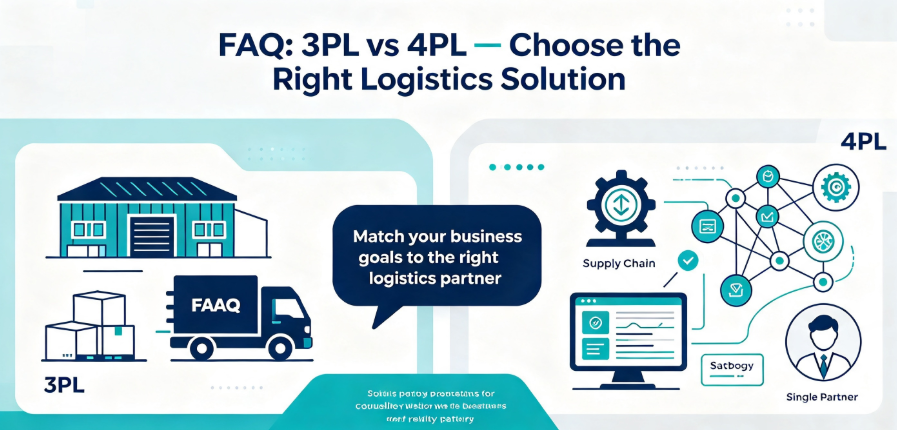
1. What is the basic difference between 3PL and 4PL?
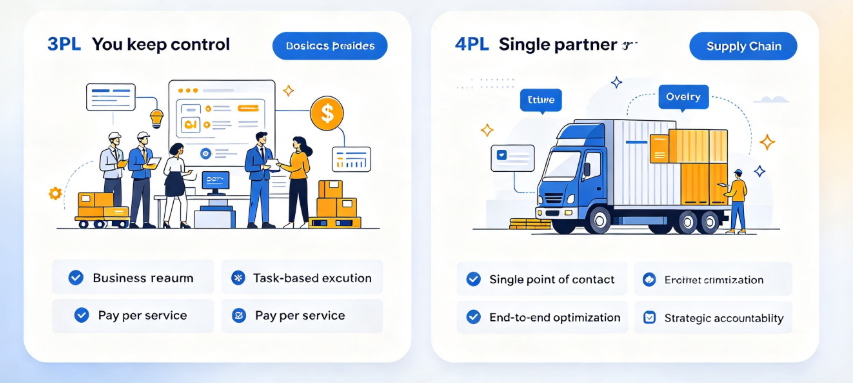
- 3PL (Third-Party Logistics): A service provider that executes day-to-day logistics tasks — warehousing, shipping, fulfillment, transportation — you still oversee the overall supply chain and coordinate multiple providers.
- 4PL (Fourth-Party Logistics): A strategic partner that takes full end-to-end ownership — they manage, design, coordinate, and optimize your entire supply chain, including selecting and supervising 3PLs and carriers on your behalf.
2. Which one gives me more control over my logistics?
3. What are the cost differences between 3PL and 4PL?
- 3PL: Lower upfront commitment; you pay for specific services (storage, shipping) as needed. Costs are straightforward but can add up if you manage multiple vendors.
- 4PL: Typically higher service fees, but often delivers greater overall savings through consolidated operations, volume discounts, and process optimization — better scaling for growing or complex supply chains.
4. When should I switch from 3PL to 4PL?
- Your business spans multiple markets or channels
- Managing several logistics providers becomes too time-consuming
- You want data-driven optimization and long-term supply chain strategy
- You need a single partner accountable for performance, costs, and reliability
.png)