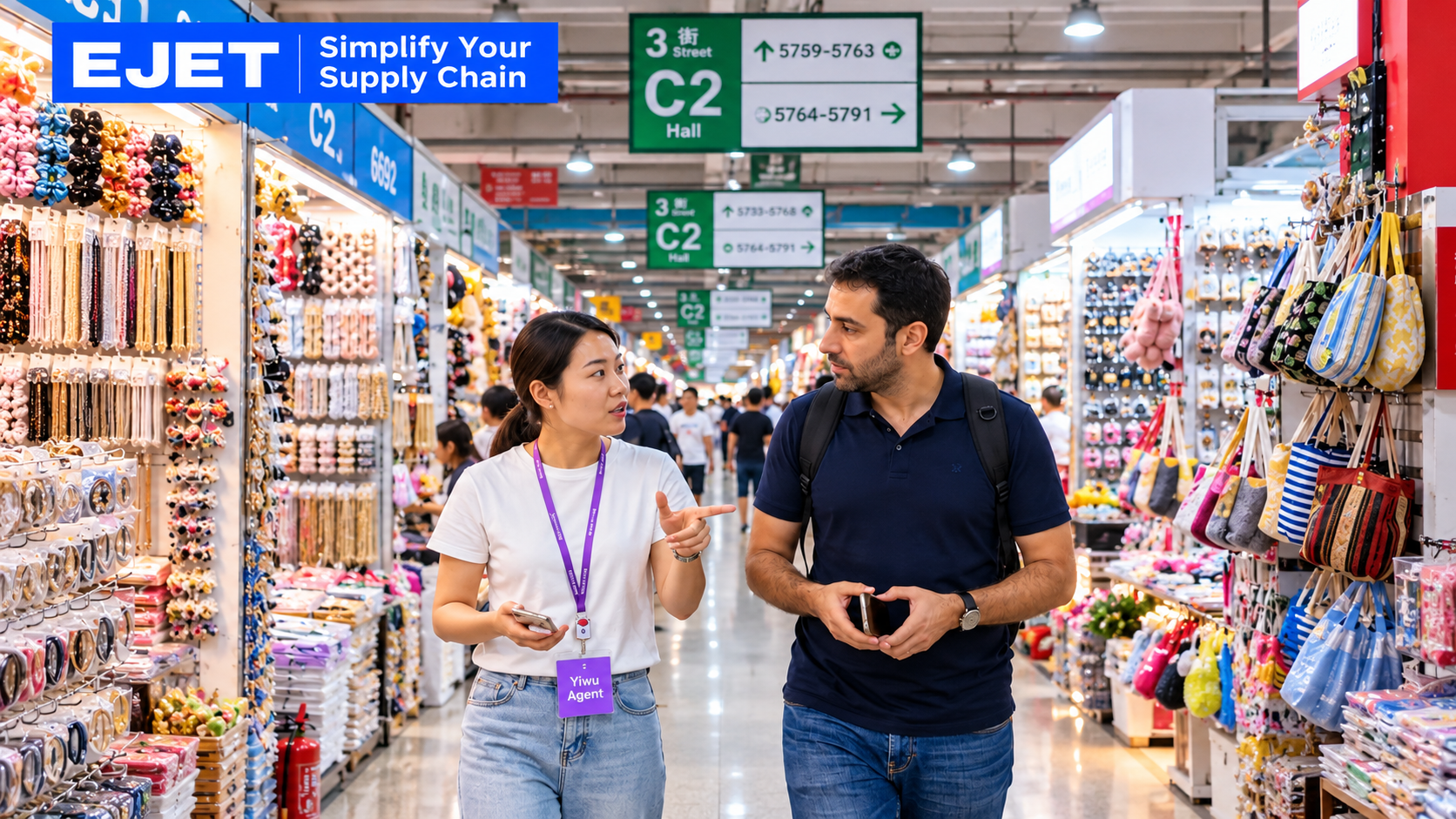
If you are exploring china sourcing for small consumer goods, a Yiwu sourcing agent can make the difference between a manageable buying process and a confusing, expensive learning curve.
These local partners help international buyers navigate the yiwu market, compare suppliers, negotiate terms, inspect goods, consolidate orders, and arrange export logistics. For startups, ecommerce sellers, retailers, and importers testing new products, the right agent turns a huge wholesale environment into a practical sourcing system.
Yiwu is best known for small commodities: accessories, home goods, stationery, toys, seasonal items, packaging, gifts, fashion basics, and many other everyday products.
Its official online market platform describes Yiwu as having around 75,000 booths, while Yiwu city materials reference more than 2.1 million commodities across 26 categories, which explains why local support is so valuable for buyers who cannot physically inspect every supplier themselves.
What does a Yiwu sourcing agent actually do?
A Yiwu sourcing agent is a local partner who helps buyers find, evaluate, purchase, inspect, and ship products from Yiwu and nearby supplier networks. Instead of expecting you to manage every booth, chat, sample, invoice, quality issue, and freight detail from overseas, the agent acts as your on-the-ground coordinator. The best sourcing agents do not simply “find a cheap supplier”; they reduce uncertainty at each stage of the buying process.
In practical terms, a Yiwu agent may walk the market for you, collect product photos and videos, compare quotes, confirm packaging details, translate requirements, and check whether a supplier can meet your order quantity.
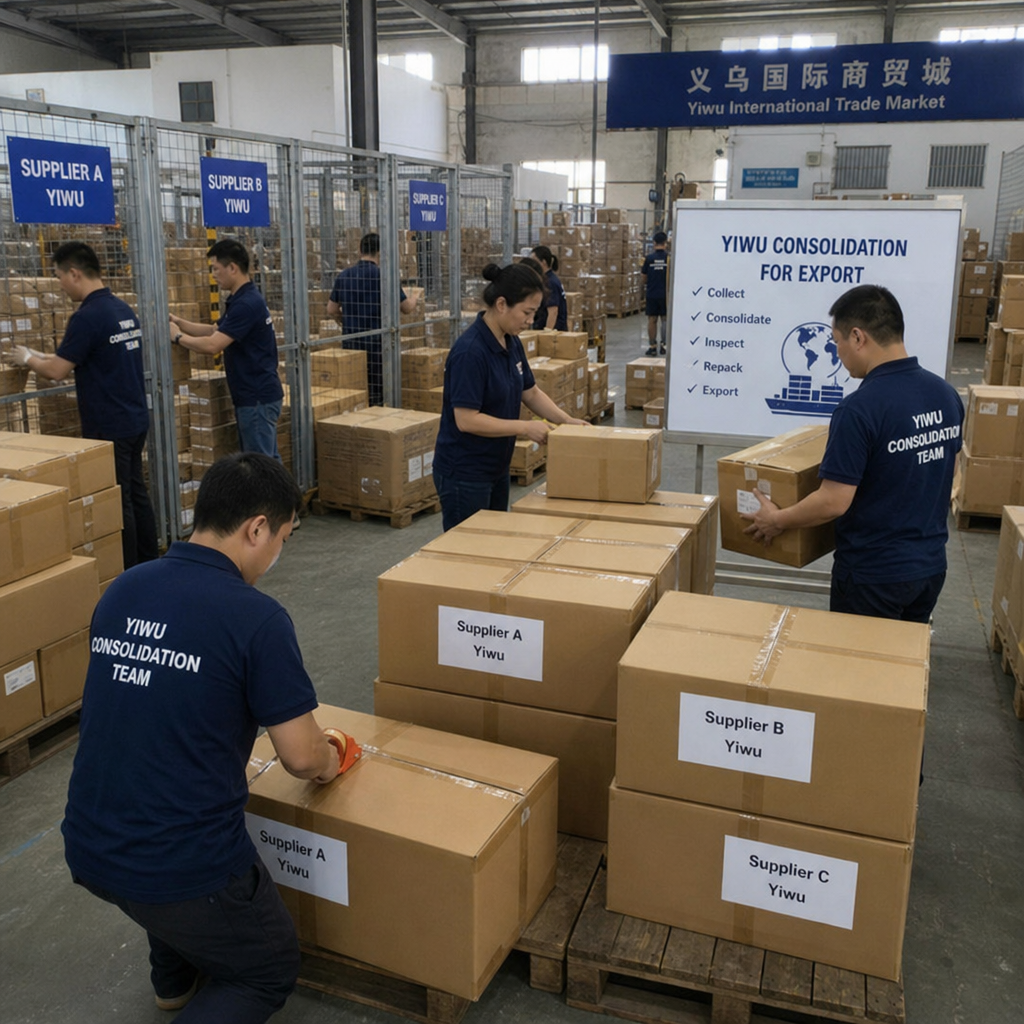
For buyers placing mixed orders across multiple categories, the agent may also gather goods from several vendors into one warehouse and prepare a consolidated shipment. That consolidation is one of Yiwu’s biggest advantages because many buyers are not purchasing a single factory-made product by the container; they are building a flexible assortment.
Common responsibilities include:
- Supplier identification: Finding booths, trading companies, or factories that match your product brief, quality level, target price, and order size.
- Quotation comparison: Checking whether prices include packaging, labeling, inner cartons, export cartons, or customization.
- Negotiation: Discussing unit price, minimum order quantity, payment schedule, sample fees, lead time, and remake terms.
- Sample coordination: Buying, photographing, shipping, or comparing samples before a larger order is placed.
- Quality control: Inspecting product appearance, quantity, packaging, labeling, and obvious defects before shipment.
- Order consolidation: Receiving goods from multiple suppliers and preparing them for one combined export shipment.
- Logistics support: Coordinating domestic transport, freight forwarders, export documents, and shipping updates.
- Communication management: Translating buyer requirements into clear instructions and keeping suppliers accountable.
Good sourcing services are not only about convenience. They help protect cash flow, reduce avoidable mistakes, and give buyers better visibility before money is tied up in inventory.
The Yiwu market rewards preparation
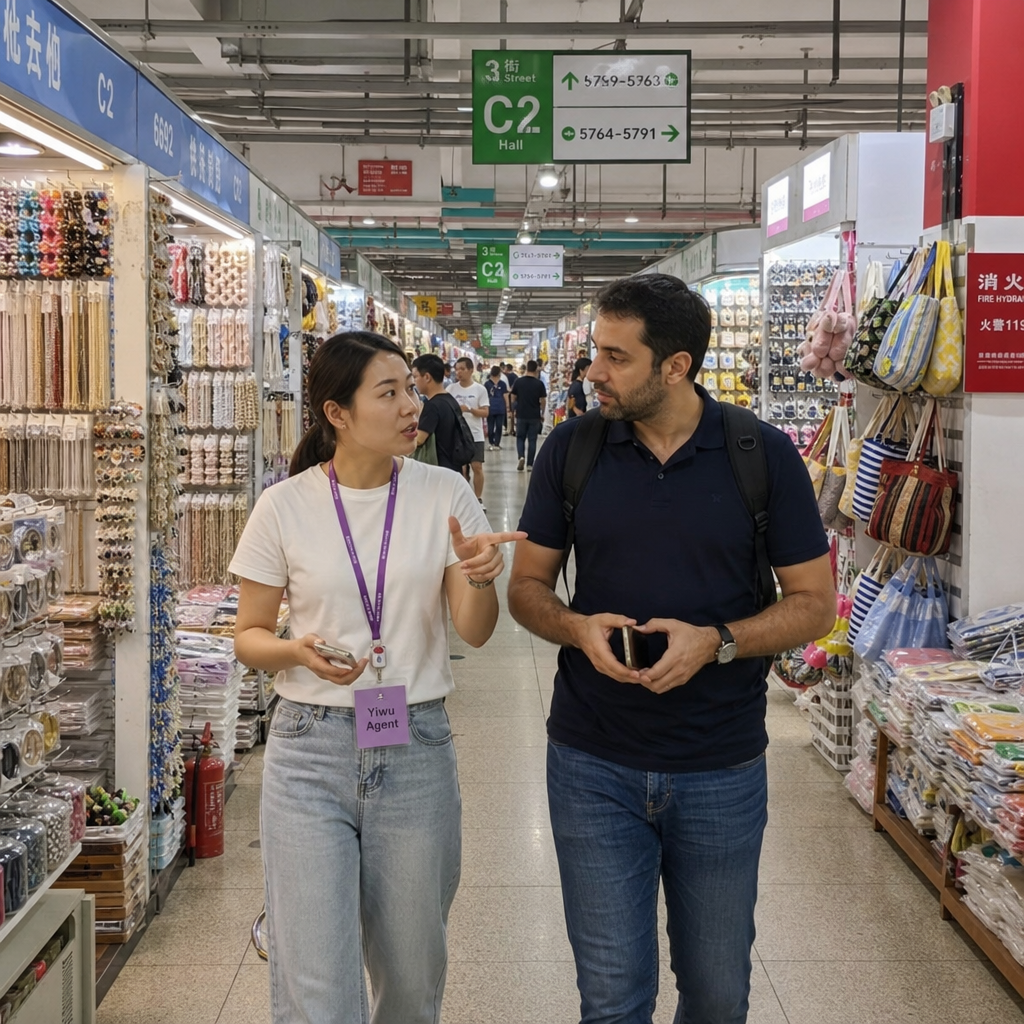
The yiwu market is not like browsing a simple online catalog. It is a large physical wholesale ecosystem where products are organized by category and displayed through booths, showrooms, and supplier counters.
The Yiwu Fair market guide lists major districts covering categories such as toys, jewelry, hardware, bags, electronics, stationery, sports goods, cosmetics, socks, textiles, shoes, belts, bedding, car accessories, pet products, and more.
That variety is exactly why buyers are attracted to Yiwu. You can compare similar products quickly, spot packaging trends, discover variations you did not think to search for, and build mixed orders across categories. For ecommerce sellers, that can be useful when testing bundles, seasonal collections, gift sets, or low-risk product ideas before committing to larger factory runs.
However, variety also creates noise. Two products that look nearly identical may use different materials, different packaging, different accessories, or different quality standards.
A booth may represent a factory, a trading company, or a distributor. Some suppliers may be strong for ready stock but less suitable for custom production. Without local verification, buyers can easily compare prices without comparing the actual offer behind those prices.
Preparation gives your agent something concrete to work with. Before requesting quotes, define:
- Product name and intended use
- Target customer and market
- Approximate order quantity
- Preferred material, size, color, and finish
- Packaging needs
- Labeling or barcode requirements
- Target price range
- Required certifications or compliance considerations
- Shipping destination and preferred delivery timeline
The clearer your brief, the less likely your agent is to waste time collecting irrelevant options. A vague request such as “find cheap kitchen products” will produce scattered results. A focused request such as “find silicone kitchen utensil sets in neutral colors, retail-ready packaging, low trial quantity, suitable for a U.S. ecommerce store” gives the sourcing process direction.
Why use Yiwu sourcing agents instead of sourcing alone?
International buyers use yiwu sourcing agents because the real challenge is not finding products; it is controlling risk across distance, language, quality, payment, and logistics. Yiwu offers enormous opportunity, but it also asks buyers to make many small decisions correctly. A sourcing agent helps turn those decisions into a repeatable process.
The biggest benefit is local presence. An agent can visit booths, check products physically, clarify details in Chinese, and follow up when a supplier is slow or unclear. This matters because product listings, photos, and quick quotes rarely tell the full story. A slightly cheaper option may have weaker packaging, inconsistent color, thinner material, or longer lead times. Someone on the ground can catch those issues earlier.
A second benefit is order flexibility. Many buyers come to Yiwu because they want to test several SKUs rather than invest heavily in one product. A local agent can help coordinate small wholesale orders, mixed cartons, samples, and supplier combinations. This is especially helpful for new sellers who are still learning which items customers actually want.
A third benefit is communication. Sourcing often fails because buyer expectations are not translated into supplier actions. Details such as logo placement, carton markings, insert cards, color tolerance, bundle combinations, and inspection standards need to be written clearly and confirmed repeatedly. Good import agents document these details so everyone is working from the same version of the order.
A fourth benefit is problem-solving. If one supplier delays production, sends the wrong color, or changes packaging unexpectedly, an overseas buyer may discover the issue too late. A local agent can push for correction, find alternatives, or advise whether the problem is worth accepting before goods leave China.
Core sourcing services that matter most
Not every agent offers the same level of support, so it helps to understand which services are essential and which are optional. A simple buying assistant may only translate and place orders. A more complete sourcing partner may handle research, negotiation, inspection, warehousing, consolidation, export coordination, and reporting.
Product research and supplier matching
Effective wholesale sourcing starts with matching the right buying goal to the right type of supplier. If you are testing a trend, you may prioritize ready stock, low quantity, and fast dispatch. If you are building a private-label product, you may need a supplier with better customization experience and stronger consistency. If you are creating a promotional item, price and deadline may matter more than long-term exclusivity.
Your agent should be able to explain why a supplier was shortlisted. A useful sourcing report might include product photos, booth details, quoted price, MOQ, packaging notes, sample availability, lead time, and concerns. Even if the report is simple, it should let you compare options on more than price.
Negotiation and order confirmation
Negotiation in Yiwu is not just about asking for a discount. It is about making the order complete. A lower unit price can become expensive if it excludes packaging, requires a higher quantity, or allows loose quality standards. Your agent should confirm the full commercial picture before you pay a deposit.
Important details include unit price, currency, payment terms, delivery date, product specification, packing method, carton quantity, carton dimensions, labeling, inspection timing, and what happens if goods fail inspection. If customization is involved, artwork files, color references, samples, and approval steps should be documented before production.
Quality control and inspection
Quality control is where many sourcing projects are either protected or lost. A Yiwu sourcing agent should not promise perfection, but they should have a practical inspection process. At minimum, that means checking quantity, product appearance, packaging condition, major visible defects, color or model consistency, and whether the goods match the approved sample or order notes.
For higher-risk products, you may need more formal third-party inspection or lab testing. This is especially important for regulated products, children’s products, electronics, cosmetics, food-contact items, medical-related goods, or anything requiring market-specific compliance. A sourcing agent can coordinate those steps, but the buyer is still responsible for understanding import rules in the destination country.
Consolidation and shipping coordination
Yiwu is ideal for mixed orders, but mixed orders create logistics complexity. If you buy from eight suppliers, someone must receive the goods, count cartons, check labels, store them safely, and prepare them for shipment. That is where consolidation becomes valuable.
A good agent will help you choose a shipping method based on cost, urgency, product type, volume, weight, and destination. They may coordinate with a freight forwarder for sea freight, air freight, rail, courier, or other routes. They should also help you understand what documents are needed, such as invoices, packing lists, export details, and any destination-specific paperwork your customs broker requests.
How do you choose a reliable Yiwu sourcing agent?
Choose a Yiwu sourcing agent by evaluating local presence, transparency, communication quality, service scope, inspection process, fee structure, and willingness to document agreements.
A trustworthy agent should be able to show how they source, how they report, how they handle problems, and how they protect your order details. If the agent is vague before payment, they are unlikely to become clearer after the order becomes complicated.
Start with communication. The agent should ask specific questions about your product, quantity, budget, packaging, destination, and quality expectations. If they rush straight to “send money” or promise the cheapest price without understanding your needs, be cautious. Good sourcing begins with diagnosis.
Next, evaluate transparency. Ask whether they work on commission, service fee, supplier margin, or a combination. None of these models is automatically wrong, but hidden incentives can distort supplier recommendations. You want to know who pays whom, what is included, and which costs are separate.
Use this checklist when comparing agents:
- Local Yiwu presence: Can they visit the market, warehouse goods, and inspect orders in person?
- Relevant category experience: Have they sourced products similar to yours, not just random items?
- Clear reporting: Do they provide photos, videos, quote sheets, supplier notes, and order confirmations?
- Written agreement: Will they document service scope, fees, payment schedule, refund terms, and responsibilities?
- Inspection process: Can they explain what they check before shipment and what they do if defects are found?
- Logistics capability: Can they consolidate from multiple suppliers and coordinate export shipping?
- Responsive communication: Do they reply clearly, answer the actual question, and set realistic timelines?
- Problem handling: Can they explain past-style scenarios without inventing guarantees or blaming every issue on suppliers?
Also watch for red flags:
- Fees that seem unrealistically low with no explanation of how the agent is paid
- Refusal to provide written terms or order documentation
- Slow replies before any order has started
- Pressure to choose quickly without comparing options
- No inspection photos or warehouse evidence
- Reluctance to clarify supplier identity or product specifications
- Promises that every product is “best quality” or “no problem”
- Poor understanding of packaging, labeling, or destination-market requirements
The goal is not to find the cheapest agent. The goal is to find a partner whose process reduces mistakes, exposes risks early, and gives you enough information to make confident buying decisions.
Yiwu sourcing agents and Alibaba serve different buying styles
Many buyers compare Yiwu agents with Alibaba because both can connect them to Chinese suppliers. The better question is not which one is universally better, but which one fits your current buying stage, product type, and ability to manage details.
Alibaba is useful when you know exactly what you want, can compare suppliers online, and are comfortable managing communication, samples, payment terms, quality control, and freight coordination. It can be especially helpful for standardized products, factory-direct relationships, and larger production runs. However, it often requires more buyer involvement, stronger vetting skills, and careful inspection planning.
Yiwu sourcing agents are useful when you want hands-on local support, mixed SKUs, lower-volume testing, fast product discovery, or help navigating physical market options. They are particularly valuable if you are new to china sourcing, lack Mandarin communication support, or need someone to consolidate goods from multiple vendors.
|
Factor |
Yiwu sourcing agent |
Alibaba-style online sourcing |
|---|---|---|
|
Best for |
Mixed products, small commodities, market research, test orders |
Defined products, factory comparison, larger standardized orders |
|
Buyer involvement |
Lower if the agent manages visits, quotes, and follow-up |
Higher because the buyer handles screening and communication |
|
Product discovery |
Strong for browsing physical market options and variations |
Strong for keyword-based online searching |
|
MOQ flexibility |
Often suitable for smaller wholesale trials, depending on supplier |
Varies widely; factory MOQs may be higher |
|
Quality control |
Agent can inspect locally or arrange inspection |
Buyer must arrange inspection or rely on supplier updates |
|
Consolidation |
Strong advantage for multi-supplier orders |
Must be arranged separately if buying from several suppliers |
|
Risk profile |
Depends heavily on agent quality and transparency |
Depends heavily on buyer vetting and supplier reliability |
For beginners, Yiwu agents can provide a safer learning path because they add local execution support. For experienced importers, Alibaba and factory-direct sourcing may offer more control when product specs are stable and volume justifies deeper supplier development. Many growing businesses use both: Yiwu for discovery and testing, then factory-direct or platform-based systems for proven products.
Costs, fees, and payment terms need to be clear from day one
The cost of using a sourcing agent depends on service scope, order value, product complexity, inspection needs, warehousing time, and shipping support. Some agents charge a percentage of the order value.
Others use fixed service fees, embedded supplier margins, logistics fees, or mixed models. The most important issue is not the exact model; it is whether the model is visible and fair.
Ask for a written fee breakdown before you approve work. Clarify whether the quoted product price includes the agent’s commission, domestic freight, warehouse handling, inspection, export documents, packaging, labeling, photography, or sample management. If shipping is included, ask which shipping method is being used and what is excluded at destination, such as duties, taxes, customs brokerage, storage, or last-mile delivery.
A practical cost conversation should cover:
- Service fee or commission: How the agent earns money and when it is paid.
- Product cost: Unit price, packaging cost, customization cost, and sample cost.
- Domestic China costs: Supplier-to-warehouse transport, local handling, or storage.
- Inspection costs: Basic agent inspection versus third-party inspection.
- Export shipping: Freight method, estimated transit time, and chargeable weight or volume.
- Destination charges: Duties, taxes, brokerage, port fees, storage, or delivery beyond the arrival point.
- Problem costs: Who pays if goods must be reworked, repacked, relabeled, or replaced.
Avoid comparing agents only by headline percentage. A low fee with weak inspection, unclear shipping, and hidden margins may cost more than a higher fee with better reporting and fewer mistakes. Cost visibility is part of risk management.
A practical workflow from idea to shipment
A clear workflow helps you judge whether an agent is organized. It also helps you stay in control even when the work happens thousands of miles away. The process below can be adapted for both small test orders and larger wholesale projects.
- Define the product brief. Include photos, target price, quantity, market, packaging, labeling, quality expectations, and unacceptable defects.
- Shortlist sourcing options. Ask your agent to compare several suppliers or booths, not just send one option unless the product is highly specific.
- Review quotes carefully. Compare product specification, MOQ, packaging, lead time, sample availability, and what is included in the price.
- Order samples when needed. For visual, functional, or branded products, approve a sample before committing to bulk purchasing.
- Confirm the purchase order. Document product details, quantities, packaging, payment terms, delivery date, and inspection expectations.
- Track production or collection. For ready stock, confirm collection timing. For made-to-order items, request progress updates.
- Inspect before shipment. Review photos, videos, counts, packaging, and any defect notes before paying the balance or authorizing export.
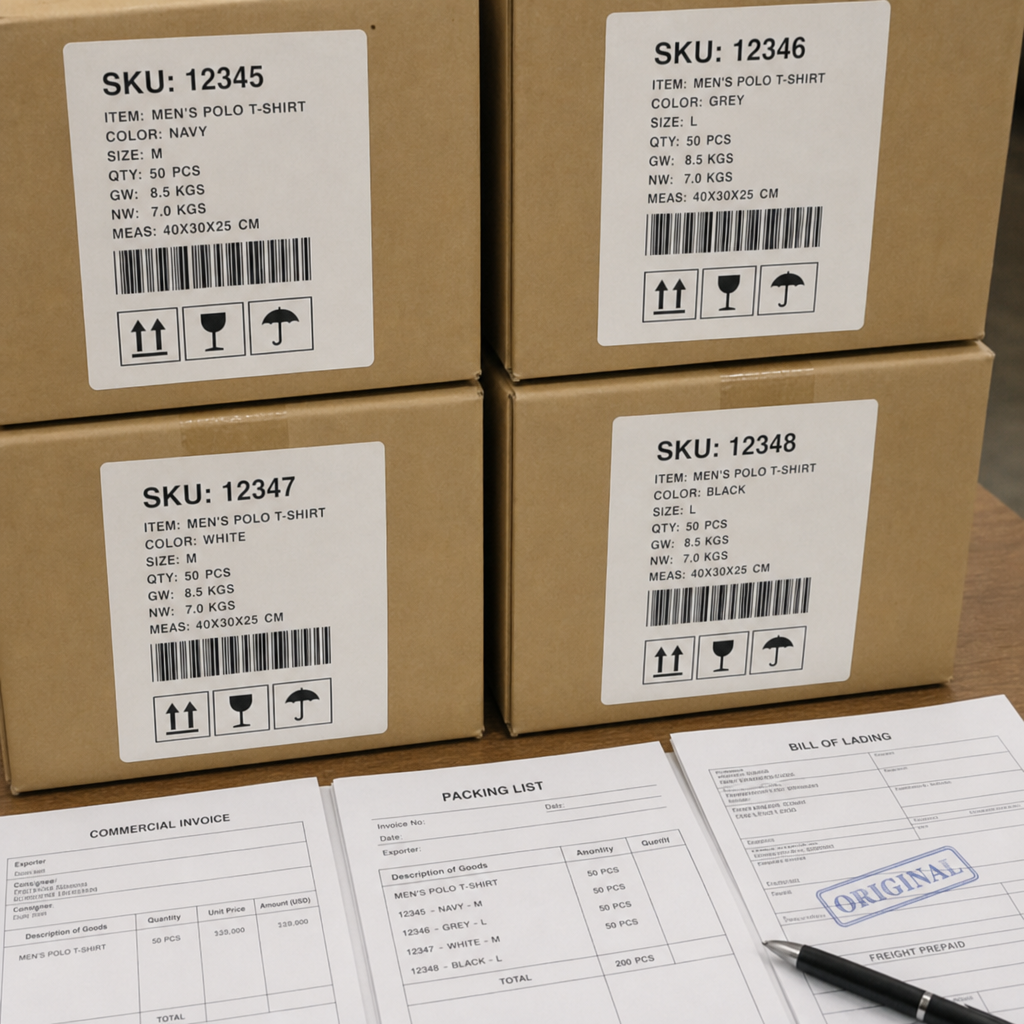
- Consolidate and label cartons. Make sure cartons are organized by SKU, supplier, quantity, and destination requirements.
- Arrange shipping and documents. Confirm invoice, packing list, freight method, consignee details, and customs support.
- Review performance after delivery. Note supplier reliability, defect rate, packaging quality, landed cost, and customer feedback before reordering.
This workflow may feel detailed, but it prevents the most common sourcing mistakes: unclear specs, rushed payments, unchecked goods, mismatched packaging, and shipping surprises.
Compliance and labeling should not be an afterthought
Yiwu is strong for product variety, but buyers still need to think carefully about compliance. Import rules vary by destination and product type. A toy, cosmetic brush, LED item, kitchen tool, textile, or electronic accessory may carry different labeling, safety, documentation, or testing expectations.
A sourcing agent can help collect supplier documents, confirm packaging text, arrange labels, or coordinate testing, but they should not be treated as a substitute for destination-market compliance advice. If you sell in the United States, the European Union, the United Kingdom, Canada, Australia, or any other regulated market, you need to understand the rules that apply to your product category. For higher-risk goods, work with qualified compliance professionals, customs brokers, or testing providers.
At minimum, discuss these points before ordering:
- Country-of-origin marking
- Barcode or SKU labels
- Warning labels and age grading when relevant
- Material composition labels for textiles
- Safety marks or certification needs for regulated products
- Retail packaging language
- Amazon FBA or marketplace carton requirements, if applicable
- Documentation requested by your customs broker
Small labeling mistakes can create delays, relabeling costs, or inventory that cannot be sold through your intended channel. Build compliance into the sourcing brief instead of trying to fix it at the warehouse.
When to move beyond agent-led sourcing
A Yiwu sourcing agent can be the right partner for a long time, especially if your business depends on mixed categories, seasonal buying, and frequent product discovery. However, your sourcing model may need to evolve as your volume grows.
The right time to change is when your product line becomes predictable enough that deeper supplier relationships, custom production, or factory-direct pricing matter more than market flexibility.
You might stay with an agent when you are testing many SKUs, buying from multiple booths, managing small batches, or relying on consolidation.
You might shift toward factory-direct sourcing when one product becomes a core seller, your specifications are stable, and your order volume gives you negotiating power. You might use an integrated sourcing and fulfillment platform when you need systems for inventory, order processing, supplier coordination, and shipping visibility.
This does not have to be an either-or decision. Many businesses keep a Yiwu agent for discovery and flexible wholesale sourcing while developing direct factory relationships for proven winners. That hybrid approach can protect experimentation while improving margins and control on products that deserve scale.
The final takeaway
Yiwu offers a powerful path into wholesale sourcing, especially for buyers who want variety, flexible testing, and access to China’s small-commodity supply ecosystem.
But the same scale that makes the market attractive also makes it difficult to navigate without structure. A capable Yiwu sourcing agent provides that structure by turning supplier search, negotiation, inspection, consolidation, and logistics into a clearer process.
Choose your agent with the same care you use to choose products. Look for local presence, transparent fees, written confirmations, practical inspection habits, and communication that makes decisions easier rather than more confusing. With the right partner and a disciplined workflow, yiwu sourcing agents can help you test smarter, import with fewer surprises, and build a more resilient sourcing operation.
Frequently Ssked Questions About Yiwu Sourcing Agents and the Sourcing Process
1. What is a Yiwu sourcing agent, and how can they help me?
A Yiwu sourcing agent is a local professional who assists international buyers in navigating the Yiwu market. They help with supplier identification, product inspections, negotiation, order consolidation, and logistics coordination, making the sourcing process more efficient and less risky.
2. How do I choose a reliable Yiwu sourcing agent?
When selecting a Yiwu sourcing agent, evaluate their local presence, transparency in communication, service scope, inspection capabilities, and fee structure. Look for agents who ask detailed questions about your sourcing needs and provide clear documentation of their services.
3. What are the costs associated with using a sourcing agent?
Costs can vary depending on the agent's services, order value, and product complexity. Agents may charge a percentage of the order value, a fixed service fee, or incorporate supplier margins into their pricing. It's essential to request a clear fee breakdown before engaging their services.
4. Can I still source products on my own without a Yiwu sourcing agent?
Yes, you can source products independently, especially if you have experience with supplier relationships and quality control. However, working with a Yiwu sourcing agent can provide local support, help you navigate the market effectively, and reduce risks related to language barriers and logistics.
5. What types of products can I source through Yiwu?
Yiwu is known for its wide range of small commodities, including accessories, home goods, stationery, toys, fashion items, packaging materials, and many everyday products. The variety available makes it an attractive option for buyers looking to test different product lines before committing to larger orders.