


Yiwu International Trade City is a wholesale marketplace in Yiwu, Zhejiang, China, where buyers can explore categories ranging from toys and jewelry to hardware, textiles, and household goods. Its specialist districts make it easier to focus your search rather than browse without direction.
This Yiwu market guide explains where to begin, how to prepare, and what to check before turning a promising product into an order.
What is Yiwu International Trade City?
China Yiwu International Trade City is a physical wholesale trading complex organized into product-focused districts. Buyers can visit supplier booths, examine merchandise, and discuss orders across numerous consumer-goods categories. Alongside its established districts, the Global Digital Trade Center represents a newer phase of development, with its market section opening on October 14, 2025.
Think of this international trade hub as a place to investigate sourcing possibilities, not simply collect low prices. Set your own buying criteria before entering: the product you need, the quality you expect, and the quantity your business can realistically sell. A useful visit should leave you with comparable quotations and clear next steps—not just a phone full of product photographs.
If you are visiting out of curiosity rather than sourcing commercially, choose one product area to explore. Give yourself permission to look closely instead of trying to see everything. For business buyers, the same principle applies: depth is more useful than a rushed circuit.
Which Yiwu market district should you visit?
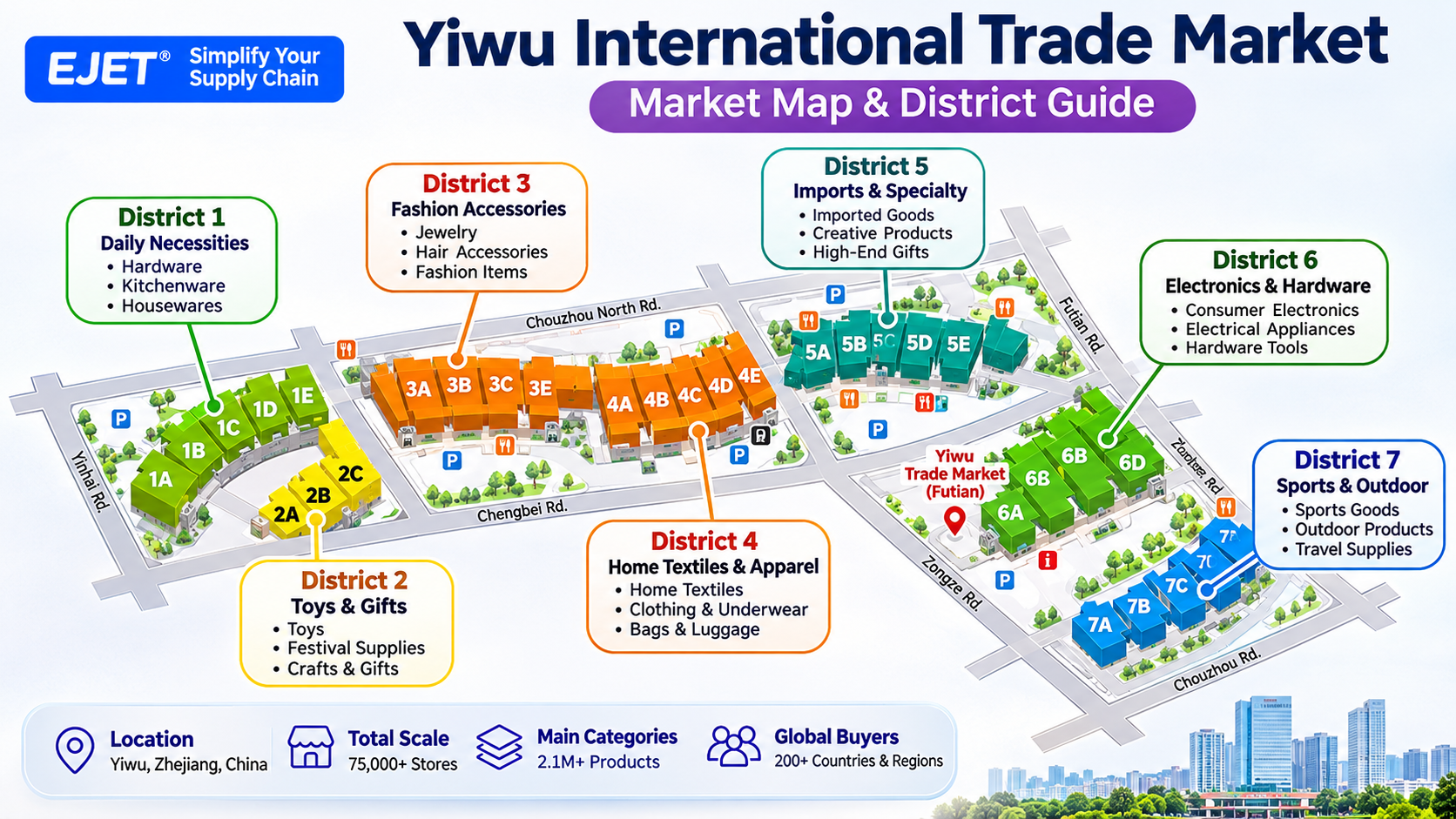
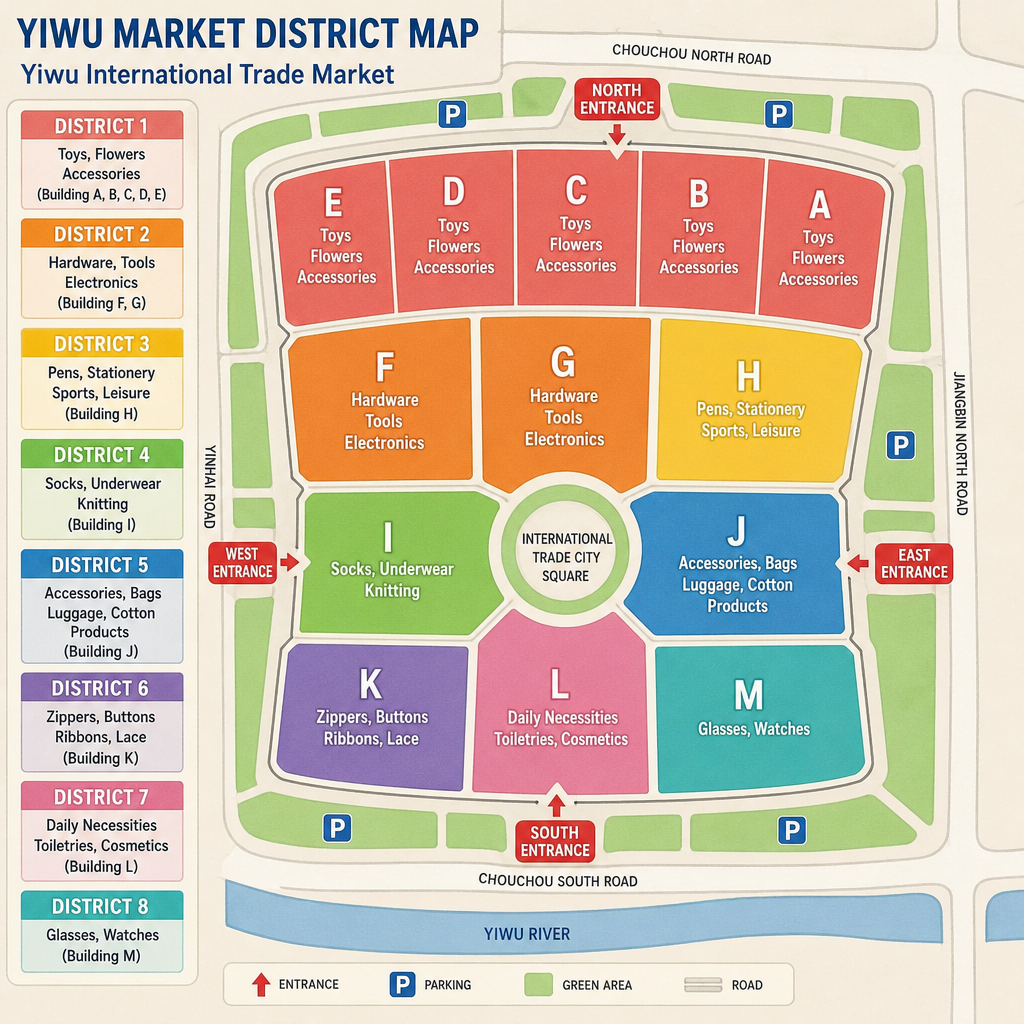
Start with the district that matches your main product category, then identify relevant floors and suppliers using the market directory. The Yiwu wholesale market groups many related goods together, but its directory also lists separate East sections and overlapping categories. Use the following overview as a starting point, then confirm individual booth locations before arranging meetings.
|
Market area |
Main categories to investigate |
|---|---|
|
Yiwu International Trade Market District 1 |
Toys, artificial flowers, hair ornaments, jewelry, festive crafts, and photo frames |
|
Yiwu International Trade Market District 2 |
Bags, luggage, umbrellas, tools, locks, electrical products, and small appliances |
|
Yiwu International Trade Market District 3 |
Stationery, office supplies, sports goods, eyewear, cosmetics, and garment accessories |
|
Yiwu International Trade Market District 4 |
Socks, hats, gloves, daily necessities, shoes, towels, underwear, and scarves |
|
Yiwu International Trade Market District 5 |
Imported goods, bedding, hair products, pet supplies, fabrics, and automotive products |
|
Yiwu International Trade Market District 6 |
Fashion jewelry, creative toys, fabrics, baby products, smart technology, drones, and robots |
These category groupings follow Yiwugo’s current market directory.
For a hypothetical gift-shop buying trip, begin by investigating District 1 rather than allocating equal time everywhere. If your buying list combines stationery and sports accessories, make District 3 your first research stop. Build your route around the merchandise, not the district numbers.
Understanding District 6 and the Global Digital Trade Center
Yiwugo identifies District 6 as the Global Digital Trade Center. Government reporting describes the development as the flagship of Yiwu’s sixth-generation market, combining a market with offices, commercial space, apartments, and a digital trade hub. Its opening marked an expansion into categories including creative toys and smart equipment.
Include this area when those categories fit your buying brief, rather than assuming the newest district must be your best starting point. Ask prospective suppliers for their current locati0n and meeting instructions. Keep the full building name in your appointment notes to avoid confusion.
Prepare a buying brief before you arrive
Before planning your visit to International Trade City Yiwu, write down what would make a product commercially worthwhile. A clear brief gives each supplier the same starting point and helps you reject unsuitable options without prolonged discussion. Include photographs or reference samples where useful, but describe the features that matter rather than relying on appearance alone.
Prepare these essentials:
- Product specifications: Record dimensions, materials, colors, finishes, and intended use. Separate essential requirements from optional preferences.
- Order expectations: Note your trial quantity, possible reorder needs, and whether you want mixed styles or colors.
- Packaging requirements: Describe retail presentation, labels, barcodes, and protective packing you want quoted.
- Commercial limits: Set a target budget and delivery window, while leaving room to investigate the complete shipment cost.
- Comparison sheet: Create fields for supplier identity, booth locati0n, product code, quotation, sample status, and unanswered questions.
Check opening arrangements directly with your intended suppliers before committing to travel dates. Confirm your transport and accommodation separately, using current information rather than an old itinerary. Save appointment details offline and keep a backup copy somewhere accessible.
For navigation, Yiwugo provides a market map and district listings. Use these to shortlist relevant locations, then ask each supplier to confirm the building, floor, booth, and convenient entrance.
How do you compare suppliers and negotiate effectively?
Compare suppliers against an identical written specification, then negotiate the whole order rather than the unit price alone. Ask each candidate to quote the same materials, quantity, packaging, and delivery expectations. Treat verification as a separate task: the U.S. Commercial Service emphasizes careful partner evaluation and due diligence when doing business in China.
Use this discussion checklist at each promising booth:
- Clarify who you are buying from. Ask for the registered business name, the party issuing the invoice, and who will manufacture or supply the goods.
- Confirm minimum quantities. Ask whether minimums apply to the complete order, each design, each color, or customized packaging.
- Inspect the exact specification. Record the material, dimensions, components, finish, and accessories included in the quotation.
- Separate samples from production. Ask whether the displayed item represents the proposed order and how an approved sample will be documented.
- Put commitments in writing. Request quotation validity, payment stages, production timing, inspection arrangements, and a proposed process for resolving defects.
When negotiating, try a specific request: “Please quote this item with standard packaging and with our proposed retail box.” That gives you a clearer decision than asking for a discount without defining the purchase. If a price changes, ask which specification or condition changed with it.
If you hire an interpreter or sourcing agent, define their scope before meetings begin. Request a written explanation of fees, any supplier commissions, and responsibility for follow-up. Keep your own copies of quotations, correspondence, and approvals.
Plan quality checks and shipping before ordering
Before paying a deposit, decide how you will establish that the finished goods match your requirements. Propose an approved reference sample, a written specification, and an inspection checklist. Include visible details such as color and packaging, alongside functional checks appropriate to the product.
For example, a bag-buying checklist could cover dimensions, stitching, zipper operation, strap attachments, and carton labeling. Ask the supplier to confirm which checks they will perform and what evidence they will provide. For unfamiliar products, seek qualified inspection or testing support rather than relying on appearance alone.
For U.S.-bound goods, importers must check applicable product-agency requirements; using a customs broker does not remove the importer’s responsibility for accurate entry information and applicable duties, taxes, and fees. Review the specific product with a qualified broker or relevant agency before ordering.
Build a shipment budget that asks about goods, packaging, inspection, inland transport, freight, insurance, customs charges, and final delivery. Obtain carton dimensions and weights for freight quotations. Request a written breakdown of included and excluded services, particularly when comparing a supplier’s shipping offer with a forwarder’s proposal.
Add a Yiwu trade fair visit when relevant
A Yiwu trade fair can complement market research, but it is a separate appointment on your itinerary. The China Yiwu International Commodities Fair–Export Goods Exhibition takes place at Yiwu International Expo Center and covers sectors including consumer goods, hardware, electronics, toys, sports goods, and office supplies. Consult the organizer’s current event information before arranging attendance.
Check the exhibitor list against your buying brief before adding a fair day. Reserve separate time for market appointments and follow-up discussions. Keep fair contacts and market-booth contacts clearly labeled so you can reconstruct where each quotation originated.
Leave with a shortlist, not just souvenirs
The most useful outcome is a manageable shortlist of suppliers you can evaluate further. Match products to districts, document comparable offers, and resolve quality and shipping questions before placing orders. Start with one focused buying objective, then expand only when your notes, budget, and verification process support the next step.
Frequently Asked Questions About Yiwu International Trade City
What is Yiwu International Trade City?
Yiwu International Trade City is a large wholesale marketplace in Yiwu, Zhejiang, China, organized into various product-focused districts, allowing buyers to explore a wide range of goods, from toys and textiles to electronics and household items.
How do I navigate the districts within Yiwu International Trade City?
Each district is dedicated to specific product categories. It is advisable to start with the district that aligns with your main product interest and use the market directory to pinpoint suppliers and locations within that district.
What should I prepare before visiting Yiwu International Trade City?
Before your visit, create a buying brief that includes product specifications, order expectations, packaging requirements, and a comparison sheet for potential suppliers to ensure an efficient sourcing process.
How can I effectively compare suppliers at Yiwu International Trade City?
When comparing suppliers, use an identical written specification for all quotes, focus on the overall order rather than just the unit price, and make sure to document all commitments in writing to avoid misunderstandings.
Are there trade fairs held at Yiwu that I can attend?
Yes, the China Yiwu International Commodities Fair is held at the Yiwu International Expo Center and covers various sectors such as consumer goods and hardware. Attending trade fairs can complement your market research but should be scheduled separately from market visits.