Yiwu, China, is a wholesale sourcing destination for buyers exploring products such as accessories, gifts, stationery, household goods, and textiles.
Its International Trade Mart groups merchandise by category, giving buyers a practical starting point for supplier research.
This guide explains how to plan your visit, compare offers, verify suppliers, and prepare an order for shipment without letting a low purchase price distract from quality or import responsibilities.
Is Yiwu the right sourcing destination for your business?
Yiwu deserves consideration when your buying list overlaps with the consumer-product categories listed in its market directories.
Start by matching your intended assortment to those categories, then investigate whether individual suppliers can meet your specifications, quantities, and destination-market requirements.
The directory establishes where to look; it does not establish whether a particular supplier is suitable.
Before committing to business in Yiwu, define what a successful first order must achieve. Are you testing a small assortment, replacing an unreliable supplier, or developing branded packaging?
Give each goal measurable acceptance criteria, but avoid committing your entire purchasing budget before samples and costs are confirmed.
For highly customized products, ask potential suppliers to explain their development process before arranging meetings. Request a realistic sequence covering drawings, samples, revisions, production approval, and inspection.
Treat unanswered technical questions as reasons to investigate further, not details to resolve after paying.
Build your buying plan before booking travel
Create a sourcing brief that another person could use without guessing. Include product photographs or drawings, dimensions, materials, intended use, packaging, order quantities, and the country where you will sell.
Separate essential specifications from preferences so negotiations do not accidentally remove a feature your customers need.
Use this preparation checklist:
- Define your assortment: Assign each intended product a reference code and purchasing priority.
- Set commercial limits: Record your target landed cost, maximum inventory commitment, and required arrival date.
- Prepare comparison questions: Ask every shortlisted supplier about the same specifications, quantities, packaging, and delivery basis.
- Create a sample register: Leave space for supplier identity, booth locati0n, sample cost, and approval status.
- Reserve decision time: Keep part of your schedule for revisiting suppliers rather than filling every hour with new introductions.
Check entry requirements through official channels for your nationality and travel purpose before purchasing nonrefundable tickets. Confirm market access and supplier availability for your intended dates rather than assuming every business will be operating normally. Keep your hotel address, meeting locations, and supplier contacts available offline.
Use a category-led Yiwu shopping guide
A useful Yiwu shopping guide should help you reach relevant suppliers, not encourage aimless browsing. The official Yiwugo platform provides market categories, shop listings, and a market map. Use those tools to build a shortlist, then confirm each supplier’s current locati0n before your visit.
These established district categories offer starting points rather than a complete map of every market area:
|
Market area |
Examples of listed categories |
What to prepare |
|---|---|---|
|
District 1 |
Toys, artificial flowers, jewelry, festive crafts |
Material requirements, dimensions, intended users |
|
District 2 |
Bags, umbrellas, hardware, small appliances |
Construction details, performance requirements, packaging |
|
District 3 |
Stationery, sports goods, cosmetics, garment accessories |
Exact materials, intended use, labeling questions |
|
District 4 |
Socks, hats, gloves, shoes, scarves |
Size ranges, fabric specifications, color assortment |
|
District 5 |
Bedding, textiles, automotive accessories, pet products |
Measurements, compatibility details, packaging needs |
The categories above follow the published Yiwu Fair market directory; verify the current floor and booth for each appointment.
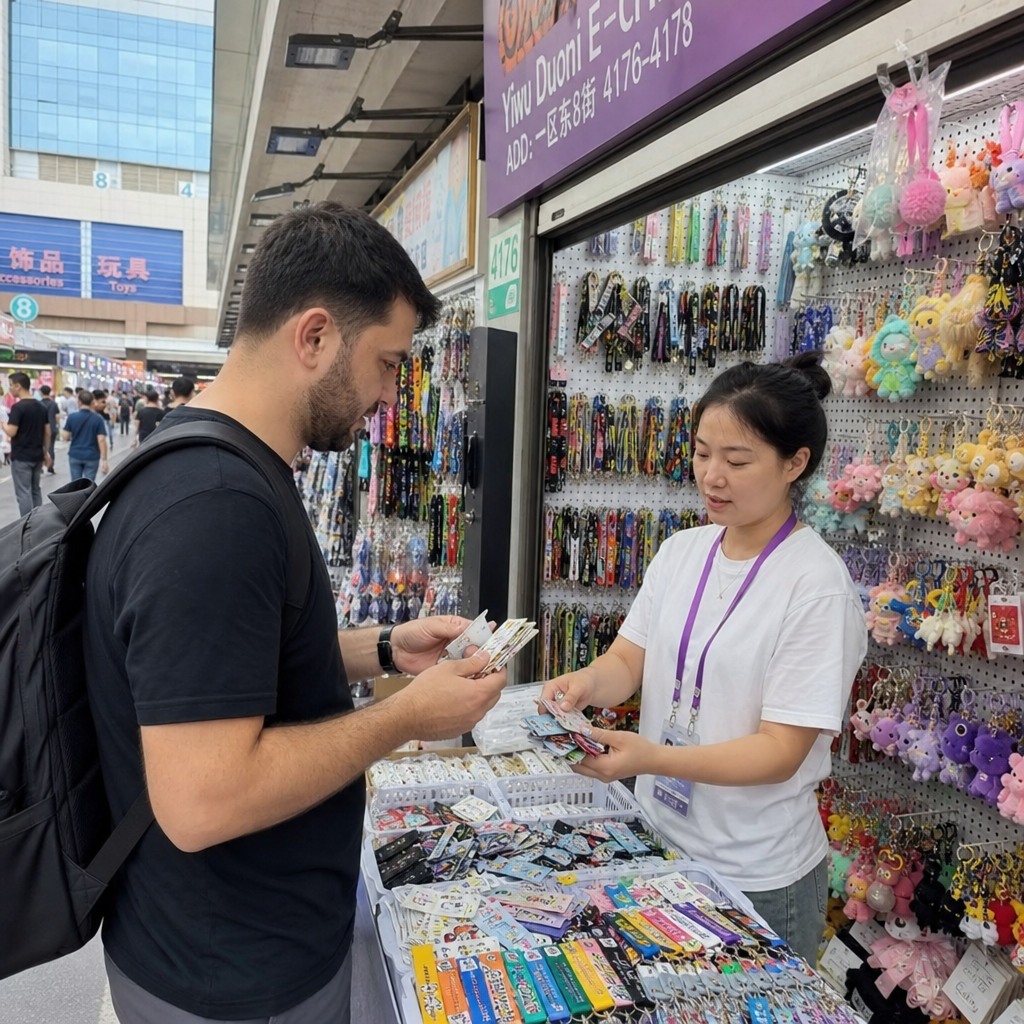
Group appointments by locati0n and product type. After each meeting, photograph permitted samples alongside your reference code and record the quotation immediately. At the end of the day, shortlist suppliers while the differences are still clear.
Verify the supplier behind the display
Before placing an order, investigate the business that will actually contract with you. The China-Britain Business Council recommends checking registration information, business licenses, and references when assessing potential partners. Its sourcing guidance also cautions that using an agent does not remove the buyer’s technical and commercial risks.
Ask whether your contact represents a manufacturer, trading business, or another intermediary. Do not treat the answer alone as a quality ranking; instead, establish who controls production, approves changes, and resolves defects. Request the legal business name and identify the entity that will appear on your contract and invoice.
For a first transaction, consider requesting:
- A business-license copy and an explanation of any differences between trading names and legal names.
- References relevant to your product category, where available.
- Production-locati0n details and permission for an appropriate verification visit or independent assessment.
- Written identification of the contracting party, exporter, and payment beneficiary.
If you hire a sourcing agent, define the assignment before work begins. Request a written fee schedule covering sourcing, translation, inspections, warehousing, and shipping coordination. Ask the agent to disclose supplier commissions and clarify who retains access to supplier records.
How do you compare quotations without buying the wrong product?
Compare quotations against one written specification, one quantity breakdown, and one delivery basis. Ask suppliers to identify every assumption and exclusion, then evaluate the complete offer rather than the unit price alone. Reject comparisons where one quotation includes packaging or transport that another leaves out.
Build a comparison sheet with columns for material, dimensions, finish, packaging, minimum order quantity, production lead time, payment milestones, and inspection arrangements. Request minimum quantities by individual design, color, and size—not simply a total order minimum. Ask suppliers to distinguish available stock from goods requiring production.
For example, if you are comparing cosmetic bags, specify the fabric, lining, zipper, dimensions, print placement, and packing method. Ask each supplier to quote that same configuration. If a lower-priced option changes a material or construction detail, record it as a separate alternative rather than calling it an equivalent offer.
Negotiate scope as carefully as price. Ask whether simpler packaging, fewer variants, or a different order schedule would produce a better fit for your budget. Keep concessions in writing so a price reduction does not quietly become a specification change.
Turn approved samples into an inspection standard
Use the approved sample as a reference, then document the characteristics that matter. Record dimensions, materials, color references where appropriate, artwork, packaging, and functional checks. Ask the supplier to acknowledge this specification before production, and retain an identified reference sample yourself.
Write an inspection brief that answers practical questions:
- Which defects would make the goods unacceptable?
- What measurements and functional checks should the inspector perform?
- Which labels, barcodes, accessories, and quantities must be present?
- How should cartons be marked and packed?
- What happens if the shipment fails the agreed checks?
Arrange inspection timing and access before placing the order. Agree how findings will be reported, who authorizes rework, and when a repeat inspection is needed. Do not allow an approaching shipping deadline to become the only acceptance criterion.
Keep quality inspection separate from regulatory compliance. For U.S. children’s products subject to applicable safety rules, CPSC guidance explains testing and certification responsibilities, including the importer’s role in issuing the Children’s Product Certificate. A foreign supplier’s certificate cannot simply be passed along as the importer’s own.
Calculate landed cost before approving the order
Build your purchasing decision around the cost of receiving saleable goods, not merely buying them. For internal planning, include the product price, packaging, origin handling, freight, insurance, applicable duties and taxes, clearance, destination delivery, inspections, and testing.
Add an explicitly labeled contingency rather than hiding uncertainty inside your expected margin.
Ask your forwarder and customs broker to review the shipment assumptions before you commit. Provide accurate product descriptions, materials, intended use, quantities, carton dimensions, and weights. Request a breakdown of included services, exclusions, and charges that depend on events such as storage or examination.
Record the agreed Incoterms® rule, named place, and version in the purchase contract. ICC explains that these rules allocate obligations, costs, and the point at which transport risk transfers, but they do not replace a sales contract. Avoid treating “shipping included” as an adequate description of either party’s responsibilities.
For U.S. imports, confirm classification and applicable charges with a licensed customs broker rather than relying on a supplier’s estimate. CBP places reasonable-care responsibilities on the importer for entry information, including classification and valuation. Recheck your assumptions before shipment instead of treating an early costing exercise as final.
Prepare export documents and destination requirements together
A practical China export guide must address both departure paperwork and the requirements where the goods will arrive. Common trade documents include the commercial invoice, packing list, and transport document; additional documentation depends on the shipment and destination.
The U.S. International Trade Administration recommends establishing document requirements with the importer or freight forwarder early in the transaction.
Keep shipment records consistent
Ask your forwarder to identify the document set needed for your particular order. Compare product descriptions, quantities, weights, business identities, and package counts across the draft records. Resolve discrepancies before documents are finalized rather than expecting the receiving broker to interpret conflicting information.
Prepare a shared shipment checklist covering:
- Commercial invoice: Confirm the seller, buyer, goods description, transaction value, and currency.
- Packing list: Check carton quantities, contents, weights, dimensions, and shipping marks.
- Transport document: Verify shipper, consignee, routing, and shipment references with the forwarder.
- Additional evidence: Establish whether certificates, permits, or product-specific records are required.
Invoice and packing-list details should align, and a packing list does not replace the commercial invoice. Documentation requirements can extend beyond these standard records.
Check compliance before dispatch
For goods entering the United States, CBP advises importers to meet other agencies’ requirements and obtain permits or licenses where required. Depending on the goods, those agencies can include CPSC, FDA, or others. Use the exact product and intended use when requesting professional guidance.
Do not accept “we export this everywhere” as your compliance plan. Request evidence relevant to the exact item, and ask an appropriate specialist to identify gaps before production. For children’s products requiring third-party testing, confirm that the laboratory is CPSC-accepted for each applicable test method.
Make the first order a controlled learning exercise
For your first purchase from Yiwu, China, choose an assortment you can inspect, document, and finance without overextending your business. Keep enough detail in your records to explain why a supplier was selected and what was approved.
After delivery, compare actual landed cost, product condition, and supplier responsiveness against your original assumptions.
Reorder only after reviewing what worked and correcting what did not. The objective is not to leave the market with the most products or the lowest quoted price. It is to build a repeatable buying process that connects clear specifications, accountable suppliers, acceptable goods, and manageable delivery costs.
Frequently Asked Questions About Yiwu China Business Guide for Buyers
What products can I find in Yiwu?
Yiwu is known for a wide variety of products, including accessories, gifts, stationery, household goods, textiles, toys, and more. The International Trade Mart categorizes these products, making it easier for buyers to find what they need.
How do I verify the credibility of suppliers in Yiwu?
To verify suppliers, check their registration information, business licenses, and request references relevant to your product category. Always confirm who will be your main point of contact for production and quality control.
What should I prepare before traveling to Yiwu?
Before your trip, create a detailed sourcing brief that includes product specifications, target costs, and a list of potential suppliers. Make sure to check entry requirements for your nationality and travel purpose.
How can I compare quotations effectively?
To compare quotes accurately, use a standardized comparison sheet that details specifications, quantities, and conditions for each quotation. Ensure that all suppliers are quoting on the same basis, including packaging and shipping terms.
What are the export documentation requirements when shipping from China?
Common export documents include the commercial invoice, packing list, and transport document. It’s essential to establish document requirements with your importer or freight forwarder early in the transaction to avoid issues at the border.