








Lululemon is a Vancouver-born performance apparel brand, but its products are made through a global supplier network rather than in company-owned factories.
The short answer is that most lululemon manufacturing takes place in Asia, especially Vietnam, Cambodia, Sri Lanka, Indonesia, and Bangladesh, while many of its fabrics originate from Taiwan, China Mainland, South Korea, and Vietnam.
Understanding that split—where garments are sewn versus where fabrics are produced—helps explain lululemon locations, lululemon quality, lululemon materials, and the questions shoppers ask about lululemon ethics.
Where Is Lululemon Made?
lululemon says it does not own or operate manufacturing facilities; instead, it works with suppliers that make finished products and separate suppliers that provide fabrics.
In fiscal 2025, the company reported that about 40% of its products were manufactured in Vietnam, 18% in Cambodia, 11% in Sri Lanka, 11% in Indonesia, and 7% in Bangladesh, with the rest made in other regions.
So if you are asking “Where Is Lululemon Made?” or “where is lululemon clothes made,” the most accurate answer is: mostly in a group of Asian manufacturing hubs, not in Canada or the United States.
That answer can feel surprising because lululemon’s brand identity is strongly tied to Vancouver, design, community, and premium retail. But brand headquarters and retail presence are not the same thing as factory location.
lululemon’s public filings describe the business as a designer, distributor, and retailer, while the actual cut-and-sew production is handled by vendors in its supply chain.
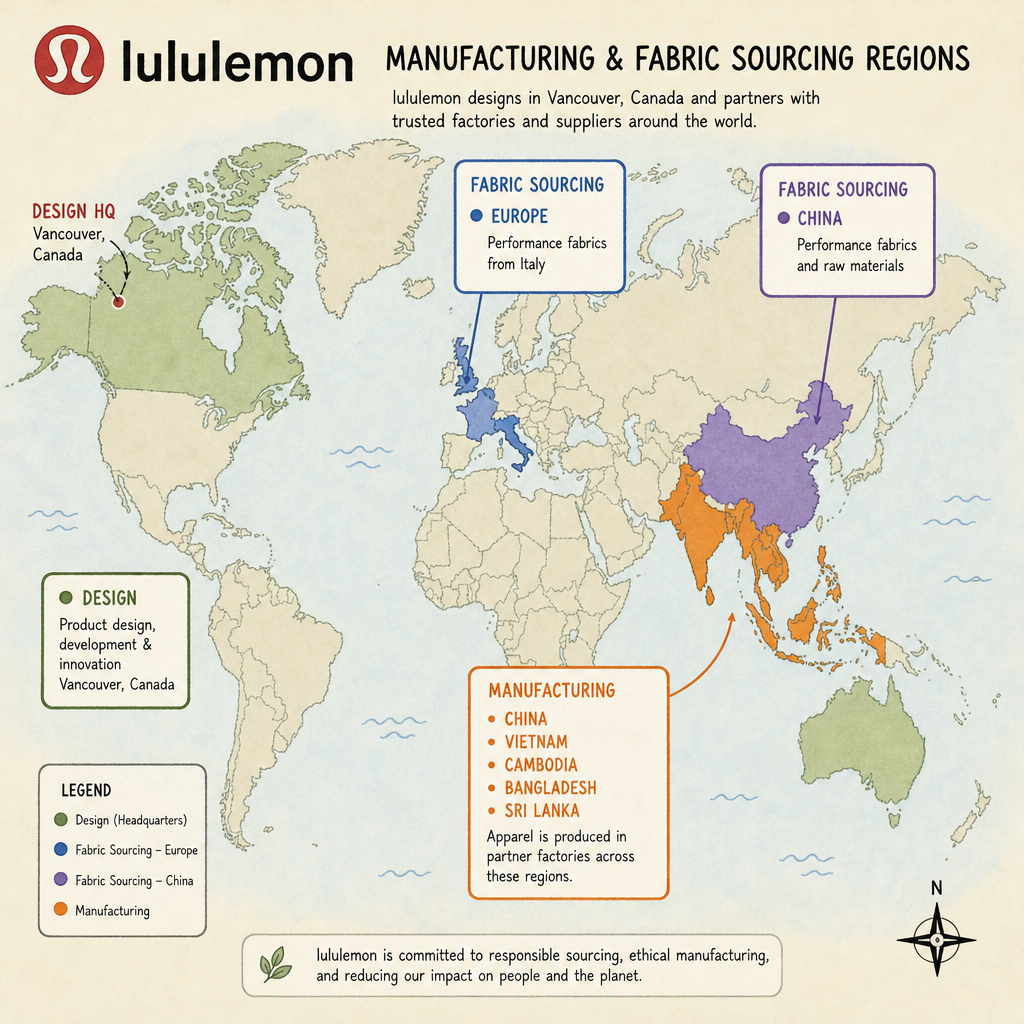
The difference between manufacturing, fabric sourcing, and retail locations
A lot of confusion starts with the word “locations.” lululemon locations can mean stores, offices, distribution centers, product manufacturers, fabric mills, subcontractors, or raw material sources.
Those are connected, but they are not interchangeable. A pair of leggings might be designed by lululemon, made from fabric produced in one country, sewn in another, distributed through a regional logistics network, and sold in a store or online market somewhere else entirely.
In its 2025 Modern Slavery Statement, lululemon reported 811 company-operated stores and approximately 39,000 employees worldwide as of February 1, 2026. The same statement separates those retail operations from its supply chain, noting that lululemon relies on product suppliers for fabrics, materials, and manufacturing.
Here is a simple way to read the supply chain:
|
Supply chain layer |
What it means |
Why it matters to shoppers |
|---|---|---|
|
Brand and design |
lululemon creates product direction, performance specifications, and retail experience |
Explains why the brand can feel consistent even when products are made by different suppliers |
|
Tier 2 fabric suppliers |
Facilities that produce or finish materials |
Influences handfeel, stretch, opacity, moisture management, and durability |
|
Tier 1 manufacturers |
Facilities that manufacture finished products |
Influences construction, stitching, fit consistency, and finishing |
|
Distribution and retail |
Warehouses, online channels, and stores |
Influences availability, returns, repairs, and guest experience |
This is why “where is lululemon manufactured” has more than one layer. If the question is about final assembly, the answer points mainly to Vietnam, Cambodia, Sri Lanka, Indonesia, and Bangladesh. If the question is about lululemon materials and fabrics, the answer shifts toward Taiwan, China Mainland, South Korea, Vietnam, and other sourcing regions.
The main countries in lululemon manufacturing
lululemon’s manufacturing footprint reflects a broader activewear industry pattern: technical apparel is often produced in countries with established textile, sewing, finishing, and export infrastructure. The company does not publish a product-by-product factory breakdown on every retail page, but its annual reporting gives a useful country-level picture based on cost.
Vietnam is the largest reported production base
Vietnam was lululemon’s largest reported product manufacturing country in fiscal 2025, accounting for about 40% of product manufacturing by cost. That does not mean every product from Vietnam is the same; it simply means Vietnamese supplier facilities represent the largest share of lululemon’s finished-goods production.
For shoppers, the practical takeaway is that a “Made in Vietnam” label on lululemon gear is normal and consistent with the company’s disclosed sourcing footprint.
Vietnam’s role also shows why modern performance apparel supply chains are built around specialization. Technical tops, leggings, outerwear, and accessories can require different equipment, trims, finishing processes, and quality checks. A large sourcing country may support many product types, but lululemon still relies on supplier qualification and product-specific standards rather than country reputation alone.
Cambodia, Sri Lanka, Indonesia, and Bangladesh also play major roles
Cambodia represented about 18% of lululemon product manufacturing in fiscal 2025, while Sri Lanka and Indonesia each represented about 11%, and Bangladesh represented about 7%. Together with Vietnam, these five countries made up the majority of lululemon’s disclosed finished-goods manufacturing footprint.
These countries are not merely low-cost sewing destinations in a generic sense. Many global apparel brands use them because they have established garment production ecosystems, experienced workforces, port access, and supplier networks that can handle large seasonal programs.
Still, country-level information is only a starting point. The factory, the buyer’s standards, the product requirements, and the monitoring system all matter when assessing lululemon quality and lululemon ethics.
Other regions round out the network
lululemon also reports that the remainder of its products are made in “other regions,” and its supplier list can change as production needs change. In its 2025 Modern Slavery Statement, the company says its supplier list evolves with seasonality and production, and that the latest list referenced active supplier facilities used by lululemon as of May 2026.
That seasonality matters. Apparel brands introduce new colors, silhouettes, fabrics, and categories throughout the year. A supplier network has to flex around those shifts, which is one reason a single static answer to “where is lululemon manufactured” can become outdated.
Why are lululemon materials sourced separately from clothing production?
lululemon materials are sourced separately because fabric creation and garment assembly are different stages requiring different expertise. In fiscal 2025, lululemon reported working with approximately 65 fabric suppliers; 34% of its fabrics originated from Taiwan, 29% from China Mainland, 10% from South Korea, and 10% from Vietnam, with the remainder from other regions.
That separation is especially important in technical athletic apparel. The fabric has to stretch, recover, resist abrasion, manage sweat, hold color, and feel good against skin.
The garment factory then has to cut, sew, bond, finish, and inspect that material without undermining its performance. A great fabric can disappoint if construction is poor, and a well-sewn garment can still fail expectations if the material is not right for the activity.
lululemon’s own reporting says its product development team works with suppliers to incorporate technical innovation and advanced fabric specifications. It also says independent inspection, verification, and testing companies test fabric performance characteristics such as pilling, shrinkage, abrasion resistance, and colorfastness.
The role of proprietary fabrics in lululemon quality
Part of lululemon’s brand strength comes from how it markets fabric experiences: soft, compressive, lightweight, brushed, slick, supportive, or sweat-wicking. Product names and fabric families can make the clothes feel distinct, but behind the branding are material choices such as nylon, polyester, cotton, elastane, and blends engineered for particular use cases.
The company’s 2024 Impact Data & Indices Supplement reported that polyester, nylon, and cotton were its largest material categories by share of sourced materials: polyester at 33%, nylon at 30%, and cotton at 18%. The same disclosure reported preferred-material progress within categories, including 77% recycled polyester, 11% recycled or renewable nylon, and 78% preferred cotton for 2024.
For shoppers, the most useful lens is not simply “natural versus synthetic.” Many lululemon products are performance pieces, and synthetics are often used because they can offer stretch, recovery, sweat management, and a smooth handfeel.
The tradeoff is that synthetic fibers are typically tied to fossil-fuel-based inputs, which is why material innovation, recycling, renewable inputs, and longer product life all matter in the sustainability conversation. lululemon has acknowledged that many of its products are made from nylon and polyester and has described work on recycled fibers, renewable bio-based inputs, and lower-impact production techniques.
What this means when you check a garment label
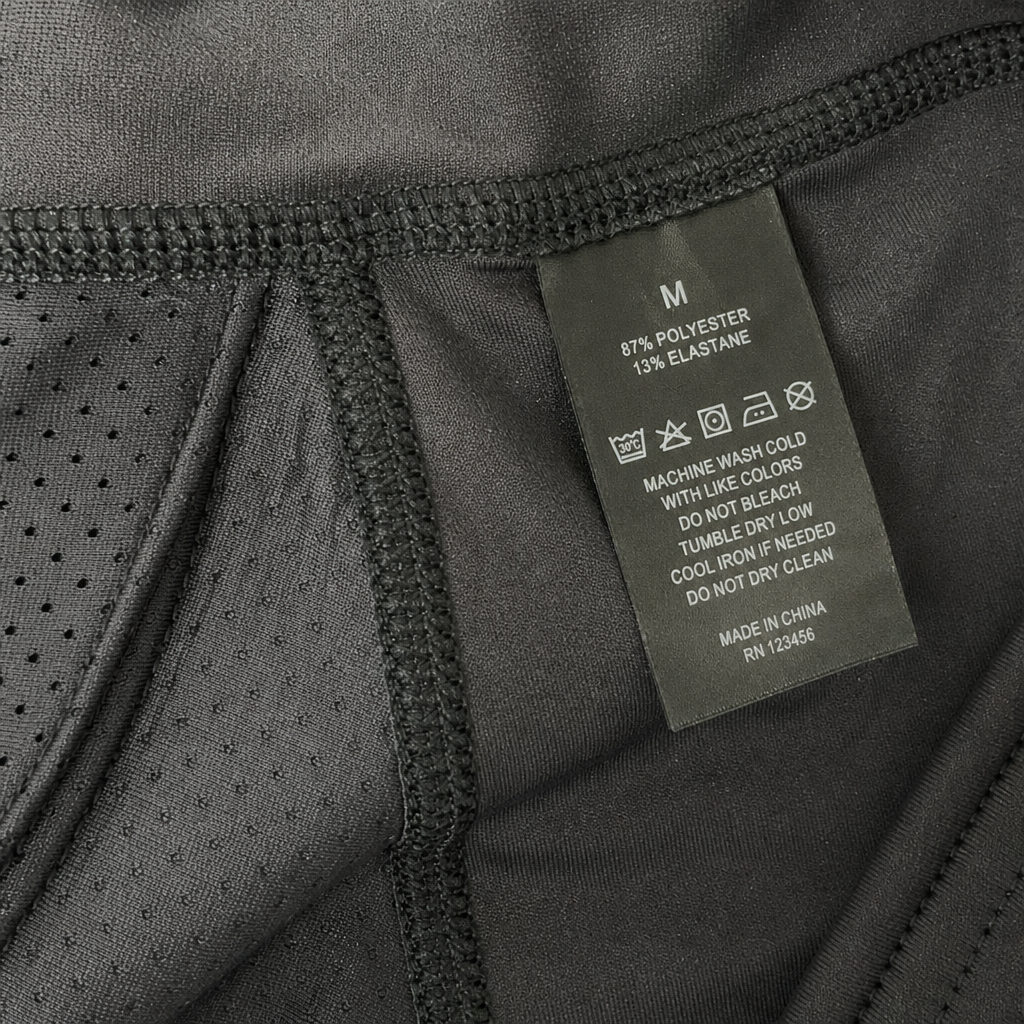
A lululemon garment label can tell you the final country of manufacture and fiber content, but it usually will not tell the full supply chain story. It may say the item was made in Vietnam, for example, while the fabric originated elsewhere. It may list nylon and elastane, but not the mill, dyeing process, or every chemical-management step used in production.
When evaluating a product, look at the label as one piece of evidence:
- Country of manufacture: This typically refers to where the finished garment was made.
- Fiber content: This tells you what the garment is made from, such as nylon, polyester, cotton, elastane, or blends.
- Care instructions: These are important for protecting stretch, shape, color, and surface finish.
- Product purpose: A running tight, yoga pant, commuter pant, and fleece hoodie are built for different expectations.
- Feel and construction: Seams, gussets, waistband structure, opacity, and recovery often matter as much as fiber content.
lululemon quality depends on both standards and execution
lululemon quality is not the result of one factory locati0n. It is the combined outcome of design specifications, material development, supplier selection, testing, production controls, and customer feedback. A premium brand can set detailed expectations, but the final product still depends on execution across multiple suppliers and production runs.
The company says identifying a suitable supplier requires satisfaction with quality control, responsiveness, service, financial stability, and labor and ethical practices. It also notes that changing or adding suppliers can take time because suppliers and manufacturers must be trained in lululemon’s methods, products, and quality control standards.
That helps explain why supply chain concentration is both useful and risky. Working with established vendors can support consistency, but relying on a limited supplier base can create exposure if capacity, costs, labor conditions, geopolitical issues, or disruptions change. lululemon reported in fiscal 2025 that five product vendors produced 47% of its products, with the largest producing 15%.
For consumers, the best way to judge quality is product-specific. One person may love a soft yoga fabric that another person finds too delicate for high-friction training.
A fabric that feels luxurious for lounging may not be the best choice for barbell knurling, trail abrasion, or repeated backpack wear. Matching the garment to the activity is often the difference between “this holds up beautifully” and “this wore out too fast.”
What does lululemon ethics mean in its supply chain?
lululemon ethics refers to the company’s stated standards for labor rights, responsible sourcing, supplier monitoring, chemical management, and environmental progress—not a guarantee that every risk disappears.
The company says its Responsible Supply Chain program is designed to advance fair labor practices and worker wellbeing, and its 2025 Modern Slavery Statement identifies forced labor, human trafficking, and child labor as risks it seeks to address in the product supply chain.
The company’s supplier-assessment page says new suppliers must meet an approval process that evaluates labor, environmental, sourcing, quality, and production factors at the facility level.
It also says Tier 1 and Tier 2 supplier facilities are assessed against lululemon’s Vendor Code of Ethics requirements and that assessments may include on-site inspections, document reviews, and interviews with management and workers.
This is important because ethical manufacturing is not only about where a product is made. It is about recruitment practices, wages, working hours, freedom from forced labor, safety, transparency, subcontracting controls, grievance systems, and remediation when issues are found. Public disclosures can help shoppers understand a brand’s systems, but they should not be treated as a substitute for independent scrutiny or ongoing improvement.
Supplier oversight in practice
lululemon says its Vendor Code of Ethics is part of supplier agreements and that subcontractors must be approved. Its assessment approach includes regular assessments of Tier 1 and Tier 2 facilities, with follow-up assessments possible when non-compliance or grievances are identified.
A practical way to read this is to separate policy, monitoring, and outcomes:
- Policy: What standards does the brand set for suppliers?
- Monitoring: How often are facilities checked, by whom, and by what method?
- Remediation: What happens when the brand finds a problem?
- Transparency: How much information is shared publicly, and how often is it updated?
- Progress: Are goals being met, missed, revised, or expanded over time?
lululemon’s FY25 Impact Report announcement said more than 102,000 workers participated in supply chain wellbeing programs between 2021 and 2025, and core Tier 1 and Tier 2 suppliers collectively achieved 33% renewable electricity against a 25% goal.
Those are company-reported figures, and the renewable electricity disclosure notes that supplier-reported data is largely verified through the Higg Facility Environmental Module verification program.
Chemical management is part of the manufacturing story
When people ask where lululemon is made, they often focus on geography. But manufacturing quality also includes chemistry: dyes, finishes, water repellents, processing aids, and restricted substances. These details are less visible than a country-of-origin label, yet they matter for product safety, compliance, performance, and sustainability.
In 2026, lululemon stated that it does not use PFAS in products today and that it maintains a Restricted Substances List based on worldwide regulatory standards. The company also says vendors must conduct restricted-substance testing through credible third-party agencies, including for PFAS, to confirm ongoing compliance.
This does not mean every shopper needs to become a textile chemist. It simply means the best view of lululemon manufacturing includes both the physical production locati0n and the standards applied to materials, finishes, and testing. For performance clothing, quality is not just how a product looks on day one; it is how it performs after sweat, washing, stretching, friction, and time.
How shoppers can interpret “Made in” labels
A “Made in” label is useful, but it is not a complete scorecard. It tells you the country of final substantial transformation, not necessarily where the yarn was spun, where the fabric was knitted or woven, where it was dyed, or where trims were sourced. lululemon’s own disclosures show why this distinction matters: finished products and fabrics have different country distributions.
Use this quick checklist when you are comparing lululemon products:
- Check the country label, but do not overread it. A country can host excellent and poor factories; standards and oversight matter.
- Read the fiber content. Nylon-heavy pieces often feel different from polyester-heavy or cotton-blend pieces.
- Match fabric to activity. Soft yoga fabrics may not be ideal for rough outdoor use, while abrasion-resistant training fabrics may feel less buttery.
- Inspect construction. Look at seam smoothness, pocket reinforcement, waistband recovery, and hems.
- Follow care instructions. Heat, rough washing, and fabric softener can shorten the life of technical apparel.
- Use repair, resale, or support options where available. lululemon reported repair or resale opportunities in 65% of global markets and more than 69,000 products repaired for guests during FY25.
The bigger picture behind lululemon’s global supply chain
lululemon’s manufacturing network reflects the reality of modern performance apparel: design and brand control may sit in one place, while materials, components, assembly, logistics, and retail span many countries.
That complexity can support technical innovation and global scale, but it also creates accountability challenges. The more stages in a supply chain, the more important transparency, supplier relationships, testing, and remediation become.
For shoppers, the key is to move beyond a single-country assumption. Asking “where is lululemon clothes made” is a good starting point, but a fuller question is: Who makes the product, where does the fabric come from, what standards apply, how is quality tested, and what happens when problems are found? lululemon’s public disclosures provide useful answers at the country and program level, even though they do not reveal every detail behind every individual item.
Final takeaway
lululemon is not made in one place. Most finished products are manufactured in Vietnam, Cambodia, Sri Lanka, Indonesia, and Bangladesh, while many fabrics come from Taiwan, China Mainland, South Korea, and Vietnam.
The company’s premium positioning depends not on a single manufacturing country, but on how well its design, materials, supplier standards, testing, and ethical programs work together.
If you are buying lululemon, treat the country label as one clue—not the whole story. The smarter way to assess a piece is to consider the intended activity, fabric composition, construction, care requirements, and the brand’s broader supply chain disclosures.
That approach gives a clearer view of where lululemon is made and what its global manufacturing model means for quality, materials, and ethics.
Frequently Asked Questions About Lululemon's Global Manufacturing Locations
Where is Lululemon clothing made?
Lululemon products are primarily manufactured in Asia, with Vietnam being the largest production base. Other significant countries include Cambodia, Sri Lanka, Indonesia, and Bangladesh.
What materials does Lululemon use in their products?
Lululemon sources various materials for its clothing, primarily including polyester, nylon, and cotton. Many of their fabrics are produced in Taiwan, China Mainland, South Korea, and Vietnam.
What does Lululemon do to ensure ethical manufacturing?
Lululemon has a Responsible Supply Chain program that focuses on fair labor practices and worker well-being. They assess their suppliers based on labor rights, environmental standards, and ethical sourcing.
How does Lululemon maintain product quality across different manufacturing locations?
Lululemon maintains product quality by setting detailed design specifications, working closely with suppliers, and conducting rigorous testing and quality control throughout the manufacturing process.
What is the significance of the "Made in" label on Lululemon products?
The "Made in" label indicates the country where the final product was assembled but does not provide information about where the fabrics or materials were sourced. It's essential to consider both the label and the overall supply chain for a complete understanding of the product's origin.