












A telegraphic transfer is an electronic payment instruction used to move money between financial institutions, commonly for overseas bank payments. Understanding the payment route, exchange rate, fees, and recipient requirements helps you judge both the cost and likely delivery time.
This guide explains how the process works and what to check before sending money.
What is a telegraphic transfer?
A telegraphic transfer, often abbreviated to TT or T/T, is a bank-arranged electronic transfer that instructs another financial institution to pay a beneficiary. The receiving institution may be reached directly or through intermediary banks. In practical terms, the meaning of telegraphic transfer is a payment sent through financial institutions rather than a physical movement of cash.
For someone asking “what’s telegraphic transfer?”, the simplest answer is an electronic bank payment, usually discussed in an international context. However, the label alone does not establish the payment network, delivery speed, or total cost. Ask the provider which service it will use and what the recipient should expect.
The distinction matters when comparing a TT with another money transfer option. Two services may both deliver money to an overseas account while using different arrangements and charging differently. Compare the actual payment terms, not just the product name.
Telegraphic transfers, wire transfers, and SWIFT
These terms overlap, but they describe different aspects of a payment. A wire transfer describes an electronic movement of money between accounts; SWIFT provides secure financial messaging. A bank may use SWIFT messages as part of a telegraphic transfer, but SWIFT itself does not hold or move the customer's funds.
|
Term |
Practical meaning |
What to check |
|---|---|---|
|
Telegraphic transfer |
An institution-to-institution electronic payment instruction |
Route, charges, and recipient requirements |
|
Wire transfer |
An electronic account-to-account transfer, domestic or international |
Whether domestic or cross-border rules apply |
|
SWIFT transfer |
Common shorthand for a payment using SWIFT messaging |
Receiving-bank processing and final credit timing |
|
Bank transfer |
A broad label that does not identify the exact service |
The underlying payment method and terms |
Treat these labels as starting points, not guarantees. A payment message reaching the destination bank is different from money becoming available in the recipient’s account. Local processing and compliance checks can still affect final delivery.
How the transfer process works
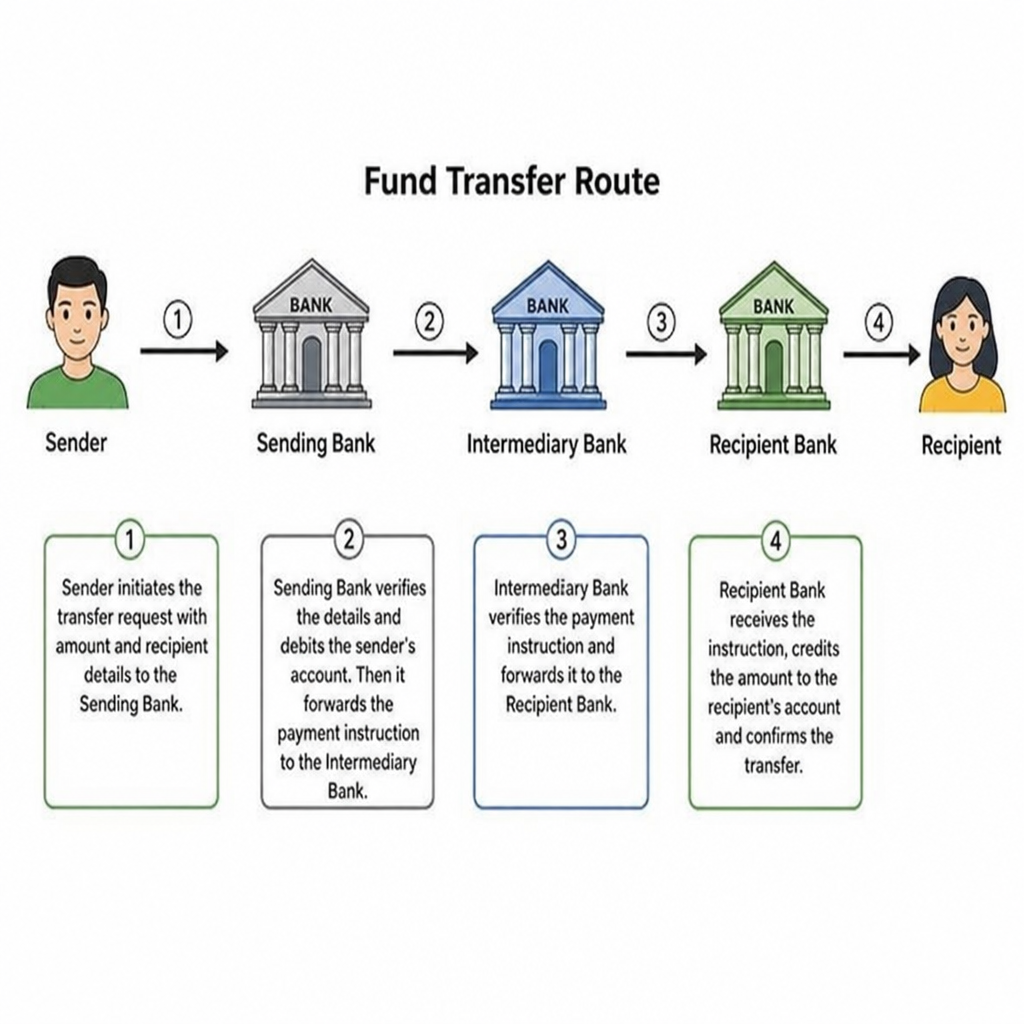
A telegraphic transfer combines your payment instructions with processing by the institutions involved. Depending on the route, an intermediary or correspondent bank may help connect the sending and receiving institutions. Accurate instructions are essential because the beneficiary bank relies on them to credit the payment.
- Submit the instruction. Enter the beneficiary, destination account, amount, currency, and payment purpose where required.
- Review conversion and charges. Check the exchange rate, applicable fees, and which account will fund the payment.
- Authorize the payment. Complete the provider’s authentication and confirmation process.
- Allow bank processing. The institutions transmit instructions and process the payment through the relevant route.
- Confirm receipt. Check that the beneficiary has received the expected amount, rather than relying only on a submission confirmation.
For example, when paying an overseas supplier, distinguish between the amount you instruct your bank to send and the amount the supplier must receive. If an invoice needs to be paid in full, resolve fee allocation before authorizing the transfer. Overseas bank charges may otherwise reduce the payment received.
Information to prepare before sending
The required details depend on the destination, currency, and provider. Obtain the recipient’s official incoming-payment instructions instead of guessing from an old payment or using a generic bank address. Some destinations require additional account identifiers or local bank codes.
Prepare the following information:
- Recipient identity: Full account-holder name and address where required.
- Account identifier: Account number, IBAN, or another destination-specific identifier.
- Bank identification: Bank name and SWIFT/BIC, plus any required local routing code.
- Payment details: Amount, currency, and purpose of payment.
- Your reference: An invoice number or other identifier that helps the recipient reconcile the payment.
An IBAN identifies an account in participating jurisdictions, while a SWIFT/BIC identifies an institution. They are not interchangeable, and not every country uses IBANs. Follow the sending provider’s destination-specific requirements rather than assuming one identifier replaces another.
Before proceeding, independently verify any unexpected change to payment instructions. Contact the recipient using a previously known telephone number, not a number supplied in the message announcing the change. The FBI recommends this approach because compromised email accounts can make fraudulent instructions appear legitimate.
Understanding fees and exchange rates
The advertised transfer fee is only one part of the cost. Foreign-exchange pricing, correspondent-bank deductions, and receiving-bank charges can affect how much you spend and how much arrives. Compare the total sender debit alongside the expected recipient amount.
Sending fees and overseas deductions
Ask which charges are included in the quote and which may arise later. In particular, establish who pays overseas bank charges and whether the provider can confirm the final amount to be credited. HSBC notes that correspondent-bank practices can affect deductions, so selecting a charge option should not be treated as an unconditional full-payment guarantee.
For a practical comparison, request quotes using the same currency pair, payment amount, and recipient details. Record the total payable, expected delivery amount, and any uncertain deductions. This makes a low advertised fee easier to assess against the complete transaction.
Telegraphic transfer selling rates
The telegraphic transfer selling rate, sometimes abbreviated to TTS, is the rate at which a bank sells a currency to a customer. “Selling” refers to the bank’s perspective, not yours. If you buy foreign currency to fund an overseas payment, this rate may be relevant to the conversion.
Bank buying and selling rates can incorporate a spread around a reference rate. Consequently, a transfer with no separate sending fee can still involve a currency-conversion cost. Check the actual conversion offered rather than assuming a published market rate will apply.
As a purely illustrative calculation, converting 1,000 currency units at 0.90 produces 900 destination-currency units before deductions. At 0.88, it produces 880. The 20-unit difference shows why the exchange rate deserves attention alongside the transfer fee; these figures are examples, not live quotes.
How long does a telegraphic transfer take?
A telegraphic transfer is not automatically an instant transfer. Timing depends on the provider, currency, destination, bank processing, and any checks required before the beneficiary receives the funds. For example, Bank of America describes international wire delivery as typically one to five business days, while noting that receiving-bank processing can affect timing. That is a provider-specific estimate, not a universal TT deadline.
Several factors deserve attention when planning a deadline:
- Cut-off times: Instructions received after the applicable deadline may be processed on the next business day.
- Bank and currency holidays: Closures affecting the payment currency or destination can delay processing.
- Payment-route complexity: Additional intermediaries or destination procedures may extend delivery.
- Compliance checks: A bank may need to complete checks before making funds available.
For a time-sensitive payment, ask when the recipient should have usable funds, not merely when your account will be debited. Request a route-specific estimate and leave room for unexpected processing. Do not promise a supplier same-day receipt simply because you submitted the instruction early.
Hong Kong compliance and remittance services
In Hong Kong, the Anti-Money Laundering and Counter-Terrorist Financing Ordinance, commonly called AMLO, establishes requirements relevant to money services. Hong Kong Customs and Excise supervises licensed Money Service Operators, including remittance agents and money changers, for customer due diligence, record keeping, and licensing compliance. These are regulatory obligations, not optional extras added to a telegraphic transfer.
What customers should expect
An MSO may need to verify identity and collect information about the parties and transaction. Customs guidance includes special requirements for wire transfers and remittance transactions, alongside ongoing monitoring and record keeping. Provide accurate information and ask the operator what documentation is needed for your particular payment.
Do not assume “wire transfer” and “remittance transaction” have identical legal definitions. Customs guidance distinguishes them, which affects the relevant requirements. For a remittance service, check the operator against the official licensing register and consult current guidance rather than relying on a general article for legal compliance.
Tracking payments and responding to problems
Keep the confirmation, transaction reference, beneficiary details, amount, currency, and payment date. These records help the provider investigate a delayed or missing fund transfer. For a SWIFT-routed payment, ask whether a Unique End-to-End Transaction Reference, or UETR, is available to help locate it in the payment chain.
If a payment has not arrived, contact the sending provider with those details and ask whether it is awaiting information or further processing. Avoid immediately sending a duplicate: first establish the original payment’s status. Keep a record of the provider’s response and any follow-up action agreed.
Cancellation rights depend on the transaction
If you discover a mistake, contact the provider immediately and review the receipt’s cancellation instructions. For qualifying U.S. consumer remittance transfers, cancellation is generally available without charge within 30 minutes of payment, provided the money has not already been deposited or collected. This protection does not automatically apply to every business payment, domestic wire, or overseas transaction.
For covered U.S. remittance errors, the CFPB explains that consumers generally have 180 days from the disclosed availability date to report a mistake. Nevertheless, reporting promptly is the practical priority. Keep receipts and correspondence so the provider can investigate clearly.
Choosing the right transfer method
Choose an international transfer method around the recipient’s requirements, your deadline, and the complete cost. A TT may suit an overseas account payment, but a familiar label should not replace comparison. Use the following checklist before authorizing any bank transfer:
- Confirm that the provider supports the destination, currency, and recipient account.
- Compare the total debit and expected recipient amount, including conversion.
- Check the delivery estimate and applicable cut-off time.
- Understand uncertain overseas charges and cancellation terms.
- Verify recipient instructions independently, especially after a change.
- Save the receipt and tracking reference.
The most useful comparison is not simply “Which service has the lowest fee?” It is “Which service can deliver the required amount, to the correct account, within the necessary timeframe?” Use those three outcomes to guide your decision, then review the final confirmation carefully before sending.
Frequently Ssked Questions About Telegraphic Transfer
What is the meaning of a telegraphic transfer?
A telegraphic transfer is an electronic payment instruction used to move money between financial institutions, primarily for international payments.
How does a telegraphic transfer differ from a wire transfer?
While both involve electronic transfers of funds, a telegraphic transfer typically refers to international transactions, whereas wire transfers can be domestic or international.
What are the typical fees associated with a telegraphic transfer?
Fees can vary by provider and may include transfer fees, foreign exchange costs, and receiving bank charges. It's essential to compare the total cost, including any expected deductions.
How can I track my telegraphic transfer?
Keep the confirmation and transaction reference. You can contact the sending provider to inquire about the status and, if applicable, obtain a Unique End-to-End Transaction Reference (UETR) for tracking.
What should I do if I receive incorrect payment instructions?
Contact the payment provider immediately, verify the information with the recipient using a previously known contact method, and refrain from sending a duplicate payment until confirming the original's status.
Feel free to add or modify any of the questions as needed!