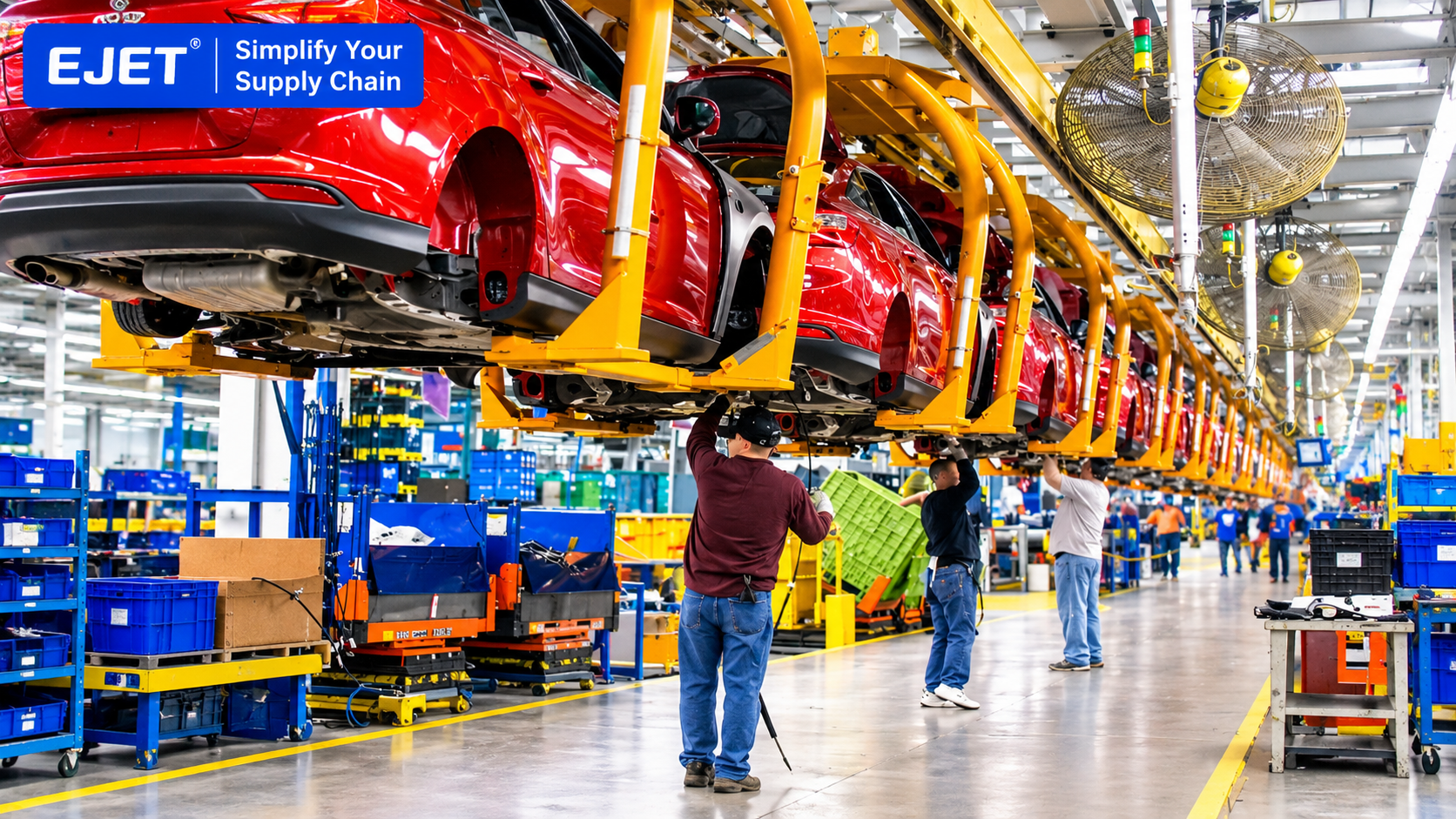
Mass production is the manufacture of large quantities of standardized goods through repeatable processes, specialized equipment, and organized workflows.
It helps explain how factories can supply everyday products at scale, from packaged food to automobiles. Understanding its principles also reveals the trade-offs behind lower production costs, consistent output, and limited flexibility.
What is mass production?
A practical mass production definition is the large-scale manufacture of identical or highly standardized products using repetitive operations. Rather than building each item as a separate project, a manufacturer establishes a process that can produce the same design repeatedly.
The aim is to achieve dependable output while keeping manufacturing costs per unit low.
What is meant by mass production becomes clearer when you look beyond quantity. A workshop might make many items, but if each requires a different design and individual fitting, it does not follow the same production model. Standardization, repeatability, and coordinated flow are central to the distinction.
There is no universal quantity that automatically makes an operation mass production. The important consideration is how production is organized: a stable product design, substantial demand, and a repeatable workflow matter more than an isolated output figure. Those conditions help justify equipment dedicated to producing a particular product efficiently.
The building blocks of a mass production system
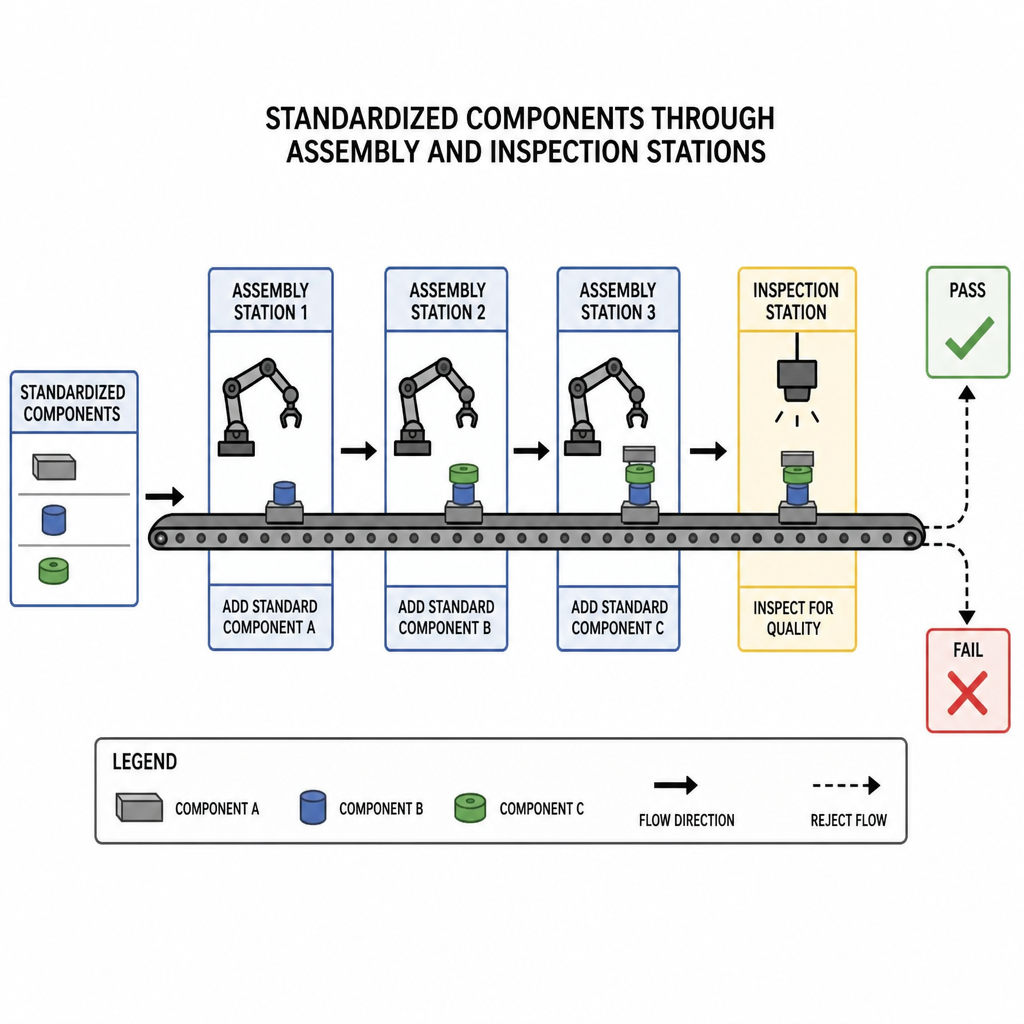
A production line works because its activities fit together, not simply because individual machines operate quickly. Ford's influential approach combined interchangeable parts, standardized work, and movement through a production sequence. Understanding those elements makes the wider system easier to recognize.
- Standardized designs: Products follow defined specifications rather than being redesigned for each customer. This creates a repeatable target for manufacturing.
- Interchangeable components: Parts are made within acceptable dimensional variation so equivalent components fit without individual adjustment.
- Specialized tasks: Work is divided into operations that workers or equipment perform repeatedly.
- Coordinated movement: Materials and products pass between operations in a planned sequence, reducing unnecessary handling.
Imagine a hypothetical factory assembling one model of desk lamp. One station prepares the base, another installs wiring, and another attaches the shade. Instead of having one person repeatedly collect tools and build an entire lamp, the proposed layout brings the required materials to each operation.
That example also shows why coordination matters. If the wiring station cannot keep pace, completed bases will accumulate before it. Speeding up base preparation would create a larger queue rather than more finished lamps.
When reviewing a proposed layout, ask where work might wait—not just how quickly each task could run.
What is mass production in history?
In history, mass production describes the development of manufacturing systems that combined standardized parts, machinery, divided labor, and organized production flow to make goods at scale. Its development was gradual rather than the work of one inventor. Earlier advances in precision manufacturing helped establish the foundation for later assembly-line systems.
Interchangeable parts were particularly important. If every component needed hand-fitting, assembly remained dependent on individual adjustment. The Henry Ford museum explains that Ford's moving assembly line required components manufactured to close tolerances so parts of the same kind could be interchanged.
A milestone in mass production history came in 1913, when Ford implemented moving assembly-line methods at its Highland Park plant. Instead of workers moving around a stationary vehicle, the vehicle moved through a sequence of workstations. Ford adapted ideas already used in other industries, rather than inventing every element from scratch.
The significance extended beyond factory speed. The Smithsonian documents how mass production lowered consumer prices while creating repetitive jobs and stricter control over working time. Its history therefore involves both wider access to manufactured goods and substantial changes in workers' daily experience.
Mass production examples in everyday life
Useful mass production examples include automobiles, canned goods, household appliances, breakfast cereals, and computer keyboards. These products differ considerably, but their manufacture can rely on standardized designs and repeated operations. The shared principle is producing many consistent units rather than treating each as a unique commission.
Consider how that principle applies to three examples:
- Automobiles: An assembly sequence brings components together through specialized operations. Ford's moving line is a historical illustration of this approach.
- Household appliances: Repeated manufacture of a defined design allows many units to follow the same production requirements rather than separate customer specifications.
- Tractors: Ford applied automobile production techniques to tractor manufacture, illustrating how production methods could transfer between related industries.
For a practical learning exercise, choose an everyday manufactured object and sketch its likely stages: material preparation, component manufacture, assembly, checking, and packaging.
Treat the sketch as a hypothesis rather than a description of a particular factory. Then consider which stages would be easy to repeat and which would become harder if every customer requested a different design.
Why manufacturers use mass production
The central attraction is the ability to produce standardized goods economically at substantial volume. Repetition and specialized equipment can reduce the work required for each unit, while a coordinated process limits unnecessary movement. Historically, these efficiencies helped manufacturers offer goods at lower prices.
Consistency is another advantage, although it depends on controlling the process. Interchangeable components require defined tolerances; they cannot simply be approximately alike. Establishing those requirements makes repeated assembly possible without routinely reshaping or adjusting individual parts.
However, producing cheaply is not the same as producing profitably. Dedicated equipment requires investment, and the case for that investment depends on sufficient demand for a reasonably stable design. High output alone does not prove that a production system is commercially suitable.
For the hypothetical lamp manufacturer, the useful comparison would be between alternative ways of meeting expected orders. A faster line deserves consideration only alongside its equipment needs, staffing requirements, and ability to make products customers actually want. Start with the demand problem, then evaluate the production solution—not the other way around.
The limitations behind high-volume output
Mass production involves commitments as well as efficiencies. Specialized machinery and large facilities can require substantial investment, while repetitive work can make jobs monotonous. These were visible features of early mass-production factories, not merely theoretical disadvantages.
Waste also deserves attention. NIST identifies overproduction, excess inventory, waiting, unnecessary transportation, and defects among the categories examined in lean manufacturing. A factory can therefore appear busy while materials wait between operations or finished products accumulate without an immediate need.
For anyone assessing a proposed operation, use those categories to investigate specific weaknesses:
- Overproduction: What would prevent the factory from making more than customers need?
- Inventory: Where would unfinished and finished goods wait, and why?
- Defects: How would an error be detected before more work was added?
- Waiting: Which operation might leave workers, machines, or materials idle?
- Transportation: Could the layout avoid unnecessary movement between stages?
These questions are more useful than assuming that maximum machine utilization is always desirable. In the lamp example, filling the floor with unfinished bases would not solve a shortage of wiring capacity. Evaluate whether each activity contributes to completed, acceptable products rather than rewarding activity for its own sake.
How does mass production differ from other methods?
Mass production emphasizes standardized products made through repeated operations, while custom production responds more closely to individual requirements. Batch production organizes work into separate runs, with equipment potentially changing between products. Mass customization combines a standardized foundation with features tailored to a customer's preferences.
|
Method |
Main organizing idea |
Illustrative scenario |
|---|---|---|
|
Custom production |
Make an item to individual requirements |
A desk designed for a particular room |
|
Batch production |
Complete one run before changing to another |
A workshop producing one lamp finish, then another |
|
Mass production |
Repeat a standardized design at scale |
A line producing the same lamp model |
|
Mass customization |
Standardize the foundation, then vary selected features |
A standard lamp platform with customer-selected shades |
The scenarios illustrate the distinction rather than describe named manufacturers. In practice, the useful comparison is not which label sounds most advanced. It is which arrangement best matches the required quantity, product variety, and customer expectations.
A highly individualized product may not benefit from a dedicated high-volume line. Conversely, rebuilding the same design as a separate custom project may introduce avoidable work. Use the comparison to identify where repetition adds value and where flexibility remains essential.
Matching the production method to the product
Choosing a production process means matching manufacturing arrangements to the product and customer demand. Operations management also involves controlling quality and costs, scheduling work, and coordinating day-to-day production. Equipment selection is therefore only part of the decision.
Before treating mass production as the preferred option, prepare a short decision brief:
- Define the product. Identify which specifications must remain fixed and which customers might expect to vary.
- Describe demand. Separate confirmed requirements from assumptions about future orders.
- Map the proposed flow. Show each operation, its inputs, and where work could accumulate.
- Plan quality checks. Decide what needs checking and what should happen when a problem appears.
- Test change scenarios. Consider how the operation would respond to a revised design or a different order mix.
This exercise should expose uncertainties rather than hide them behind a production target. For example, if the lamp's design is still changing, committing immediately to dedicated equipment deserves closer scrutiny. The goal is a defensible match between the product, the process, and the expected workload.
High volume does not have to mean producing excess
Mass production and disciplined production control are not opposites. Toyota's production system illustrates an approach built around making what is needed, when it is needed, in the required amount. Its just-in-time principle links production and supply more closely to actual requirements rather than treating large inventories as an achievement.
Toyota also describes jidoka: stopping when an abnormality occurs so problems are addressed instead of continuing unchecked. That principle offers a useful counterpoint to the idea that an effective factory must never stop. Maintaining flow matters, but allowing defects to continue through a process can undermine the purpose of producing efficiently.
The practical takeaway is to distinguish scale from excess. Ask whether output is needed, whether quality is protected, and whether the process makes problems visible. Those questions help keep attention on useful production rather than volume for its own sake.
The essential takeaway
Mass production is best understood as an organized system of standardization, repetition, and coordinated work—not simply a large number of products. Its usefulness depends on matching that system to demand while managing quality, investment, and flexibility.
When assessing any example, start with three questions: what stays the same, how does work move, and why is that volume needed? Together, they turn an abstract manufacturing term into a practical way to understand how products are made.
Frequently Asked Questions About Mass Production
What is mass production?
Mass production is the large-scale manufacture of identical or highly standardized products using repeatable operations. It focuses on achieving dependable output while keeping costs per unit low.
What are some examples of mass production?
Examples of mass production include automobiles, packaged food, household appliances, and electronic devices. These items are produced in large quantities using standardized designs and operations.
How did mass production evolve in history?
Mass production evolved gradually through advances in precision manufacturing and standardized parts, with key milestones like Henry Ford's implementation of the moving assembly line in 1913.
What are the advantages of mass production?
The main advantages of mass production include reduced manufacturing costs, consistent product quality, and the ability to meet high demand efficiently while offering goods at lower prices.
What are the limitations of mass production?
Limitations of mass production include substantial initial investments in specialized equipment, potential for monotony in jobs, and the risk of waste if production exceeds actual demand.