


Cross-border e-commerce is the online sale of goods or services between buyers and sellers in different countries.
It gives businesses a route to overseas customers, but successful expansion requires more than switching on international shipping.
This guide explains how international e-commerce works, where the opportunities lie, and how to approach pricing, payments, logistics, and market entry without losing sight of profitability.
What is Cross-Border E-Commerce?
Cross-border e-commerce happens when a customer orders online from a seller based in another country. It includes business-to-consumer sales, such as a shopper buying clothing from an overseas brand, and business-to-business transactions, such as a retailer ordering inventory from a foreign supplier.
The defining features are the online order and the international relationship between buyer and seller.
For example, imagine a U.S. homeware business selling a lamp through its website to a customer in France. The website attracts the buyer and accepts the order, while payment processing, export preparation, customs clearance, and delivery support the transaction. This illustrates how a familiar online purchase can involve several international operations.
E-commerce can also cover digitally delivered goods and services.
This article focuses primarily on physical products, where borders introduce practical questions about transport, customs, delivery, and returns. Customs-focused definitions are narrower than broader definitions of online commerce, so context matters when comparing industry reports.
How does cross-border e-commerce work?
Cross-border e-commerce connects an online storefront or marketplace with payment services, fulfillment operations, and international delivery networks. For physical goods, the seller must coordinate the order information and shipment so the product can reach the buyer through the relevant customs processes.
Responsibilities differ depending on the sales channel, delivery arrangement, and destination.
A typical order follows this sequence:
- Discovery: The buyer finds a product through search, advertising, social media, or a marketplace.
- Checkout: The store presents payment options, shipping charges, and applicable information about duties and taxes.
- Preparation: The seller or fulfillment partner packs the goods and prepares shipment data and documents.
- Border clearance: Customs authorities assess the shipment under the destination’s requirements.
- Delivery and support: Delivery partners complete transport, while the seller handles questions, refunds, or returns.
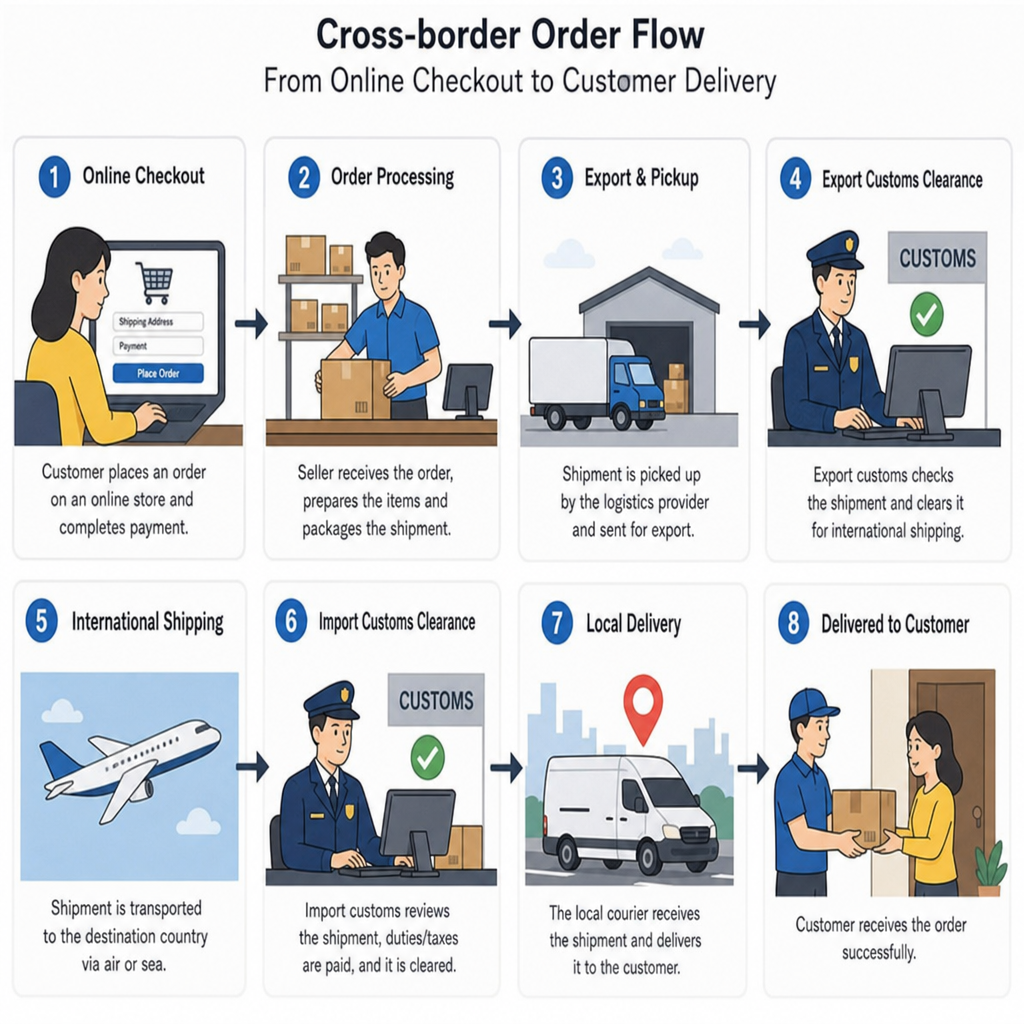
Use this sequence as an ownership map. Assign someone to each stage, including exceptions such as rejected payments, incomplete addresses, or delivery problems, before opening a market.
The opportunity behind global market access
The appeal of global market access is straightforward: businesses can reach customers beyond their domestic market through digital sales channels. International e-commerce can support both overseas sales and brand awareness, making it relevant to established exporters as well as businesses exploring their first foreign market.
However, access is not the same as demand. Before committing resources, research who buys your category, which channels they use, and what competing offers already exist. The International Trade Administration recommends examining market opportunities before investing heavily in an e-commerce strategy.
Frame the opportunity as a testable proposition: a specific audience, in a specific country, buying a specific product range. For example, your initial goal might be to validate demand for lightweight accessories rather than export an entire catalog. That narrower scope gives your team a clearer basis for deciding whether expansion deserves further investment.
Which international market should you enter first?
Choose a market where evidence of demand overlaps with workable delivery, suitable payment options, and manageable operating requirements. A large population or impressive market forecast is not enough. Your first destination should fit your products, resources, and ability to serve customers consistently.
This approach follows official guidance to combine market research with an assessment of business readiness.
Build a simple scorecard before choosing:
|
Factor |
What to investigate |
|---|---|
|
Demand |
Relevant search interest, existing inquiries, and category competition |
|
Product suitability |
Restrictions, labeling needs, fragility, and shipping dimensions |
|
Economics |
Delivery charges, taxes, duties, payment costs, and likely returns |
|
Customer experience |
Language, preferred payments, support needs, and delivery expectations |
|
Channel fit |
Whether your target buyers favor marketplaces, independent stores, or distributors |
Treat the scorecard as a research tool, not a prediction. Where evidence is missing, record the uncertainty rather than awarding an optimistic score. Compare a small shortlist and prioritize the market with the strongest overall fit—not simply the largest theoretical audience.
Also choose your sales channel deliberately. Your website, online marketplaces, social channels, and distributors are different routes to overseas buyers; the right mix depends on purchasing habits and your digital strategy.
Build pricing around the full delivered cost
An export price needs to account for more than the product and postage. Landed cost describes the total cost of getting a product to the buyer, including freight, insurance, applicable tariffs and taxes, and other fees. Understanding that total helps you assess whether an offer remains attractive after crossing a border.
Keep the customer’s delivered price separate from your internal profitability calculation. For planning purposes, build an order-level model that subtracts product cost, fulfillment, shipping subsidies, channel fees, payment costs, and a reasonable allowance for returns from net sales revenue. Use your own operating data wherever possible, and label uncertain inputs clearly.
Then test less favorable scenarios. Consider what happens if a parcel needs reshipping, an exchange rate moves against you, or a customer returns the item. Set a minimum acceptable contribution before launching so that revenue growth does not become your only measure of success.
Explain import charges before the purchase. Official website-globalization guidance recommends providing international tax and duty information before checkout. Confirm who will pay those charges and ensure your checkout wording matches the delivery arrangement.
Make cross-border logistics part of the offer
Cross-border logistics covers more than moving a parcel between countries. It involves fulfillment, shipment information, international transport, customs processes, final delivery, and returns. International sellers also need to plan for address formats, delays, damage, and the way shipping information appears on their websites.
Compare fulfillment arrangements against your current needs. Shipping from your existing locati0n and using an overseas fulfillment operation involve different inventory and operational commitments.
Government guidance identifies direct shipping, marketplace fulfillment, warehousing services, and in-country distributors as possible approaches; none should be selected without examining responsibilities and costs.
When evaluating partners, ask for practical answers:
- Which destinations and product categories can you support?
- What shipment data and documents must we supply?
- How are customs questions, delivery exceptions, and claims handled?
- Where does tracking begin and end?
- How will customers return products, and what charges apply?
Request a walkthrough of an unsuccessful shipment as well as a successful one. That conversation can help you identify gaps in ownership before a customer experiences them.
Make the returns policy easy to find and understand. Explain the return destination, process, costs, and refund conditions, subject to applicable requirements. Clear delivery and returns information is an important part of adapting an online store for overseas customers.
Localize the buying experience, not just the words
Localization means adapting the store for a particular market, including language, currency, payments, content, and customer support. Translating product descriptions is useful, but it does not address every obstacle an overseas buyer may encounter. Official export guidance also highlights navigation, forms, local communication preferences, and privacy notices.
Prioritize the pages customers need to make and manage a purchase: product details, checkout, shipping, returns, and support.
Review measurements, sizing explanations, address fields, and currency displays alongside the translation. Website-globalization guidance specifically recommends measurement conversions, currency information, and market-focused content as part of international readiness.
Payments deserve their own review. The International Trade Administration advises exporters to balance payment risk with buyers’ needs and spending preferences. Ask prospective providers about supported markets, payment methods, settlement currencies, refunds, disputes, and fees rather than assuming your domestic setup is suitable everywhere.
For international SEO, research how customers in the target market describe your products instead of relying only on translated domestic keywords. Export guidance recommends considering SEO for each language used on the site. Pair that work with useful product information rather than creating near-identical pages solely to target more search terms.
Treat compliance as a launch requirement
Cross-border trade brings obligations that depend on the product, origin, destination, and transaction structure. Customs classification, origin information, declared value, product restrictions, and labeling requirements all deserve attention. An online sale does not remove the requirements that apply to the underlying goods.
Before accepting orders, create a product-and-market checklist. Verify the relevant export and import requirements with official authorities, and seek qualified customs, tax, or legal advice where the position is unclear. Record who owns each check and when the information should be reviewed.
Do not build your pricing around an assumed low-value exemption. Thresholds and eligibility conditions vary by market and can change; official Canadian export guidance explicitly recommends checking current rules when designing an e-commerce fulfillment model. Likewise, confirm what any marketplace or service provider handles rather than assuming it covers all your obligations.
E-commerce trends worth translating into action
Useful e-commerce trends are those that affect operating decisions. The World Customs Organization highlights the importance of electronic shipment information and cooperation among sellers, platforms, logistics providers, and customs authorities. For merchants, the practical response is to maintain accurate product and order data and understand how that information reaches delivery partners.
Digital wallets and instant payments are another development identified by the WCO. Rather than adding every available method, investigate which options your intended customers use and which your payment provider can support reliably. Adoption elsewhere is a reason to research, not proof that a particular integration will improve your results.
Finally, resist treating market-growth headlines as a business case. The WCO notes that measuring cross-border e-commerce remains challenging because definitions and measurement approaches differ. Use broad reports for context, then make investment decisions against your own market evidence and operating results.
Start with a pilot you can measure
A focused launch gives you a practical way to test the complete customer journey. Set the scope before launch: one priority market, a manageable product selection, named operational owners, and a defined review point. Establish success criteria that cover service quality and profitability as well as sales.
Use this launch checklist:
- Validate demand: Document the audience, competing offers, and reasons customers might choose you.
- Confirm readiness: Complete product, customs, tax, and destination checks.
- Test checkout: Review currency, payments, addresses, delivery information, and import-charge wording.
- Test fulfillment: Follow a shipment through dispatch, tracking, clearance, and delivery.
- Review outcomes: Track conversion, order contribution, delivery performance, refunds, and support themes.
Use the results to decide what to change before widening access. Official digital-strategy guidance recommends establishing performance indicators, monitoring customer feedback, and using the findings to inform business decisions. (trade.gov)
Build a repeatable international business
Approach expansion as a service you must deliver, not simply a checkout setting you can enable. Choose a focused opportunity, test the complete economics, and make responsibilities clear throughout the order journey. Expand when the evidence supports it—and when your team can repeat the experience reliably.
Frequently Asked Questions Related to Cross-Border E-commerce
What is cross-border e-commerce?
Cross-border e-commerce refers to the online sale of goods and services between buyers and sellers in different countries. It includes both business-to-consumer (B2C) and business-to-business (B2B) transactions, allowing businesses to reach international customers through digital platforms.
What are the main challenges of cross-border e-commerce?
Some key challenges include navigating different customs regulations, managing cross-border logistics, handling international payments, dealing with currency fluctuations, and ensuring compliance with local laws and taxes in different markets.
How can I choose the best international market for my e-commerce business?
Evaluate factors such as demand for your products, competition in the market, logistics capabilities, payment preferences, and customer expectations. Conduct thorough market research to ensure the selected market aligns with your product and business capabilities.
What does ‘landed cost’ mean in cross-border e-commerce?
Landed cost refers to the total cost of getting a product to the buyer, including product price, shipping fees, customs duties, taxes, and insurance. Understanding the landed cost is crucial for pricing your products competitively while still maintaining profitability.
How important is localization in cross-border e-commerce?
Localization is essential for success in cross-border e-commerce. It involves adapting your online store’s content, currency, payment methods, and customer support to meet the cultural and practical needs of customers in the target market. Proper localization can significantly enhance the customer experience and increase conversion rates.