








CE marking is the manufacturer’s declaration that a product meets applicable European Union requirements that require the mark.
Often called “CE certification,” the process involves assessing conformity, preparing evidence, and completing the required declarations—not simply buying a certificate.
This guide explains how the system works, what exporters must check, and how requirements differ for electronics and construction products.
What is CE Marking?
CE marking is a regulatory conformity mark used for products covered by specific EU legislation. CE stands for Conformité Européenne, meaning European conformity. By applying it, the manufacturer takes responsibility for meeting the relevant requirements, whether the product was manufactured inside or outside Europe. It is not a premium quality award or a statement of European origin.
To define CE certification accurately, distinguish the overall compliance process from third-party certification. Some products require an authorised independent organisation, known as a notified body.
Others permit manufacturer self-assessment, provided the manufacturer completes the required evaluation and holds adequate supporting evidence. There is no universal CE certificate issued by a central EU approval office.
For businesses asking what the CE mark is and why it is used, its purpose is to support consistent product requirements and market access. However, the symbol does not replace the underlying obligations: authorities can investigate whether a marked product actually complies.
Products Covered and Businesses Responsible
CE marking applies only when legislation specifically requires it. Covered categories include toys, many electrical products, medical devices, personal protective equipment, and certain machinery and construction products. A product outside the relevant legislation must not carry CE marking merely to reassure customers.
Manufacturers lead the conformity process, but importers and distributors also have responsibilities. Importers bringing goods from outside the EU must verify relevant compliance steps, markings, documentation, and traceability information. A US supplier should therefore agree early with its European commercial partners who will hold records, provide instructions, and respond to authorities.
Rebranding deserves particular attention. Importers or distributors marketing a product under their own name can take on manufacturer responsibilities; relying on the original factory’s paperwork without checking its scope is not enough. Establish the responsible legal entity before preparing labels and declarations.
How Do You Meet CE Certification Requirements?
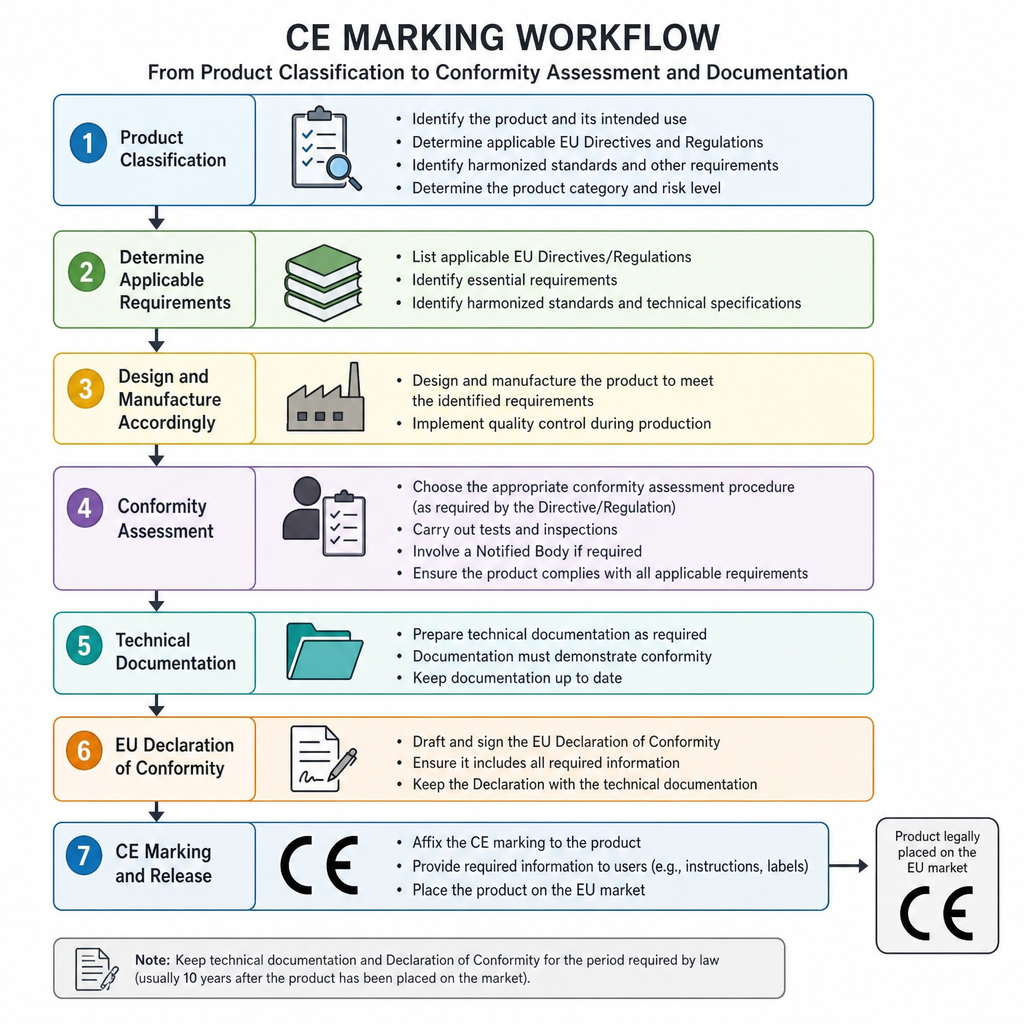
You meet CE certification requirements by identifying applicable legislation, following its conformity assessment procedure, documenting compliance, and applying the marking correctly. The route depends on the product’s intended use, characteristics, and risk category. Start with legal scope rather than a laboratory’s generic testing package.
1. Identify the Legislation and Standards
Create a product description covering intended users, operating conditions, power sources, materials, and functions. Use it to identify every applicable directive or regulation; several may apply simultaneously. Then identify relevant harmonised standards and check the references and limitations published for the applicable legislation.
Harmonised standards generally provide a voluntary technical route to demonstrating conformity with the requirements they cover. Alternative approaches may be possible, but require a defensible explanation and evidence. Do not assume that a familiar international standard automatically provides the same regulatory benefit as a cited European harmonised standard.
2. Select the Assessment Route and Gather Evidence
Check whether the law allows internal assessment or requires notified-body involvement. Where a notified body is necessary, confirm its authorisation for the exact legislation and assessment activity through the EU’s NANDO database. A laboratory’s testing capability and a notified body’s legal authorisation are different things.
Plan testing around the finished product and its intended configurations. Supporting evidence should connect identified requirements to design decisions, assessments, and results. For US exporters, existing domestic reports may help, but testing to US standards alone is generally insufficient to demonstrate EU conformity.
3. Build the Technical Documentation
The technical file explains what the product is and how compliance was established. It should allow an authority to understand the design and assess the evidence, rather than merely collect unrelated supplier certificates. Organise it around an identifiable product model and revision.
Depending on the applicable legislation, useful contents include:
- Product identity: model references, intended use, descriptions, and drawings.
- Risk assessment: relevant hazards and measures used to address them.
- Technical evidence: calculations, test reports, specifications, and standards applied.
- Production controls: measures that keep manufactured units consistent with the assessed design.
- User information: instructions, warnings, labels, and required translations.
- Formal records: declarations and notified-body documents where required.
4. Complete Declarations and Marking
For many product categories, the manufacturer signs an EU Declaration of Conformity identifying the product and applicable legislation. Construction products have a distinct declaration framework, discussed below. A test report is supporting evidence, not a substitute for the required declaration.
Apply CE marking only after completing the required process. Follow the applicable rules for visibility, proportions, placement, accompanying information, and any required notified-body identification number. Do not add a laboratory’s number simply because it performed testing.
What Does CE Mean on Electronics?
On electronics, CE means the manufacturer declares conformity with the EU legislation applicable to that device. Depending on its design, this can involve electrical safety, electromagnetic compatibility, radio performance, and restrictions on hazardous substances. It does not mean every electronic device follows the same testing route.
Common legislation to assess includes:
- Low Voltage Directive: addresses safety for electrical equipment within specified voltage ranges.
- Electromagnetic Compatibility Directive: addresses electromagnetic emissions and immunity.
- Radio Equipment Directive: applies to radio equipment, including many wireless products.
- RoHS Directive: restricts certain hazardous substances in covered electrical and electronic equipment.
For example, adding wireless connectivity can change the compliance analysis. A Bluetooth-enabled product requires consideration of radio-equipment rules, not just the assessment used for a non-wireless version. Assess the finished device rather than treating a component supplier’s documents as complete proof for the whole assembly.
Window and Door Export Requirements: CE, AAMA, and AS 2047
Window and door exporters face destination-specific requirements, not one interchangeable global certificate. CE marking, AAMA certification, and AS 2047 address different regulatory or certification frameworks. Plan separate compliance reviews for each destination rather than assuming one set of reports automatically satisfies all three.
|
Destination or framework |
Main planning consideration |
|---|---|
|
European Union: CE marking |
Identify the applicable construction-product specification, assessment system, and declaration obligations. |
|
North America: AAMA certification |
Check the applicable certification program, product scope, and project requirements; programs can address structural, air, and water performance. |
|
Australia: AS 2047 |
Check requirements for windows and external glazed doors alongside applicable building and installation requirements. |
These frameworks are not substitutes for one another.
The EU construction-products framework is transitioning. The main provisions of Regulation (EU) 2024/3110 became applicable on January 8, 2026, but older and newer frameworks coexist while product families migrate. Confirm which framework and declaration apply to the relevant product specification; do not assume every window or door moved to the new system on that date.
Maintaining CE Compliance After Launch
CE compliance continues after the first shipment. Manufacturers must keep production consistent, retain documentation for the applicable period, and review changes that could affect conformity. For many products, the retention period is ten years, but the relevant legislation determines the actual obligation.
Use this release checklist before placing a product on the market:
- Confirm the documentation covers the exact model being supplied.
- Check required declarations, markings, traceability details, and instructions.
- Verify that any required notified-body involvement matches the assessment route.
- Establish responsibility for records and regulatory enquiries.
- Review design and production changes before relying on earlier evidence.
Budget for assessment, testing, documentation, and any required third-party work—not for purchasing the CE symbol itself. Costs depend on product complexity and the required procedure. Be cautious of voluntary “CE certificates” presented as a shortcut: they cannot replace the legally required conformity assessment.
Frequently Asked Questions About CE Certification
What is CE Certification and Why is it Important?
A brief overview of CE certification and its significance in ensuring product safety and compliance.
What Products Require CE Marking?
Information on the categories of products that need to be marked with CE.
How Can I Meet CE Certification Requirements?
Steps and procedures needed to achieve compliance with CE marking standards.
What Does CE Mean on Electronics?
Clarification of CE's role and significance in the electronic devices sector.
What Are the Consequences of Not Having CE Certification?
Potential risks and penalties businesses may face when non-compliant with CE regulations.