











Customs duties and fees are charges that can apply when goods enter the United States, separate from the price of the goods and their transportation.
Understanding them means identifying the product’s tariff classification, origin, customs value, and applicable entry requirements—not simply applying one percentage to every purchase.
U.S. Customs and Border Protection (CBP) administers the import process, while brokers and carriers may charge separately for their services.
Whether you are ordering one item or planning a commercial shipment, start with the full delivered cost.
The sections below explain the charges to check, the information to request, and how to build a useful estimate before buying.
What are customs duties and fees in the United States?
Customs duties are taxes assessed on imported merchandise. Customs fees are separate government charges associated with processing entries or certain transportation activities; a carrier’s invoice may also include private brokerage charges.
These categories are related, but they are not interchangeable.
Keep these distinctions in mind when reviewing a quote:
- Import duties: Government charges determined through the applicable tariff provisions and other import measures.
- Tariff charges: Another term for duties, sometimes referring specifically to additional trade-related tariffs.
- Other import taxes: Certain products, such as alcohol and tobacco, can attract federal excise taxes.
- Government customs fees: Charges such as the Merchandise Processing Fee or, for qualifying vessel cargo, the Harbor Maintenance Fee.
- Brokerage charges: Private fees for preparing entries and handling customs clearance.
For your budget, create separate lines for government charges, transportation, and clearance services. That makes it easier to compare sellers and ask useful questions when a quote simply says “customs included.” Ask which charges are included, who pays them, and whether anything can still be billed after arrival.
How are import duties calculated?
Import duties depend on the merchandise’s classification, customs value, country of origin, and applicable tariff treatment. Some duties are percentages of value; others depend on quantity or combine different methods. Additional duties may apply beyond the ordinary tariff rate, so a single product lookup is only the starting point.
Product classification establishes the starting rate
The Harmonized Tariff Schedule of the United States, usually called the HTS or HTSUS, organizes imported goods into classifications. Classification requires reading the product descriptions and relevant legal notes, not choosing whichever search result looks closest. A supplier’s code can be a useful lead, but the digits after the internationally harmonized first six can differ between countries.
Before requesting classification help, gather a clear product description, material composition, intended use, and technical details. Avoid descriptions such as “accessories” when something more specific is available. For unresolved classification questions, CBP’s binding ruling program provides a route to obtaining a pre-import decision based on detailed product information.
Customs value is not necessarily the checkout total
For a typical purchase, valuation begins with the price paid or payable for the goods, subject to customs valuation rules. International freight and insurance generally are not part of the dutiable value, but required additions can include packing, assists, and certain commissions or royalties. Simply declaring a lower number does not create a lawful saving.
Ask for goods, freight, and insurance to be identified separately. If you supply tooling, components, or other production support to the manufacturer, flag that arrangement to your broker rather than assuming the supplier’s invoice captures everything. Those facts can affect the valuation analysis.
Origin and additional measures complete the picture
Country of origin concerns where goods were produced under the applicable origin rules, not merely where the parcel was dispatched. Products made across several countries can require a substantial-transformation analysis or other applicable origin rules. Origin can affect ordinary tariff treatment, trade preferences, and additional duties.
Check relevant Chapter 99 provisions and current trade measures as well as the basic classification. Antidumping and countervailing duties require separate attention: the USITC explains that these are not ordinary tariffs listed in the HTS. For exposed products, ask a specialist to review the applicable order rather than relying solely on a calculator.
Low-value shipments need a fresh check
Do not assume that an order under $800 enters duty-free. The United States suspended the familiar duty-free de minimis treatment, and regulations published on June 24, 2026, implemented an indefinite suspension for postal and non-postal merchandise. Exceptions under separate authorities require their own analysis.
CBP also introduced a new postal informal entry process effective July 24, 2026. Its guidance describes a process generally available for eligible mail merchandise valued at $2,500 or less, subject to restrictions. Informal entry is a clearance procedure; it should not be confused with automatic exemption from duties.
For a small purchase, ask the seller or carrier which entry process will be used and how charges will be collected. Do not base a buying decision on an old article, marketplace comment, or previous shipment that cleared under different rules. Use current CBP guidance and obtain a shipment-specific estimate.
Government fees and private charges belong in separate columns
The Merchandise Processing Fee, or MPF, applies to formal and informal entries, subject to applicable exemptions. Formal-entry calculations use a percentage with minimum and maximum amounts, while informal-entry fees follow a different structure. Because fee limits can change, check the current schedule rather than copying a previous year’s figures.
The Harbor Maintenance Fee, or HMF, generally applies to commercial cargo using covered ports and is assessed at 0.125% of cargo value. It is not charged on cargo imported by air. This is one reason the mode of transportation matters beyond the freight quote alone.
Brokerage charges are different: they pay a private business for clearance services. CBP notes that brokers charge for their work and recommends discussing rates with providers. Before accepting a service, request an itemized quote showing what the clearance fee covers and what would trigger another charge.
Also check whether product-specific federal taxes apply. Alcohol and tobacco are examples of goods subject to federal excise tax, while state or local tax obligations are a separate matter from CBP’s federal collections. A duty estimate should not be treated as an all-tax estimate unless its scope expressly says so.
Who pays customs charges on international shipping?
The sales contract allocates costs between buyer and seller, while customs law determines the importer’s obligations. Under Incoterms® 2020, Delivered Duty Paid (DDP) places import clearance and tariff costs on the seller; Delivered at Place (DAP) places the import burden on the buyer.
Hiring a broker does not remove the importer’s responsibility for compliance.
Do not read “free international shipping” as a promise that import duties are covered. Instead, ask the seller to confirm the delivery term, named destination, importer arrangements, and treatment of government charges in writing. Shipping costs and import charges are different parts of the transaction.
For a business order, put the answer in the purchase agreement rather than leaving it in a sales conversation. Ask what happens if tariffs change before entry and whether the seller’s quote is fixed or adjustable. The International Chamber of Commerce recommends using clearly defined contract responsibilities to manage tariff risk.
Build a landed-cost estimate before ordering
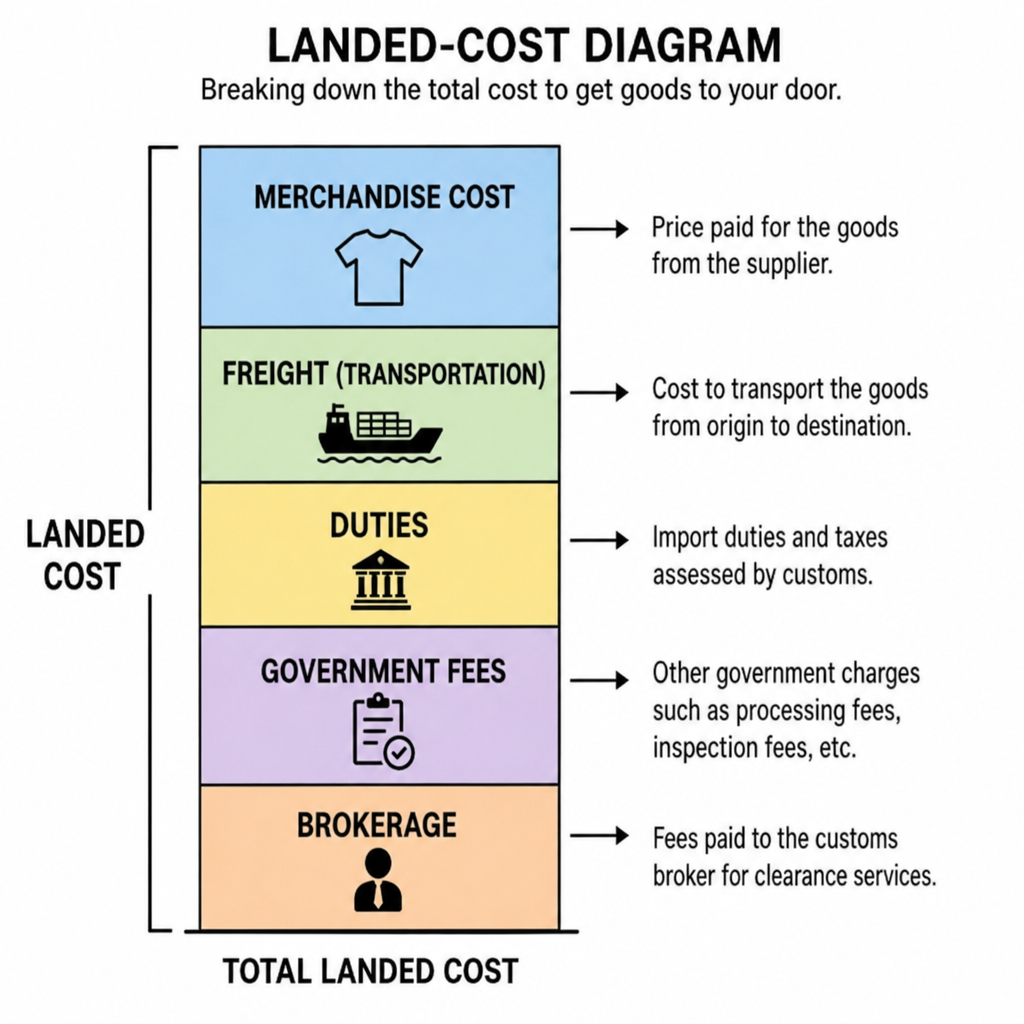
Landed cost is the total cost of getting the product to its destination, including the goods, freight, insurance, tariffs, taxes, and other fees. It is the more useful comparison when two suppliers offer different prices or delivery arrangements. A cheaper product is not necessarily the cheaper delivered purchase.
Use this worksheet for each quote:
|
Cost category |
What to request or verify |
|---|---|
|
Merchandise |
Purchase price, quantity, and currency |
|
Customs value |
Valuation basis and any required additions |
|
Import duties |
Classification, origin, base rate, and additional measures |
|
Government fees |
Applicable processing and transportation-related fees |
|
Transportation |
Freight, insurance, and delivery scope |
|
Clearance services |
Broker’s fee and services included |
|
Product-specific taxes |
Any applicable excise or other tax obligations |
These categories draw on CBP’s valuation and fee guidance and the Commerce Department’s landed-cost framework. Keep the assumptions with the estimate so someone reviewing it later can see exactly what was included.
For illustration only, suppose merchandise has a customs value of $1,000 and a hypothetical percentage duty of 5%, with no additional duty assumed. The duty calculation would be $50. If hypothetical freight is $100, the subtotal is $1,150 before government processing fees, brokerage, insurance, or other applicable costs. These are invented teaching figures, not a rate quote for any product.
For repeat commercial imports, track estimated and actual costs by product. Record the classification used, origin, entry date, and supporting quote alongside the final invoice. This gives you a practical review trail when a later shipment costs more than expected.
Prepare documents that answer clearance questions
Good preparation starts with accurate descriptions and values. CBP’s invoice guidance calls for the price paid for the goods and relevant valuation additions, while its classification ruling process depends on detailed product information. Give your broker enough information to evaluate the shipment instead of asking them to infer it from a short marketplace listing.
Before dispatch, assemble a working file containing:
- The commercial invoice: Check the buyer, seller, goods, quantities, prices, and currency.
- Product information: Keep material specifications, intended use, photographs, and technical descriptions where relevant.
- Origin information: Ask where the goods were produced and identify any manufacturing across multiple countries.
- The delivery agreement: Preserve the agreed term, destination, and allocation of import costs.
- The cost estimate: Save the broker’s or carrier’s assumptions and any exclusions.
Use this as a preparation checklist, not a universal list of legally required documents. Exact requirements depend on the merchandise and entry circumstances; the importer remains responsible for ensuring compliance even when a broker handles the filing.
Review unexpected bills before paying or disputing
When a charge differs from your estimate, request a breakdown separating duties, government fees, and private service charges. Compare the product description, customs value, origin, and tariff treatment against your records. A broker’s invoice can include its own service fee, so an unfamiliar “customs” amount is not necessarily an increase in the government duty rate.
Ask the filing party to explain any mismatch and identify whether a correction is appropriate. Keep the invoice, estimate, payment records, and correspondence together. For recurring uncertainty about classification, consider resolving the issue before the next order through CBP’s binding ruling program.
The takeaway: budget for the whole shipment
Understanding customs duties and fees in the United States starts with separating taxes, government fees, transportation, and private clearance services. Verify the product details and current rules, then ask for an itemized landed-cost estimate. Most importantly, settle responsibility before shipping—not when a delivery or clearance notice arrives.
Frequently Asked Questions About Customs Duties and Fees in the United States
What are customs duties and fees?
Customs duties are taxes imposed on imported goods, while customs fees are additional government charges for processing imports. Understanding both is crucial for accurately estimating total import costs.
How are import duties calculated?
Import duties are based on the merchandise’s classification, customs value, country of origin, and applicable tariff treatment. Different products may have varying duty rates, so it’s essential to consult the Harmonized Tariff Schedule.
Are low-value shipments exempt from duties?
Not necessarily. While orders under $800 may have been duty-free, recent regulations have changed this. Always verify current customs guidance to determine if any duties apply.
Who is responsible for customs charges in international shipping?
Responsibility for customs charges is defined by the sales contract and can vary based on Incoterms® 2020. It’s important to clarify this before shipping to avoid unexpected costs.
What documents are required for customs clearance?
Essential documents include the commercial invoice, product information, origin information, delivery agreement, and cost estimate. Proper documentation ensures compliance and smooth clearance through customs.