The strongest candidates for trending products to sell in 2027 include beginner craft kits, personalized gifts, repair accessories, pet enrichment products, and practical technology accessories.
These are opportunities to investigate, not confirmed 2027 bestsellers: the year is still ahead, and the evidence below comes from earlier sales, searches, and consumer research.
Use this shortlist to choose a focused product idea, test demand, and avoid committing too much inventory before customers prove your assumptions.
What products are most promising to sell in 2027?
Products worth testing for 2027 are those that connect an observable demand signal with a specific customer need and a workable business model.
Current evidence supports investigating hands-on hobbies, personal keepsakes, longer-lasting purchases, pet care, and easier-to-use technology.
However, marketplace growth and survey findings describe particular audiences and periods; they do not guarantee your product will sell.
Treat the ideas below as a research shortlist rather than a ranked forecast. For each one, identify who would buy it, what makes your version useful, and how you could test it without a large opening order.
The opportunity is the specific offer you build, not simply membership in a popular category.
Eight product opportunities to investigate
1. Beginner craft kits with a clear finished result
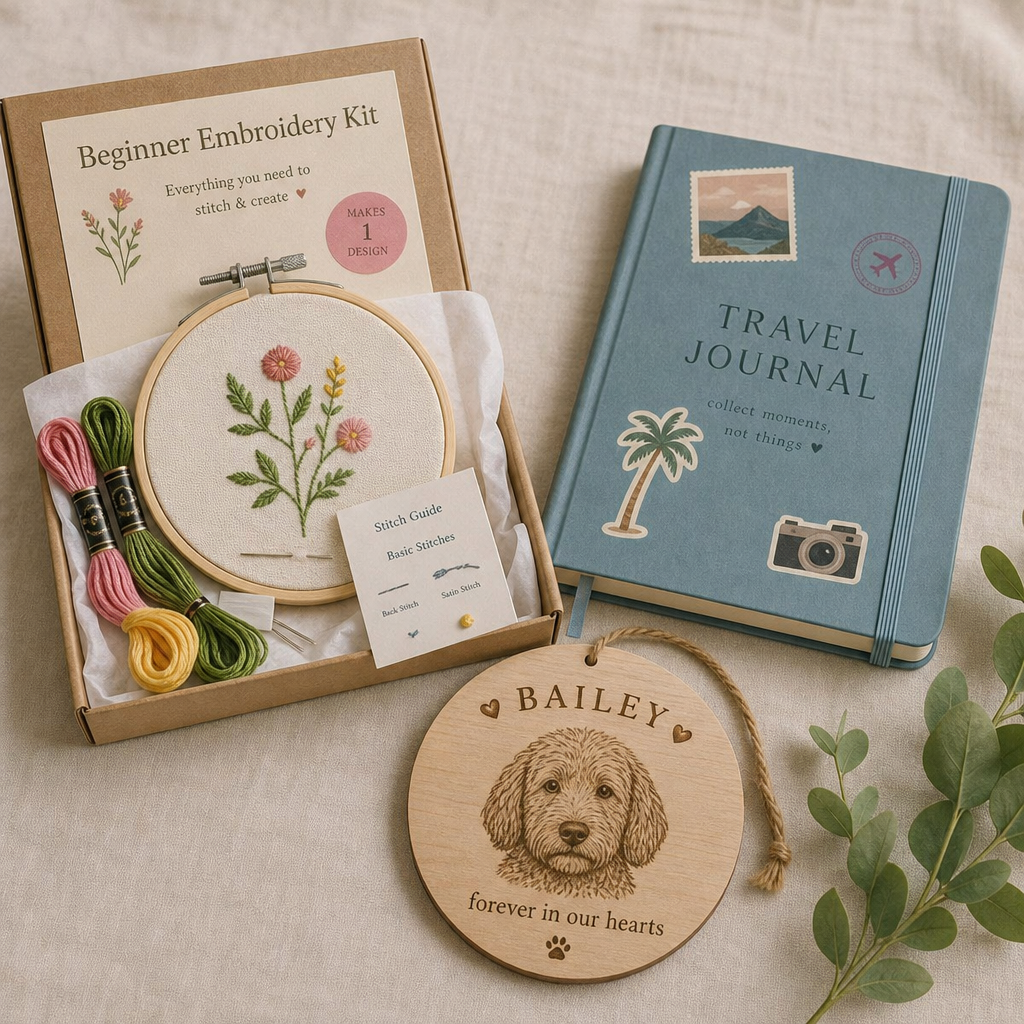
Etsy’s spring and summer 2026 trend report highlighted rising interest in beginner needlepoint kits, alongside crochet and embroidered products. That provides a concrete signal for investigating approachable, hands-on activities ahead of 2027.
Consider a small embroidery project, a visible-mending sampler, or a crochet kit designed around one useful object. Make the finished result easy to picture, and specify the tools, materials, and skills required.
Build your offer around removing uncertainty:
- Photograph every included component, not just the finished project.
- Explain whether scissors, frames, or other tools must be purchased separately.
- Test the instructions with someone who has never tried the craft.
- Offer a next-step project rather than launching many unrelated kits.
Avoid calling something beginner-friendly until a beginner can actually complete it using your instructions.
2. Journaling and memory-keeping accessories
Etsy also reported increased searches for traveler journals, memory journals, journal charms, and leather journal covers in its 2026 seasonal research. These signals make analog accessories worth investigating, without assuming every notebook style will share that demand.
Potential products include reading-log inserts, travel-memory pockets, refillable covers, and coordinated scrapbooking supplies. Instead of offering another generic blank notebook, choose a recognizable use: recording family recipes, documenting a trip, or keeping a personal reading history.
Show page layouts and dimensions clearly. If you sell inserts or covers, list the exact compatible sizes rather than relying on labels such as “standard.” Consider a starter bundle with a limited selection of accessories, then let buyers choose refills individually. Before stocking deeply, test whether customers prefer the complete system or just one component.
3. Personalized gifts with controlled customization
Etsy’s fall and winter 2026 report identifies opportunities around custom pet gifts, personalized portraits, and gifts that recognize friendships and chosen family. For 2027, these are useful starting points for researching specific gifting occasions.
Product ideas might include an original pet illustration, an engraved keepsake, or a recipe towel featuring a customer’s family recipe. Choose a format you can reproduce consistently, then define exactly what buyers may change.
Set clear boundaries for names, dates, colors, image quality, and revisions. Show realistic examples of long names and imperfect customer photographs, not just ideal samples. Price the work only after timing the full process, including messages and proof approval. For an initial test, consider limiting customization options so you can learn which requests matter before expanding the service.
4. Repair and clothing-care accessories
In eBay’s 2026 recommerce survey, 80% of respondents said products should be designed to last longer and be easier to repair. That finding supports exploring maintenance-related offers, although stated preferences are not the same as purchases of a particular repair kit.
Consider visible-mending supplies, knitwear-care bundles, or replacement components for a narrowly defined product type. Start with a repair you understand well enough to explain accurately.
Make compatibility and limitations central to the listing. A patch intended for one fabric should not be presented as a universal solution. Include close-up instructions and demonstrate the finished appearance on representative materials.
Before selling a bundle, ask testers to identify missing tools or confusing steps. Your goal should be a complete, usable solution—not a collection of inexpensive accessories packaged together without guidance.
5. USB-C accessories for specific setups
The European Union’s common-charger requirements extended to laptops on April 28, 2026. Although this is an EU development rather than a U.S. sales forecast, it provides a reason to investigate accessories built around USB-C device setups.
Possible offers include cable organizers, labeled travel pouches, desk cable holders, and carefully specified charging bundles. For a first product test, consider non-powered organization accessories before taking on electrical products.
Define the scenario: a shared family charging station, a compact travel kit, or a tidy home-office desk. If you sell chargers or cables, verify power specifications, supported functions, and compatibility instead of treating the connector shape as sufficient information.
The European Commission’s guidance itself distinguishes the charging port from charging characteristics and compatible power requirements.
6. Pet enrichment and everyday-care accessories
The American Pet Products Association reported U.S. pet industry spending of $158 billion in 2025. That establishes a substantial existing market, but it does not prove that any individual toy or accessory is trending.
Use that distinction to guide a narrower test. Consider washable feeding mats, species-appropriate enrichment products, or organizers for walking and grooming supplies. Pick one type of pet owner and one routine to improve.
For each product, document dimensions, materials, cleaning instructions, and intended use. Ask testers about setup, storage, and cleanup rather than relying only on whether the product looks appealing.
Avoid unsupported claims about treating anxiety or changing behavior. If you cannot confidently explain suitable use and relevant precautions, choose a different product before ordering inventory. Start with a small assortment so feedback can shape the next version.
7. Easy-to-use technology accessories
AARP’s 2026 technology research found that three in five adults age 50-plus felt technology was not designed with their age in mind. The same research identified usability and privacy concerns, making practical design a useful angle to investigate.
Potential products include stable tablet stands, clearly labeled cable organizers, and easy-grip device accessories. Frame these around the task they support rather than making assumptions about a buyer’s age or ability.
Test the complete experience: opening the package, identifying parts, reading instructions, and using the accessory with its intended device. Ask people with different preferences and dexterity levels to try it. Use photographs that show controls and adjustment points clearly.
Avoid presenting an accessory as a medical aid or guaranteed accessibility solution without appropriate supporting evidence. Let observed usability guide the design.
8. Bedding and sleep-environment accessories
Shopify’s 2026 product report includes bedding among popular categories sold by its U.S. merchants. This is evidence of an established category, not proof that a particular sleep accessory will break out in 2027.
Investigate a focused offer such as washable eye masks, travel pillow covers, or bedside storage accessories. Choose a customer situation you can demonstrate clearly: packing for overnight travel, organizing a small bedroom, or simplifying a bedtime setup.
For textiles, publish accurate dimensions, material details, and care instructions. Test samples after washing and inspect seams, closures, and fit before selecting a supplier. Describe physical features rather than promising better sleep or relief from a health condition. Consider launching one carefully tested style in a small color range, then use customer feedback to decide what deserves expansion.
How can you validate demand before buying inventory?
Validate demand by combining search behavior, marketplace evidence, customer conversations, and a small purchase test. For consumer trends in 2027, require more than one positive signal before making a substantial commitment. Use the process below to separate an interesting idea from an offer customers will actually choose.
- Compare search patterns over time. Examine several years where data is available, then check recent movement in your target geography. Google Trends reports normalized relative interest, not absolute search volume or sales.
- Inspect comparable offers. Record competing products, positioning, materials, delivery promises, and review themes. Look for a problem you could realistically solve rather than copying the most visible listing.
- Talk to likely buyers. Ask about their most recent relevant purchase, what disappointed them, and what they considered instead. Avoid relying solely on “Would you buy this?”
- Test a specific offer. Use a small batch, a clearly described preorder, or a landing page with an honest availability message. State delivery expectations accurately.
- Define the decision in advance. Decide what evidence would justify reordering, revising, or stopping. Include customer complaints and operational effort, not just initial orders.
When researching upcoming trends for 2027, keep a dated evidence sheet. Record the source, market, measurement period, and whether the signal reflects searches, survey answers, or completed sales. That makes it easier to spot an exciting headline built on old or mismatched data.
Check the economics behind the attention
Before choosing between trending products, build an order-level cost estimate. Include the supplier price, inbound freight, packaging, payment and marketplace fees, fulfillment, shipping support, and a realistic allowance for returns or replacements. For customized products, include the time spent preparing artwork, answering messages, and correcting mistakes.
Use this planning calculation:
Contribution per order = selling price − variable costs associated with that order.
Keep advertising assumptions separate and test several possible acquisition costs. Then account for fixed expenses before treating the remaining amount as profit. A positive contribution on paper is not a substitute for checking the whole business.
Compare your shortlist using a simple scorecard:
|
Factor |
Question to resolve |
|---|---|
|
Customer need |
What specific job does this product perform? |
|
Differentiation |
Why would someone choose this version? |
|
Fulfillment |
Can you pack, ship, and support it reliably? |
|
Quality |
Can you verify consistency across samples? |
|
Inventory exposure |
What happens if demand disappoints? |
Reject ideas that depend on unrealistic pricing or unexplained supplier claims.
Build a focused launch around one customer
Use future product trends to generate hypotheses, then narrow your launch to one audience and one main product. For example, test a beginner embroidery kit for people making their first handmade gift, rather than opening a broad craft store immediately.
Create the product page around the questions that audience needs answered: what arrives, how it works, what else is required, and when it will ship. Support the page with original photographs and a useful demonstration.
Ask early buyers what nearly stopped them from ordering, then improve the product or explanation before adding more stock.
The takeaway for 2027 sellers
The best product on this shortlist is the one you can validate, differentiate, and deliver well. Choose a narrow customer need, examine the evidence carefully, and test a small offer before scaling.
Treat forecasts as starting points for decisions—not substitutes for paying customers and workable economics.
Frequently Asked Questions About Trending Products to Sell in 2027
What types of products are expected to be popular in 2027?
Products that are anticipated to trend include beginner craft kits, personalized gifts, pet enrichment products, repair accessories, and practical technology accessories.
How can I identify if a product has demand before selling it?
You can validate demand by analyzing search patterns on platforms like Google Trends, inspecting competitors, conducting customer interviews, and testing offers with a small batch or preorders.
What should I consider when choosing a product to sell?
Key factors include understanding customer needs, differentiating your product from competitors, ensuring reliable fulfillment, verifying product quality, and assessing inventory exposure.
How do consumer trends affect product selection?
Consumer trends provide insights into shifting preferences and demands. Researching these trends can help you identify opportunities that align with what consumers are currently seeking.
What steps should I take to launch a new product effectively?
Focus your launch on one specific audience and product, create an informative product page, use original photographs, gather early customer feedback, and refine your offering based on their insights before scaling your inventory.