Product sourcing is the process of finding, evaluating, and acquiring products to sell through your online store.
This guide walks you through choosing a sourcing model, checking demand, comparing suppliers, and testing an order before committing more cash.
Use it to build a repeatable buying process—not simply a list of inexpensive products.
What does product sourcing involve?
Product sourcing involves matching a customer need with a dependable supply of merchandise that your business can sell profitably.
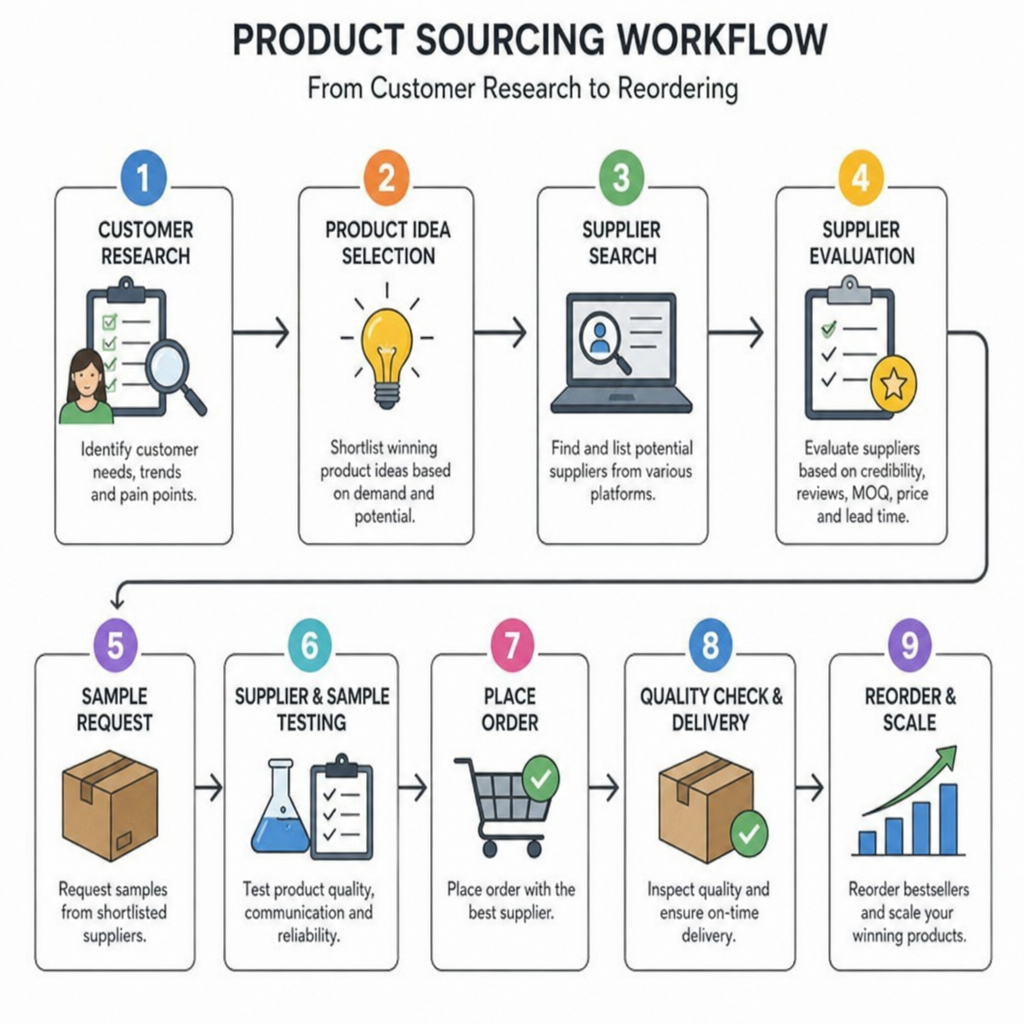
It includes identifying products, evaluating suppliers, ordering samples, and calculating costs before purchasing inventory.
Some businesses buy and store goods; others use suppliers that ship directly to customers.
Treat sourcing as a series of decisions rather than a shopping trip. A product should pass your demand, quality, cost, and delivery checks before it earns a place in your catalog. A low quote alone should never settle the decision.
Write a brief before contacting suppliers: who the buyer is, what problem the item solves, which specifications matter, and how much money you can put at risk. This gives every conversation a clear purpose.
How do you choose products worth selling online?
Choose products by investigating customer demand, competing offers, and the practical requirements of selling each item. Look for a specific buyer and a clear reason that buyer would choose your offer.
The Small Business Administration recommends combining market research with competitive analysis to identify an advantage.
Start with a customer situation rather than an enormous category. “Desk accessories” leaves almost everything undecided. “Compact cable organization for shared workspaces” gives you a clearer use case to investigate without assuming the idea will succeed.
For each candidate, build a short evidence file:
- Customer problem: Read reviews and speak with potential buyers. Record repeated frustrations, not isolated complaints.
- Competing offers: Compare materials, dimensions, bundles, delivery promises, and selling prices for genuinely similar items.
- Purchase evidence: Where available, examine completed sales rather than treating asking prices as proof of demand.
- Operational fit: Check storage needs, packaging requirements, variations, and the work needed to explain or demonstrate the product.
- Reason to choose you: Propose a useful improvement, such as clearer sizing information, a better-matched bundle, or more helpful instructions.
Keep observations separate from assumptions. “Several reviewers mention unclear dimensions” is evidence; “everyone will pay more for our version” is a hypothesis to test. Set a maximum research budget, then move the strongest candidate toward a small trial.
Match sourcing strategies to your resources
Wholesale, manufacturing, and dropshipping place different demands on your cash, storage, and involvement.
Wholesale involves buying inventory for resale, while manufacturing can involve producing or customizing goods to your requirements.
Dropshipping leaves inventory storage and customer shipment with a supplier.
Use this comparison to identify the questions each route needs to answer:
|
Sourcing model |
Consider it when |
Resolve before committing |
|---|---|---|
|
Wholesale |
You want existing products to stock and resell |
Order minimums, storage space, replenishment, and resale documentation |
|
Manufacturing or private label |
Your offer needs specific materials, features, or branding |
Specifications, samples, production quantities, and inspection arrangements |
|
Dropshipping |
You want supplier-managed storage and shipping |
Sample quality, dispatch times, tracking, packaging, and returns handling |
|
Print-on-demand |
Your offer centers on original designs applied after purchase |
Print consistency, usable margins, production time, and design rights |
|
Liquidation |
You can evaluate and process surplus or returned inventory |
Condition, manifest accuracy, freight, repair work, and unsellable units |
These are screening priorities, not promises of profitability. Start with the model you can operate reliably, then compare its costs against your proposed selling price.
Print-on-demand providers, for example, can print, package, and ship after an order, but you should still test the finished item.
Avoid assuming that you must use one model forever. For an unproven product, prioritize a manageable test over the largest available discount.
Build a supplier shortlist with comparable quotes
Use several discovery routes: supplier marketplaces, trade shows, manufacturer websites, and referrals. Trade shows offer opportunities to inspect products and meet suppliers, while online sourcing allows you to request samples and compare options remotely.
Send each candidate the same request for quotation. Include the product specifications, quantity, destination, packaging needs, and desired schedule. Alibaba’s sourcing guidance emphasizes documenting quantity, specifications, shipping information, and other agreed requirements in the order.
Your request should ask for:
- Sample price, shipping cost, and whether the sample represents normal production.
- Minimum order quantity, including minimums for individual colors or sizes.
- Unit prices at quantities you could realistically purchase.
- Production time, dispatch arrangements, and delivery estimates stated separately.
- Packaging, labeling, customization, and setup charges.
- Payment milestones and the process for handling shortages or defects.
Keep responses in a spreadsheet and mark missing answers. Ask follow-up questions before ranking suppliers; otherwise, the cheapest quote may simply exclude something another quote includes. Prefer clear answers over enthusiastic assurances.
How can you verify a supplier before ordering?
Verify a supplier by checking the business behind the offer, testing representative samples, and recording measurable order requirements. Request relevant documentation and confirm that the supplier can meet your specifications before placing a larger order.
Samples, detailed purchase orders, and inspection services are all safeguards identified in Alibaba’s buyer guidance.
Ask whether the business manufactures the item, distributes it, or coordinates another producer. Then confirm who handles quality problems and repeat orders. You need a workable accountability chain, not just a contact who answers quickly.
Test samples against a written checklist. Measure dimensions, inspect construction, try the intended use, and examine packaging. Keep photographs and notes so you can compare the shipment with the approved sample.
Put acceptance criteria in the order itself. “Premium quality” is subjective; a specified material, dimension, finish, or approved artwork version is easier to assess. Alibaba’s guidance similarly recommends precise specifications and keeping supporting evidence in platform records.
For eligible Alibaba.com purchases, Trade Assurance provides a dispute-resolution framework tied to the order terms and supported payment process. It is not blanket insurance against every commercial loss. Check the protection and deadlines for your particular order, and do not move payment off-platform based on an informal promise.
Calculate costs beyond the supplier’s price
Landed cost includes more than the item price: shipping, applicable duties, taxes, and other acquisition charges also matter. Build your calculation around the actual destination and shipment rather than assuming that a previous order’s costs will apply.
For your own planning, separate acquisition costs from the costs of making a sale:
Estimated contribution per sale = selling price − allocated landed inventory cost − selling fees − fulfillment costs − expected returns allowance − customer acquisition cost.
Use contribution to assess what remains toward overhead and profit; do not label it net profit. Include packaging and any handling work wherever they belong in your model, without counting the same expense twice.
Run a second, less favorable scenario. Try a lower selling price, a higher delivery quote, or fewer sellable units. If the order only looks attractive under optimistic assumptions, reduce its size or reconsider it.
Also map payment timing. Write down when deposits, balances, freight, and selling expenses must be paid, then compare that schedule with expected customer receipts. Keep a cash reserve rather than spending the entire budget on stock.
Use AliExpress research without relying on outdated instructions
If you searched for “aliexpress seller platform product sourcing guide 2025,” separate the supplier-evaluation advice from instructions about specific screens, features, or policies.
Recheck those details in the platform before ordering. For example, AliExpress’s Free Return terms distinguish participating products and buyers and include eligibility conditions; do not assume identical coverage across every purchase.
For a product you are considering, order a sample through the shipping route you intend to use. Record dispatch, tracking, arrival condition, packaging, and whether the item matches its description. Ask the seller to explain variant availability and how replacements would be handled.
If your plan involves dropshipping, test the complete customer experience rather than inspecting the product alone. Supplier-managed shipping does not give you firsthand control over each outgoing parcel, so establish expectations before publishing delivery promises.
Shopify’s dropshipping guidance recommends supplier research and product samples before committing.
Product sourcing 101: liquidation guide essentials
Liquidation requires careful attention to both inventory type and product condition. B-Stock distinguishes overstock, customer returns, display items, and other categories; it also notes that sellers can use different condition labels. Read the listing, manifest, and seller-specific definitions together instead of interpreting “returns” as a quality grade.
Use this checklist before bidding or buying:
- Review the manifest. Identify models, quantities, variations, and gaps that prevent a useful resale estimate.
- Confirm the photographs. Ask whether they show the actual merchandise or examples. B-Stock warns that listing images may be stock images and that stated retail values are estimates.
- Price the work. Allow for testing, cleaning, missing accessories, repackaging, and disposal where needed.
- Confirm freight. Establish who arranges transport and obtain a quote before deciding your maximum purchase price.
- Use conservative recovery estimates. Base your bid on what you expect to sell, not the lot’s headline retail value.
As a planning calculation, divide the total acquisition and preparation cost by the number of units you reasonably expect to sell. Treat uncertain units cautiously rather than counting every item as revenue. Set your maximum bid before the auction and stick to it.
Check safety and selling requirements before launch
For US consumer products, include a safety and recall review before accepting inventory or listing it. The Consumer Product Safety Commission says its laws apply to sellers and distributors, including secondhand sellers, and directs resellers to examine inventory and check recalls. Selling recalled products is illegal.
Do not treat a supplier’s willingness to sell as confirmation that your intended sale is permitted. Check the requirements for your product, destination, and sales channel, and obtain qualified help where the answer is unclear. Keep invoices, product identifiers, supplier correspondence, and any relevant documentation organized.
Turn a small test into a repeatable sourcing process
Before your trial order, define what would justify another purchase. Set decision rules for acceptable quality, delivery performance, contribution, and customer feedback. These are your operating thresholds, not universal industry benchmarks.
Track what happens after launch: which variants sell, why customers return items, how much handling is required, and whether actual costs match your estimate. Review the results before negotiating a larger quantity. A disappointing trial is useful if it prevents a much larger mistake.
The most useful sourcing techniques make decisions easier to repeat: consistent quote requests, written specifications, sample checklists, and order reviews. Start with one clear customer need, test a manageable purchase, and expand only when the evidence supports it. Sourcing products well means building a dependable offer—not merely finding something cheap.
Frequently Asked Questions About Product Sourcing
What is product sourcing?
Product sourcing is the process of finding, evaluating, and acquiring products to sell through an online store. It involves identifying reliable suppliers, assessing product demand, and managing inventory to meet customer needs effectively.
How do I choose the right products to sell online?
Start by researching customer demand, analyzing competing offers, and understanding the specific problem your products solve for buyers. Building a short evidence file for each potential product can help you make informed decisions.
What are the different sourcing strategies I can use?
Common sourcing strategies include wholesale purchasing, manufacturing or private labeling, dropshipping, print-on-demand, and liquidation. Each strategy has its own requirements and considerations regarding inventory management, cost, and fulfillment.
How can I verify a supplier before placing an order?
To verify a supplier, check their business legitimacy, request product samples, and review their documentation. It's essential to confirm that they can meet your specifications and quality standards before committing to a larger order.
What costs should I consider beyond the supplier's price?
Besides the item price, consider additional costs such as shipping, duties, taxes, and handling fees. Calculating the total landed cost is crucial to ensure that your selling price will cover all expenses and generate a profit.