Bring product sourcing, supplier communication, quality checks, and shipping coordination into one connected plan.
A China sourcing and shipping agent can serve as your central contact, with responsibilities agreed before work begins.
For wholesalers, retailers, and growing brands, the goal is straightforward: understand what you are buying, what needs approval, and how the order will reach its destination.
Request a sourcing and shipping plan. Share your product requirements, expected quantity, and delivery destination to start a focused discussion about scope, costs, and next steps.
What can one sourcing partner coordinate for you?
One sourcing partner can coordinate the journey from your initial product brief through supplier selection, sampling, production follow-up, inspection arrangements, and freight handover.
The exact services should be confirmed in writing, including work handled by outside specialists. Treat the partnership as a defined coordination role—not an assumption that every manufacturing, transport, or import responsibility transfers to the agent.
Build the scope around the decisions your business actually needs help making:
- Supplier research and comparison: Request candidates assessed against the same product specifications, quantities, and commercial requirements.
- Sampling and approvals: Set a process for reviewing samples, recording changes, and approving the version intended for production.
- Order follow-up: Define updates, milestones, and escalation points for delays or proposed substitutions.
- Quality coordination: Agree on inspection arrangements, acceptance criteria, reporting, and who decides whether goods can proceed.
- Shipping preparation: Include cargo details, collection arrangements, document handover, and delivery requirements in the plan.
Keep final purchasing decisions and spending approvals visible throughout. Your partner should know which actions require your consent, while you should know who is responsible for completing each task.
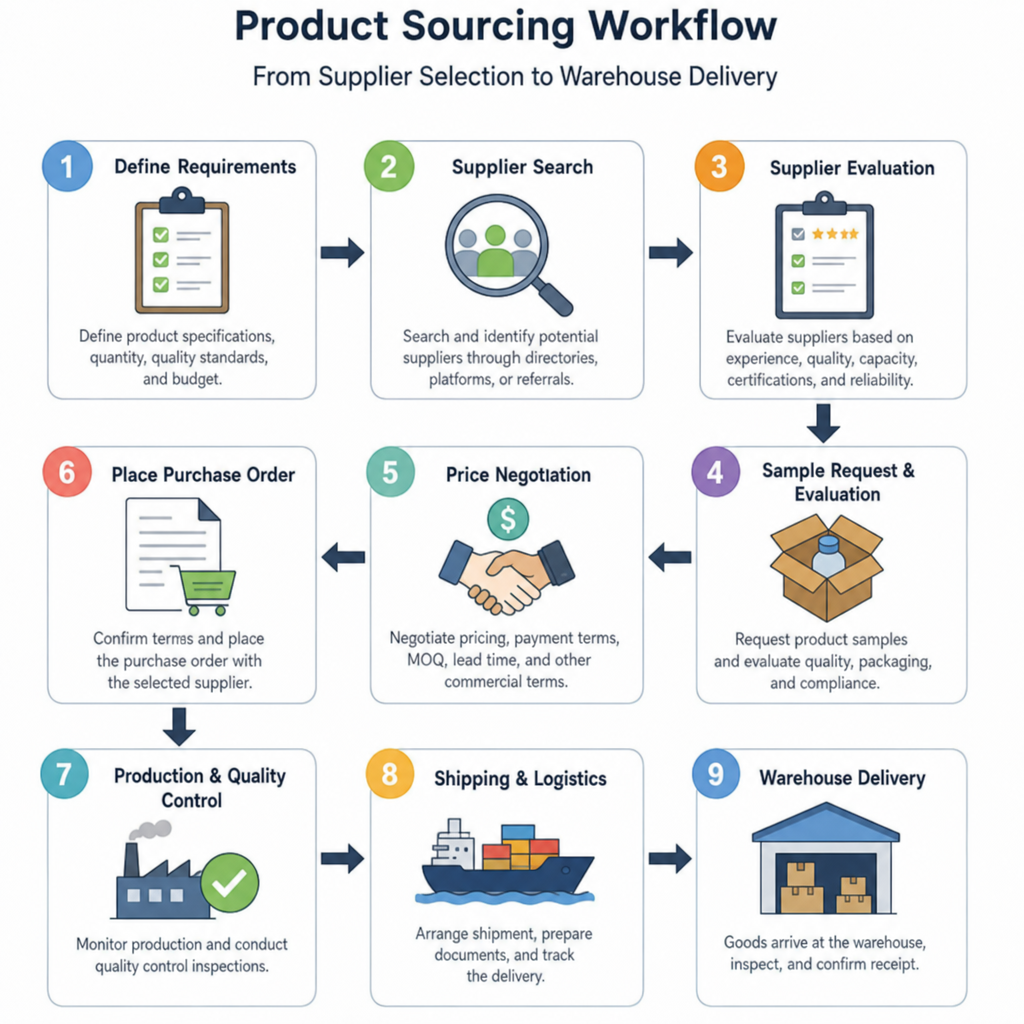
Connect sourcing decisions with delivery requirements
Start with the destination, not just the product listing. Tell your prospective partner where the goods need to arrive, how they will be received, and what must happen before they become saleable inventory. That gives the sourcing discussion a practical finish line.
For example, imagine ordering a product from one supplier and branded packaging from another. Your plan needs to connect sample approval, packaging dimensions, supplier completion dates, and the point where the two orders come together. Approving each purchase separately would leave those dependencies unresolved.
Ask for one shared order record covering specifications, approved samples, supplier commitments, inspection status, and shipment readiness. Use that record as the reference for changes rather than relying on separate message threads. When a decision changes, record its effect on cost, timing, and the next approval.
This is the working model to request: one central point of coordination, supported by clearly identified suppliers and specialists. It gives you a place to bring questions without pretending that one company performs every task itself.
Build your sourcing brief around the product you need
Effective China product sourcing starts with a usable brief. Canada's Trade Commissioner Service advises buyers to prepare appropriate drawings and specifications before sourcing, and to consider whether a supplier's operating scale fits their purchasing needs. Use that principle to make your requirements specific enough for meaningful supplier discussions.
Instead of requesting a “premium storage container,” describe the intended use, material, dimensions, finish, and packaging. Separate requirements you cannot compromise on from preferences you are willing to discuss. If an existing product is your reference, explain which characteristics matter rather than assuming the supplier will interpret the reference exactly as you do.
Prepare the following before requesting supplier proposals:
- Product definition: Photos, drawings, dimensions, materials, functions, and intended use.
- Order structure: Initial quantity, variations, packaging quantities, and possible reorder needs.
- Brand requirements: Logo files, artwork, label wording, and packaging references where available.
- Commercial priorities: Target budget, acceptable trade-offs, and your intended sales channel.
- Delivery context: Destination country, receiving locati0n, preferred arrival window, and relevant handling instructions.
You do not need every detail resolved before making contact. Mark unknowns clearly and ask which decisions must be settled before suppliers can provide useful quotations. The first deliverable can be a better brief rather than a premature purchase order.
Compare Chinese suppliers on a consistent basis
When sourcing products from China manufacturers, ask for a comparison that shows more than unit price. Set out the information each candidate must provide, then review the responses against your own priorities. A supplier comparison should help you choose a workable purchasing arrangement, not simply identify the lowest figure.
Make supplier background review a separate part of that process. The U.S. International Trade Administration recommends carefully selecting business partners and using due diligence to assess their suitability. A product quotation should therefore sit alongside relevant background checks, rather than substitute for them.
Request a comparison covering:
- The quoted specification, including any proposed alternatives or exclusions.
- Minimum order quantities for the product, each variation, and custom packaging.
- Sample charges, tooling charges, and other separately quoted items.
- Production timing assumptions and the event that starts the production schedule.
- Payment milestones, delivery terms, and the validity of the quotation.
- Available evidence supporting the supplier's stated capabilities.
Ask your partner to distinguish confirmed information from supplier statements that still need checking. Also request disclosure of who will manufacture the goods, who will issue the invoice, and who will receive payment. Keep unanswered questions visible until you decide whether the remaining uncertainty is acceptable.
Approve samples before committing to production
Make sample review a defined purchasing stage with an approval record. Specify what you want evaluated, who will review it, and how changes will be communicated. Treat the sample as a decision tool rather than a parcel that receives an informal thumbs-up.
For a branded household accessory, your review might cover fit, surface finish, color, logo placement, and the way the item sits inside its packaging. Record the outcome against each requirement. If the sample is acceptable except for one detail, state that exception clearly and decide whether another sample is needed.
Ask your sourcing partner to maintain a record of:
- The supplier and product version associated with each sample.
- Photographs, comments, and requested modifications.
- Approved materials, dimensions, finishes, artwork, and packaging.
- Remaining issues and the person responsible for resolving them.
- Written approval to proceed to the next agreed stage.
Do not treat visual sample approval as confirmation of every product requirement. Identify any separate testing, technical review, or specialist advice your project needs, and assign responsibility before production approval. Keep those decisions connected to the purchasing plan instead of leaving them for shipment time.
Keep production follow-up tied to clear milestones
Once you approve an order, ask for a schedule that identifies decision points as well as expected dates. Include the approvals needed to start work, the updates you want during production, and the evidence required before dispatch. Make each milestone understandable to someone who has not followed every supplier conversation.
A useful update should explain what has been completed, what remains open, and whether a decision is needed from you. Request photographs or documents where they serve a specific purpose, rather than collecting updates without a clear standard. Agree on how urgent issues will be escalated.
Consider a packaging change proposed after production begins. Your partner should present the proposed change, the reason, and any quoted effects on price or schedule before seeking approval. Keep the original requirement in force until you authorize a replacement.
For repeat orders, reference the approved specification and record any changes explicitly. Ask whether the supplier is quoting the same product, packaging, and commercial terms as before. A reorder should have its own confirmation rather than depend on the phrase “same as last time.”
Define quality checks before shipment release
Build quality expectations into the order rather than introducing them after the goods are ready. Canada's Trade Commissioner Service recommends checking quality before shipment and ensuring packaging meets the buyer's requirements. Use those checkpoints to define what your partner must arrange and what evidence you need before deciding whether to release the order.
Specify the inspection scope with the appropriate provider. For your project, that could include reviewing selected dimensions, appearance, functionality, labeling, packaging, or quantities. State the agreed criteria and reporting requirements instead of relying on an undefined promise of “strict quality control.”
Before inspection, establish the decision path:
- Who appoints the inspector and pays the inspection charges.
- Which specification and approved references the inspector will use.
- How findings will be documented and shared with you.
- Who discusses corrective action with the supplier.
- Whether another inspection is required after corrections.
- Who has authority to approve shipment release.
If a report identifies a problem, request a proposed resolution before making the next decision. Record whether you require rework, replacement, another check, or a different agreed outcome. Keep commercial discussions separate from the factual inspection findings so you can see both clearly.
Plan collection and consolidation around order readiness
If your purchasing plan involves several suppliers, discuss consolidation before placing the orders. Consolidation can involve collecting cargo from multiple suppliers into a coordinated shipment; DHL describes this approach for combining supplier volumes into dedicated containers. Availability and suitability still need to be confirmed for your shipment.
Ask where goods would be received, how incoming cargo would be identified, and what happens when suppliers finish at different times. Include receiving checks, storage arrangements, handling charges, and release instructions in the proposal. Do not assume those activities are included in a freight quotation.
Return to the example of a product and its branded packaging arriving from different suppliers. Decide who confirms that the quantities match, whether any packing work is required, and when the combined order becomes ready for collection. Make those tasks explicit before goods move.
Your China shipping agent also needs a complete cargo description. Request confirmation of the final carton count, packed dimensions, weight, collection addresses, and any handling considerations relevant to the goods. Use the final information to review the shipment proposal rather than treating an early estimate as the finished plan.
Agree on shipping scope and commercial responsibilities
Ask for shipping options presented against the same starting point and destination. Each proposal should state the service offered, the charges included, the assumptions behind the estimate, and the responsibilities left with you. Request an expected schedule that distinguishes preparation and collection from the international transport stage.
Confirm the delivery term in the purchase contract. Incoterms® rules allocate specified costs, risks, and obligations between buyers and sellers, including responsibilities related to transport and customs formalities. They should be selected deliberately and understood alongside the rest of your agreement.
For each proposed shipment, request written confirmation of:
- The collection point and the exact delivery point covered by the quotation.
- Origin handling, transport, destination handling, and delivery charges included.
- Excluded charges and circumstances that may create additional costs.
- Cargo insurance arrangements, if requested, and the coverage being proposed.
- Required documents, responsible parties, and relevant handover deadlines.
- How shipment changes, exceptions, or delivery problems will be communicated.
Choose the arrangement that fits your inventory needs and budget after reviewing the full scope. If one option has a lower headline price, identify what it excludes before comparing it with a broader service. Ask for clarification wherever the wording leaves responsibility unclear.
Keep importing responsibilities visible
One coordination partner does not remove the need to identify the importer and the appropriate customs support. For U.S. shipments, CBP states that the importer of record remains ultimately responsible for entry-document accuracy and applicable duties, taxes, and fees, even when using a broker. Confirm your responsibilities with a qualified customs professional before shipping.
Product-specific requirements also deserve early attention. CBP advises importers to ensure merchandise meets applicable requirements administered by other agencies and to obtain required licenses or permits where relevant. Ask the appropriate specialist to assess your actual product rather than relying on general assurances about importing from China.
Build document coordination into the sourcing scope. Ask who gathers product descriptions, invoice information, packing details, and supporting records, and who reviews them before submission to the relevant professional. Resolve inconsistencies through a documented process.
Keep compliance decisions distinct from logistics coordination. Your sourcing contact can be a point of communication, but ask which activities require a licensed broker, testing provider, attorney, or other specialist. For destinations outside the United States, obtain advice specific to the destination and goods before committing to shipment.
Review the complete cost before approving the order
Use a project cost worksheet rather than a unit-price comparison alone. Ask each provider to identify its own charges, supplier charges, third-party charges, and estimates that remain subject to confirmation. Keep the worksheet updated as specifications and shipment details become final.
Include only applicable items, but leave no relevant category unexamined:
- Product purchase price, customization, and tooling.
- Samples, sample delivery, and agreed development work.
- Sourcing or coordination fees and the basis for calculating them.
- Inspection, testing, or specialist review charges.
- Collection, receiving, storage, packing, and consolidation.
- International transport, insurance, and destination services.
- Broker charges, assessed import costs, and final delivery.
Where a charge is not yet known, label it as an estimate or an unresolved item. Ask what information is needed to confirm it and who will supply that information. Your approval should distinguish confirmed expenditure from amounts that may change.
Set a spending authorization process as well. State which charges your partner may incur without further approval and which require written consent. That gives both sides a practical way to handle small operational decisions without leaving larger commitments open-ended.
Choose a partnership that matches your buying situation
A single-partner model is worth discussing when you want help connecting several purchasing stages. Define the work you need coordinated before comparing sourcing agents in China. Then assess proposals against that scope, rather than assuming every China sourcing agent offers the same service.
Your brief may fit one of these situations:
- A first wholesale order: You have a product idea but need a structured route through supplier comparison, samples, approvals, and shipment planning.
- A private-label launch: You need product specifications, artwork, packaging, and approval records managed together.
- A multi-supplier purchase: You want collection and shipment planning discussed alongside separate production schedules.
- An established reorder program: You need consistent order records, exception reporting, and confirmation of changes between purchases.
If your suppliers, inspection arrangements, and freight processes are already established, consider requesting a narrower coordination scope. Ask the prospective partner to identify where its involvement begins and ends. Avoid paying for overlapping work that your team or another provider already performs.
Whether you buy wholesale China products for resale or source components for your own range, make the working relationship explicit. Request fee disclosure, supplier relationship disclosure, communication expectations, and a written description of deliverables before appointing a partner.
Start with a focused sourcing and shipping request
Turn your product idea or existing order into a brief that a prospective partner can assess. You do not need a finished procurement department or a fully resolved shipping plan. You do need to explain what you want to buy, where the goods need to go, and which parts of the process require support.
Include these details in your initial request:
- The product: Send a description, reference images, or an existing specification.
- The quantity: State your expected initial order and any planned variations.
- The destination: Identify the country and intended receiving locati0n.
- The priorities: Explain your budget expectations, timing needs, and non-negotiable requirements.
- The support required: Identify supplier research, sampling, order follow-up, inspection coordination, shipping, or an agreed combination.
Ask for a proposed scope, fee structure, required approvals, and the information needed to move forward. If something is unknown, say so; make resolving that uncertainty part of the discussion. Review the proposal before authorizing supplier outreach, paid samples, or other chargeable work.
Request your sourcing and shipping plan. Build your China supply chain around a clear brief, documented decisions, and a coordinated route from supplier selection to delivery.
Frequently Asked Questions About Sourcing and Shipping Products from China
What is a sourcing agent, and how can they help me?
A sourcing agent is a professional who helps businesses find and negotiate with suppliers in China. They can assist with product sourcing, supplier communication, quality control, and shipping logistics to streamline the procurement process.
How do I find reliable suppliers in China?
To find reliable suppliers, conduct thorough research by using online platforms like Alibaba or global sourcing websites, attending trade fairs, or seeking recommendations from trusted partners. It's essential to verify the suppliers' credentials, assess their production capabilities, and check reviews or references.
What factors should I consider when negotiating prices with Chinese suppliers?
Consider factors like production costs, minimum order quantities, payment terms, shipping expenses, and potential customs duties when negotiating prices. It’s also important to discuss quality standards and lead times to ensure alignment on expectations.
What are Incoterms, and why are they important in shipping?
Incoterms (International Commercial Terms) are a set of rules that define the responsibilities of buyers and sellers in international transactions. They clarify who is responsible for shipping costs, insurance, and customs duties, making them essential for avoiding misunderstandings during the shipping process.
How can I ensure the quality of the products I source from China?
To ensure product quality, establish clear specifications and quality standards before production begins. Conduct pre-production and post-production inspections, and consider hiring third-party inspection services to verify that the products meet your requirements before shipment.