











For overseas buyers, sourcing from China is no longer simply about finding a factory with a competitive price. As global trade becomes more complex, buyers need to weigh supplier reliability, production capacity, quality consistency, lead times, inventory, logistics, compliance, and shifting market demand — all at once.
A sourcing strategy that works under normal conditions can quickly become difficult to maintain when demand changes, a supplier runs into production issues, or logistics conditions shift. This is why supply chain resilience has moved from a nice-to-have to a core priority in China sourcing.
A resilient China sourcing supply chain is not necessarily built by working with the largest number of suppliers or holding the largest amount of inventory. It rests on systematic supplier evaluation, appropriate diversification, flexible procurement planning, continuous quality control, integrated logistics, and regular supply chain reviews.
For overseas buyers looking to source products from China in 2026, the key question is no longer simply:
"Where can I find a supplier?"
It is:
"How can I build a sourcing system that remains reliable when conditions change?"
What Is a Resilient China Sourcing Supply Chain?
A resilient China sourcing supply chain is a procurement system that allows overseas buyers to maintain reliable supply while adapting to changes in suppliers, demand, costs, regulations, and logistics. It combines reliable supplier relationships, diversified sourcing options, flexible purchasing, quality control, inventory planning, and supply chain visibility.
In practice, this means building a sourcing system where:
- Suppliers are evaluated systematically rather than by price alone
- Critical products have appropriate backup sourcing options
- Procurement volumes can adapt to changing demand
- Product quality is monitored throughout the purchasing process
- Inventory and replenishment plans reflect realistic lead times
- Procurement, warehousing, and logistics are properly coordinated
- Supplier and supply chain performance is reviewed regularly
Together, these practices help overseas buyers reduce sourcing risks while maintaining a more stable and flexible supply operation.
1. Why China Sourcing Needs a More Resilient Strategy in 2026
China remains an important sourcing market because of its extensive manufacturing ecosystem, product variety, competitive production capabilities, and established export infrastructure.
However, sourcing from China involves many interconnected decisions. Buyers may need to manage supplier communication, quotation comparison, sample development, production, quality inspection, order consolidation, and international logistics. When these processes are managed separately, a problem in one area can quickly ripple through the rest of the supply chain.
For example, selecting a supplier based mainly on price may create quality problems later. Large orders may reduce unit costs but increase inventory pressure. Relying entirely on one supplier can create significant disruption if that supplier cannot meet production requirements.
A China sourcing strategy should therefore be viewed as a long-term supply chain decision rather than a series of individual purchasing transactions. The aim is not to eliminate every possible risk — that is unrealistic. It is to build enough flexibility and visibility into the sourcing process to respond effectively when problems occur.
2. Start With a Systematic Supplier Evaluation Process
One of the most important steps in building a resilient China sourcing supply chain is establishing a consistent supplier evaluation process.
Many buyers initially compare suppliers based on quotation, MOQ, and product appearance. While these factors matter, they are not enough to determine whether a supplier is suitable for long-term cooperation. A more complete evaluation should consider:
Manufacturing Capability
Can the supplier consistently produce the required specifications? Buyers should examine production capacity, equipment, manufacturing experience, product expertise, and the ability to handle expected order volumes. Capacity should also be assessed during peak seasons — a supplier that performs well on a small trial order may struggle when volumes increase.
Quality Consistency
A good sample does not automatically guarantee consistent bulk production. Buyers should understand how product specifications are controlled during manufacturing and whether the supplier has appropriate quality management procedures in place.
Lead Time and Reliability
Lead time should be based on realistic production conditions rather than an ideal quotation. Consider standard production time, peak-season capacity, raw material availability, replenishment capability, and historical delivery performance.
Communication and Responsiveness
Clear communication is critical in international sourcing. A reliable supplier should be able to communicate effectively about specifications, production schedules, quality issues, packaging, and order changes.
Export and Compliance Capability
Depending on the product and destination market, buyers may also need to verify certifications, testing requirements, labeling, packaging standards, and export documentation. These requirements should be confirmed before production begins.
A Practical Evaluation Process
Instead of selecting a supplier after one quotation, buyers can use a staged process:
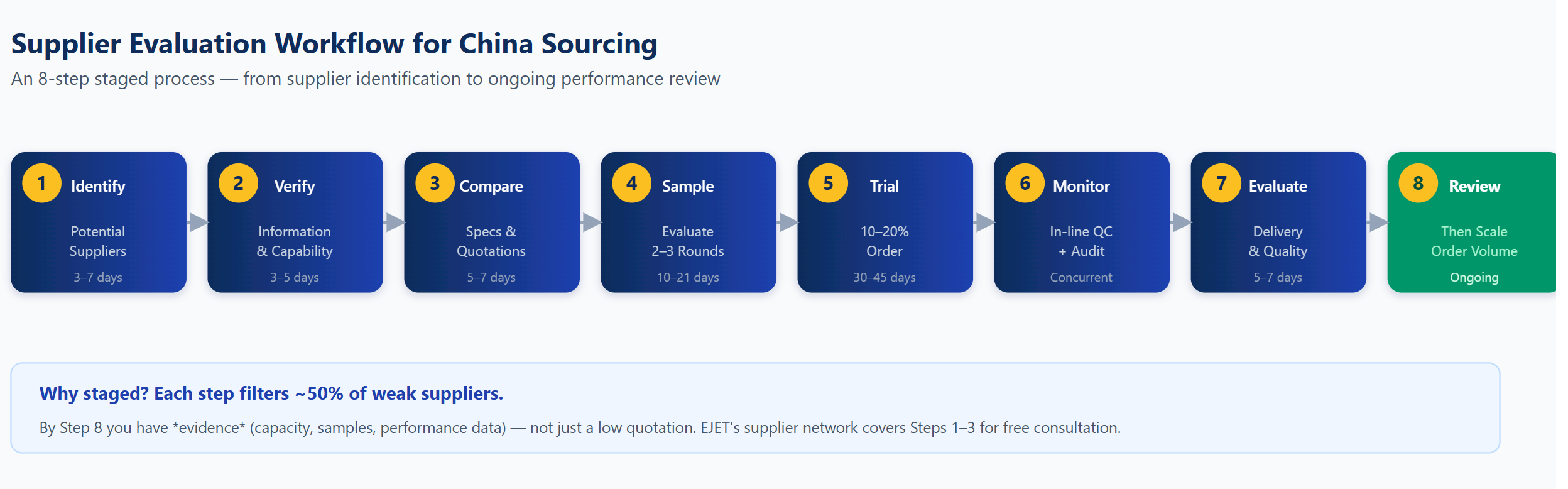
- Identify potential suppliers
- Verify supplier information and capabilities
- Compare specifications and quotations
- Request and evaluate samples
- Conduct a trial order where appropriate
- Monitor production and quality
- Evaluate delivery performance
- Review performance before increasing order volume
This requires more work initially but can significantly reduce the risk of committing to an unsuitable supplier.
3. Build a Reliable and Diversified Supplier Network
Supplier diversification is another important part of supply chain resilience. However, this does not mean every product needs multiple suppliers. Excessive supplier fragmentation can increase management costs and create inconsistent product specifications.
The objective is to balance supplier stability with sourcing flexibility. For critical products, buyers can consider maintaining:
- A proven primary supplier
- One or more qualified backup suppliers
- Clearly documented product specifications
- Consistent quality standards
- Alternative production options where practical
For example, a buyer may use one primary supplier for regular production while keeping a qualified backup supplier that can be activated if demand increases or the primary supplier experiences disruption.
Supplier diversification is particularly useful for:
- High-volume products
- Seasonal products
- Business-critical products
- Products that are difficult to replace quickly
- Products where supply disruption would have a significant business impact
The key question is not how many suppliers a business has, but which products require additional sourcing options.
4. Make Procurement and Inventory Planning More Flexible
A resilient sourcing strategy also requires flexible procurement and inventory planning. Placing large orders simply to obtain lower unit costs can create unnecessary inventory risk when demand is uncertain.
Procurement decisions should consider:
- Historical sales
- Demand forecasts
- Current inventory
- Supplier lead time
- Production capacity
- Shipping time
- Seasonal demand
- Product lifecycle
- Working capital
- Replenishment speed
Different products require different purchasing strategies. For new products with uncertain demand, smaller initial orders can help businesses test market response before making larger commitments. For established products with predictable demand, more structured procurement plans may be appropriate. Seasonal products require additional consideration of both production and international logistics lead times.
For overseas buyers, the effective replenishment cycle includes more than factory production. It may also involve supplier confirmation, raw material preparation, inspection, consolidation, export procedures, and international transportation. Inventory planning and China procurement strategy should therefore be managed together — the aim is not simply to hold more stock, but to maintain enough inventory and sourcing flexibility without unnecessarily tying up working capital.
5. Integrate Quality Control Into the China Sourcing Process
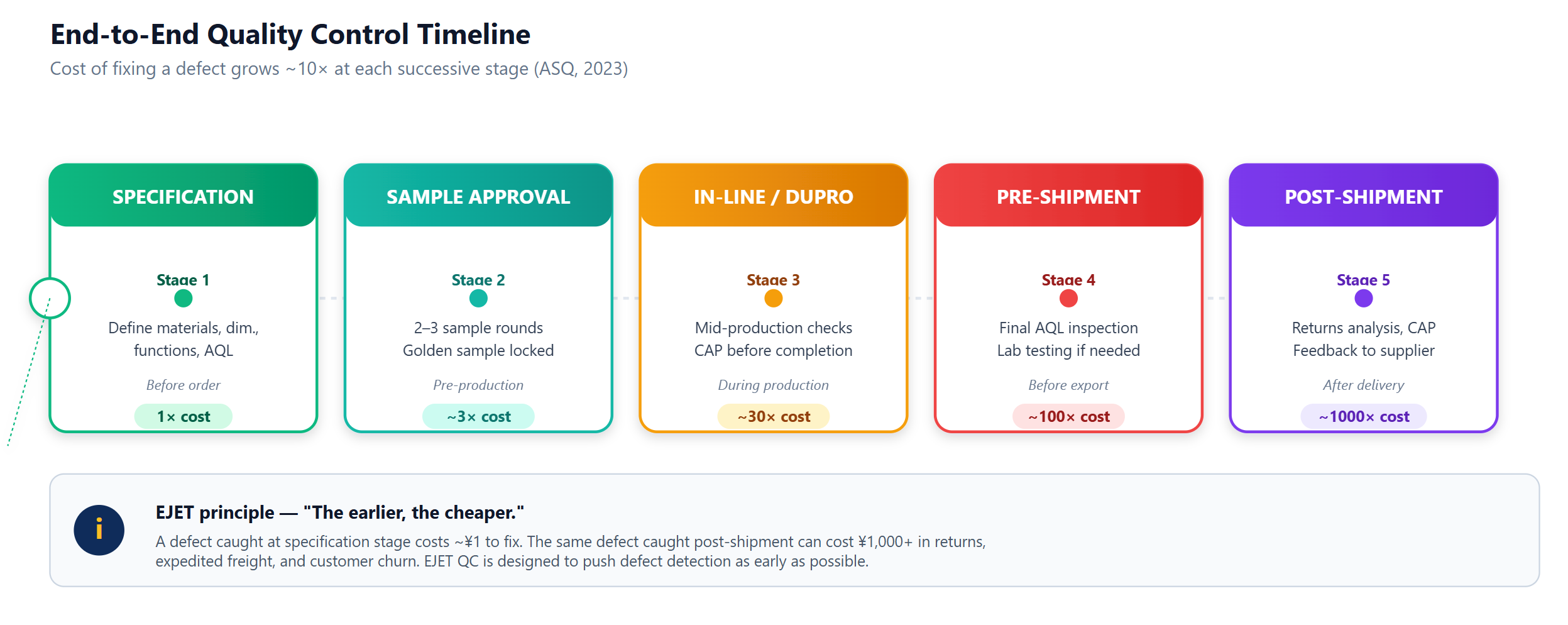
Quality control should not be treated as a final inspection before shipment. For a resilient China sourcing supply chain, quality management should be integrated throughout the procurement process.
Product Specification
Before placing an order, buyers should establish clear requirements for materials, dimensions, colors, functions, packaging, labeling, performance, and acceptable quality standards. Clear specifications make it easier to evaluate bulk production.
Sample Approval
The approved sample provides an important reference for mass production. For customized or private-label products, this stage is particularly important because product specifications must be clearly confirmed before production begins.
Production Monitoring
Quality problems are usually easier to resolve during production than after goods have arrived overseas. Depending on the product and order size, buyers can use production monitoring, supplier quality checks, or other inspection procedures to identify problems earlier.
Pre-Shipment Inspection
A final inspection can help verify whether finished goods meet agreed specifications before shipment. For products requiring specialized testing or certification, third-party inspection and testing may also be appropriate.
The principle is simple:
The earlier a quality problem is identified, the more options the buyer has to resolve it.
6. Connect Procurement, Warehousing, and Logistics
Supplier management alone cannot create a resilient supply chain. After production, buyers still need to manage consolidation, warehousing, transportation, and delivery.
When sourcing from multiple Chinese suppliers, buyers may need to coordinate different production schedules, packaging formats, pickup locations, warehouse receiving, export documentation, and shipping arrangements. Managing each supplier separately can create unnecessary coordination work — especially for overseas businesses without a local procurement team in China.
An integrated approach can improve supply chain visibility and make order consolidation and shipment planning more efficient. Instead of independently coordinating factories, inspection providers, warehouses, and logistics companies, buyers can use a centralized procurement process. The aim is not necessarily to outsource every part of the supply chain, but to create a clear management structure in which procurement, quality control, warehousing, and logistics work toward the same delivery objective.
7. Continuously Review and Improve Your China Sourcing Strategy
A sourcing strategy should not remain unchanged after suppliers have been selected. Markets change, demand changes, supplier performance changes, and logistics costs change. New suppliers may also enter the market while existing suppliers expand or reduce their capabilities.
For this reason, supplier management should be an ongoing process. Overseas buyers can regularly review:
- On-time delivery
- Product quality
- Defect rates
- Price changes
- MOQ changes
- Production capacity
- Response time
- Order fulfillment
- Lead-time stability
- Dependence on individual suppliers
- Inventory turnover
- Logistics performance
The purpose is not simply to rank suppliers, but to identify potential problems before they become major disruptions. For example, a consistent increase in supplier lead times may indicate a capacity problem. Rapidly increasing demand for a product may also require buyers to reassess supplier capacity or develop an additional sourcing option.
A resilient China supply chain is therefore not a fixed structure. It is a system that must be continuously monitored and adjusted.
8. When Should Overseas Buyers Work With a China Sourcing Partner?
Not every overseas buyer needs a professional sourcing company. Businesses with an experienced China-based procurement team may already have the supplier relationships, quality control processes, and logistics infrastructure required to manage sourcing independently.
However, a China sourcing partner can be valuable when a business:
- Does not have a local procurement team in China
- Needs to identify multiple qualified suppliers
- Sources products across different manufacturing regions
- Has difficulty verifying Chinese suppliers remotely
- Needs product development or OEM/ODM support
- Requires production quality control
- Purchases from multiple suppliers
- Needs consolidated procurement and logistics management
- Wants to scale procurement without building a large local team
The value of a sourcing partner should not simply be measured by whether it can find a lower price. A capable partner should help build a more reliable procurement system through supplier discovery, evaluation, negotiation, product development, order management, quality control, warehousing, consolidation, and logistics coordination. In other words, the role is closer to supply chain management than simply "finding products."
9. How EJET Supports a More Resilient China Sourcing Strategy
For overseas buyers looking to build a more structured sourcing operation in China, EJET provides end-to-end procurement and supply chain services.
Founded in Yiwu in 2007, EJET has developed from a sourcing company into an integrated supply chain ecosystem serving global buyers and Chinese suppliers. Its services cover product discovery, sourcing, procurement execution, quality control, supply chain management, and global market expansion.
Through EJET Procurement, buyers can access services covering supplier discovery, product development, procurement management, quality assurance, and global logistics. EJET also provides sourcing tours and buying agent services in major Chinese sourcing hubs, together with OEM/ODM support for customized products. The objective is not simply to connect buyers with individual factories, but to make the sourcing process more structured and manageable.
Supplier Discovery and Matching
Finding a supplier is only the beginning. EJET works with an established supplier network to help match buyer requirements with appropriate manufacturing resources, reducing some of the information and communication barriers overseas buyers may face when sourcing directly from China.
Flexible Procurement
Different businesses require different purchasing models. For ecommerce sellers, low MOQs, small-batch testing, flexible manufacturing, and faster replenishment can be important when demand is uncertain. For importers and wholesalers, stable supply, supplier verification, cost control, and long-term supplier management may be more important. EJET provides sourcing solutions designed around these different business requirements.
Quality Control and Execution
As order volumes increase, quality consistency and supply chain coordination become increasingly important. EJET's procurement services include supplier audits, quality inspections, procurement management, and logistics coordination, providing overseas buyers with a more centralized approach to China sourcing. For businesses without a mature procurement team in China, this can reduce the operational burden of independently managing multiple suppliers and supply chain processes.
10. A Practical Framework for Building a Resilient China Sourcing Supply Chain
Building supply chain resilience does not require changing everything at once. Overseas buyers can start by reviewing their current sourcing operation across six areas:
If weaknesses exist in any of these areas, they can become potential sources of supply chain disruption.
The objective is not to build the most complicated procurement system.
It is to build a system that is reliable enough for today's operations and flexible enough for tomorrow's changes.
Frequently Asked Questions About China Sourcing
What makes a China sourcing supply chain resilient?
A resilient China sourcing supply chain combines reliable suppliers, appropriate supplier diversification, flexible procurement, effective quality control, realistic inventory planning, integrated logistics, and continuous supplier performance management.
How should overseas buyers evaluate Chinese suppliers?
Supplier evaluation should consider manufacturing capability, product quality, production capacity, lead time, MOQ, communication, export experience, compliance requirements, pricing, and long-term reliability. Samples and trial orders can provide additional evidence before larger commitments are made.
Should I work with one supplier or multiple suppliers in China?
There is no universal answer. A single reliable supplier can simplify management, while multiple qualified suppliers can reduce dependence on one source. The appropriate structure depends on product criticality, order volume, switching costs, and supply risk.
How can I reduce risks when sourcing products from China?
Start with systematic supplier evaluation, use samples and trial orders, establish clear product specifications, implement quality control, maintain appropriate backup sourcing options, and coordinate procurement with inventory and logistics planning.
How can small businesses source from China without a local team?
Small businesses can work with a professional China sourcing company or procurement partner to handle supplier discovery, product sourcing, supplier communication, quality control, order coordination, and logistics.
What does a China sourcing company do?
A China sourcing company can help overseas buyers identify and evaluate suppliers, negotiate purchasing terms, develop products, manage orders, coordinate quality control, consolidate shipments, and support logistics.
Conclusion: Resilience Is the Next Competitive Advantage in China Sourcing
The future of China sourcing is not simply about finding the cheapest supplier. For overseas buyers, the more important question is whether the entire sourcing system can continue to deliver reliable products when demand, costs, suppliers, or logistics conditions change.
A more resilient China sourcing supply chain starts with six fundamental practices:
- Systematic supplier evaluation
- Reliable and diversified supplier networks
- Flexible procurement and inventory planning
- Continuous quality control
- Integrated warehousing and logistics
- Regular supply chain review and optimization
These practices can help businesses reduce sourcing risks, improve operational visibility, and respond more effectively to changing market conditions.
China sourcing does not have to be complicated.
The right strategy is to make it structured, transparent, flexible, and scalable.
For businesses looking for professional support with sourcing, procurement, supplier management, quality control, and supply chain execution in China, EJET Procurement provides an end-to-end sourcing infrastructure designed to simplify the process and support long-term growth. You can also get in touch with our team to discuss your specific sourcing needs.
EJET — Simplify Your Supply Chain.

_1751507038923.png)