Procurement services coordinate the work of identifying business needs, evaluating suppliers, negotiating agreements, and managing supplier relationships.
They connect buying decisions with the wider supply chain management process rather than treating each purchase as an isolated transaction.
This article explains how to organize that work around clearer requirements, practical controls, and measurable outcomes.
The goal is not simply to approve orders faster or demand bigger discounts. Build a process that helps employees obtain what they need while giving procurement, finance, and operations a shared view of cost, responsibility, and performance.
What makes procurement services efficient?
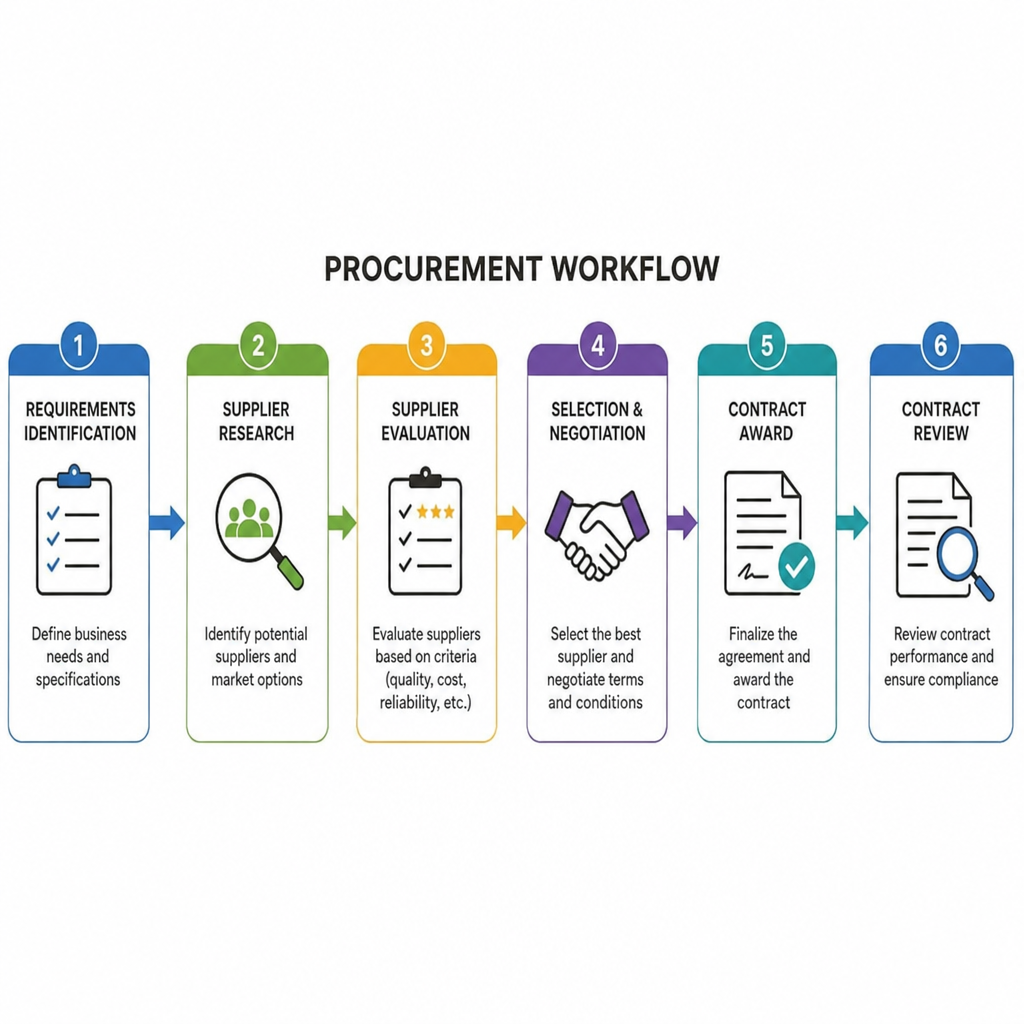
Efficient procurement services combine clear requirements, an appropriate sourcing approach, and ongoing performance management.
The process should connect the original business objective to supplier selection and contract delivery, rather than ending when an agreement is signed.
GSA’s acquisition framework follows this progression from team formation and objectives through market research, sourcing, performance management, and closeout.
Start by defining efficiency in terms your organization can assess. A routine replenishment order and a business-critical service agreement should not automatically follow the same review path. Set controls according to the purchase’s complexity, operational importance, and risk.
Use three questions to test proposed improvements:
- Does this remove avoidable work? Look for repeated data entry, unclear handoffs, and approvals that duplicate an earlier review.
- Does this preserve necessary oversight? Keep an accountable owner for specifications, budget approval, supplier selection, and acceptance.
- Does this improve the outcome? Check whether the change supports reliable delivery and usable services, not just a shorter approval time.
Start with a shared view of spending and demand
Before changing suppliers or buying technology, assemble a usable picture of current purchasing. Combine purchase orders, invoices, supplier records, and active agreements where available. Choose a review period that captures your normal buying cycle and any important seasonal variation.
Group the information by category, business unit, supplier, and contract status. Investigate purchases that appear similar but use different descriptions or supplier names. Confirm whether those differences reflect genuine operational needs before recommending consolidation.
For example, ask departments purchasing maintenance supplies to compare specifications and delivery requirements. Consider a shared agreement where their needs align, but preserve exceptions for specialized equipment or locations. Avoid treating every variation as waste.
Turn the review into a short opportunity register. For each opportunity, name an owner, identify the evidence needed, and record the operational concern that could prevent implementation. Prioritize work that has both a clear business benefit and a realistic path to completion.
How does strategic sourcing improve purchasing decisions?
Strategic sourcing improves purchasing decisions by connecting business objectives and market research to the choice of supplier and commercial approach.
Instead of beginning with a preferred vendor or a request for discounts, define the required outcome and investigate how suppliers could deliver it. GSA’s acquisition guidance places objectives, market research, and requirements before acquisition strategy and source selection.
For each important category, prepare a sourcing brief before contacting the market. Agree on the evaluation approach with the people who will use, fund, and manage the purchase. Keep the brief specific enough to guide decisions without prescribing unnecessary details.
Include these elements:
- Business outcome: Explain what the purchase must enable and what would count as an unacceptable result.
- Demand profile: Describe expected usage, delivery locations, timing, and any uncertainty suppliers should address.
- Cost comparison: Request a consistent breakdown of setup, usage, support, maintenance, and exit charges where relevant.
- Evaluation evidence: Identify the demonstrations, documents, references, or other evidence needed to assess each proposal.
Compare offers against the same assumptions. Where a supplier proposes a different scope or pricing basis, resolve the difference before ranking proposals. Record the reasoning behind the recommendation so approvers can understand the trade-offs.
Write requirements around observable outcomes
Describe what successful delivery looks like before deciding how to measure it. For a service agreement, specify the required output, delivery conditions, acceptance criteria, and responsibilities on both sides.
As a useful reference point, federal performance-based acquisition guidance emphasizes required results and measurable standards rather than simply prescribing hours or methods.
Replace broad requests such as “provide responsive support” with a requirement stakeholders can interpret consistently. Ask which incidents need attention, how priorities will be assigned, and what evidence will show that an issue is resolved. Set actual targets only after confirming business needs and supplier capability.
Invite users and operational managers to challenge the draft. Ask them to identify missing dependencies, unrealistic assumptions, and requirements that add cost without supporting a necessary outcome. Resolve conflicting expectations before seeking final offers.
Also identify what your organization must provide. Specify access, information, approvals, equipment, or staffing needed for the supplier to perform. Assign internal owners to those dependencies rather than leaving them implicit.
Make vendor management proportionate to business risk
Organize vendor management around the importance of each relationship instead of giving every supplier the same meeting schedule and reporting burden. CIPS distinguishes strategic supplier relationships from less intensive arrangements, noting the time and resources needed to manage critical, high-risk, or high-value relationships.
Create a practical supplier segmentation method. Consider operational dependency, replacement difficulty, expenditure, and access to sensitive resources. Ask business owners to validate the result, particularly where a low-spend supplier supports an essential activity.
For critical suppliers, establish a review agenda covering delivery, quality, unresolved issues, upcoming demand, and changes that could affect service. Assign an owner and due date to each agreed action. Escalate recurring problems through a defined route rather than allowing them to disappear into meeting notes.
For routine suppliers, use lighter monitoring and review exceptions when they occur. Keep contact details, contract ownership, and renewal dates accessible. Reserve more intensive relationship work for situations where it supports an identifiable business need.
Approach contract negotiation as an operating agreement
Use contract negotiation to settle how the relationship will work, not just what it will cost. Prepare a prioritized list of required outcomes, acceptable alternatives, and points needing specialist review. Bring procurement, operations, finance, and appropriate legal advisers into the discussion before committing to material terms.
Ask negotiators to address the complete commercial arrangement:
- Scope and acceptance: Define included work, exclusions, deliverables, and the process for confirming satisfactory completion.
- Pricing and changes: Clarify charging units, assumptions, price-review mechanisms, and authorization for additional work.
- Performance oversight: Agree on reporting, review responsibilities, and the process for addressing missed expectations.
- Transition and exit: Plan for handover, outstanding work, records, and relevant assets when the relationship ends.
Where appropriate, connect performance standards to an agreed assessment method. Federal performance-based contracting guidance provides an example of this discipline by pairing measurable standards with methods for evaluating contractor performance.
Apply requirements suited to your organization and procurement context rather than assuming federal rules govern every purchase.
After signature, translate the agreement into a working handover for the contract owner. Highlight commitments, review dates, dependencies, and escalation contacts. Check that the people managing delivery can locate the terms they need.
Apply document discipline to specialized procurement
Specialized purchases deserve careful attention to the actual solicitation, not assumptions drawn from a category name. For context, MARTA’s April 9, 2026, board agenda listed a resolution authorizing a contract award for Bus Tire Lease Services, IFB B50694.
That agenda entry identifies the procurement but does not establish its detailed specifications or contract obligations.
Someone searching for “georgia bus tire lease services procurement ifb b50694” should therefore use the reference to locate authoritative procurement records. Check the issuing authority’s documents and applicable amendments before relying on a summary. Do not infer present availability, submission instructions, or award terms from an agenda entry alone.
For a comparable fleet-service purchase, build a clarification checklist around the proposed operating model. Ask who would supply tires, perform servicing, maintain records, and manage replacements. Request explanations of charging assumptions and handover responsibilities without assuming those items appeared in this particular solicitation.
Use the same discipline for other specialized categories. Separate verified requirements from questions still awaiting answers, and retain the documents supporting each decision. Make unresolved assumptions visible before approval.
Choose technology around a defined workflow
Treat procurement technology selection as a process-design exercise. First map a request from submission through approval, ordering, receipt, and payment. Identify where information is missing, where ownership changes, and where users must repeat work.
Then write requirements for the workflow you want to support. Consider guided request forms, approval routing, searchable agreements, renewal reminders, and exception reporting. Ask prospective providers to demonstrate your actual scenarios rather than relying only on a standard presentation.
Pilot the proposed approach with a manageable category or business unit. Include both routine requests and realistic exceptions, such as incomplete specifications or an unavailable approver. Collect feedback from requesters, buyers, finance staff, and contract owners before expanding the rollout.
Set ownership for supplier records and approval rules. Decide who can create or change information and how corrections will be reviewed. Keep human review for decisions involving ambiguous requirements, significant commitments, or unresolved supplier concerns.
When should you consider procurement consulting?
Consider procurement consulting when you can define an important improvement project but need additional capacity, specialist input, or an independent assessment to complete it. Establish the problem, expected deliverables, and internal decision owner before inviting proposals. Evaluate the engagement against the work you need completed, not a broad promise of transformation.
For example, scope an engagement around analyzing a category, redesigning an intake process, or preparing a sourcing strategy. Require the proposal to explain the information needed, stakeholder involvement, review stages, and handover approach. Ask how recommendations will account for your operating constraints.
Compare proposed fees with the deliverables and responsibilities included. Clarify how potential benefits would be calculated and validated, particularly when compensation depends on savings. Distinguish proposals for future improvements from results already implemented.
Make knowledge transfer part of the scope. Request usable templates, documented decisions, and guidance for the employees who will maintain the process. Name an internal sponsor who can resolve issues and accept completed work.
Turn improvements into a repeatable operating rhythm
Choose a small set of measures linked to the outcomes you want. GSA’s acquisition guidance recommends relating performance measures directly to requirements and considering how results will be collected and assessed. Use that principle to avoid building a dashboard without a clear decision-making purpose.
Begin with measures your team can define consistently:
|
Measure |
Suggested definition |
Review question |
|---|---|---|
|
Request cycle time |
Time from a complete request to an approved order |
Where are requests waiting? |
|
Contract coverage |
Addressable spending supported by active agreements |
Which categories need attention? |
|
Supplier delivery performance |
Deliveries meeting agreed timing and acceptance criteria |
Which exceptions require action? |
|
Invoice exceptions |
Invoices requiring investigation before payment |
Are ordering or receipt records incomplete? |
Establish a baseline before setting targets. Review the underlying cases, not just averages, and assign owners to corrective actions. Start with one category or workflow, test the changes, and expand only after confirming what worked.
Efficient procurement is a practical discipline: define the need, compare realistic options, establish workable agreements, and follow through on delivery. Choose one recurring source of friction to address first. Make the improvement measurable, give someone ownership, and use the result to guide your next step.
Frequently Asked Questions About Procurement Services
What are the key components of efficient procurement services?
Efficient procurement services incorporate clear requirements, appropriate sourcing methods, and continuous performance management, ensuring that the entire procurement process aligns with business objectives and supplier capabilities.
How can organizations define efficiency in procurement?
Organizations should define efficiency based on their specific context by evaluating the complexity, importance, and risk associated with each purchase, allowing for a tailored review process that meets operational needs.
What is strategic sourcing and how does it enhance procurement decisions?
Strategic sourcing involves aligning business objectives with market research to choose suppliers and commercial approaches that best meet defined outcomes, ultimately leading to more informed and effective purchasing decisions.
Why is vendor management crucial in procurement services?
Vendor management is vital because it ensures that organizations can effectively oversee supplier relationships, reduce risks, and improve overall procurement performance by differentiating the management approach based on the importance and complexity of each supplier.
When should organizations consider using procurement consulting services?
Organizations should consider procurement consulting services when they need additional expertise, capacity, or an independent assessment for significant improvement projects, particularly when they have clear goals and deliverables in mind.