


“Made in China” connects two subjects: the influence of Chinese manufacturing on global commerce and the role of Made-in-China.com in helping businesses find suppliers.
The platform connects international buyers with independent sellers; it does not manufacture or sell the listed products itself. This guide explains the broader impact of Chinese production and offers a practical framework for assessing suppliers, costs, quality, and purchasing risks.
What does “Made in China” mean for buyers today?
For buyers, “Made in China” identifies a manufacturing origin, not a complete description of quality, value, or technical capability. China sourcing now involves more than finding inexpensive goods: Canada’s Trade Commissioner Service describes a manufacturing market that has moved up the value chain, including technically complex products.
The useful question is therefore whether a particular supplier can meet your requirements, not whether a country-of-origin label is inherently good or bad.
Keep three concepts separate when researching china products:
- Manufacturing origin: Where goods are produced, subject to the destination market’s applicable origin rules.
- Supplier identity: The business responsible for manufacturing, trading, or exporting the goods.
- Marketplace identity: The service used to discover suppliers and arrange transactions, such as Made-in-China.com.
This distinction matters because marketplace verification and import compliance address different responsibilities. A platform may help you investigate a supplier, while you still need to establish whether its products are suitable and admissible in your market. U.S. Customs and Border Protection places responsibility on importers to exercise reasonable care and meet applicable requirements.
The wider impact of Chinese manufacturing
Chinese manufacturing is part of global value chains in which components, production tasks, and expertise cross borders. The World Bank explains that these networks can increase productivity, employment, and access to technology, with value added across multiple locations. Chinese exports should therefore be understood as part of interconnected production systems, rather than exclusively as finished products competing on price.
More sourcing opportunities—and more decisions
Digital marketplaces make supplier discovery more accessible. On Made-in-China.com, buyers can search product categories, contact sellers, and submit sourcing requests to obtain quotations. These tools create opportunities to compare suppliers without beginning every relationship through an overseas visit. However, easier discovery is only the start of procurement; it does not establish that two apparently similar offers are equivalent.
Treat a wider supplier pool as an opportunity to ask better questions. Compare production capability, material choices, customization limits, and support requirements alongside the quoted price. A useful shortlist should reflect the needs of your business rather than the number of attractive listings you can collect.
Competitiveness requires a broader comparison
China trade can support sourcing strategies involving technically complex products and international supply chains, but China is not automatically the best locati0n for every purchase. The Trade Commissioner Service recommends assessing alternative sourcing locations and choosing a sourcing model before proceeding. It also advises matching supplier size to your intended business.
For a practical comparison, evaluate a Chinese supplier against realistic local or regional alternatives. Include replenishment needs, oversight effort, and the consequences of interruption. Consider a backup source for a business-critical component, even when the first supplier appears promising.
How Made-in-China.com fits into the sourcing process
Made-in-China.com is a business-to-business marketplace operated by Focus Technology Co., Ltd. Its role is to connect buyers with supplier members, whose products appear in marketplace listings. That distinction is essential: communicating through the platform does not make the platform the manufacturer or seller of your order.
Its buyer services include product and supplier searches, sourcing requests, supplier audit reports, and Secured Trading Service. The platform says its audit reports provide information about supplier capabilities, including trade ability and quality-control systems. These resources can support preliminary research and help buyers decide which companies deserve further investigation.
When using a china marketplace, give each tool a defined purpose. Use searches to identify candidates, reports to investigate capabilities, and conversations to clarify your requirements. Do not let a polished profile substitute for a product specification, accepted sample, or documented purchasing agreement.
Is Made-in-China.com legit?
Made-in-China.com is an established B2B platform with an identified operator, published user agreements, and documented buyer services. However, a legitimate marketplace does not guarantee every supplier, product, or transaction. A sensible answer to “is made in china com legit” separates the platform’s existence from the reliability of the particular company you intend to pay.
What an audited supplier badge establishes
The platform describes its Audited Supplier program as involving on-site verification and freely available audit reports. Use the report to investigate the business behind the listing, rather than treating the badge as a universal endorsement. Read its scope, findings, and date before deciding what further checks your order requires.
As a purchasing rule, distinguish company verification from order acceptance. An audit report should not replace an agreement about your materials, dimensions, performance, packaging, or inspection criteria. Ask the supplier to explain any mismatch between its documented capabilities and the product you want.
Reading Made-in-China.com reviews critically
When reading made in china com reviews, separate comments about the platform from comments about individual suppliers. Then distinguish product problems from shipping, communication, or payment disputes. This approach helps you avoid drawing a marketplace-wide conclusion from an experience with a single seller.
Give greater weight to reviews that explain what was ordered, what was promised, and what evidence supported the complaint or resolution. Look for patterns relevant to your intended purchase rather than relying on a star rating alone. Treat reviews as leads for investigation, not proof that your transaction will succeed or fail.
A practical framework for evaluating China suppliers
Start supplier screening before negotiating the final price. The goal is to establish who will fulfill the order, whether its capabilities fit your needs, and what evidence supports its claims. The following checklist turns a broad search for china suppliers into a more disciplined comparison.
|
Check |
Evidence to request |
Decision it supports |
|---|---|---|
|
Business identity |
Registered company details and relevant audit report |
Whether the seller’s identity is consistent |
|
Production role |
Explanation of manufacturing, trading, and subcontracting arrangements |
Who controls production and resolves problems |
|
Technical capability |
Relevant samples, drawings, and process information |
Whether the supplier understands the product |
|
Quality controls |
Inspection procedures and proposed acceptance criteria |
How conformity will be assessed |
|
Payment identity |
Documented beneficiary and explanation of discrepancies |
Whether payment instructions match the agreement |
|
After-sales support |
Written warranty, replacement, and claims procedures |
What happens if something goes wrong |
The platform’s own safety guidance recommends formal documentation, checking bank accounts, and considering supervision or inspection services. Use those measures alongside your own supplier assessment, not instead of it. If payment details change, pause and verify the instructions through an independently established contact method.
Be explicit about intermediaries. Ask whether you are dealing with a factory, trading company, or another business coordinating production. Rather than rejecting an intermediary automatically, require clarity about responsibilities, access to production information, and the party accountable for defects.
From product brief to a controlled first order
A useful product brief reduces ambiguity before quotation. Include drawings where appropriate, material requirements, dimensions, functional expectations, packaging, and the destination market. Preparing proper specifications before approaching suppliers is also part of the Trade Commissioner Service’s sourcing guidance.
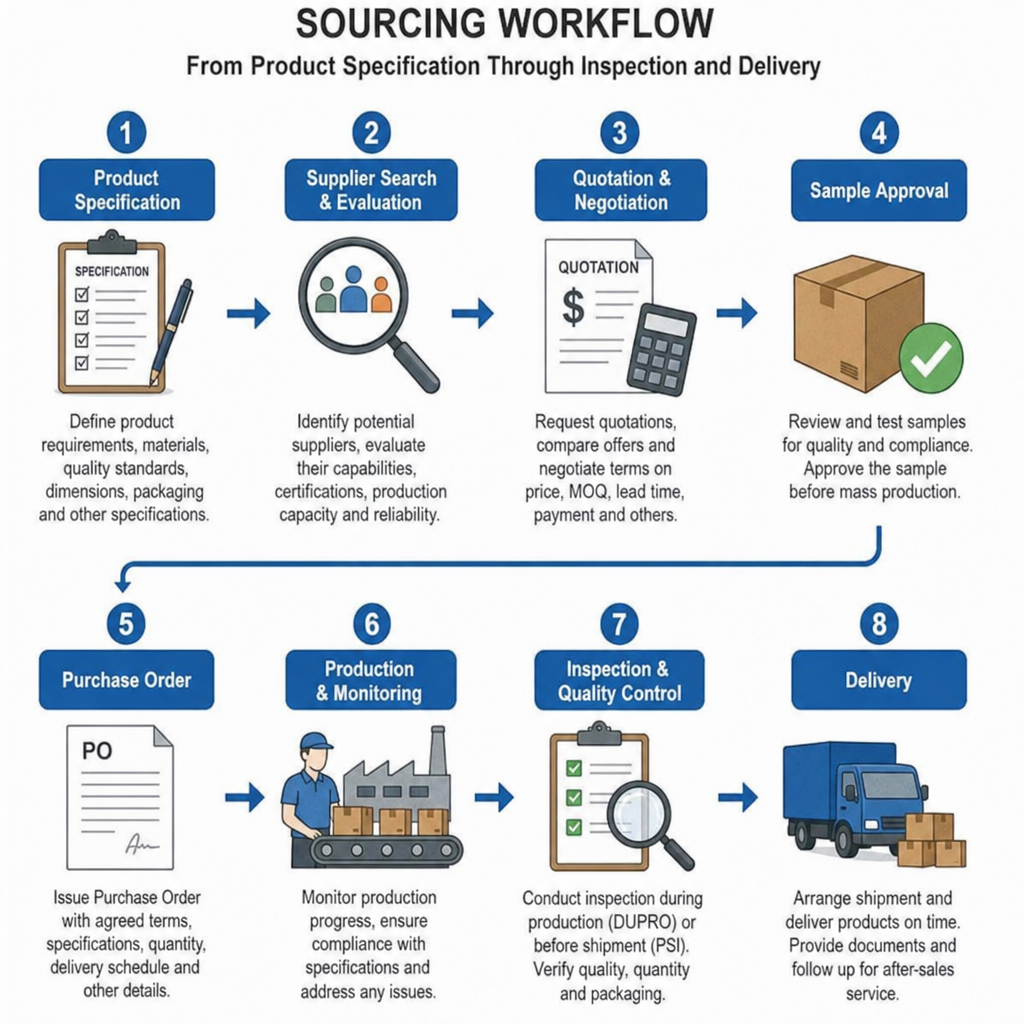
Use a staged process rather than moving directly from a listing to a large order:
- Send a consistent request for quotation. Give shortlisted suppliers the same specification, quantities, and delivery assumptions so their responses can be compared.
- Resolve exceptions in writing. Ask suppliers to identify substitutions, exclusions, tooling requirements, or uncertain requirements before you approve an offer.
- Evaluate samples against defined criteria. Record what you tested and what passed. Keep an approved reference sample where practical.
- Document the production agreement. Include specifications, packaging, timing, inspection arrangements, payment milestones, and procedures for nonconforming goods.
- Plan checks before shipment. Decide who will inspect, what they will examine, and what happens if the order fails acceptance criteria.
- Review the first delivery before scaling. Compare the received goods with the agreement and resolve outstanding issues before committing to repeat volume.
For example, a hypothetical buyer sourcing metal enclosures should specify more than appearance. Dimensions, material grade, finish, hole positions, and packaging all deserve explicit acceptance criteria. This makes the sample review a test of the intended product rather than a judgment about whether it looks convincing.
Comparing total cost instead of headline prices
For china wholesale purchasing, use a complete cost worksheet rather than treating the listing price as the final commercial answer. Request a breakdown of what the quotation includes and excludes. Keep uncertain amounts visible until a supplier, freight provider, broker, or other responsible party confirms them.
Build your comparison around these categories:
- Product and setup: Unit price, samples, tooling, customization, and packaging.
- Quality assurance: Testing, inspections, and any agreed corrective work.
- Transportation: Origin handling, freight, insurance, and destination delivery.
- Import charges: Applicable duties, taxes, brokerage, and clearance costs.
- Operating exposure: Storage, financing, replacements, and inventory held while problems are resolved.
For U.S. imports, classification and other product-specific criteria affect import requirements. CBP also documents additional Section 301 duties for covered Chinese-origin goods. Verify the rules and rates applicable to your intended entry rather than applying a single assumed tariff to all china goods.
Stress-test the comparison before choosing a supplier. Consider whether the order still makes commercial sense if freight increases, delivery slips, or some units require replacement. Use realistic scenarios as planning tools, not invented forecasts presented as facts.
Payment protection and import responsibilities
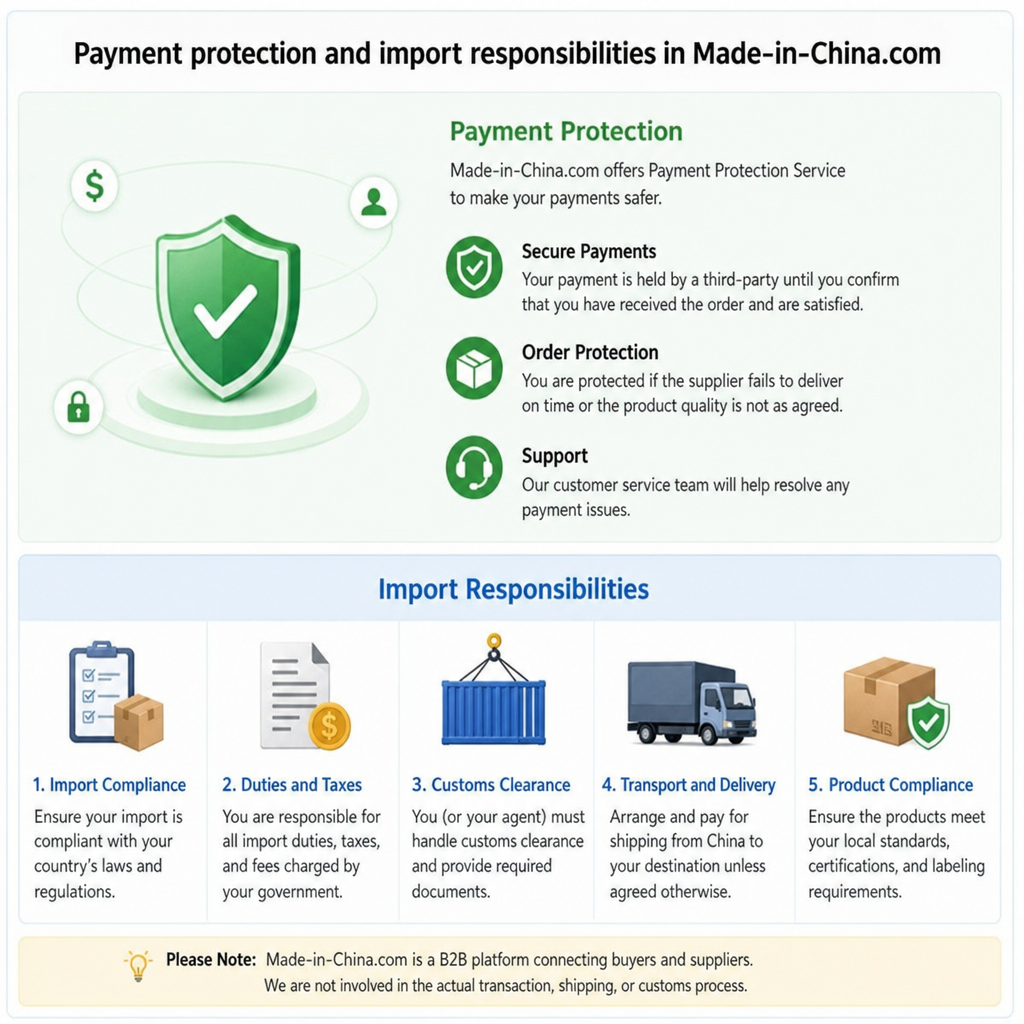
Made-in-China.com offers Secured Trading Service, with published terms governing its operation. Before paying, read the terms applicable to your order, including payment handling, refunds, dispute procedures, and deadlines. Do not interpret the name of a protection service as an unconditional promise that every disagreement will result in reimbursement.
Keep specifications, approvals, invoices, payment records, and relevant correspondence organized. Ask how the agreed quality and shipping requirements will be recorded within the transaction. Your objective should be a clear evidence trail, not merely an assurance that someone will help if trouble occurs.
Import compliance is a separate responsibility. U.S. buyers must ensure merchandise meets applicable agency requirements, which may involve organizations such as the CPSC, FDA, EPA, or others depending on the product. CBP recommends seeking appropriate specialist guidance when necessary.
Responsible sourcing also reaches beyond the immediate seller. CBP states that importers must exercise reasonable care over supply chains and understand where and how products are manufactured, including relevant inputs. Ask for traceability information appropriate to the product and investigate gaps before ordering.
For proprietary designs, consider intellectual-property protection before disclosing sensitive material. The USPTO’s China toolkit recommends comprehensive partner due diligence and attention to contractual protections. Obtain qualified advice for valuable designs, tooling, confidential processes, or brand assets.
Turning sourcing access into lasting value
The practical impact of Made-in-China.com is access to supplier discovery and purchasing tools; the value you obtain depends on how you use them. Start with a clear specification, investigate the company, compare complete costs, and establish acceptance criteria before payment. Treat the first order as a controlled test, document what you learn, and expand only when the evidence supports doing so.
Frequently Ssked Questions About Impact of Made-in-China
What does "Made in China" signify for buyers in today's market?
"Made in China" indicates the manufacturing origin of products, and it doesn't provide a complete picture of quality or value. Buyers should assess suppliers based on their ability to meet specific requirements rather than solely relying on the country-of-origin label.
Is Made-in-China.com a legitimate platform for sourcing suppliers?
Yes, Made-in-China.com is an established B2B marketplace that connects buyers with verified suppliers. However, buyers should perform due diligence on individual suppliers and not assume that every listing is a guaranteed reliable source.
How can I evaluate Chinese suppliers effectively?
A practical framework for evaluating suppliers includes requesting evidence of their business identity, production capabilities, quality controls, and after-sales support. This thorough assessment should happen before finalizing any pricing agreements.
What steps should be taken before placing a large order with a supplier?
Before placing a large order, buyers should send a consistent request for quotations, resolve any exceptions in writing, evaluate samples, document the production agreement, plan pre-shipment checks, and review the first delivery before scaling up.
How can I protect myself financially when sourcing from China?
It is essential to understand the payment protection terms offered by platforms like Made-in-China.com, keep comprehensive records of specifications and transactions, and ensure compliance with import regulations. Buyers should also investigate traceability and quality assurance processes in their supply chains.