


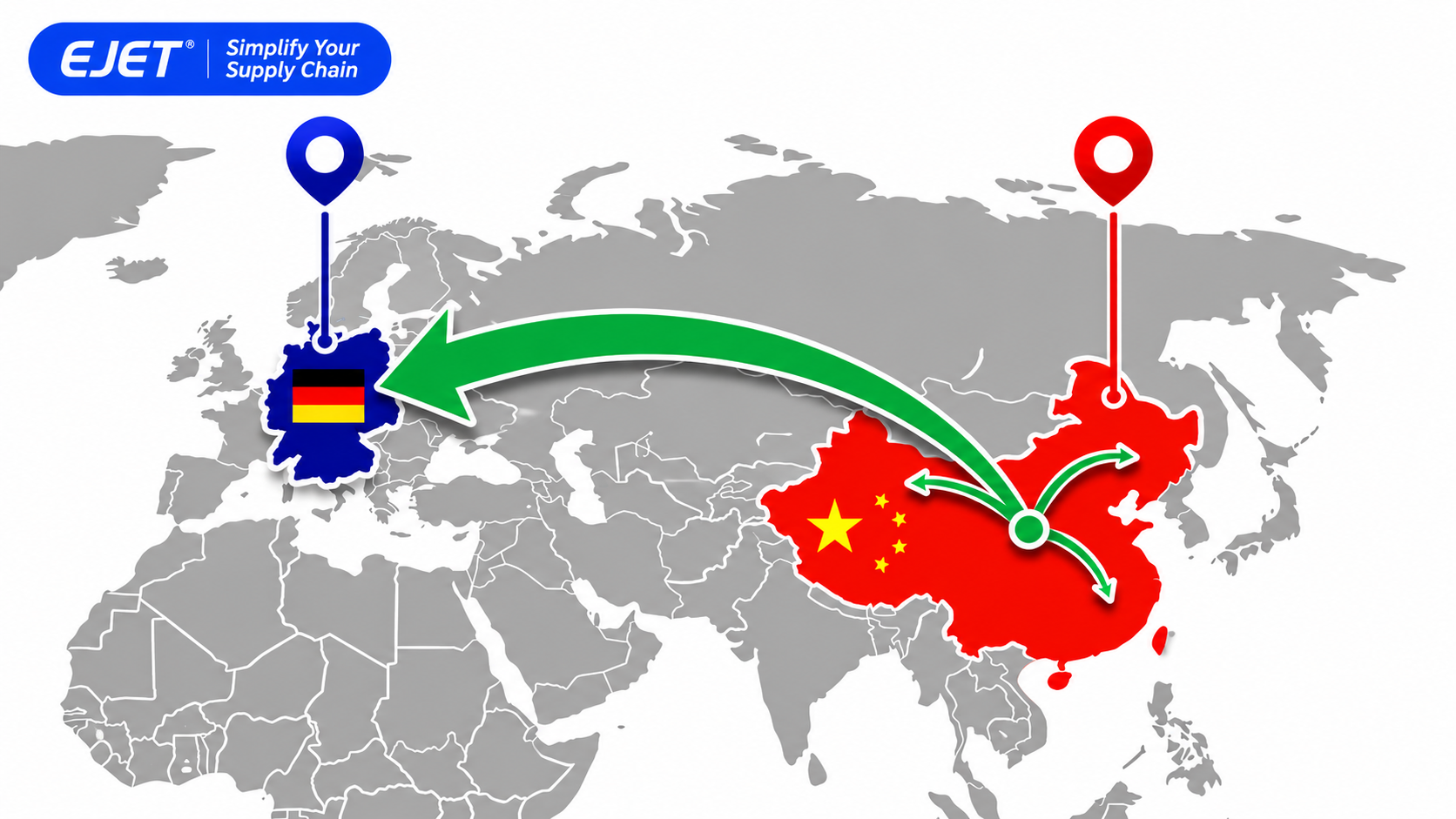
Importing from China to Germany involves more than finding a supplier and booking freight.
You need to establish who handles customs, verify product compliance, calculate the full delivered cost, and prepare consistent shipment documents before goods leave China.
This China import guide explains those decisions for commercial buyers, with additional considerations for complete solar photovoltaic systems.
What do you need to import goods from China to Germany?
For a typical commercial shipment, you need an EORI number, an accurate customs classification, transaction and transport documents, and products that meet applicable EU requirements.
You must also establish who submits the customs declaration and pays import charges. Product-specific restrictions, licences, or registrations may add further requirements, so there is no universal checklist that replaces checking the actual goods.
An Economic Operators Registration and Identification number identifies your business for customs operations.
EU-established businesses obtain it from the customs authority in their country of establishment; a German business therefore applies through German Customs. Arrange this before dispatch rather than discovering the missing registration when cargo arrives.
Start with a written product description covering materials, function, intended users, and technical characteristics. Use it to investigate the correct tariff classification and requirements through the European Commission’s Access2Markets portal. That classification connects your purchasing decision to duties, restrictions, and relevant import formalities.
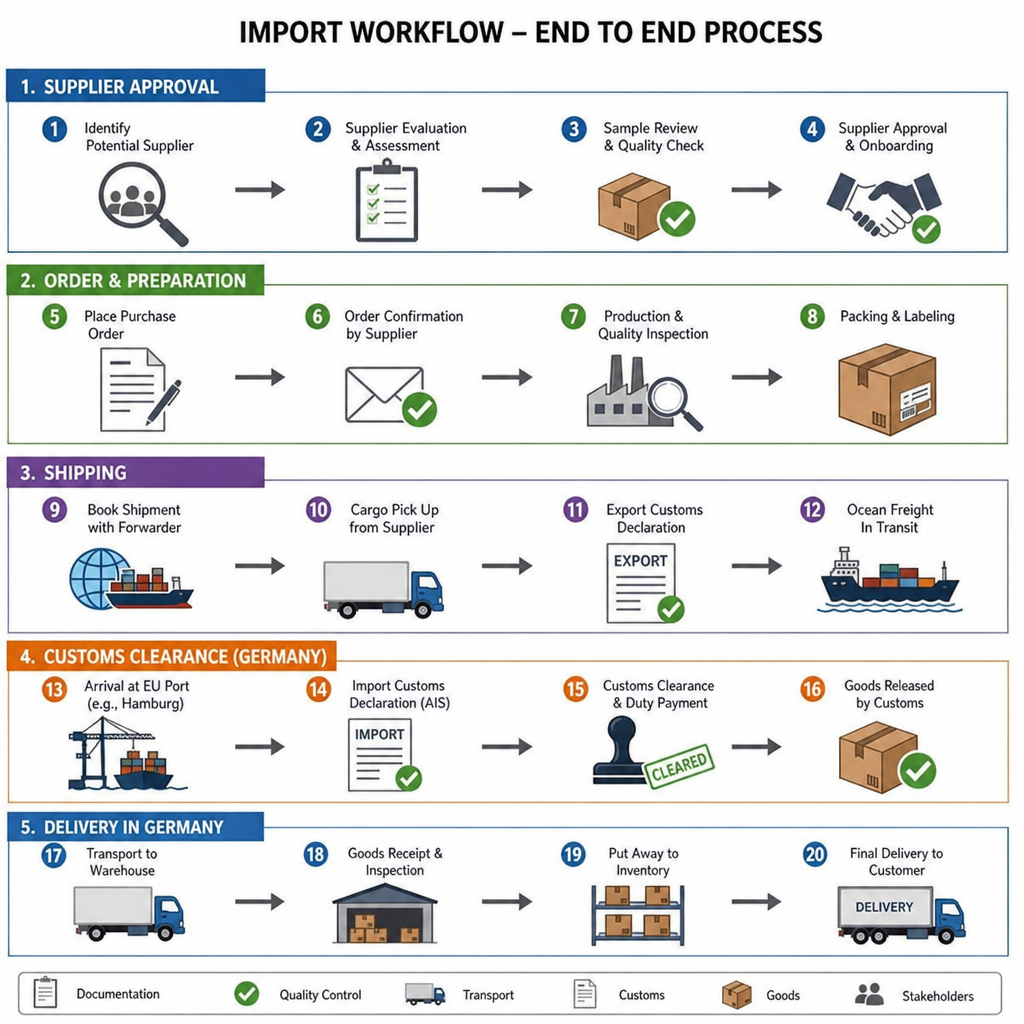
For planning purposes, separate the shipment into three workstreams: supplier and quality checks, product compliance, and logistics and customs. Assign an owner to each. A freight booking should not be treated as confirmation that the other two are complete.
Sourcing from China starts with a verifiable specification
Before approaching suppliers, create a specification that makes competing quotations comparable. Include dimensions, materials, performance requirements, packaging, labelling, acceptable defects, and the documents you expect. For electrical equipment, request exact model references rather than accepting a broad catalogue description.
Use the same questions with every shortlisted supplier:
- Who is supplying the goods? Request the legal business name and establish whether you are contracting with a manufacturer or trading company.
- What exactly is quoted? Confirm model, accessories, packaging, minimum order quantity, and delivery terms.
- What supports compliance? Request documentation for the actual model, not a vaguely similar product.
- How will quality be checked? Agree sample approval, inspection criteria, and the remedy for nonconforming goods.
- How will problems be resolved? Set out warranty handling, replacement arrangements, and responsibility for associated freight.
Treat an approved sample as a reference, not the end of quality control. Consider retaining a signed specification and reference sample, then arranging an inspection against them before dispatch. Ask the inspector to record model labels, quantities, packaging condition, and agreed functional checks.
Build payment milestones around evidence you can review. For example, negotiate when inspection results and final shipping documents must be available. Avoid relying on verbal assurances where a measurable acceptance condition would make the agreement clearer.
Product compliance belongs before the purchase order
When importing goods from China to Germany, customs clearance is only one part of the process. As an EU importer, you must verify that the manufacturer has fulfilled the relevant product obligations before placing goods on the market. These include applicable conformity assessment, technical documentation, markings, traceability, and required instructions or safety information.
CE marking is required only for products covered by relevant legislation; it is not a universal import label. Where it applies, check that the EU Declaration of Conformity identifies the actual product and applicable requirements. A photograph of a CE logo is not a substitute for checking the supporting documentation.
Ask a product-compliance specialist to review unfamiliar categories before committing to production. Give them the specification, intended use, model documentation, labels, and proposed sales channel. Request a written list of missing evidence and required changes so the supplier can price corrections before you pay a deposit.
Also investigate environmental registration obligations separately from product safety. Packaging placed on the German market can trigger LUCID registration requirements; electrical equipment and batteries require their own category-specific checks. Do not assume one registration covers every component or packaging stream.
How much does importing from China to Germany cost?
The real cost comprises the goods, freight, insurance, import duties and taxes, clearance, and delivery-related charges—not simply the supplier’s invoice.
Customs duty depends on the product classification and applicable measures, while German import VAT is generally 19%, with reduced or zero rates available where legal conditions are met. Confirm treatment for the exact shipment before approving the order.
For budgeting, separate these cost categories:
|
Cost category |
What to request or calculate |
|---|---|
|
Goods and preparation |
Product price, tooling, samples, export packaging, inspection, and testing |
|
Origin and international transport |
Collection, export handling, freight, and cargo insurance |
|
Customs and taxes |
Applicable duty, additional trade measures, import VAT, and brokerage |
|
Arrival and delivery |
Terminal handling, storage exposure, onward transport, and unloading |
|
After-sales provision |
Spare parts, potential returns, replacements, and warranty administration |
Use the table as a quotation checklist, not an assumption that every charge applies. Ask each provider to mark what is included, excluded, or payable by another party. This makes a low freight headline easier to compare with a more comprehensive offer.
The customs value generally starts with the transaction value and includes relevant transport and insurance costs to the EU entry point, subject to valuation adjustments.
The import VAT base can additionally include customs duty and relevant incidental costs to the destination specified under the tax rules. These are different calculations, so avoid applying both percentages only to the factory price.
Eligible businesses may deduct import VAT as input tax when the conditions are satisfied. Nevertheless, distinguish recoverable tax from permanent costs and allow for its cash-flow impact. Confirm documentation and deduction eligibility with your tax adviser.
Match transport to the shipment, not a headline rate
Sea, air, and rail offer different cost-and-speed trade-offs on Asia–Europe routes. Air generally prioritises speed at a higher transport cost; ocean transport generally prioritises lower freight cost over speed; rail can occupy the middle ground. These are planning comparisons, not guaranteed outcomes for a particular shipment.
Request quotations using identical collection and delivery addresses, cargo dimensions, gross weight, packaging details, and readiness date. Ask whether the quoted schedule is terminal-to-terminal or door-to-door, and have the forwarder identify the allowance for clearance and final delivery.
For your comparison, ask providers to price relevant alternatives:
- Ocean freight: Request shared-container and full-container options where appropriate, with destination charges itemised.
- Air freight: Ask for the chargeable weight calculation and any handling restrictions.
- Rail freight: Confirm the proposed route, cargo acceptance, and contingency arrangements.
For China-to-Germany shipments with a fixed launch or installation date, work backwards from when goods must be usable. Include time for incoming checks and resolving discrepancies, rather than treating arrival as immediate readiness for sale or installation.
Put delivery responsibilities in writing
Incoterms allocate specified delivery responsibilities, costs, and risks between seller and buyer. State the chosen rule, named locati0n, and version in the contract—for example, FCA at an identified collection point under Incoterms 2020. Avoid using an unexplained three-letter abbreviation as the entire shipping agreement.
For containerised or multimodal shipments where you arrange main carriage, ICC guidance points buyers toward considering FCA. Under that arrangement, the seller handles export clearance and delivers to the agreed carrier or point. FOB instead fits delivery on board a vessel and should not be selected merely because the goods eventually travel by sea.
If offered an inclusive delivered price, request a responsibility schedule alongside it. Establish who will appear in the customs records, which charges are included, and what evidence you receive after clearance. Keep product specifications, payment terms, inspection rights, and remedies explicit in the wider purchase contract.
Prepare customs documents before dispatch
A typical clearance file includes the commercial invoice, packing list, and relevant transport document, together with product-specific supporting documents where required. The invoice records the transaction; the packing list describes the physical shipment. Transport documentation varies by mode, such as a bill of lading, air waybill, or rail waybill.
Have the supplier and customs representative check the draft file before loading:
- Product descriptions: Use meaningful descriptions rather than vague terms such as “accessories.”
- Commercial details: Reconcile quantities, unit prices, currency, and delivery terms with the purchase agreement.
- Physical shipment: Match package counts, weights, and model references across documents.
- Customs information: Confirm classification, origin information, and any required supporting evidence.
- Business details: Check the importing entity and its identifying information.
The importer or an appointed customs representative can submit the customs declaration. Agree who supplies missing information and approves corrections, then retain the final declaration and tax documents with the shipment file.
What changes when importing a complete solar PV system from China to Germany?
Importing a complete solar PV system from China to Germany requires checking the individual components as well as the proposed installation. A package may contain modules, an inverter, storage, mounting equipment, and electrical accessories with different documentation and compliance considerations. Customs clearance does not establish that the assembled system meets the requirements for its intended German installation.
Before ordering, ask your intended installer to review the full bill of materials and exact model numbers. Seek written confirmation of component compatibility, required connection documentation, and any missing protection or mounting equipment. Clarify who will provide commissioning support and how replacement components will be obtained.
Pay particular attention to tax assumptions. German law provides a zero VAT rate for qualifying imports of solar modules, essential components, and storage where the statutory conditions are satisfied. This is not a blanket exemption for every solar-labelled consignment, and it does not remove the need to establish customs treatment.
Plan the installation administration before shipping, too. Grid-connected generation and relevant storage installations must be registered in the Marktstammdatenregister. Agree who handles registration and coordinates any required network-operator process; importing the hardware is not the final project milestone.
A final checkpoint before releasing the order
Use a brief approval meeting to test whether the shipment is genuinely ready:
- The specification and approved sample match the order.
- Compliance evidence has been reviewed for the exact models.
- Customs classification and applicable charges have been checked.
- Freight quotations include a clear list of exclusions.
- Inspection, payment, and document-release milestones are agreed.
- Someone owns arrival checks, records, and after-sales issues.
If an answer remains uncertain, turn it into a named action rather than an assumption. Resolving a documentation gap before production gives you a clearer decision than trying to negotiate around it after dispatch.
Successful importing starts with a complete purchasing decision: suitable goods, credible evidence, clear responsibilities, and a realistic delivered budget. Validate those foundations on a manageable first order, document what you learn, and use that record to make repeat shipments more controlled.
Frequently Asked Questions Related toImporting from China to Germany
What documents are required for importing goods from China to Germany?
You need essential documents such as an EORI number, customs classification, commercial invoice, packing list, and any specific certifications or compliance documents related to your products.
What are the costs involved in importing from China to Germany?
The total cost includes the price of the goods, freight, insurance, import duties, VAT, and customs clearance fees. Additionally, you should factor in any extra charges for handling and delivery.
Do I need to pay VAT on imported goods?
Yes, import VAT is generally 19% in Germany. However, certain conditions may allow for reduced or zero VAT rates, especially for specific products like solar modules.
What is the role of customs clearance in the importing process?
Customs clearance is a crucial part of the importing process, where the importer must ensure that all required documents are submitted, duties are paid, and the goods comply with EU regulations before they can enter Germany.
How can I ensure product compliance when importing from China?
It's essential to verify that the manufacturer meets the relevant product obligations, including conformity assessments and technical documentation. Consulting a product compliance specialist may help you navigate these requirements effectively.