Importing goods from China to South Africa involves checking product requirements, registering with SARS Customs, finding a supplier, arranging freight and clearing the shipment.
Before ordering, establish whether the goods need permits or approvals and calculate their full landed cost—not just the supplier’s price.
This article explains the process for commercial buyers, from product selection to delivery.
What do you need to import from China to South Africa?
For a commercial shipment, you need SARS importer registration, accurate product classification, the applicable permits or approvals, and documents supporting the customs declaration.
You must also arrange transport and budget for any duties, import VAT and clearance charges. A licensed clearing agent can handle the declaration, but product details and supporting paperwork still need your attention.
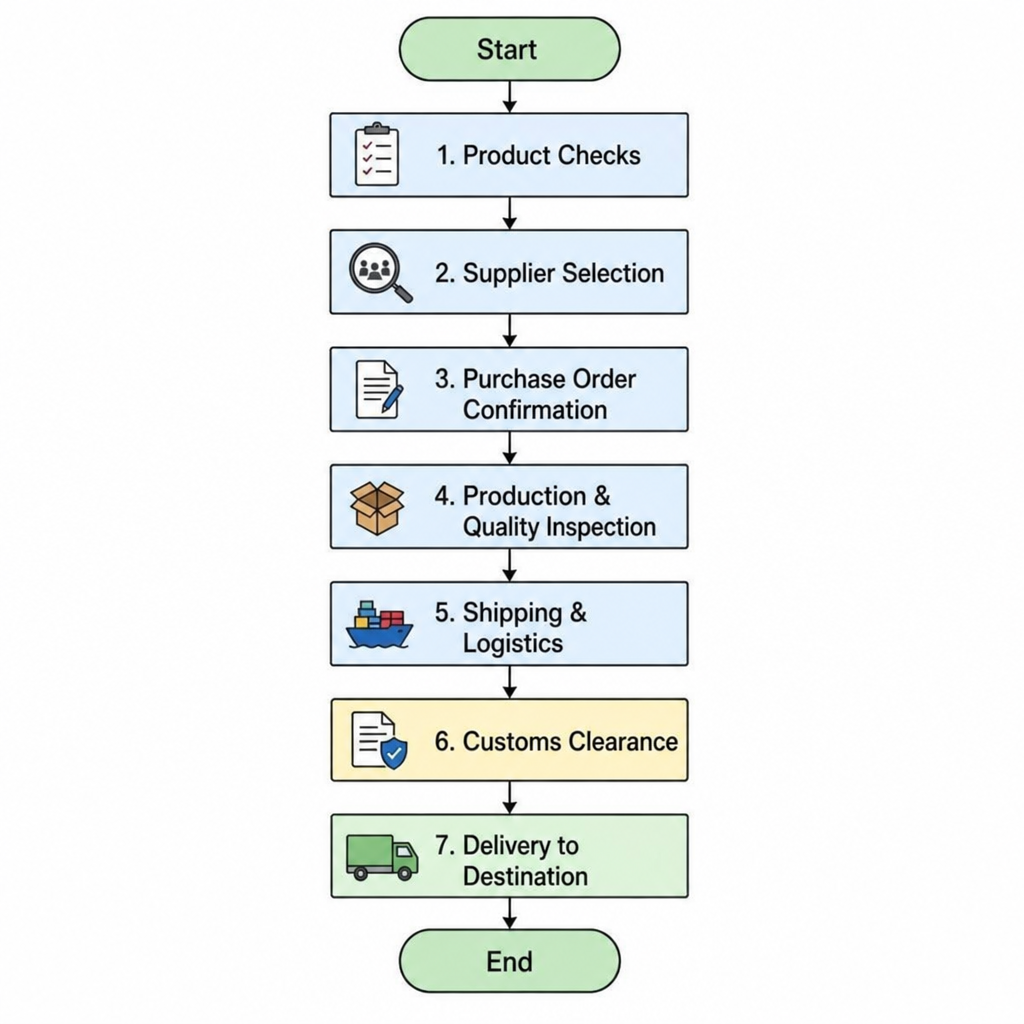
Use this sequence to organise your first order:
- Define the product: Record its materials, function, model and intended use.
- Check admissibility: Establish whether restrictions, permits or technical approvals apply.
- Confirm classification: Have the proposed tariff code and duty treatment checked.
- Complete registration: Arrange SARS Customs registration for commercial importing.
- Validate the supplier: Review samples, specifications and payment terms.
- Price the complete shipment: Obtain freight, clearance and delivery quotations.
- Inspect and dispatch: Check the goods and documents before departure.
- Clear and receive: Complete customs formalities, then inspect the delivery.
Treat these as decision gates rather than tasks to finish after paying a deposit. Registration, import controls and customs documentation are separate requirements; completing one does not replace the others.
Choose products around demand and compliance
Start with the customer, not the catalogue. Identify who will buy the product, what problem it solves and the selling price your market can support. Then test whether the purchase remains attractive after transport, taxes, selling expenses and a realistic allowance for returns.
For your first Chinese products import order, consider keeping the range narrow. Comparing a few clearly specified items is more manageable than coordinating unrelated products with different packaging, quality checks and approval requirements. Request samples before committing to a production order.
Build a product file containing photographs, technical descriptions, material composition and model numbers. Use it when discussing classification and restrictions with your clearing agent. South Africa imports are assessed through tariff classification, valuation and origin, so precise descriptions matter more than a broad label such as “accessories.”
Register with SARS and check product approvals
For commercial importing from China, arrange importer registration with the South African Revenue Service. SARS provides the Registration, Licensing and Accreditation application process through eFiling. Prepare the identity, business, address and banking documents relevant to your application, using the current SARS requirements rather than an old checklist.
Do not confuse commercial orders with personal shopping. SARS allows qualifying private individuals to use a generic customs code under specific conditions, but that concession does not cover goods imported for resale or other business purposes. A small commercial order is still commercial.
Next, establish whether the product is controlled. Most new goods are exempt from general import-control measures, while controlled goods and used or second-hand goods require attention from the International Trade Administration Commission, or ITAC. Waste and scrap are also subject to import controls.
Technical approval is a separate check. Products falling under relevant compulsory specifications may require approval or a Letter of Authority from the National Regulator for Compulsory Specifications, or NRCS. Ask about the exact model and specification; a supplier’s general assurance that a product is “certified” is not a substitute for confirming South African requirements.
Find suppliers and turn samples into specifications
When sourcing from China, send each shortlisted supplier the same written request. Specify materials, dimensions, colour, quantity, packaging and any required test documentation. Comparable requests make it easier to judge whether a lower quotation reflects genuine savings or a different product.
Ask for a sample and a detailed purchase order before placing the full order. Alibaba.com’s own sourcing guidance recommends samples, detailed orders and production monitoring or inspection as ways to strengthen purchasing controls. Use the approved sample as a reference, but also document measurable requirements.
Your supplier checklist should cover:
Business identity: Request the legal company name and clarify whether you are dealing with a manufacturer or trading company.
Product definition: Record the exact model, materials, finish and permitted substitutions.
Order conditions: Confirm minimum quantities, production milestones and packaging responsibilities.
Quality acceptance: Agree which defects require correction and how inspection results will be handled.
Payment instructions: Verify the beneficiary and independently confirm any requested bank-detail changes.
Consider arranging an independent pre-shipment inspection for an unfamiliar supplier or significant order. Define what the inspector should check, including quantity, workmanship, basic operation, labels and packaging. These are among the checks available through Alibaba.com’s inspection services; agree the scope rather than assuming every test is included.
How much does importing from China actually cost?
The useful figure is the total cost of getting saleable stock into your warehouse, not the factory quotation alone. Build a landed-cost worksheet covering the purchase, freight, insurance, applicable duties, import VAT, clearance and final delivery. Have your agent verify the tax treatment before using the figure to set retail prices.
Request written figures or estimates for each cost bucket:
|
Cost category |
What to include in your budget |
|---|---|
|
Supplier charges |
Goods, agreed packaging, tooling and sample costs |
|
Origin services |
Collection, export handling and documentation where applicable |
|
International transport |
Freight and any separately arranged cargo insurance |
|
Border charges |
Customs duty, import VAT and other applicable levies |
|
Destination services |
Clearing, handling, possible storage and inland delivery |
|
Commercial overhead |
Banking, inspection, warehousing and selling expenses |
Customs duty depends on classification and other applicable tariff provisions; there is no single rate for everything arriving from China. Some duties are percentage-based, while others use a specific quantity-based calculation. Ask your agent to check whether additional duties apply to your product.
For a standard-rated import originating in China, SARS explains the VAT calculation as 15% × [customs value + 10% of customs value + applicable non-rebated duties]. The 10% uplift forms part of the VAT calculation; it is not a separate charge payable to SARS. Product-specific exceptions can apply.
As an illustration—not a quoted duty rate—assume a customs value of R100,000 and applicable duty of R10,000. The VAT base would be R120,000, producing R18,000 in import VAT. Freight, handling and other business expenses must still be accounted for separately in your budget.
Keep a cash-flow view alongside your profitability calculation. Ask your accountant whether import VAT is recoverable in your circumstances and what evidence is required. Do not assume an amount that may later be deductible is cash you can leave out of the shipment budget.
Agree payment terms and shipping responsibilities
Write payment milestones into the order and, where possible, negotiate a quality check before the final balance becomes due. Retain the specifications, correspondence and inspection evidence together. If using Alibaba.com Trade Assurance, follow its eligible order and payment process; payments outside the platform are not protected by that service.
Also state the agreed Incoterms® rule, named place and version. These rules allocate delivery obligations, costs and transport risk between buyer and seller. An incomplete phrase such as “shipping included” leaves too much room for misunderstanding about the services being quoted.
For containerised or multimodal shipments, discuss FCA with your forwarder rather than automatically requesting FOB. ICC guidance identifies FCA as appropriate for containers or delivery to a terminal, while FOB applies to delivery aboard a vessel. Ask your forwarder to explain the practical responsibility transfer for your shipment.
Which shipping method suits your order?
Choose transport according to urgency, shipment size, cargo value and the margin available to absorb freight costs. Air freight generally prioritises speed, while ocean freight supports larger, less urgent replenishment. For sea freight, compare less-than-container-load and full-container-load quotations rather than assuming the smaller booking is always better value.
Use these options as a starting point:
- Air freight: Consider it for urgent replenishment or high-value, low-weight goods where speed justifies the expense.
- LCL sea freight: Request a quotation when your shipment will share container capacity with other cargo.
- FCL sea freight: Compare it as volumes increase, even if your goods will not completely fill a container.
For every China to South Africa quotation, provide the collection address, destination, carton count, dimensions, gross weight and cargo description. Ask the forwarder to identify exclusions and distinguish the estimated transport time from the complete delivery schedule. Budget time for production, inspection and clearance rather than treating the sailing or flight as the whole project.
Ask separately about cargo insurance, including exclusions, insured value and claims evidence. Confirm who will arrange it and when cover begins. Avoid relying on the word “insured” without reviewing the actual terms.
Prepare documents before the goods leave
South African customs clearance involves checking the declaration against supporting documents, assessing duties and VAT, and examining goods when required. Customs may request more information or hold goods for another department’s checks. Preparing documents early gives you an opportunity to resolve discrepancies before arrival.
Ask your clearing agent to confirm the shipment-specific document pack. It will commonly involve a commercial invoice, transport document and any required permits or origin evidence. Also request a packing list and relevant technical approvals where applicable.
Check that names, quantities, currency, product descriptions and model numbers agree across the paperwork. Send draft documents to the agent before dispatch and request corrections from the supplier. Never ask a supplier to understate the purchase price: customs valuation follows prescribed rules, not an arbitrary figure chosen to reduce charges.
Receive, review and improve the next order
At delivery, photograph the packaging before opening and record shortages or visible damage. Compare quantities and product condition against the order and inspection report. Keep packaging and supporting records if you need to pursue a supplier or insurance claim.
Then reconcile estimated costs against actual invoices. Calculate the cost per saleable unit, noting damaged or rejected stock separately. Use the results to decide whether your next improvement should be supplier negotiation, packaging changes, a different shipping arrangement or a smaller product range.
A sound China–South Africa trade plan starts with a controlled first order, not an ambitious container booking. Confirm compliance, approve the product, understand the landed cost and keep the paperwork consistent. Apply the same checks to repeat orders whenever the product, supplier or shipping terms change.
Frequently Asked Questions About Importing from China to South Africa
What are the essential documents required for importing from China to South Africa?
To import goods, you need to complete SARS (South African Revenue Service) registration, obtain the necessary permits or approvals, and prepare documentation such as a commercial invoice, packing list, and transport document.
Do I need to be a registered importer to import goods from China?
Yes, for commercial shipments, you must register as an importer with SARS, as personal shopping codes do not apply to goods intended for resale or business use.
How do I calculate the total landed cost of my imported goods?
The total landed cost includes the purchase price, freight charges, insurance, applicable customs duties, VAT, and any other fees associated with delivery and clearance.
What should I consider when selecting a shipping method?
Consider factors such as urgency, shipment size, cargo value, and the margin you can absorb for freight costs. Air freight is faster, while sea freight is more cost-effective for larger shipments.
How can I ensure product compliance with South African regulations?
Verify if your products require technical approvals from the National Regulator for Compulsory Specifications (NRCS) and check for any import-control measures that might apply to your specific goods.