











Import costs from China include the goods, transport, insurance, customs duties, taxes, clearance, and delivery charges needed to reach your chosen destination.
Calculate them as a landed cost rather than treating the supplier’s price or freight quote as the complete bill.
This guide provides a calculation method, destination-specific checks, and a worked example to help you build a realistic purchasing budget.
How much does it cost to import from China?
There is no single percentage or shipping rate that accurately answers this question for every shipment. Your total depends on the product, customs classification, origin, destination, shipment size, transport method, and agreed delivery responsibilities.
Start with a shipment-specific landed-cost calculation, then check the applicable duties and taxes against official destination-country guidance.
Use this planning formula:
Landed cost = goods + origin charges + international freight + insurance + import duties + nonrecoverable import taxes + clearance and destination charges + final delivery.
For a fuller purchasing decision, add separately identified product-development, inspection, testing, payment, and financing expenses. Keeping these visible helps you distinguish the physical cost of bringing stock into your warehouse from the wider cost of making that stock ready to sell.
Calculate two totals:
- Economic cost: The expense you expect the business to retain after any valid tax recovery.
- Cash requirement: The money you need to pay suppliers, logistics providers, authorities, and other parties before customer receipts arrive.
These totals may differ. For example, an eligible UK VAT-registered business may recover import VAT, subject to the normal rules, or account for it through postponed VAT accounting rather than paying it at the border. Recoverable VAT therefore needs different treatment from an irrecoverable duty charge.
Finally, divide the appropriate total by the number of saleable units—not simply the number ordered. Use that unit cost when evaluating your selling price and margin.
Build your calculation from a complete shipment brief
Before requesting prices, create one shipment brief and send the same information to every supplier, forwarder, and customs broker. Consistent inputs make quotations easier to compare. They also give you a clear record of what each estimate actually covers.
Include the following details:
|
Input |
What to record |
Why it helps |
|---|---|---|
|
Product description |
Materials, function, model, and intended use |
Supports classification and compliance review |
|
Quantity and value |
Units, invoice currency, unit price, and total |
Establishes the purchasing baseline |
|
Packaging |
Carton count, external dimensions, gross weight, and pallets |
Supports freight pricing |
|
Origin information |
Manufacturer and declared country of origin |
Supports tariff and documentation checks |
|
Collection and delivery |
Factory address, arrival locati0n, and final postcode |
Defines the transport scope |
|
Delivery term |
Incoterm, named locati0n, and version |
Clarifies included responsibilities |
|
Timing |
Cargo-ready date and required arrival date |
Allows realistic service comparisons |
|
Special characteristics |
Batteries, liquids, fragile items, or oversized dimensions |
Flags handling questions for the provider |
Product details support commodity-code selection, while weight, dimensions, route, transport mode, and additional services affect freight quotations. Incoterms clarify how shipment responsibilities are divided between buyer and seller.
Avoid accepting “shipping included” as a complete description. Ask where the service starts, where it ends, and which charges remain payable by you. Record the response alongside the quotation rather than relying on a conversation you may need to reconstruct later.
Create spreadsheet columns for estimated amount, currency, exchange rate, source, validity date, included elsewhere, and actual amount. The “included elsewhere” column is particularly useful: it helps prevent double-counting freight or handling already contained in a supplier’s price.
Understand the main components of import costs
Product price and origin expenses
Start with the supplier’s commercial quotation, including the agreed packaging and any separately charged customization. Keep samples, tooling, and initial development in separate rows so you can decide how to allocate them across the order. A first shipment and a repeat shipment should not automatically carry identical setup costs.
Next, ask which origin activities are included: collection, export packing, inland movement, export clearance, and handling before international departure. The allocation of these tasks depends on the agreed delivery term. Compare suppliers only after bringing their offers to the same delivery basis.
For example, if one quotation includes delivery to a named export handover point and another stops at the factory, request the missing movement as a separate quote. Do not interpret the lower factory price as a confirmed saving until the remaining work has been priced.
Freight and cargo insurance
Separate the main transport charge from the surrounding services. Request an itemized quotation showing collection, international carriage, applicable surcharges, destination handling, customs services, and final delivery. Freight providers identify weight, volume, route, transport mode, required transit time, and additional services as pricing inputs.
For insurance, request the actual premium and policy terms rather than inserting an unexplained percentage. Ask the provider to identify the insured value, covered journey, deductible, exclusions, and claims process. Then check whether insurance is already included in the supplier’s agreed delivery term before adding another allowance.
Duties, taxes, and clearance
Customs duty is not necessarily calculated on the same amount as your supplier invoice or total landed cost. The destination’s valuation rules determine the relevant customs value, while the product classification and applicable measures determine the duty treatment. Import VAT, where applicable, can have a different calculation base again.
Keep these items separate:
- Ordinary customs duty and any applicable additional duties.
- Import VAT, excise, or other destination taxes.
- Government processing or port-related fees.
- Broker clearance, filing, and administrative services.
- Any provider charge for advancing duties or taxes on your behalf.
Ask the broker to distinguish government assessments from its own service fees. In the United States, for example, merchandise processing fees and harbor maintenance fees are separate from ordinary customs duty, and their applicability depends on the entry and transport circumstances.
Compliance and payment expenses
Check compliance before approving production. For US general-use consumer products subject to applicable CPSC safety rules, manufacturers and importers must certify compliance; requirements differ for children’s products. Build your budget around the requirements for the actual product rather than assuming every item needs the same testing package.
Also request your bank or payment provider’s conversion rate and transaction charges. Use a clearly stated exchange-rate assumption for budgeting, then replace it with the actual settled amount during reconciliation. Keep a separate contingency rather than quietly inflating every expense line.
How do shipping methods affect your total cost?
Shipping from China affects more than the international freight line: compare each service using the same collection point, final destination, chargeable quantity, and required delivery date. Providers calculate freight using shipment characteristics and service requirements, so a rate without those inputs is not a dependable landed-cost estimate. Ask for comparable, itemized offers rather than choosing solely on the headline price.
Express and air freight
Request express and air-freight quotations when your order size or delivery requirement makes them candidates. Ask whether each offer includes customs clearance, delivery, and any duty-advancement charges. Compare the promised service scope, not just the transport label.
Pay particular attention to chargeable weight. DHL explains that it compares actual gross weight with volumetric weight and uses the higher figure for the freight calculation. That means packaging dimensions can matter even when the product itself is light.
For planning purposes, use the provider’s specified method:
Volumetric weight = package volume ÷ the quoted conversion factor.
Confirm the measurement units, divisor, rounding rules, and whether the calculation applies per carton or across the shipment. Do not reuse a divisor from a previous provider without checking it.
Less-than-container-load and full-container-load sea freight
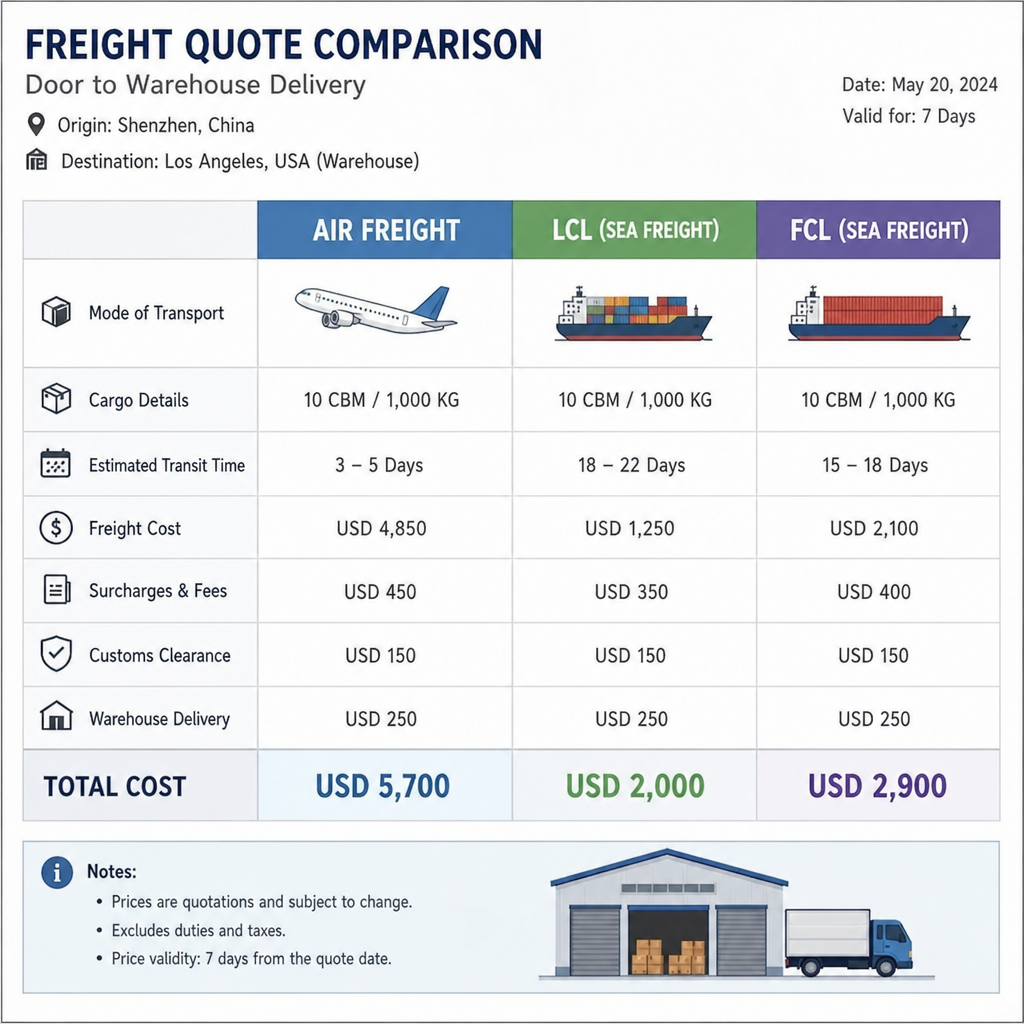
For ocean freight, request both less-than-container-load, or LCL, and full-container-load, or FCL, quotations when the shipment could reasonably use either. DHL distinguishes LCL volume-based charging from FCL’s per-container charge. The comparison should still include all quoted origin and destination services.
Ask the forwarder to show the total for the actual shipment under each option. Include any quoted consolidation, deconsolidation, terminal handling, container transport, unloading, and return obligations. A useful comparison ends at your warehouse, not at an overseas port.
Time-sensitive charges
Obtain written details of free time and the applicable container charges. Maersk describes detention and demurrage as charges arising when containers are kept beyond the agreed time; its terms distinguish the relevant charging arrangements. Storage and other local charges should be checked separately in your quote.
Before booking, confirm who monitors release, books collection, arranges unloading, and manages container return. Treat these as named tasks with deadlines rather than leaving them under a vague “delivery” heading.
Use Incoterms to identify what is already included
Incoterms allocate specified tasks, costs, and risks between buyer and seller. They do not replace the full sales contract or determine every commercial issue, such as payment timing or transfer of ownership. Always record the selected rule, its named place or port, and the agreed version.
Use the following as a budgeting checklist, not a substitute for the rule’s full wording:
|
Term |
Budgeting implication |
Question to resolve |
|---|---|---|
|
EXW |
Budget for collection and substantial onward responsibilities |
Who handles loading and export formalities? |
|
FCA |
Establish the seller’s named handover point |
Which costs remain after handover? |
|
FOB |
Identify the named shipment port and onboard delivery point |
Which onward freight and arrival costs are excluded? |
|
CIF |
Identify the freight and insurance included to the named destination port |
Which arrival, import, and delivery expenses remain? |
|
DAP |
Identify delivery to the named destination, with import clearance generally for the buyer |
What duties, taxes, and clearance charges must you arrange? |
|
DDP |
Identify the seller’s import-clearance and duty responsibilities |
Who will perform the import formalities, and what evidence will you receive? |
These distinctions follow the responsibilities described in official Incoterms guidance. FOB and CIF are sea and inland-waterway rules; FCA is suitable for multimodal movements, including containerized handover arrangements identified by the ICC.
When comparing DDP with another offer, request enough detail to understand the import arrangement. Ask who will appear in the customs records and which documents will be available to your business. In the United States, using a broker does not remove the importer of record’s responsibility for accurate entry documentation and applicable duties, taxes, and fees.
The practical rule is simple: add only the costs outside the agreed price, but verify the boundary before relying on it.
Calculate import costs from China to USA
For US imports, establish the HTS classification, customs value, country of origin, and applicable entry requirements before settling your budget. The Harmonized Tariff Schedule provides ordinary tariff treatment, but additional measures can require further checks. The USITC also notes that antidumping and countervailing duties are not ordinary customs tariffs and are not contained in the HTS itself.
Verify the complete duty treatment
Ask your broker for a written breakdown covering:
- The product’s HTS classification and ordinary duty treatment.
- Applicable China-related Section 301 duties and any valid exclusion.
- Other additional measures relevant to the product and entry date.
- Potential antidumping or countervailing duty exposure.
- The calculation basis and supporting authority for each assessment.
The USITC provides guidance on locating additional duties, including China Section 301 measures. Do not treat an ordinary tariff lookup as confirmation of the entire amount payable.
Separate customs value from freight spending
CBP generally bases transaction value on the price paid or payable, subject to the relevant valuation rules and additions. International freight and insurance are generally excluded, while qualifying packing, assists, selling commissions, royalties, and proceeds may require inclusion. Have the broker review separately charged tooling or other supplier support rather than automatically leaving it outside customs value.
Add applicable processing fees, broker services, and bond premiums separately. A customs bond guarantees payment to CBP; its face amount is not the same as the premium you pay to obtain it. For applicable ocean shipments, also confirm responsibility for advance Importer Security Filing requirements before loading.
Do not assume a shipment below the former $800 de minimis threshold is automatically duty-free. CBP’s 2026 rules suspend that exemption for covered postal and non-postal merchandise. Verify the applicable entry process and assessments for your shipment.
Calculate import costs from China to UK
For a commercial shipment into Great Britain, begin with the commodity code, customs value, duty treatment, import VAT, declaration arrangements, and final delivery costs. UK guidance distinguishes Great Britain from Northern Ireland, so confirm which process applies before using a calculation prepared for another destination. Also check registration, licensing, and certification requirements relevant to the goods.
The UK Trade Tariff tool lets you check commodity codes, duty, VAT, and available suspensions or reductions. Use a detailed product description and select the relevant origin and import circumstances. A code suggested by an overseas supplier still needs checking for UK treatment.
For valuation, HMRC generally includes relevant delivery and insurance costs to the place of introduction in the customs value. The import VAT value can include customs duty and qualifying incidental expenses, including transport to the first UK destination and certain further destinations known at importation. Do not calculate VAT only on the factory price.
Keep three figures visible in your worksheet:
- Customs value: The amount used for the applicable customs calculation.
- Import VAT value: The separately determined base for import VAT.
- Retained business cost: Your cost after any valid VAT recovery.
Eligible VAT-registered businesses can use postponed VAT accounting to declare and, subject to the normal rules, recover import VAT on the same VAT Return. Confirm eligibility, declaration instructions, and recordkeeping with your adviser before assuming that treatment in your cash forecast.
Treat car imports to South America as country-specific projects
Car import costs from China to South America require a destination-country assessment rather than a regional tax estimate. Establish admissibility and approval requirements before paying for the vehicle or booking transport. Chile, for example, generally prohibits used-vehicle imports except where a legal exception applies, while Brazil has vehicle environmental licensing and approval procedures administered by Ibama.
Prepare a vehicle-specific costing brief containing:
- Destination country, arrival port, and intended registration locati0n.
- Importer identity and personal-use or commercial purpose.
- New or used status, model year, VIN, and purchase documents.
- Engine or propulsion type and manufacturer specifications.
- Required approvals, supporting certificates, and inspection arrangements.
- Separate transport, clearance, inland movement, and registration quotations.
Ask the destination broker to confirm the relevant classification, customs valuation method, taxes, and approvals in writing. For Brazil, Ibama identifies import-license analysis for relevant vehicles subject to pollutant-emission and noise controls. That makes regulatory review a purchasing prerequisite, not merely a charge to add after shipment.
Also ask the carrier to confirm acceptance and handling requirements for the exact vehicle, particularly an electric vehicle. Obtain quotations for available transport options rather than assuming every route supports the same service. Extend your comparison through legal road use, not just port release.
Worked example: calculate shipment and unit costs
The following figures are entirely hypothetical. They demonstrate the method; they are not freight quotations, official duty rates, or a tax estimate for the United States, United Kingdom, or any South American country.
Assume you order 1,000 units for delivery to a warehouse. For this example only, customs value includes the goods, origin charges, international freight, and insurance. Assume an illustrative 5% duty and 20% import VAT, with no additional duties.
|
Cost item |
Illustrative amount |
|---|---|
|
Goods |
$10,000 |
|
Origin transport and export charges |
$500 |
|
International freight |
$1,800 |
|
Cargo insurance |
$100 |
|
Assumed customs value |
$12,400 |
|
Illustrative duty: $12,400 × 5% |
$620 |
|
Clearance, destination handling, and delivery |
$900 |
|
Allocated inspection and compliance spending |
$300 |
|
Total before import VAT |
$14,220 |
The customs-value subtotal is a calculation base, not an extra expense. Do not add it again when totaling the shipment.
Now assume the VAT base includes customs value, duty, and $400 of qualifying destination expenses already contained within the $900 line:
Illustrative VAT base = $12,400 + $620 + $400 = $13,420.
Illustrative import VAT = $13,420 × 20% = $2,684.
This produces:
- Cash required if VAT is paid upfront: $14,220 + $2,684 = $16,904.
- Cost per unit if VAT is fully recoverable: $14,220 ÷ 1,000 = $14.22.
- Cost per unit if VAT is not recoverable: $16,904 ÷ 1,000 = approximately $16.90.
The supplier’s $10 unit price is therefore not the warehouse unit cost in this example. If only 980 units are saleable, the pre-VAT cost becomes approximately $14.51 per saleable unit. Keep any contingency reserve separate from these totals until it becomes an actual expense.
How can you reduce costs without weakening compliance?
Reduce import costs by improving the inputs you control and comparing complete alternatives, not by removing legitimate charges from the calculation. Start with packaging, shipment configuration, purchasing terms, and quote scope. Preserve accurate classification and valuation throughout: CBP warns that undervaluing goods can result in penalties.
Test changes before committing
Ask the supplier for alternative carton layouts and obtain revised freight quotes using the new dimensions. Because freight pricing considers weight and volume, this gives you a measurable comparison rather than an assumed packaging saving. Check product protection alongside the quoted transport difference.
For mixed orders, ask whether combining purchases changes the total delivered price. Compare that result with separate shipments, including any additional collection or handling quoted by the forwarder. Do not let a lower freight total obscure a larger inventory purchase than the business needs.
Use a simple sensitivity test before approval:
|
Scenario |
Change to test |
Decision it supports |
|---|---|---|
|
Base case |
Current valid quotations |
Expected purchasing budget |
|
Freight change |
Substitute a higher provider quote |
Exposure to transport repricing |
|
Currency change |
Apply your chosen adverse exchange rate |
Payment affordability |
|
Delivery disruption |
Add a quoted storage or handling scenario |
Contingency requirement |
|
Lower saleable quantity |
Reduce the unit denominator |
Margin resilience |
Choose the assumptions yourself and label them clearly. The purpose is not to predict every disruption; it is to identify which change would make the order unattractive.
Allocate shared expenses consistently
For shipments containing several products, document how you allocate shared charges. Consider weight or volume for transport-related expenses and invoice value where a value-based allocation is appropriate. Retain product-specific duties, testing, and handling against the relevant product rather than spreading everything evenly.
Use the same approach for repeat orders so comparisons remain meaningful. If you change the method, record why. A consistent worksheet is more useful than a superficially precise number that shifts its assumptions between purchases.
Complete your pre-shipment cost review
Before authorizing shipment, use this final checklist:
- Confirm the product description, classification review, and origin information.
- Obtain the applicable duty and tax breakdown from the destination specialist.
- Check that freight quotes use final packaging dimensions and gross weights.
- Match the supplier’s Incoterm to the costs included in your worksheet.
- Identify exclusions, quote expiry dates, and conditional charges.
- Confirm required approvals and assign responsibility for filings.
- Separate recoverable taxes from retained costs and upfront cash needs.
- Calculate unit cost using a realistic saleable quantity.
- Assign an owner to collection, clearance, delivery, and any container return.
- Preserve the assumptions and supporting documents with the purchase record.
After delivery, replace estimates with actual invoices and compare each variance. Separate errors in your initial assumptions from genuine changes in scope or price. Feed those findings into the next order rather than simply overwriting the original budget.
The most useful import-cost calculation is a traceable one: every amount has a source, every exclusion has an owner, and every unit-cost figure uses a clear denominator. Build that discipline before committing funds, and you can judge importing from China on the delivered economics—not just an attractive supplier price.
Frequently Asked Questions About Importing Costs from China
What are the main components of import costs from China?
Import costs typically include the cost of goods, transportation, insurance, customs duties, taxes, clearance fees, and delivery charges. It's essential to calculate these as a landed cost rather than relying solely on the supplier’s price.
How can I calculate the landed cost of importing goods from China?
Use the formula: Landed cost = goods + origin charges + international freight + insurance + import duties + nonrecoverable taxes + clearance + final delivery. It's crucial to include all potential costs to get an accurate total.
What are customs duties and how are they determined?
Customs duties are tariffs imposed on imported goods, determined by the product's Harmonized Tariff Schedule (HTS) classification, customs value, origin, and applicable trade agreements. These can vary widely depending on the type of product.
What role do Incoterms play in international shipping?
Incoterms define the responsibilities of buyers and sellers regarding the delivery of goods. They clarify who is responsible for various costs and risks at different stages of transportation, thus impacting overall import costs.
Are there any additional charges I should be aware of when importing?
Yes, in addition to standard customs duties and taxes, you may encounter fees for customs processing, broker services, container detention, demurrage, and any applicable environmental fees, especially for items like vehicles. It's essential to account for these in your total cost calculation.