








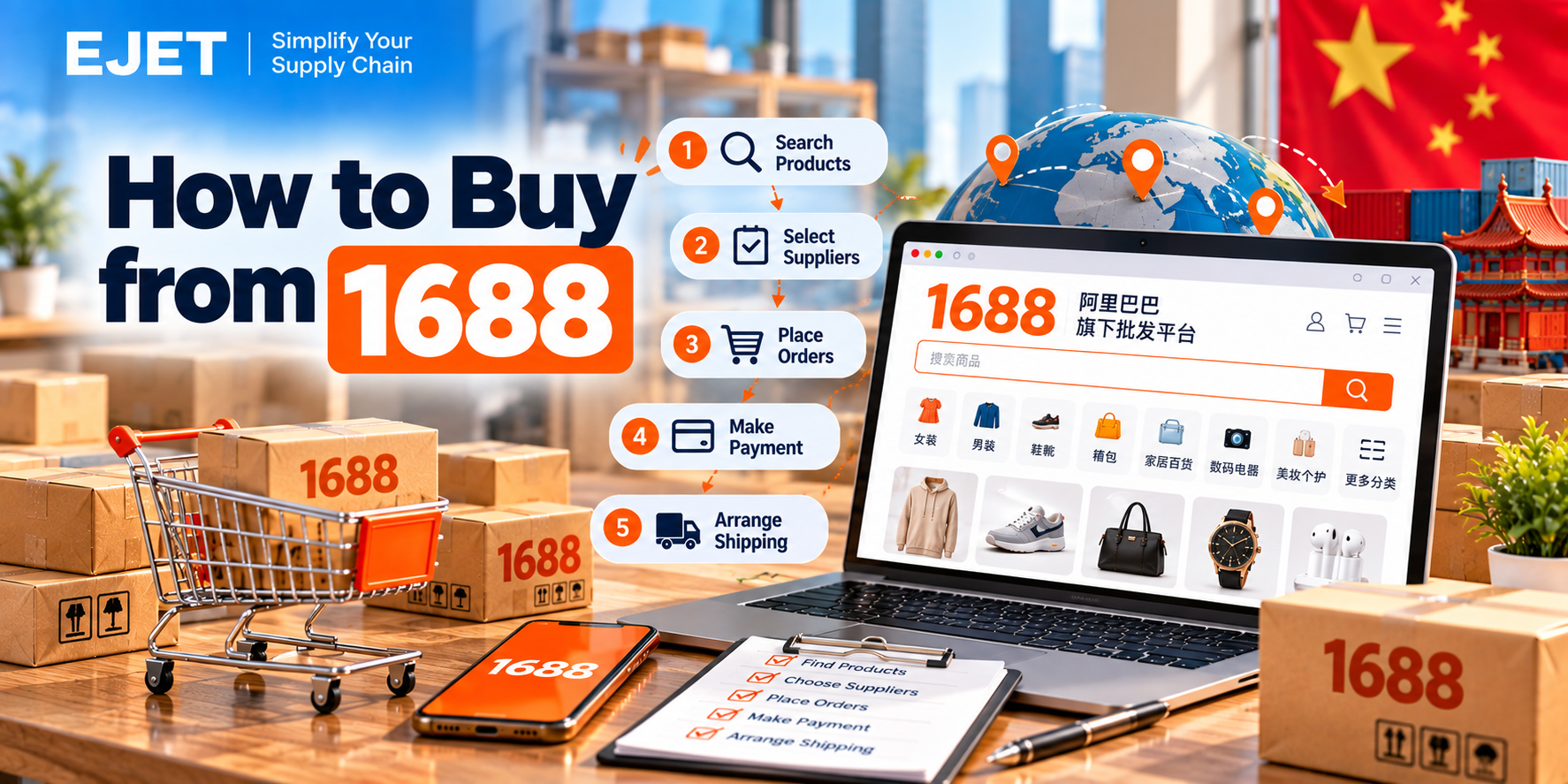
f you're looking for wholesale products from China, 1688 can be one of the most useful sourcing platforms to explore. The marketplace connects buyers with Chinese manufacturers, wholesalers, factories, and trading companies across thousands of product categories.
However, learning how to buy from 1688 as an international buyer can seem complicated at first. The platform primarily serves China's domestic market, so overseas buyers may need to handle supplier communication, payment, a Chinese warehouse, international freight, customs clearance, and import taxes separately.
The process becomes much easier once you understand how each stage works.
In simple terms, an international 1688 order usually follows this process:
Find Product → Check Supplier → Order Sample → Confirm Price → Pay Supplier → Deliver to China Warehouse → Inspect/Consolidate → Ship Internationally → Clear Customs → Receive Goods
This guide explains each stage so you can source from 1688 with greater confidence.
What Is 1688?
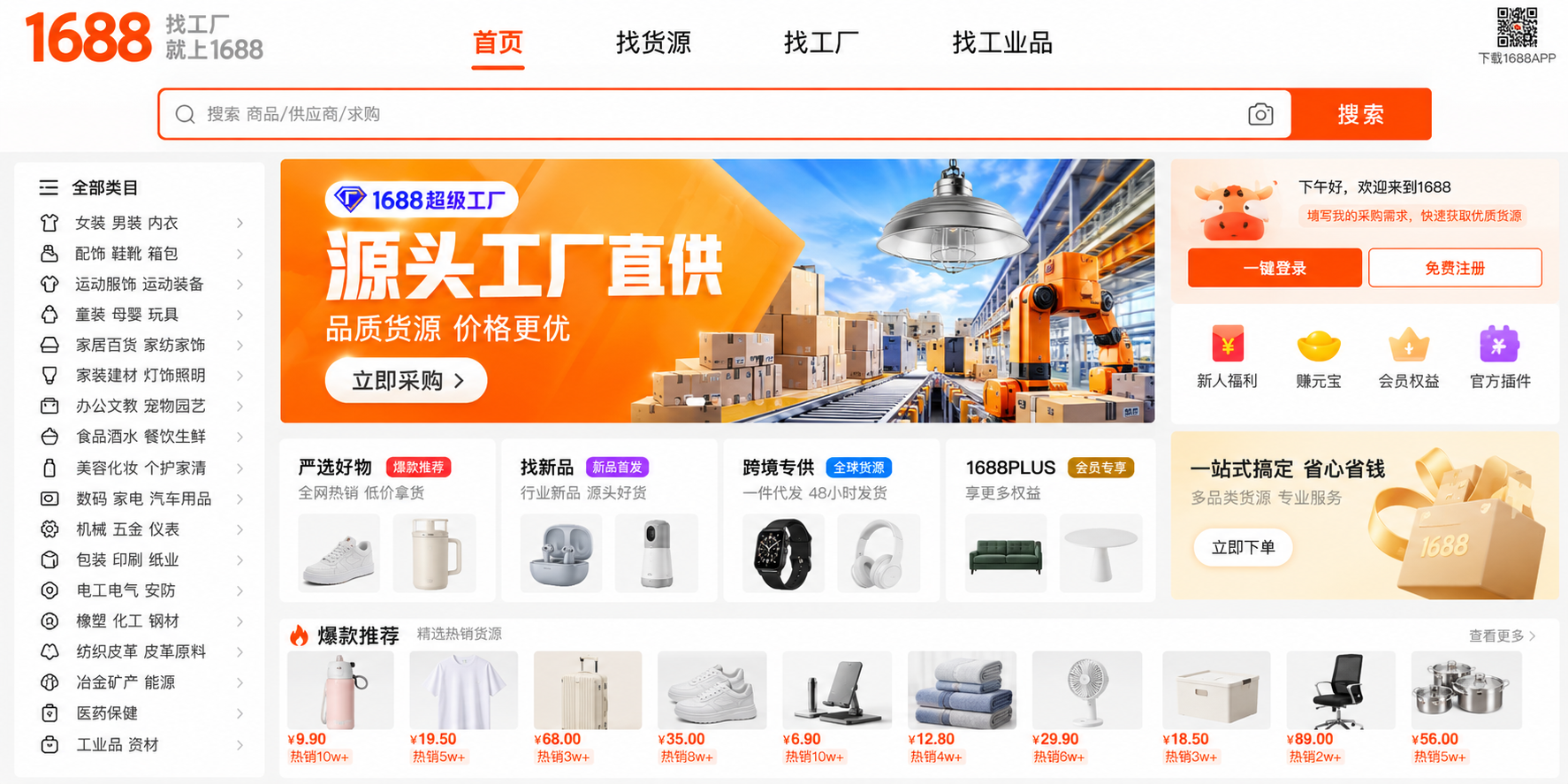
1688 is a Chinese wholesale marketplace where businesses can source products from manufacturers, factories, wholesalers, distributors, and trading companies.
It covers an enormous range of products, including clothing, accessories, packaging materials, electronics, home products, beauty accessories, machinery, automotive products, toys, office supplies, industrial components, and many other categories.
Unlike marketplaces designed mainly for international trade, 1688 primarily targets China's domestic market.
That's an important distinction.
Suppliers may quote domestic prices and expect products to be delivered to an address within China. International buyers may therefore need to arrange overseas shipping separately.
Can International Buyers Buy From 1688?
Yes, international buyers can buy products from 1688.
However, the process may be more complicated than ordering from an international retail website.
Depending on your location and transaction, you may need to arrange:
-
Account registration and verification
-
Translation or supplier communication
-
Payment
-
China domestic delivery
-
Warehouse receiving
-
Product inspection
-
Order consolidation
-
International freight
-
Customs clearance
-
Import duties and taxes
-
Final delivery
Some international buyers manage these steps independently, while others use sourcing agents or freight forwarders.
The best approach depends on your experience, order size, destination country, and the type of products you're buying.
1688 vs Alibaba: What's the Difference?
1688 and Alibaba.com both connect buyers with Chinese suppliers, but they're designed for different markets.
| Feature | 1688 | Alibaba.com |
|---|---|---|
| Primary audience | Chinese domestic buyers | International buyers |
| Main language | Chinese | Multiple languages |
| Supplier type | Manufacturers, wholesalers and traders | Export-focused manufacturers and suppliers |
| International shipping | Often arranged separately | Commonly supported |
| Overseas purchasing | More complex | Generally easier |
| Product selection | Extensive domestic wholesale market | Extensive export marketplace |
| Best for | Cost-focused and experienced sourcing | International wholesale purchasing |
A lower listing price on 1688 doesn't automatically mean the final cost will be lower.
Always compare the landed cost.
How to Buy From 1688 Step by Step
Step 1: Create Your 1688 Account
Start by creating an account on 1688.
International users may need to provide a mobile number and complete applicable verification requirements.
Because registration and verification processes can change, follow the current instructions displayed by 1688 rather than relying on old online tutorials.
Once your account is active, you can begin researching products and suppliers.
Step 2: Search for the Product
Search for the product you want to purchase using keywords, categories, supplier names, or product images.
Chinese search terms can sometimes produce better results because the platform primarily serves Chinese users.
Image search is particularly helpful.
If you already have a picture of the product you're looking for, image-based searching can help you find similar products without knowing the Chinese product name.
Don't immediately purchase from the first supplier you find.
Compare several listings.
Look at differences in price, minimum order quantity, materials, specifications, packaging, customization, supplier history, and estimated production time.
Step 3: Evaluate the Supplier
Supplier verification is one of the most important parts of learning how to order from 1688.
A low price doesn't necessarily mean you've found a good supplier.
Review available information about the business, including its operating history, product specialization, transaction activity, customer feedback, and company information.
You should also communicate directly with the supplier when possible.
Ask questions about the product's materials, dimensions, colors, packaging, minimum order quantity, customization, production lead time, and domestic shipping charges.
For example, if you're buying custom packaging, don't simply ask:
"How much?"
Instead, provide the exact size, material, thickness, printing requirements, quantity, packaging method, and other relevant specifications.
Better questions usually produce more accurate quotations.
Step 4: Order Samples Before Buying in Bulk
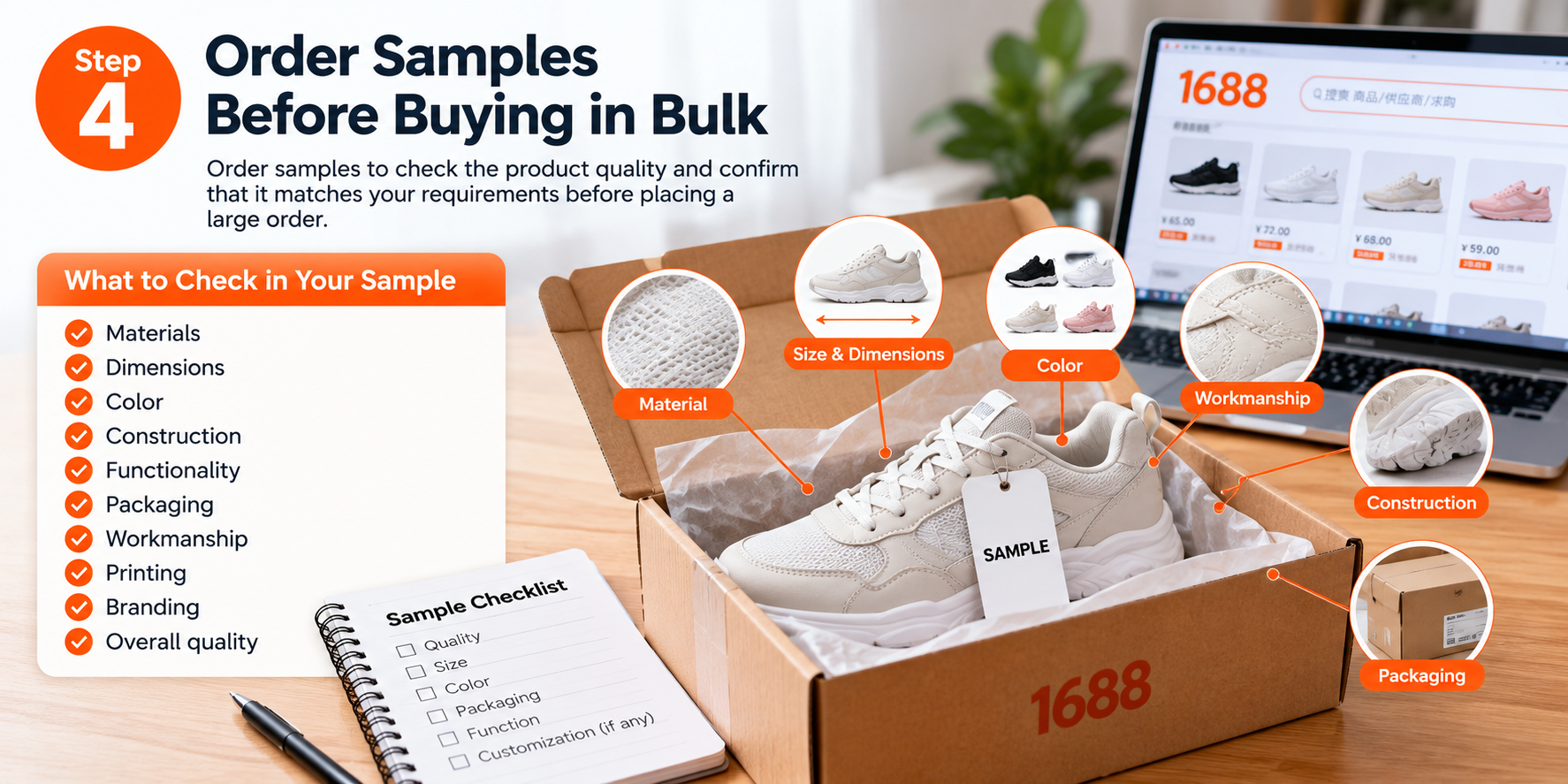
Ordering samples is one of the simplest ways to reduce sourcing risk.
A product may look excellent in listing photographs but appear very different when you actually receive it.
Use your sample to check:
-
Materials
-
Dimensions
-
Color
-
Construction
-
Functionality
-
Packaging
-
Workmanship
-
Printing
-
Branding
-
Overall quality
If you're developing a private-label product, confirm your logo, packaging, labels, colors, and other customized elements before approving mass production.
Don't skip this step just to save a small amount of money.
Finding a quality problem after ordering 2,000 units will cost much more than testing a sample beforehand.
Step 5: Confirm the Final Order Details
Before making payment, confirm everything in writing.
Your order information should clearly specify the product, quantity, unit price, total price, material, dimensions, colors, model, packaging, customization, production lead time, and delivery arrangement.
For example:
| Order Detail | Example |
|---|---|
| Product | Stainless Steel Bottle |
| Quantity | 1,000 units |
| Capacity | 750 ml |
| Color | Black |
| Logo | Custom printed logo |
| Packaging | Individual box |
| Unit Price | Confirm with supplier |
| Production Time | Confirm with supplier |
| China Delivery | Warehouse address |
| Inspection | Before international shipment |
Clear specifications reduce misunderstandings.
If something is important to you, don't assume the supplier already knows it.
How to Pay on 1688 as an International Buyer
Payment is one of the main challenges international buyers encounter.
Available payment methods can depend on your country, account, transaction, and current platform support.
Some overseas buyers can use supported cross-border payment solutions, while others purchase through sourcing agents or intermediaries.
For example, WorldFirst currently provides information about its 1688 World Pay solution for eligible international buyers. Buyers should check current eligibility, verification requirements, fees, supported currencies, and transaction conditions before using the service.
If you're using a sourcing agent, the agent may handle the purchasing process on your behalf.
Before sending money, understand exactly:
-
Who you're paying
-
What you're paying for
-
Exchange rates
-
Transaction fees
-
Agent commissions
-
Refund conditions
-
Order terms
Never treat payment as a minor administrative detail.
Do You Need a 1688 Sourcing Agent?
No. Using a sourcing agent isn't mandatory for every buyer.
Experienced buyers may be able to communicate with suppliers, make payments, manage warehouse deliveries, inspect products, and arrange international freight themselves.
However, a sourcing agent can make the process easier for beginners.
A sourcing agent may help with supplier communication, price negotiation, purchasing, payments, warehouse receiving, product inspection, repacking, consolidation, and international shipping.
The main disadvantage is additional cost.
Therefore, don't compare agents based solely on commission percentages. Ask for a breakdown of all possible charges.
These may include purchasing fees, warehouse charges, inspection fees, repacking costs, consolidation fees, payment charges, and shipping-related expenses.
Step 6: Arrange a Warehouse or Freight Forwarder in China
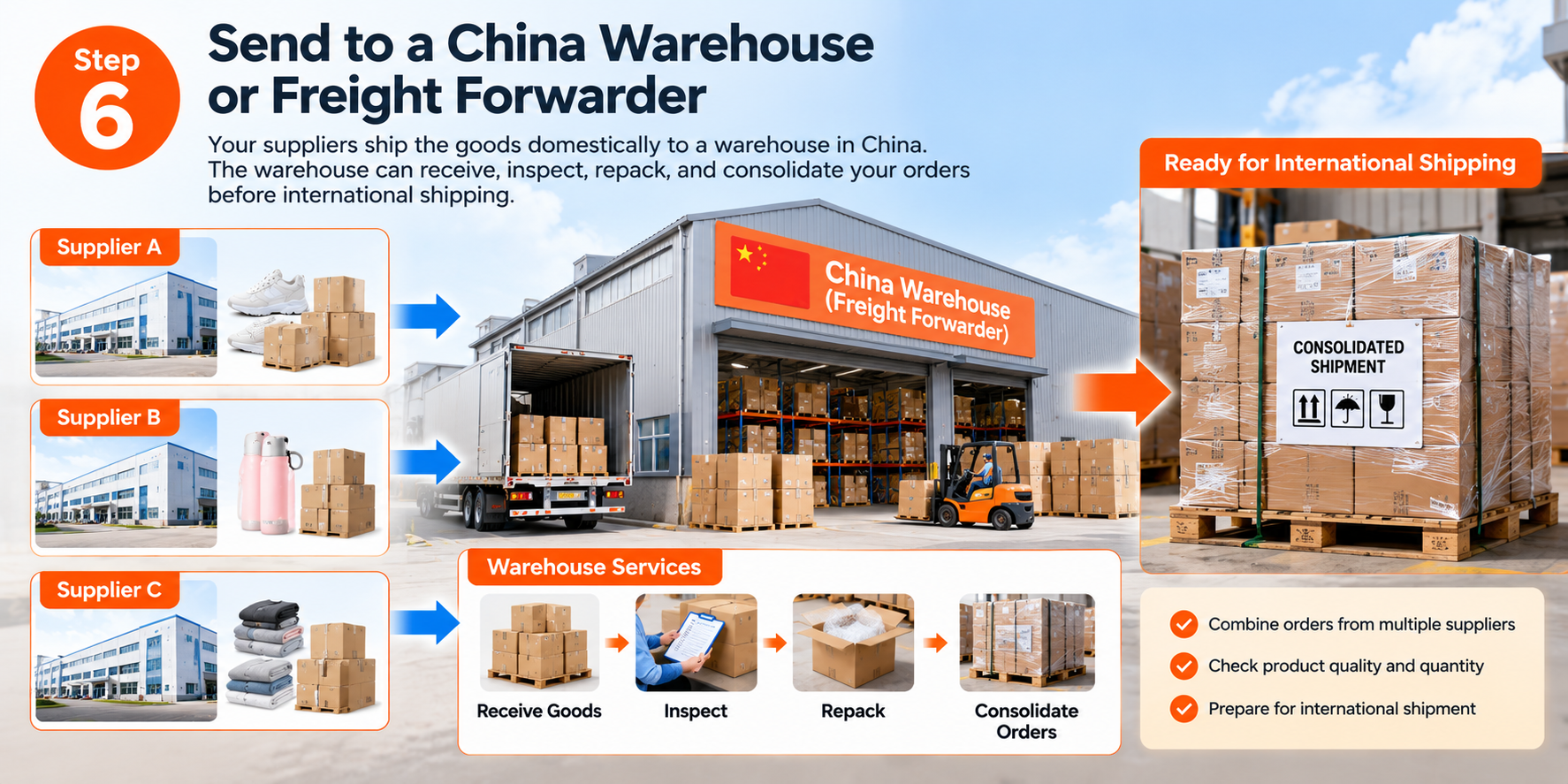
Many international buyers send their 1688 purchases to a warehouse in China before exporting them.
Your supplier ships the goods domestically to this warehouse.
The warehouse or freight forwarder can then receive, store, consolidate, inspect, repack, and prepare the products for international transportation.
This approach becomes particularly useful when you're purchasing from multiple suppliers.
For example:
Supplier A → China Warehouse
Supplier B → China Warehouse
Supplier C → China Warehouse
The warehouse can combine those orders into a larger international shipment.
This process is known as cargo consolidation.
Consolidation may reduce unnecessary international shipments and make inventory easier to manage.
Step 7: Inspect Your Products
For larger orders, consider inspecting the products before they're shipped internationally.
Once defective products arrive in another country, returning them to China can be expensive and complicated.
An inspection can check factors such as quantity, dimensions, materials, workmanship, appearance, packaging, labeling, colors, and basic functionality.
The exact inspection requirements should depend on the product.
For example, inspecting clothing is different from inspecting electronic equipment or industrial machinery.
Provide inspectors with clear specifications rather than simply asking them to "check the quality."
Step 8: Choose an International Shipping Method
After the goods arrive at the Chinese warehouse, choose an appropriate international shipping method.
Common options include express courier, air freight, sea freight, rail freight on supported routes, and consolidated shipping services.
| Shipping Method | Speed | Relative Cost | Suitable For |
|---|---|---|---|
| Express Courier | Very fast | High | Samples and small parcels |
| Air Freight | Fast | Medium to high | Urgent commercial cargo |
| Sea Freight | Slow | Lower for suitable bulk cargo | Large and heavy shipments |
| Rail Freight | Medium | Varies | Supported international routes |
| Consolidated Shipping | Varies | Often economical | Smaller combined shipments |
There's no single best shipping method.
A 2 kg sample and a 2,000 kg commercial order shouldn't use the same logistics strategy.
Compare freight based on the shipment's actual weight, volumetric weight, dimensions, destination, delivery speed, product type, and customs requirements.
Step 9: Calculate Your Total Landed Cost
Don't make purchasing decisions based only on the 1688 product price.
Calculate the total landed cost.
A simple formula is:
Landed Cost = Product Cost + China Domestic Freight + Payment/Agent Fees + Inspection + International Freight + Insurance + Customs Duties + Taxes + Clearance Charges + Final Delivery
Imagine you buy products for $5,000.
Your actual expenses might look like this:
| Cost Category | Example |
|---|---|
| Products | $5,000 |
| China domestic shipping | $200 |
| Inspection and handling | $250 |
| International freight | $1,000 |
| Customs and taxes | $700 |
| Local delivery | $200 |
| Total Landed Cost | $7,350 |
These figures are examples only.
Actual costs vary significantly according to your destination, product, shipment size, freight method, tariff classification, taxes, and local regulations.
This calculation matters because your $5,000 inventory actually costs $7,350 by the time it reaches you in this example.
Step 10: Handle Customs Clearance and Import Requirements
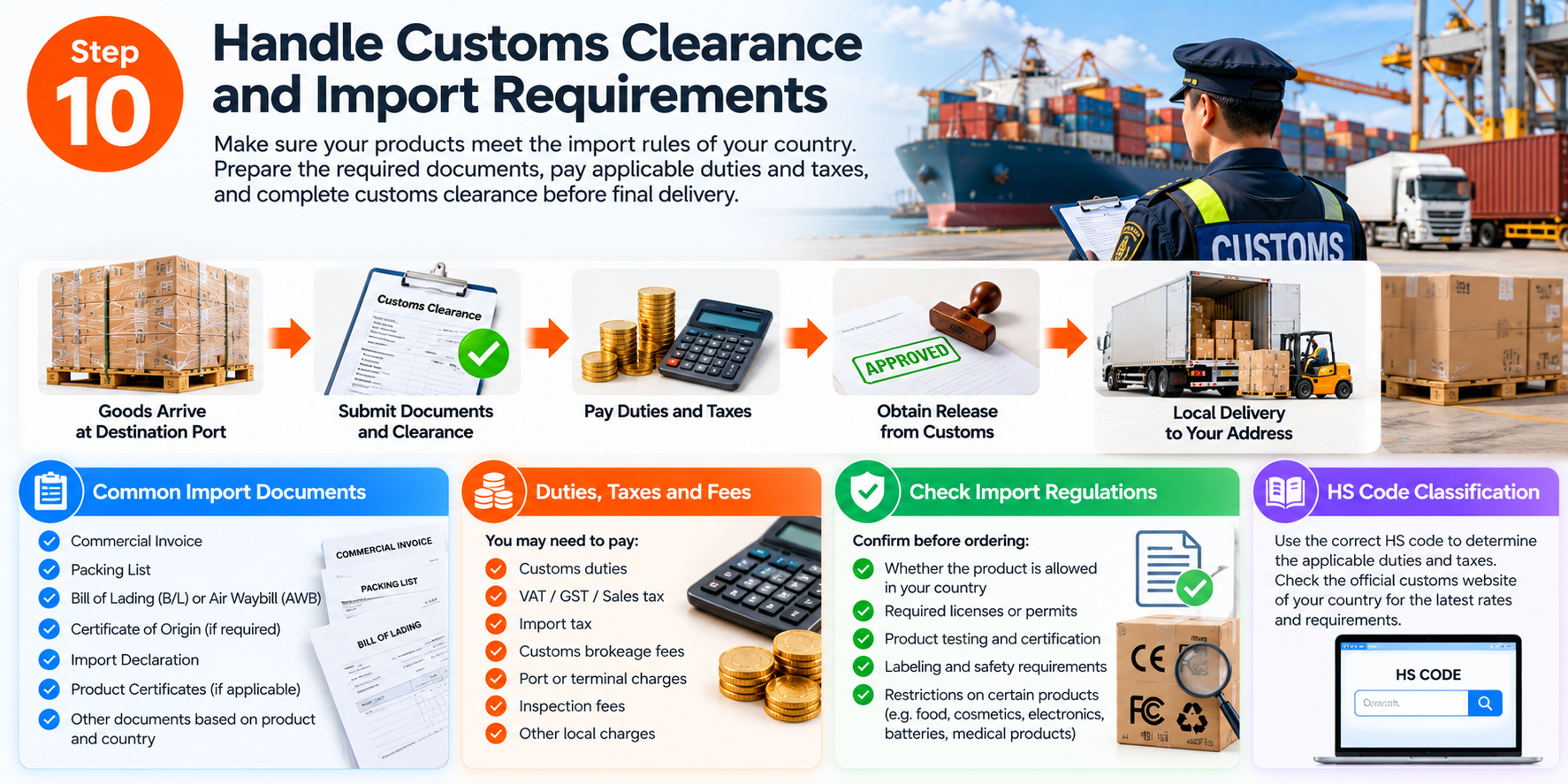
Every destination country has its own import regulations.
Before ordering, determine whether your product can legally be imported and whether it requires licenses, permits, testing, certification, special labeling, or other approvals.
You should also identify the correct HS code, which is used internationally for classifying traded products.
Your import costs may include:
-
Customs duties
-
VAT
-
GST
-
Sales tax
-
Import tax
-
Customs brokerage
-
Port or terminal fees
-
Inspection charges
-
Documentation fees
The terminology and rules vary by country.
For example, a buyer importing into the United States may face different requirements from someone importing into the United Kingdom, Canada, Australia, Germany, Saudi Arabia, Singapore, South Africa, or Malaysia.
Therefore, check the official customs authority for your destination country before placing a commercial order.
This is especially important for regulated products such as food, cosmetics, medical products, batteries, electronics, chemicals, children's products, telecommunications equipment, and certain branded goods.
How Does 1688 International Shipping Work?
A typical international order follows this route:
1688 Supplier → Domestic Delivery in China → Chinese Warehouse/Freight Forwarder → Export → International Transport → Destination Customs → Local Delivery → Buyer
Some suppliers or logistics services may offer different arrangements.
Before ordering, confirm who is responsible for each stage.
Don't assume that "shipping included" means door-to-door international delivery.
Ask exactly where the supplier's delivery responsibility ends.
How to Find Reliable Suppliers on 1688
Finding a good supplier requires more than sorting listings by price.
Look at the overall business.
A reliable supplier should be able to provide clear answers about the products it sells and explain specifications, materials, MOQ, packaging, customization, production times, and delivery.
Compare several potential suppliers before making a decision.
A simple supplier comparison table can help:
| Factor | Supplier A | Supplier B | Supplier C |
|---|---|---|---|
| Product Price | Check | Check | Check |
| MOQ | Check | Check | Check |
| Sample Quality | Check | Check | Check |
| Experience | Check | Check | Check |
| Communication | Check | Check | Check |
| Customization | Check | Check | Check |
| Production Time | Check | Check | Check |
| Packaging | Check | Check | Check |
| Domestic Freight | Check | Check | Check |
Price should be only one part of your decision.
Factory vs Trading Company: Which Is Better?
Neither is automatically better.
A factory may be suitable when you need large production quantities, specialized manufacturing, custom designs, or direct production control.
A trading company may offer a broader product selection and greater flexibility, particularly when you're sourcing different products.
Choose based on your requirements rather than assuming every factory is better than every trader.
Common Mistakes When Buying From 1688
New buyers often focus heavily on finding the lowest price and overlook the rest of the sourcing process.
Some common mistakes include choosing suppliers based only on price, skipping samples, failing to confirm specifications, ignoring China domestic freight, underestimating international shipping, forgetting import duties and taxes, ordering regulated products without checking requirements, failing to inspect large orders, and using unreliable agents or freight forwarders.
Another common mistake is assuming that product photos accurately represent the final product.
Always verify important specifications.
A bargain isn't really a bargain if the products can't be sold.
How to Buy Safely From 1688
Risk can't be completely eliminated from international sourcing, but it can be managed.
Start with a smaller order when working with a new supplier. Request samples, confirm specifications in writing, keep records of important conversations, and understand the payment terms.
For larger purchases, consider independent product inspections.
Most importantly, avoid rushing.
If you're planning to order thousands of dollars' worth of inventory, spending additional time checking the supplier and product is usually worthwhile.
1688 Buying Checklist for International Buyers
| Stage | What You Should Do |
|---|---|
| Research | Identify the exact product you need |
| Compare | Review multiple suppliers |
| Verify | Check supplier information and history |
| Sample | Test product quality |
| Negotiate | Confirm price, MOQ and specifications |
| Pay | Choose a suitable payment method |
| China Delivery | Send products to your warehouse/forwarder |
| Inspect | Check goods before export |
| Consolidate | Combine orders when appropriate |
| Ship | Choose suitable international freight |
| Customs | Prepare documents and check import requirements |
| Receive | Inspect the final shipment |
| Review | Calculate actual landed cost and supplier performance |
Is 1688 Good for Small Businesses?
It can be.
Small businesses can use 1688 to source products for online stores, physical retail shops, wholesale businesses, private-label brands, marketplaces, and other commercial operations.
However, small businesses should pay close attention to MOQ and freight costs.
A product that costs $1 at the factory could become significantly more expensive after domestic shipping, international freight, taxes, marketplace fees, packaging, advertising, and local delivery are included.
Calculate profitability before ordering inventory.
Is 1688 Good for Dropshipping?
1688 can be used as a product sourcing source for dropshipping, but the platform itself isn't designed primarily as a global dropshipping service.
Traditional 1688 suppliers may expect bulk orders and domestic Chinese delivery.
A dropshipping business may therefore require an agent, warehouse, fulfillment provider, or another logistics partner capable of receiving products and sending individual orders to customers.
For this business model, product price isn't the only concern.
Processing speed, inventory accuracy, packaging, tracking, delivery time, and return handling are equally important.
Frequently Asked Questions About Buying From 1688
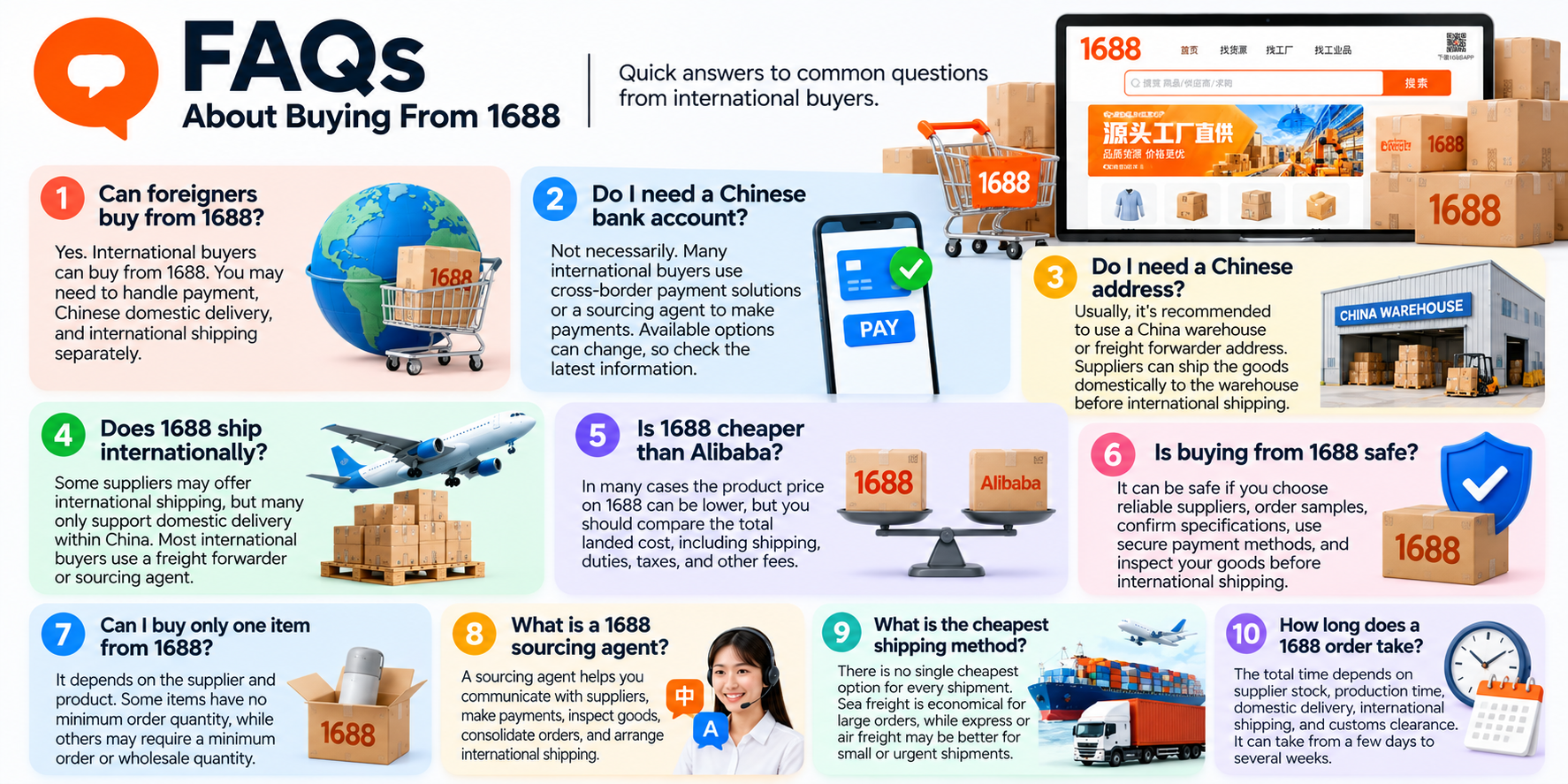
Can foreigners buy from 1688?
Yes. International buyers can source products from 1688, although the process may involve additional steps for payment, supplier communication, warehousing, international shipping, and customs clearance.
Do I need a Chinese bank account to buy from 1688?
Not necessarily. Supported cross-border payment services may be available to eligible international buyers, while sourcing agents can also make purchases on behalf of customers. Available payment options can change, so check the current options presented for your account and transaction.
Do I need a Chinese address?
Not necessarily, but having access to a Chinese warehouse or freight forwarder can make international sourcing easier. Suppliers can send domestic orders to the warehouse, which can then consolidate and export them.
Does 1688 deliver internationally?
International delivery options vary. Because 1688 primarily serves China's domestic market, many overseas buyers use freight forwarders or warehouses in China to arrange international transportation.
Is 1688 cheaper than Alibaba?
Sometimes the listed product price may be lower, but you should compare total landed costs rather than listing prices alone. Freight, payment charges, inspection, agents, customs duties, taxes, and local delivery can significantly affect the final cost.
Is buying from 1688 safe?
It can be used successfully for product sourcing, but international purchasing always involves risk. Research suppliers, order samples, document specifications, use appropriate payment methods, inspect larger orders, and check import regulations.
Can I buy only one item from 1688?
It depends on the listing and supplier. Some products support small orders, while others have minimum order quantities or wholesale pricing tiers.
What is a 1688 sourcing agent?
A 1688 sourcing agent is a person or company that helps international buyers purchase products from suppliers. Services may include communication, negotiation, payment, inspection, warehousing, consolidation, and shipping.
What is the cheapest way to ship from 1688?
There isn't one cheapest method for every shipment. Sea freight can be economical for suitable large shipments, while consolidated services may work better for smaller orders. Compare quotes based on weight, volume, destination, product type, and delivery time.
How long does a 1688 order take?
The total time depends on supplier stock, production lead time, domestic delivery, warehouse processing, inspection, international transportation, and customs clearance. Ask for estimates at each stage instead of relying on one general delivery estimate.
What should I check before paying a 1688 supplier?
Confirm the exact product, quantity, price, specifications, material, colors, dimensions, packaging, customization, production time, domestic shipping cost, payment terms, and delivery destination.
Should beginners use a 1688 agent?
An agent can make the process easier for beginners who aren't comfortable managing supplier communication, Chinese domestic logistics, payment, inspection, or international freight. However, buyers should compare agent fees and understand exactly what services are included.
Conclusion
Learning how to buy from 1688 gives international buyers another way to access China's enormous manufacturing and wholesale supply chain.
The process can be summarized simply:
Find the right product, verify the supplier, order samples, confirm specifications, arrange payment, receive the goods at a Chinese warehouse when necessary, inspect them, choose international freight, clear customs, and calculate your final landed cost.
Don't choose products based only on their advertised price. Successful sourcing depends on product quality, supplier reliability, shipping costs, import compliance, and profitability.
Whether you're importing into the United States, Canada, the United Kingdom, Europe, Australia, Southeast Asia, the Middle East, Africa, or another market, always check the customs and product regulations that apply specifically to your destination country.
When you're starting out, start small, verify everything, calculate the complete cost, and scale your orders only after you've established that the product and supplier are reliable.
_1751507038923.png)