
A China sourcing agent may charge a percentage of your goods value, a fixed project fee, or a margin built into the product price.
For 2027 planning, published provider schedules offer useful benchmarks, including percentage fees around 5%–10% for certain services, but these are not confirmed market-wide rates for 2027.
This guide explains fee structures, included services, possible additional charges, and how to compare quotations without confusing the agent’s fee with your total import budget.
What should you budget for a sourcing agent in 2027?
Use a percentage-based allowance as an initial planning tool, then replace it with a written quotation covering your actual product, order size, and service requirements.
Published examples include JingSourcing’s Basic plan at 5% of product value with a $100 minimum, and LeelineSourcing’s schedule ranging from 10% for some smaller orders to 6% for orders above $20,001. These are individual providers’ advertised terms, not a universal industry tariff.
Timing matters: this article is prepared on November 7, 2026, so 2027 is still ahead. Treat the figures below as planning benchmarks rather than guaranteed future prices. Request confirmation of the applicable schedule, quotation expiry date, and any conditions before committing to an order.
For a simple illustration, a 5% commission on $20,000 of goods equals $1,000. At 8%, the fee would be $1,600. Neither calculation tells you whether sampling, independent inspection, laboratory testing, freight, or import charges are covered.
Build your budget in three separate layers:
- Goods: the products, agreed packaging, and any separately quoted tooling.
- Agent services: commission, project fees, retainers, or an embedded product margin.
- Other purchasing and delivery costs: separately quoted checks, handling, transport, insurance, customs-related charges, and destination delivery.
Use these categories as a worksheet, not a reason to count costs twice. Ask the agent to identify anything already included in another line.
The main fee structures behind a sourcing quotation
Published sourcing offers demonstrate that the same service can be sold through different commercial models. JingSourcing distinguishes between a separately charged Basic plan and a Pro plan with costs included in the product’s unit price; TMDSourcing publishes separate percentages for new projects and unchanged reorders.
Compare the payment model alongside its scope.
|
Fee structure |
How to evaluate it |
What to clarify |
|---|---|---|
|
Commission |
Multiply the agreed fee base by the percentage |
Minimum charge, exclusions, and reorder rate |
|
Fixed project fee |
Match the price to specific deliverables |
Supplier count, revisions, and project endpoint |
|
Monthly retainer |
Compare the commitment with your ongoing workload |
Capacity, reporting, and cancellation terms |
|
Embedded margin |
Compare the complete product price and service package |
Supplier visibility and separately billed extras |
|
Hybrid arrangement |
Add every component before comparing offers |
Whether an upfront fee offsets later commission |
Percentage commission
With commission pricing, establish exactly what “order value” means. Ask whether the calculation includes packaging, tooling, domestic freight, or other pass-through expenses. Write the agreed definition into the quotation rather than assuming every agent uses the same base.
Also distinguish a minimum fee from an additional fee. A 5% rate with a $100 minimum produces a $100 fee on $1,000 of goods, not $50. Its effective rate on that small order is therefore 10%.
Fixed fees and retainers
For a fixed quotation, describe the endpoint precisely: a shortlist, approved samples, a production-ready specification, or a completed purchasing cycle. Request separate prices for work beyond that endpoint. For a retainer, ask what access, workload, and reporting the monthly payment buys.
Avoid an agreement that promises unlimited support without explaining response expectations or capacity. Instead, define who handles urgent issues, how additional products are priced, and what happens to unfinished work when the agreement ends.
Embedded margins
A quotation showing no separate service fee does not necessarily mean the commercial service has no cost. JingSourcing explicitly states that its Pro plan includes costs in the product unit price. Evaluate that arrangement through the overall price, service commitments, and quality terms rather than the zero-fee label alone.
Commission-based vs fixed pricing: which fits your order?
Choose commission-based pricing when you want the agent’s payment linked to purchasing activity; consider fixed pricing when you can define and control the work clearly. Neither model is automatically cheaper. Compare the total fee at your expected order value, then test whether both quotations cover the same deliverables.
Suppose one agent offers 6% commission and another quotes a hypothetical $1,200 fixed fee for equivalent work. Their fees meet at a $20,000 goods value. Below that amount, the percentage fee is lower; above it, the fixed fee is lower, provided its scope remains unchanged.
Break-even goods value = fixed fee ÷ commission rate.
Do not use that calculation to compare a supplier-search assignment with end-to-end production support. First align the number of products, sample rounds, inspections, reporting requirements, and shipping coordination. Otherwise, the apparent saving may simply reflect less work.
For recurring orders, request a separate reorder quotation. TMDSourcing, for example, advertises 8% for standard new sourcing projects and 5% for unchanged reorders involving products, suppliers, and specifications it previously managed. That distinction illustrates why first-order pricing should not automatically become your permanent rate.
Included services need written definitions
Published service descriptions can encompass supplier sourcing, quotation comparison, sample communication, purchasing coordination, order follow-up, inspections, or shipping support.
However, provider packages differ: LeelineSourcing describes several of these activities within its sourcing offer, while MeliPrep lists inspection and certain warehouse services separately. Never assume a service is included merely because another company bundles it.
Translate each broad promise into something you can check:
- Supplier sourcing: request selection criteria, a comparison format, and a deadline for presenting candidates.
- Supplier verification: specify whether you expect document checks, a video review, or an on-site assessment.
- Sample coordination: state the number of suppliers and revision rounds covered, with sample and courier charges identified separately.
- Production follow-up: agree on update frequency, supporting photos, milestone tracking, and escalation procedures.
- Quality inspection: identify the inspection stage, locati0n, checklist, sampling approach, report format, and reinspection terms.
- Shipping coordination: separate administrative support from freight, insurance, clearance, and delivery charges.
Ask to see an anonymized example of the reporting you will receive. A sample report helps you judge whether “quality control” means a documented inspection or a brief visual check. Use it to agree on what evidence must arrive before you authorize shipment or final payment.
For customized goods, make approved drawings, materials, dimensions, packaging, and sample references part of the working brief. Ask the agent to record supplier acceptance of those requirements. That gives everyone a clearer basis for discussing deviations instead of relying on memory or scattered messages.
Possible additional charges to investigate
Use the following categories to request explicit inclusions, exclusions, and approval rules. They are a quotation checklist, not a prediction that every project will incur every charge. Require written authorization before the agent commissions extra work on your behalf.
Samples, development, and tooling
Request separate lines for physical samples, courier shipments, artwork, prototypes, molds, and packaging development. State how many revisions the service fee covers. If a supplier offers to credit a sample charge against production, ask for the qualifying order conditions in writing.
For tooling, request terms covering ownership, storage, maintenance, access, and transfer. Identify the deliverable you are buying, such as an approved mold or production file. Do not treat a development payment as complete merely because the invoice has been paid.
Inspections, testing, and repeat visits
Ask whether inspection is included or invoiced independently. MeliPrep, for example, states that inspections and factory verification are separately invoiced services. Establish the number of visits, inspection locati0n, and authorization process for additional work before comparing its quote with a bundled offer.
Request separate confirmation of any laboratory testing you need rather than assuming an inspection report covers it. For U.S. imports, identify applicable product requirements with qualified support; CBP emphasizes that importers must ensure merchandise meets relevant agency requirements. Avoid budgeting on the assumption that a sourcing agent takes over those responsibilities.
Handling, storage, and payment costs
Ask for warehouse receiving, consolidation, relabeling, repacking, storage, and dispatch charges where relevant. Require the charging unit: per piece, carton, shipment, pallet, or storage period. MeliPrep’s published pricing distinguishes sourcing commission from warehouse services, reinforcing the need to check both categories.
For payments, request the invoice currency, conversion method, transfer charges, and treatment of refunds. Ask whether any quoted exchange rate includes a service margin. Compare the amount you must actually send, not just the product subtotal shown before payment adjustments.
Freight and import costs
Keep the delivery basis consistent across quotations. Under Incoterms® 2020, EXW and DDP allocate very different transport and clearance obligations; ICC explains that EXW places substantially more responsibility on the buyer, while DDP places substantially more on the seller. An EXW product price and a DDP destination price are therefore not equivalent comparisons.
For a 2027 shipment, obtain an updated freight quotation and product-specific customs assessment near the purchasing decision. Do not insert a generic tariff percentage into every budget. For U.S. imports, CBP states that the importer of record remains responsible for entry accuracy and applicable duties, taxes, and fees even when using a broker.
Example sourcing budgets for different order sizes
The following example sourcing budgets are hypothetical calculations, not provider quotations or forecasts of 2027 prices. They show how to separate goods, agent compensation, and selected additional allowances. All amounts are in U.S. dollars, and the examples deliberately exclude international freight, insurance, import duties, taxes, brokerage, and destination delivery.
|
Budget item |
Small trial order |
Growing product order |
Larger fixed-fee project |
|---|---|---|---|
|
Goods |
$5,000 |
$20,000 |
$100,000 |
|
Agent fee |
$400 at 8% |
$1,200 at 6% |
$2,500 fixed |
|
Sample allowance |
$200 |
$300 |
$400 |
|
Separate inspection allowance |
$250 |
$300 |
$600 |
|
Handling allowance |
$150 |
$200 |
$500 |
|
Illustrative subtotal |
$6,000 |
$22,000 |
$104,000 |
In the small trial order, the agent commission is 8%, but all listed non-goods expenses together equal 20% of goods value. That difference is the point of separating the budget. Quoting only the commission would leave $600 of the illustrated purchasing expenses out of view.
For the growing product order, the $1,200 commission is just one component of the $2,000 above the goods price. Before using a similar budget, replace each allowance with a quotation. Delete any inspection or handling line already covered by the agent’s package.
In the larger project, the fixed agent fee equals 2.5% of goods value. This is arithmetic, not evidence that a provider will accept $2,500 for your project. Request confirmation that its scope covers your product complexity, supplier count, revisions, and production support.
To complete any of these budgets, add quoted delivery and import costs, plus separately identified testing, tooling, or other requirements. Keep unresolved items visibly marked as pending rather than treating them as zero. Ask for a second version showing the cash required before production, before shipment, and after arrival.
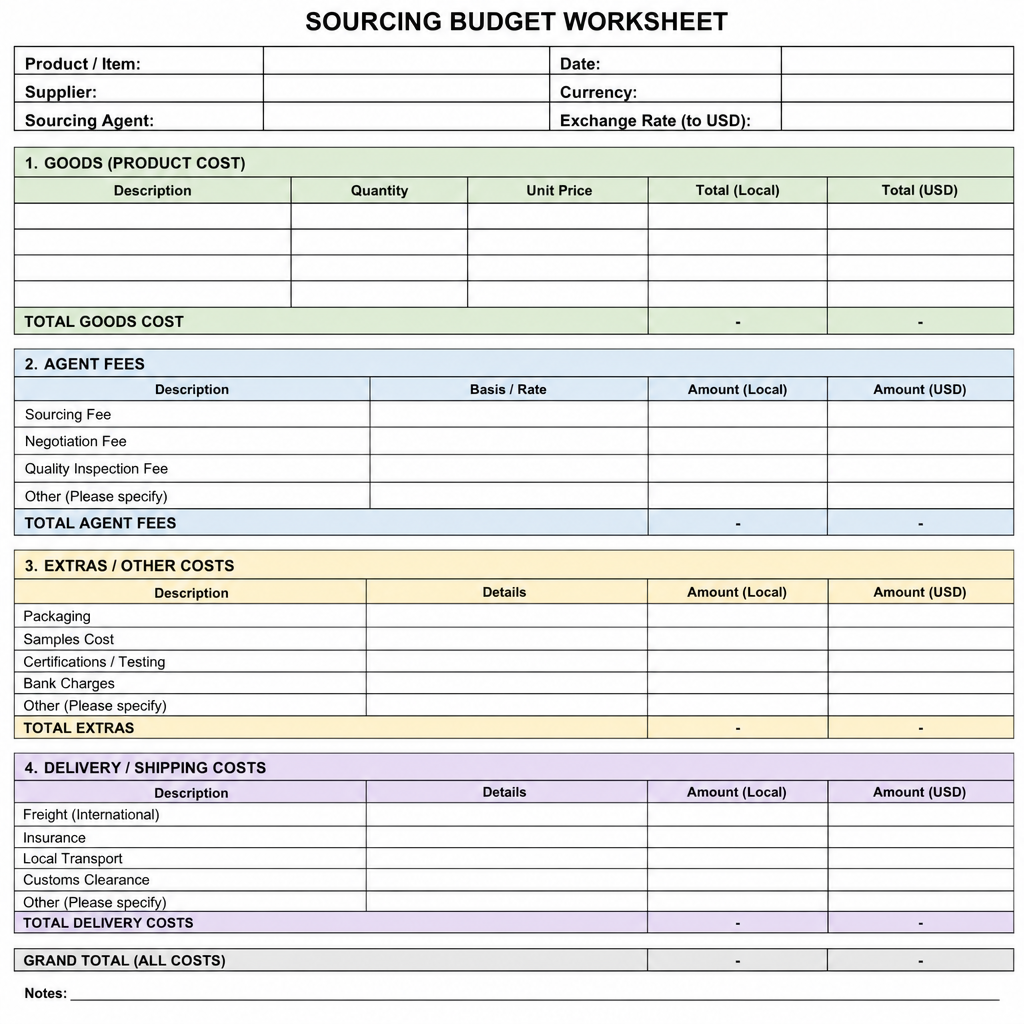
How do you compare quotations fairly?
Compare quotations by giving every agent the same specification and requiring an itemized response on the same delivery basis. Then calculate the total cost of the services and purchasing responsibilities you actually need. The lowest commission is not necessarily the lowest comparable quotation, especially when one provider bundles work that another excludes.
Use this process:
- Issue one sourcing brief. Include product specifications, quantities, destination, packaging, quality expectations, and target milestones. Ask agents to list assumptions rather than fill gaps silently.
- Standardize the commercial basis. Request the same currency, quantity, named delivery place, and trade term. ICC’s rules allocate costs, risks, and obligations, so differences need to be resolved before comparing totals.
- Expose the compensation model. Ask whether the agent earns commission, a product margin, a fixed fee, supplier-side payments, or a combination. Request disclosure rather than assuming that one model is inherently improper.
- Mark every service. Use four labels: included, separately priced, excluded, or awaiting confirmation. Resolve blank cells before selecting a provider.
- Calculate comparable totals. Add goods, agent compensation, and required extras once only. Keep costs outside the quotation visible in a separate section.
- Review the terms behind the number. Check payment milestones, cancellation, rework, refunds, reporting, supplier access, and handover arrangements.
Here is a hypothetical comparison. Agent A quotes $20,000 for goods, 5% commission, and $900 in required extras: $21,900 total. Agent B quotes the same goods price and 7% commission with those same extras included: $21,400 total.
Agent B’s higher percentage produces a $500 lower comparable total. That conclusion holds only if the goods, specifications, service scope, payment conditions, and delivery basis really match. Keep those assumptions beside the calculation so a tidy spreadsheet does not disguise an uneven comparison.
Reduce costs by removing ambiguity, not essential work
Start your negotiation with a clear brief and an explicit scope. Ask the agent to show which tasks drive the quotation and which tasks you can handle internally. Remove unnecessary duplication before asking for an across-the-board discount.
Use these practical requests:
- Price initial sourcing and reorders separately. Define the changes that would trigger a new-project fee, including new materials, packaging, suppliers, or specifications.
- Set approval limits. Require consent before extra sample rounds, travel, storage, or third-party services are commissioned.
- Avoid duplicate services. If you appoint an independent inspection provider, clarify whether the agent’s fee changes and who manages corrective action.
- Ask for volume options without overcommitting. Request pricing at realistic quantities, but do not buy excess inventory solely to obtain a lower commission percentage.
- Define a handover package. Agree on access to approved specifications, reports, production records, and any supplier information the commercial arrangement permits.
Keep quality requirements explicit during negotiation. If a lower quote removes an inspection, report, or verification task, record that change rather than describing it as the same service at a better price. You can then decide consciously whether the reduced scope suits your order.
Confirm the working relationship before paying
Before appointing a China sourcing agent, ask for the business name, contracting entity, invoice details, and explanation of who receives each payment. Request relevant work examples and references you can assess independently. Treat these checks as part of supplier selection, not as proof that any particular fee level guarantees reliability.
Ask who contracts with the factory and who handles a disagreement about quality or delivery. Set out the evidence required to raise an issue, who coordinates rework, and what compensation or refund terms actually apply. Avoid relying on a general promise that the agent will “take care of everything.”
For the first project, consider a bounded assignment with clear deliverables and payment milestones. Evaluate the quality of communication, quotation detail, sample coordination, and reporting before expanding the relationship. Choose a scope that lets you assess execution without creating a larger commitment than you need.
The takeaway for your 2027 budget
When asking how much a China sourcing agent costs, look beyond the headline commission. Published schedules provide useful starting points, but your decision should rest on a current written quotation with defined services, exclusions, and payment terms. Confirm 2027 pricing rather than assuming today’s advertised fees will remain unchanged.
Build a budget that separates goods, agent compensation, additional work, and delivery costs. Compare equivalent scopes, remove double counting, and leave unresolved costs visible. The strongest quotation is the one that makes both the price and the responsibilities clear.
Frequently Asked Questions About How Much Does a China Sourcing Agent Cost in 2027
What is the average commission rate for China sourcing agents in 2027?
The average commission rates for China sourcing agents typically range from 5% to 10% of the product value, depending on the services provided and the agent's fee structure.
Are there any additional charges I should be aware of when hiring a sourcing agent?
Yes, potential additional charges may include costs for samples, inspections, testing, freight, and handling. Always clarify what is included in the agent's fee and request written definitions of all services.
How can I compare quotations from different sourcing agents fairly?
To compare quotations effectively, issue a standardized sourcing brief to each agent, request itemized responses, and ensure that the scope of services, pricing structure, and terms are consistent across all quotes.
What is the difference between commission-based and fixed pricing for sourcing agents?
Commission-based pricing links the agent's fee directly to the purchase volume, while fixed pricing provides a set fee for specific deliverables. The best option depends on the clarity of your project's requirements and expected order size.
How do I build a budget for working with a sourcing agent?
Build a comprehensive budget by separating costs into three layers: the cost of goods, agent services (commissions, fees), and other purchasing and delivery expenses. Use clear categories to avoid double counting and leave unresolved costs visible.