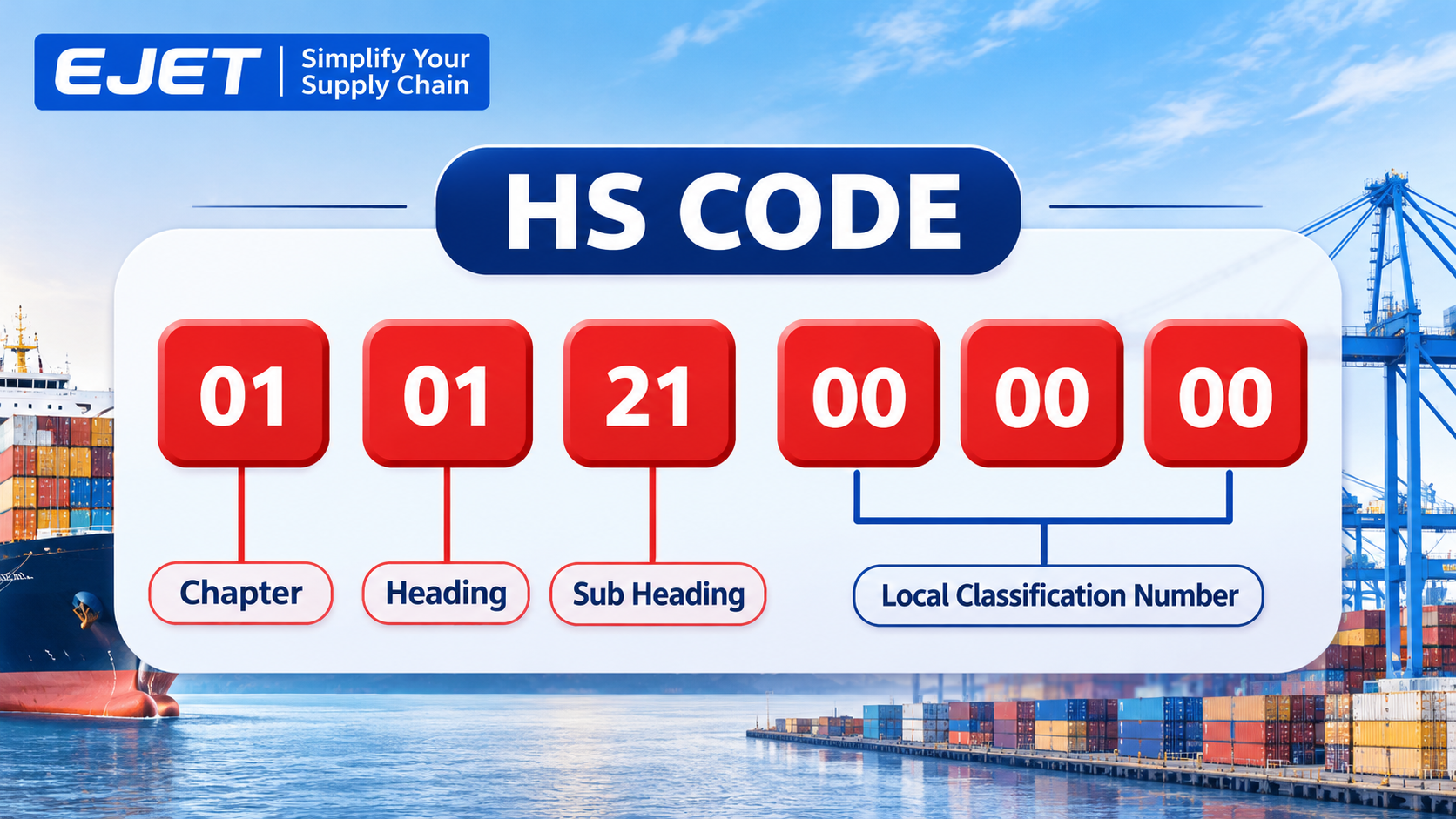
HS Codes classify physical goods traded internationally, giving customs authorities and businesses a shared framework for identifying products. They underpin national tariff schedules and help organize trade statistics.
This guide explains how the codes work, where to research them, and how to build a classification process that goes beyond copying the first search result.
What Is HS Code, and Why Does It Matter?
An HS code is a six-digit product classification within the Harmonized Commodity Description and Coding System, commonly called the Harmonized System. Maintained by the World Customs Organization (WCO), this framework organizes traded goods into internationally standardized categories.
A Harmonized System Code identifies a product category—not a particular brand, supplier, or individual shipment.
The distinction matters because classification connects your product description to the tariff framework used by the importing country. Businesses also use these categories to research markets, compare trade flows, and prepare shipping information.
Instead of treating the code as an administrative afterthought, establish it while planning a new product’s international movement.
Think of classification as a product-identification decision with practical consequences. First establish what the goods actually are; then investigate the relevant tariff treatment. Starting with a desirable duty rate and working backward reverses that logic.
How the HS Code Structure Works
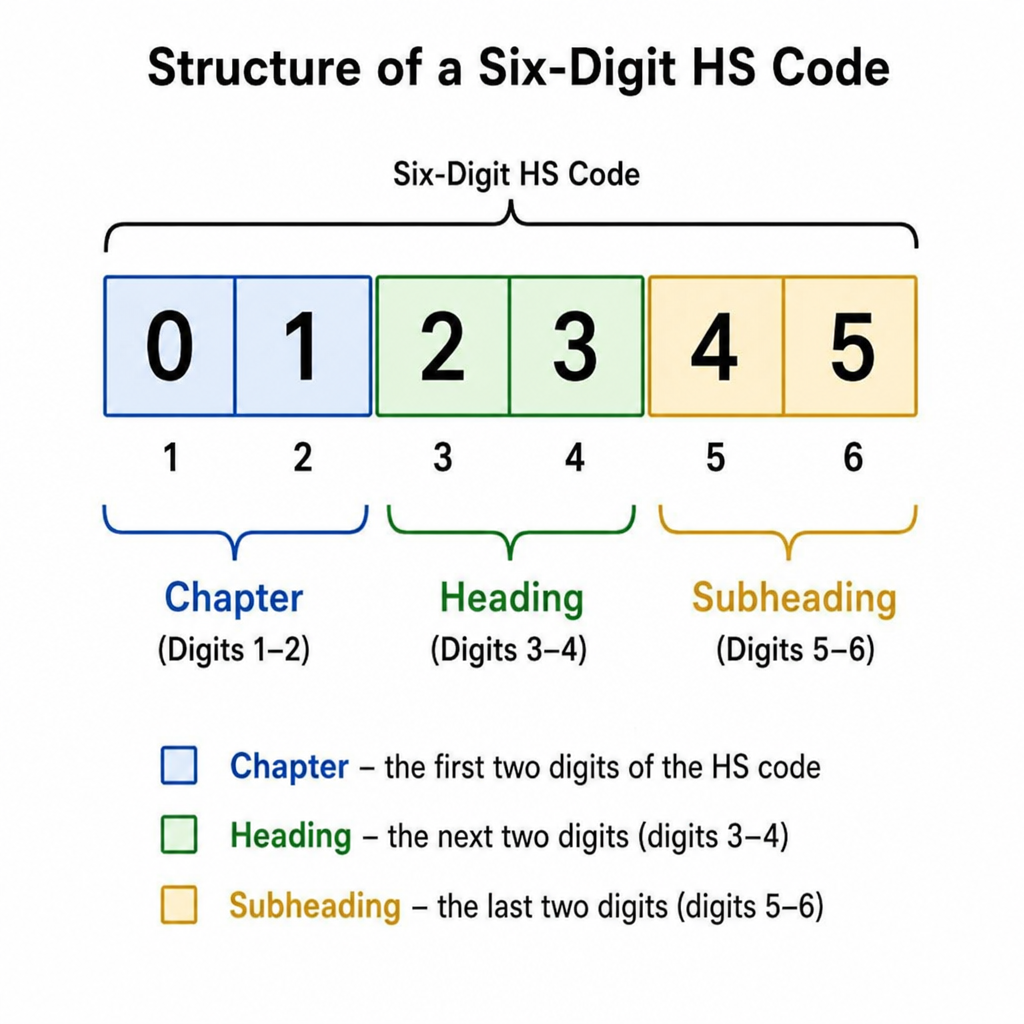
The Harmonized System is hierarchical: each additional pair of digits narrows the category. The first two digits identify the chapter, the first four identify the heading, and all six identify the international subheading. Reading a code therefore means following a path from a broad grouping to a more specific description.
|
Level |
Digits |
What it identifies |
|---|---|---|
|
Chapter |
First 2 |
Broad grouping of goods |
|
Heading |
First 4 |
Product category within the chapter |
|
HS subheading |
First 6 |
Internationally standardized subdivision |
|
National extension |
Beyond 6 |
Further distinctions used by a particular country |
Countries can extend the six-digit framework for their own tariff and statistical purposes. Consequently, an international HS code and the complete number required on a national customs declaration are not necessarily the same length.
HS Codes, HTS Codes, and Schedule B Numbers
For U.S. imports, consult the Harmonized Tariff Schedule of the United States, maintained by the U.S. International Trade Commission (USITC). For U.S. exports, Schedule B is the classification system administered by the U.S. Census Bureau. Both build on the international HS framework, but they serve different reporting purposes.
Their complete 10-digit numbers are not automatically interchangeable. The international foundation is shared, while the national subdivisions can differ; U.S. import classifications are often more detailed than export classifications. Always confirm whether the task concerns an import declaration, export reporting, or the destination country’s requirements.
An HS Code Example: Cotton Sewing Thread
Consider cotton sewing thread put up for retail sale. The USITC uses 5204.20.00 as an example of an eight-digit U.S. tariff classification. Its structure illustrates how the international classification sits inside a longer national number.
- 52 identifies the chapter covering cotton.
- 5204 identifies the heading for cotton sewing thread.
- 5204.20 narrows the category to cotton sewing thread put up for retail sale.
- 5204.20.00 shows the corresponding eight-digit U.S. tariff provision in this example.
The important lesson is the narrowing process, not memorizing this number. Before using an example for an actual shipment, verify the product description, applicable notes, current national schedule, and complete reporting number. A similar name alone is not sufficient evidence that another product belongs in the same category.
How Do You Perform an Accurate HS Code Lookup?
An accurate HS code lookup starts with detailed product information, uses the correct official classification resource, and checks candidate codes against the relevant legal wording and notes. Search tools help locate possibilities; they do not replace classification analysis. Follow the hierarchy rather than selecting an isolated description that sounds close.
Build a Useful Product Description
Before searching, prepare a short technical profile. Use the following prompts as an internal information-gathering checklist:
- Identity: What is the product called in ordinary and technical language?
- Composition: What materials or ingredients does it contain, and in what proportions?
- Function: What does it do, and how does it operate?
- Condition: Is it complete, unfinished, assembled, or supplied in separate components?
- Presentation: Is it packaged individually, for retail sale, or with other items?
- Supporting evidence: Are specifications, photographs, manuals, or composition records available?
Gather these details from someone who understands the product rather than guessing from a sales listing. Keep the technical profile alongside the commercial description so another reviewer can follow the same evidence. CBP emphasizes that cargo descriptions should be clear, concise, and detailed enough to identify the commodity’s characteristics.
Search, Compare, and Verify
Use this sequence to keep research focused:
- Choose the correct jurisdiction and purpose. Separate U.S. import research from U.S. export research and destination-country requirements.
- Search with product characteristics. Enter the item name, then refine using relevant material, function, capacity, or processing details. The Census Bureau’s Schedule B search supports this approach.
- Try alternative terminology. Technical language may differ from everyday language. Census search guidance illustrates this with computers described as automatic data processing machines.
- Read the surrounding hierarchy. Check the heading and relevant notes before comparing its subordinate descriptions. Do not jump directly to a promising final line.
- Resolve uncertainty before filing. Research relevant rulings or seek classification assistance when the available evidence does not support a clear conclusion.
Treat the first result as a lead. A useful HS code search should leave you with both a candidate number and an explanation of why its description fits your goods.
Where to Find a Reliable HS Code List
Start with official resources suited to the task. A general HS code list can help you explore the international structure, but shipment preparation requires the relevant national schedule and its supporting information. Keep these resources distinct in your research notes.
|
Resource |
Best use |
|---|---|
|
WCO nomenclature |
Reviewing international headings, subheadings, and legal notes |
|
USITC Harmonized Tariff Schedule |
Researching U.S. import classifications and tariff provisions |
|
Census Bureau Schedule B |
Researching U.S. export commodity classifications |
|
CBP Customs Rulings Online Search System, or CROSS |
Investigating published U.S. classification rulings |
These resources serve complementary purposes rather than providing interchangeable answers. The WCO publishes the international nomenclature; U.S. agencies provide the national schedules and classification decisions relevant to their responsibilities.
When comparing HS codes lists, check the issuing authority, edition, country, and code length. For repeat HS codes lookup tasks, record which source you consulted rather than saving only a copied number. This makes later review more useful than an unexplained spreadsheet entry.
The Rules Behind HS Code Classification
HS code classification follows the General Rules of Interpretation, together with the applicable legal notes and heading descriptions. It is not simply a keyword-matching exercise. Product characteristics matter because they must be evaluated against the wording and requirements of the classification system.
Start with the terms of the headings and relevant section or chapter notes. Other rules address situations such as incomplete goods, mixtures, composite products, and certain sets. For example, the International Trade Administration explains that an unassembled bicycle supplied as one unit may be classified as a bicycle rather than as separate components.
This is where apparently straightforward research can become technical. If a product combines different materials or functions, document the unresolved issue instead of assuming that the most visible component decides everything. Ask a reviewer to explain the applicable rule and reasoning, not merely supply a number.
Do HS Tariff Codes Tell You the Duty Rate?
HS tariff codes help identify the relevant tariff category, but a six-digit code alone does not establish the final duty payable. You must consult the importing country’s tariff provisions and assess the circumstances of the goods. CBP notes that product details and origin-related information can affect duty research.
Keep three questions separate: what the product is, where it originates, and how its customs value is determined. Classification answers the first; it does not settle the other two. Preferential treatment also requires checking the applicable program’s conditions rather than assuming a qualifying code guarantees a reduced rate.
For commercial planning, use a separate landed-cost worksheet. Record the classification, origin assumptions, valuation information, and date of the tariff research. Label unresolved items clearly so a preliminary estimate is not mistaken for a confirmed shipment cost.
Common Classification Mistakes to Avoid
The following shortcuts deserve particular attention during review:
- Copying a supplier’s complete foreign code. The digits after the international six-digit level can be country-specific. Confirm the importing country’s extension.
- Choosing a match from its name alone. A plausible description may sit under an unsuitable heading or be affected by an exclusion. Read the surrounding provisions.
- Treating import and export numbers as identical. Verify the full number in the appropriate system rather than carrying it across automatically.
- Reusing a code after a product change. Make classification review part of your internal change process when materials, function, or presentation change.
- Saving the answer without the reasoning. Preserve the product evidence, source, review date, and explanation so future colleagues can understand the decision.
A practical internal control is a classification register organized by product identifier and market. Include separate fields for the international HS subheading and any national reporting number. Assign an owner to review entries when specifications change or tariff updates require attention.
When to Seek Help or a Binding Ruling
Seek specialist input when competing classifications remain plausible or important product facts are unclear. Before requesting help, assemble specifications, photographs, composition details, intended function, and the candidate headings you have considered. A focused question gives the reviewer a better starting point than an unexplained request for a code.
For prospective U.S. imports, CBP’s Binding Ruling Program offers binding pre-entry classification decisions. This provides a formal route for obtaining clarity before importing the product and filing entries. Distinguish that process from informal assistance or simply finding a published ruling about another item.
If using CROSS for research, compare the underlying product facts and return to the tariff schedule to check the candidate classification. Published rulings can inform the investigation, while unresolved questions may justify requesting your own determination.
Make Classification a Repeatable Process
Reliable classification starts with knowing the product, selecting the correct official resource, and following the legal structure beyond the search results. Maintain enough evidence to explain the decision and distinguish the international code from national extensions.
For your next shipment, create a product profile, verify the applicable classification, and save the reasoning in a shared record. The goal is not merely to find a number—it is to build a decision that your team can understand, review, and use consistently.
Frequently Asked Questions About HS Codes
What is an HS Code and why is it important?
An HS Code, or Harmonized System Code, is a six-digit classification for products that is used internationally to identify goods traded across borders. It is vital for determining tariff rates, complying with trade regulations, and ensuring accurate reporting of trade statistics.
How can I look up an HS Code for my product?
To look up an HS Code, you should begin by gathering detailed information about your product, such as its composition, function, and presentation. Then, use official resources like the World Customs Organization's nomenclature or the Harmonized Tariff Schedule of your country to search for the appropriate code.
Are HS Codes the same for all countries?
No, HS Codes follow an international standard, but countries can extend the six-digit codes with their own numbers for national tariff and statistical purposes. Therefore, the complete code required for customs declarations may differ between countries.
What are the common mistakes to avoid when classifying HS Codes?
Common mistakes include copying a supplier’s foreign code without verifying its accuracy, choosing a code based solely on product names without checking the corresponding rules, and failing to review the classification when product specifications change.
Can I request a binding ruling for an HS Code classification?
Yes, if you're uncertain about classification or face conflicting descriptions, you can request a binding ruling from customs authorities, which provides a formal, pre-entry classification decision for specific products to clarify obligations before importing.