Guangzhou wholesale markets offer distinct starting points for sourcing clothing, fabrics, bags, toys, gifts, and other consumer goods.
The best choice depends on what you want to buy, how much you need, and whether you are browsing, testing products, or building a repeat supply relationship.
This market guide connects the main shopping areas with practical advice on comparing suppliers, checking quality, and planning purchases.
Approach the trip with a shortlist rather than a mission to see everything. Leave room for discovery, but make each stop answer a buying question: does this product, supplier, and order arrangement fit your needs?
Which Guangzhou wholesale markets should you visit first?
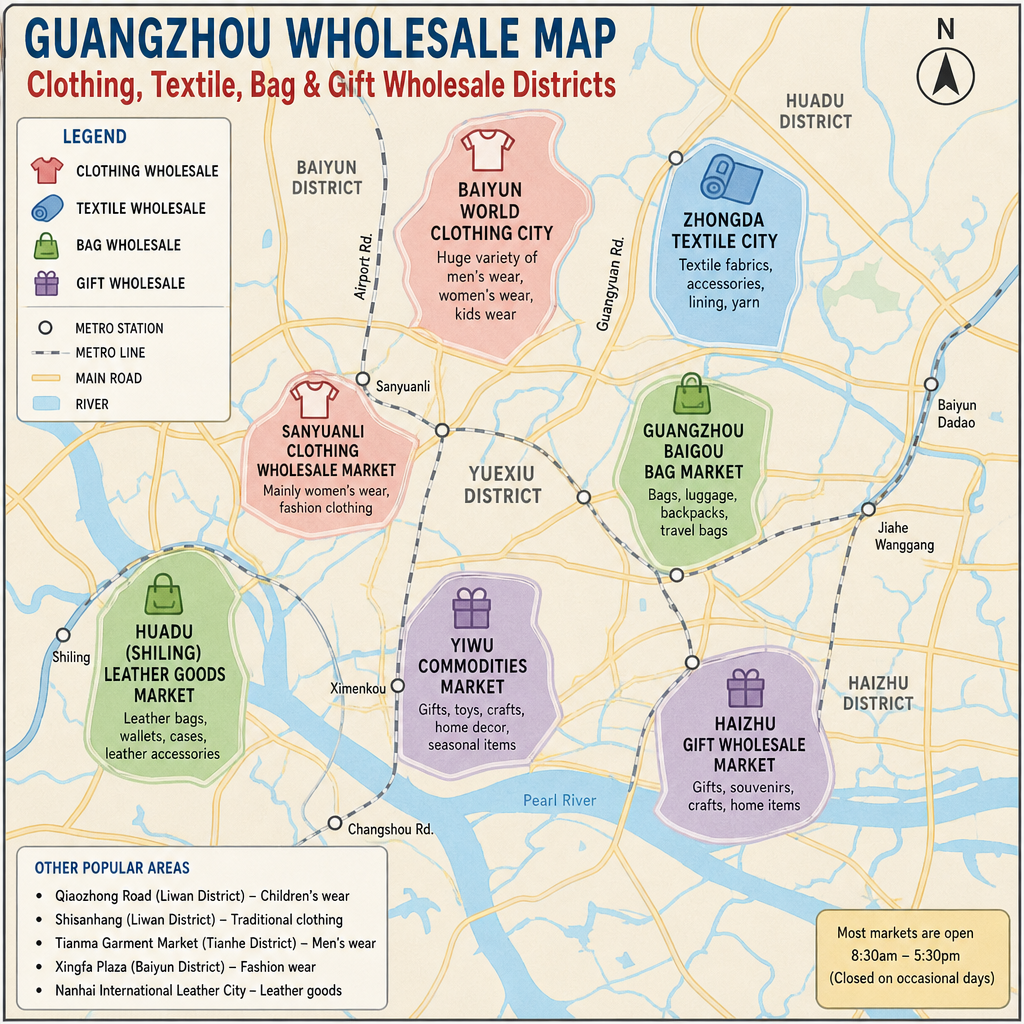
Start with the market cluster that matches your product category: Baima and the Liuhua area for clothing, Shisanhang and Shahe for further garment exploration, Zhongda for fabrics and trims, Sanyuanli and Guihuagang for bags, and Yide Road for toys and gifts.
These are separate sourcing areas, not departments inside one enormous market. Choose your first destination by product fit, then compare individual sellers rather than assuming an entire district shares one quality level.
Use this shortlist to narrow your route. The final column suggests a buying task, not a promise about every stall.
|
Market or cluster |
Main sourcing focus |
Suggested first task |
|---|---|---|
|
Baima and Liuhua |
Finished clothing |
Compare garment construction and supplier terms |
|
Shisanhang |
Fashion clothing, particularly womenswear |
Build a focused assortment shortlist |
|
Shahe |
Clothing across multiple market buildings |
Compare equivalent styles and quantity requirements |
|
Zhongda |
Fabrics, trims, and garment accessories |
Collect labeled swatches against a specification |
|
Sanyuanli and Guihuagang |
Bags and leather goods |
Check materials, hardware, and construction |
|
Yide Road and Wanling Plaza |
Toys, gifts, stationery, and decorative goods |
Compare packaging, assortment, and carton requirements |
These category groupings are supported by Guangzhou’s commerce authorities and local reporting; use them as orientation rather than a substitute for confirming a particular building’s tenants.
Clothing markets worth exploring
Baima and the Liuhua area: a starting point for garment comparisons
Baima is an established clothing wholesale market opposite Guangzhou Railway Station. The wider station-area shopping landscape includes other clothing markets, including Liuhua, Hongmian, and several neighboring fashion buildings. Treat Baima as an anchor for a focused garment-sourcing session rather than a guarantee that every product will suit your business.
Begin with a clear product brief: occasionwear, everyday separates, workwear, or another defined category. Compare garments intended for the same customer and selling season. Put similar pieces side by side in your notes, recording fabric composition, lining, fastening quality, measurements, and the quantities attached to each quote.
For a boutique assortment, prioritize coherence over variety. Ask yourself whether the pieces work together and whether you can explain their differences to customers. Before leaving a promising seller, request written confirmation of the available sizes, colors, replenishment options, and sample-purchase terms.
Shisanhang: explore womenswear with an assortment plan
Shisanhang is a clothing-market district, with New China Building among its established trading locations. Guangzhou’s commerce bureau identifies that building as a well-known womenswear wholesale market. Use the district as a focused destination for comparing fashion assortments, while checking each seller’s actual specialization.
Bring reference images, but add buying criteria beneath each image. Specify the silhouette, fabric feel, acceptable transparency, garment length, and intended customer. A photograph alone leaves too much room for two people to agree on a style while imagining different products.
When a display catches your attention, ask whether the quoted goods are available now or require production. Confirm which colors and sizes the quotation covers, and request measurements rather than relying only on size labels. Keep your initial shortlist small enough to revisit before committing.
Shahe: compare clothing beyond the price tag
Shahe is another major clothing-market cluster, encompassing multiple trading buildings rather than a single shopping hall. Recent local reporting describes its development beyond its traditional affordable, volume-oriented image toward more original brands and international business.
Avoid treating its reputation as a fixed description of every supplier.
Set one comparison task for your visit, such as evaluating casual tops in a particular material and fit. Ask several sellers to quote against that same brief. Record whether the offer requires mixed sizes, fixed color packs, or a minimum quantity for each variation.
Resist judging value from the most visible garment on a rack. Inspect the inside seams, stretch recovery, print alignment, and finishing on the piece you intend to order. If you cannot reconcile the sample, quotation, and packing arrangement, pause the purchase rather than filling the gaps with assumptions.
Specialist markets beyond finished clothing
Zhongda: fabrics and trims for product development
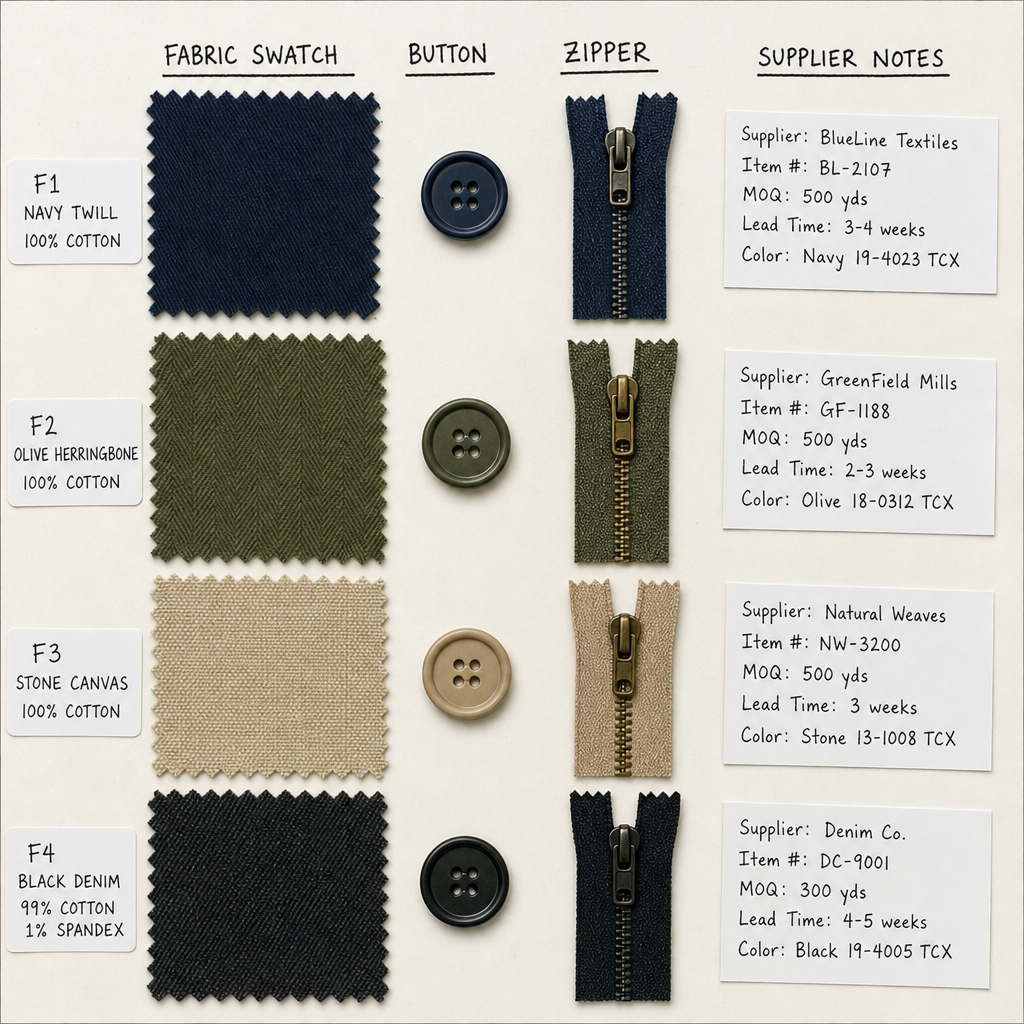
Zhongda’s textile cluster in Haizhu is a destination for fabric and garment-accessory sourcing. Its product range includes woven and knitted fabrics, blends, decorative materials, buttons, and other trims. Guangzhou International Textile City is one of the major venues within this broader textile ecosystem.
Go with a material specification, not just a color reference. For example, describe the intended garment, desired composition, weight, width, stretch, opacity, and finish. Ask the seller to identify which details are confirmed and which still need testing or production approval.
Label every swatch immediately with the supplier, stall, fabric code, quoted unit, and date. Request separate terms for sampling and a larger order, including color minimums and production timing. Before approving bulk material, arrange suitable checks for its intended use rather than treating touch and appearance as complete evidence.
Sanyuanli and Guihuagang: bags and leather goods
The Sanyuanli and Guihuagang area is associated with Guangzhou’s bag and leather-goods trade, including Baiyun World Leather Trading Center. Guangzhou authorities also identify Sanyuanli as an established leather-goods cluster. Focus your search on products with clear material descriptions and a traceable supplier relationship.
Bring a construction checklist for each bag type. Examine handle attachments, strap adjustment, lining, zipper movement, edge finishing, and hardware consistency. Ask for the material description in writing; do not use appearance, smell, or a seller’s informal terminology as your only verification method.
Be especially cautious about branded merchandise. U.S. trade authorities have identified counterfeiting concerns at Baiyun Leather Trading Center; that finding does not establish that every seller or product there is counterfeit. Choose original or legitimately authorized goods, and do not interpret a familiar logo as evidence of authenticity.
Yide Road and Wanling Plaza: gifts, toys, and decorative goods
Yide Road is an established small-commodities trading area, with toys, stationery, gifts, and seasonal products among its categories. Wanling Plaza, also called OneLink Plaza, is a prominent destination within this shopping landscape. Local reporting describes its assortment of toys, accessories, stationery, and decorative merchandise.
Explore by intended use: gift-shop stock, event decorations, desk accessories, or another defined category. For every promising item, ask to see the selling package and shipping arrangement. Record whether the offer is for individual pieces, assorted packs, inner boxes, or full cartons.
For children’s products, investigate compliance before negotiating a large order. U.S. toy importers must address applicable safety, testing, certification, and labeling requirements; a supplier’s verbal assurance does not replace that work. Ask for product-specific documentation and have its relevance checked before purchasing for resale.
Plan market exploration around decisions, not distance
Build your itinerary around one primary category each day, with an optional nearby stop only after the main task is complete. Give yourself time to compare, ask follow-up questions, and review notes away from the sales floor. A useful visit should leave you with clearer decisions, not just more product photographs.
Before traveling to a market, confirm the exact building name, current business hours, and the availability of any supplier you specifically want to meet. Save the Chinese name and entrance locati0n alongside your accommodation address. Avoid organizing an entire day around an unverified opening time copied from an old directory.
Use a preparation checklist:
- Define the buying brief. List your customer, product category, material expectations, quantity range, and nonnegotiable features.
- Set a sample budget. Separate exploratory purchases from money available for a commercial order.
- Prepare a quote sheet. Use the same fields for every supplier so comparisons remain consistent.
- Pack for recording details. Bring a charged phone, power bank, measuring tape, and labeled sample bags where relevant.
- Arrange language support if needed. Ask an interpreter or sourcing assistant to explain their scope, fees, and any supplier commissions before engagement.
- Leave a review window. Reserve time to revisit shortlisted sellers instead of making every decision during the first conversation.
For a first trip, consider a three-stage rhythm: scout, verify, then order. During scouting, identify plausible products and contacts. During verification, resolve specifications, documentation, and delivery questions. Place an order only when the information is sufficiently clear to record in writing.
If you are visiting for personal wholesale shopping rather than resale, state that you want a small quantity at the beginning. Ask whether individual purchases are accepted and what inspection or return terms apply. Do not build your budget around obtaining the same terms as a larger commercial buyer.
How do you compare wholesale suppliers fairly?
Compare wholesale suppliers against the same specification, quantity, packaging, and delivery scope. Ask each seller to explain what the quotation includes, what remains undecided, and how the supplied goods will be matched to your approved sample. Treat price as one part of the decision, alongside product suitability and the clarity of the agreement.
Start by establishing who you are dealing with. Request the business name, contact details, stall locati0n, and the entity that would receive payment and issue the invoice. Ask whether the seller manufactures the goods, represents a producer, or trades stock from other sources; verify important claims before relying on them.
Make every quotation comparable
Use one record per product and supplier. Avoid combining several similar-looking products under an informal description such as “black shoulder bag” or “summer blouse.” Assign your own reference code and connect it to the seller’s product code and sample photographs.
Capture these fields:
|
Quote field |
What to clarify |
|---|---|
|
Product specification |
Materials, dimensions, components, finish, and approved variation |
|
Minimum order |
Minimum per style, color, size, or total order |
|
Unit price |
Currency, quantity tier, and what packaging is included |
|
Availability |
Existing stock, production requirement, and confirmation date |
|
Delivery scope |
Collection point, local delivery, or separately quoted freight |
|
Payment |
Recipient, payment stages, and written payment confirmation |
|
Quality resolution |
Inspection process and agreed response to shortages or defects |
After the conversation, send a concise written recap and ask the supplier to confirm it. Resolve discrepancies while you are still able to revisit the stall. Keep the confirmed version with your sample record rather than relying on a long, unstructured message thread.
Negotiate scope before pushing for a discount
Ask for prices at quantities you could realistically purchase. Then discuss which changes might improve the offer: fewer color variations, simpler packaging, a different assortment, or a revised delivery arrangement. Require a new written quotation whenever the product or scope changes.
Keep your commercial limits visible. Decide in advance how much stock you are willing to test and which product features you will not compromise. If the only workable price requires an order larger than you can justify, decline or ask about a smaller trial rather than negotiating yourself into excess inventory.
Check wholesale products before committing
Use samples to define what you are buying, not simply to decide whether you like the design. Photograph identifying details and record the agreed measurements, materials, components, colors, and packaging. Ask the supplier to confirm how the order will be checked against that reference.
For clothing, inspect both the exterior and interior. Check seam finishing, closures, lining, print placement, and key measurements. For bags, operate zippers and clasps, examine attachment points, and compare the finish across visible and less visible surfaces.
For gifts and decorative goods, review edges, joints, paint finish, and packaging protection. Where performance, safety, or material claims matter, seek appropriate testing or specialist review. Do not substitute a quick visual inspection for evidence that the product meets its intended requirements.
Use these shopping tips to keep inspection practical:
- Identify the approved reference. Give the sample or specification a clear code that appears on the order.
- Record acceptable variation. Clarify which differences in dimensions, shade, finish, or assortment require approval.
- Agree on an inspection point. Establish when you or a representative can inspect goods before dispatch.
- Document discrepancies. Record the affected product codes, quantities, photographs, and requested resolution.
- Keep a complete file. Store quotations, approvals, payment records, and packing information together.
Start with a manageable trial when the supplier relationship is new. Set your evaluation criteria before ordering: conformity to the approved reference, communication, packing accuracy, and delivery performance. Use the results to decide whether to reorder, revise the specification, or continue your search.
What should you arrange before shipping purchases home?
Before dispatch, arrange an itemized invoice, a checked packing list, a clear transport quotation, and confirmation of the destination country’s import requirements.
Establish who is responsible for each stage, from collection through delivery. For U.S.-bound commercial purchases carried in baggage, confirm the applicable clearance process in advance rather than treating them as ordinary personal shopping.
Ask your freight provider for an itemized explanation of the proposed service. Request the collection point, destination, transport method, estimated timing, insurance options, and exclusions. Have the provider explain any quoted trade term in plain language, especially where responsibility or payment changes hands.
Before approving dispatch, work through four checks:
- Match documents to goods. Reconcile product descriptions, quantities, carton counts, and supplier references.
- Review packing. Ask for suitable protection and confirm how separate suppliers’ orders will remain identifiable.
- Confirm destination requirements. Have an appropriate broker or specialist review classification, duties, labeling, and product-specific obligations.
- Record the handover. Obtain collection confirmation and retain shipment references with the order file.
For U.S. resale, check the relevant regulator’s requirements before purchasing, not after the cartons are packed. CPSC provides importer resources for consumer products under its jurisdiction, while its toy guidance explains specific testing and certification responsibilities. Use those resources and qualified advice to assess the actual products you intend to import.
Keep budget decisions separate from optimistic shipping assumptions. Obtain a transport estimate while the order is still adjustable, then revisit your buying decision using the fuller cost picture. If key charges or responsibilities remain unclear, resolve them before authorizing collection.
Turn a promising visit into a repeatable sourcing process
Before leaving Guangzhou, organize your shortlist into three groups: ready for a trial, needs more evidence, and unsuitable. Give every unresolved item a specific next action, such as requesting a revised quotation or checking a test report.
Avoid keeping a supplier on the shortlist solely because the conversation was friendly or the display looked impressive.
Send each shortlisted supplier a focused follow-up message. Include the product references you discussed, the decisions already confirmed, and the questions still open. Ask for corrections explicitly; silence should not be treated as agreement.
After receiving a trial order, compare it with the same criteria you used during market exploration. Record what matched, what required clarification, and what you would change next time. Keep that assessment alongside the supplier’s details so a reorder begins with evidence rather than memory.
A focused approach beats a crowded itinerary
The best Guangzhou wholesale markets for your trip are the ones that help you find suitable products and evaluate the people supplying them. Start with the right category, make quotations comparable, and keep samples connected to written specifications.
Reserve as much attention for quality, documentation, and delivery as you give to the asking price.
Choose a manageable route, ask precise questions, and leave room to reconsider. A small, well-understood first order is a stronger outcome than a suitcase of samples or a large purchase you cannot confidently explain.
Frequently Asked Questions About Guangzhou Wholesale Markets
What products can I find in Guangzhou wholesale markets?
You can find a variety of products such as clothing, fabrics, bags, toys, gifts, and other consumer goods. Specific markets focus on particular categories, so it's important to know your target product before visiting.
How do I navigate the various wholesale markets in Guangzhou?
It’s best to group your visits based on product categories. For example, visit Baima and Liuhua for clothing, Zhongda for fabrics, and Yide Road for toys. Creating a shortlist of goals for each market will help you stay focused.
What should I prepare before visiting the markets?
Before your trip, prepare a buying brief that includes your target products, specifications, a budget for samples, and a checklist for each supplier. Additionally, having reference images and measurements will aid in effective comparisons.
How can I ensure the quality of the products I purchase?
Inspect samples thoroughly for quality by checking seams, materials, and finishes. Document any discrepancies in terms of the specifications provided by suppliers, and ensure you have clear agreements regarding quality assurance processes.
What are the customs regulations I should be aware of when importing goods from China?
Check the import regulations of your country before purchasing. Regulations may include product safety standards, labeling requirements, and potential duties. It's advisable to consult a customs broker to assist with compliance and documentation.