


A freight forwarder from China to USA destinations coordinates international transport and can arrange services such as pickup, shipping documentation, and customs-broker support.
The right partner helps you compare routes and understand which charges and responsibilities belong to you. This article explains how to assess providers, choose freight shipping solutions, and prepare your shipment before booking.
What does a freight forwarder from China to USA destinations do?
A freight forwarder organizes the movement of goods between suppliers, carriers, and receiving locations. Depending on the agreement, its work may include collecting cargo, reserving transport capacity, reviewing shipping documents, arranging insurance, and coordinating with a customs broker. Its role is to connect the stages of the shipment, rather than necessarily operate the aircraft, vessel, or delivery truck.
Start by asking where the service begins and ends. A port-to-port quote is not equivalent to a door-to-door quote; pickup, clearance, and inland delivery need explicit treatment. Providers offer different combinations of these services, so compare the written scope rather than the service label alone.
Also distinguish forwarding from customs brokerage. A broker conducting customs business for another party must hold a valid U.S. customs broker license. Ask whether brokerage is provided directly or through a separate company, and who will contact you when information is missing.
Choose the transport method around your inventory needs
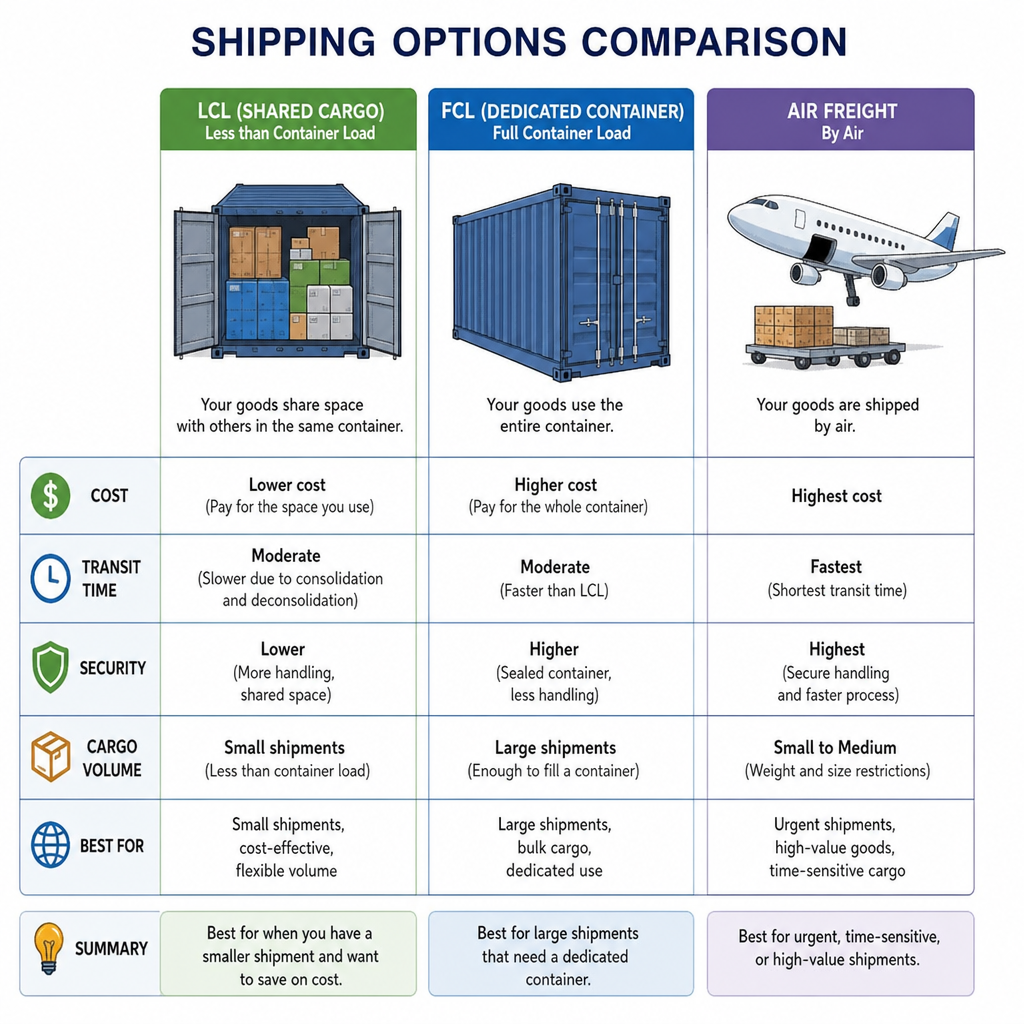
Shipping from China starts with a practical trade-off: how much cargo needs to move, how quickly it is needed, and what the business can afford. Air and ocean services meet different needs, while ocean freight offers both shared-container and dedicated-container options. Request alternatives against the same cargo details instead of assuming one method is always cheapest.
Ocean freight: LCL and FCL
Less-than-container load, or LCL, combines your goods with other shippers’ cargo. Full-container load, or FCL, gives one shipper exclusive use of a container. LCL can suit smaller orders, but consolidation and additional handling need consideration alongside the freight price.
For a growing shipment, request both options. Compare the complete destination charges, handling requirements, and delivery plan—not only the ocean transport line. Make the decision using your actual shipment rather than a universal volume threshold.
Air freight and express services
Air freight can make sense when speed justifies the expense. Express services are another option for time-sensitive packages, while freight services accommodate pallets and larger shipments. Ask which service fits the packed cargo and receiving location.
Pay attention to chargeable weight. A carrier may compare actual gross weight with volumetric weight and charge using the higher figure, making packaging dimensions important to the quote. Provide final packed measurements rather than product dimensions alone.
How do you choose the best freight forwarder China to USA shipments require?
The best freight forwarder for China to USA shipments is the provider whose documented capabilities match your cargo, delivery requirements, and communication needs. Build your shortlist around a consistent written brief, then assess how clearly each company explains its service. Treat a low headline price as one comparison point, not the decision itself.
Use these checks before committing:
- Relevant experience: Ask how the provider would handle your product category, packaging, and delivery destination. Request an explanation of any special handling rather than accepting a general assurance.
- Clear accountability: Identify the contracting company, origin contact, destination contact, and customs broker. Ask who owns the next action when a shipment stops moving.
- Written commercial terms: Request inclusions, exclusions, payment terms, quote validity, and the process for approving extra charges.
- Useful visibility: Ask for a sample status update. Look for milestones and next actions, not simply a tracking number.
- A credible exception plan: Discuss missed departures, damaged cartons, document corrections, and unsuccessful delivery attempts before they happen.
For U.S.-bound ocean services, establish whether the company acts as an agent or a non-vessel-operating common carrier, known as an NVOCC. Check the relevant legal entity against Federal Maritime Commission records. Foreign-based NVOCCs may be licensed or registered, so the absence of a U.S. license number alone does not settle whether a company is properly authorized.
When reviewing a China to USA freight forwarder, ask which entity issues the transport document and which entity invoices you. Resolve unexplained differences before paying. The goal is a clear relationship with identifiable parties, not an impressive collection of logos.
What should a freight quote include?
A useful freight quote identifies the shipment, service boundaries, applicable charges, and assumptions behind the price. Freight costs depend on factors including weight, dimensions, route, transport mode, required speed, and additional services. Without matching inputs and scope, two totals may describe different services.
Ask providers to address the following items explicitly:
|
Quote item |
What to clarify |
|---|---|
|
Origin services |
Supplier pickup, loading, handling, and export-document support |
|
Main transport |
Mode, routing, service level, and applicable surcharges |
|
Destination services |
Terminal handling, cargo release, and any warehouse handling |
|
Customs support |
Broker fees, bond arrangements, and filing responsibilities |
|
Government charges |
Whether duties and other charges are included or estimated separately |
|
Final delivery |
Delivery locati0n, unloading needs, appointments, and access restrictions |
|
Contingencies |
Storage, examinations, waiting time, redelivery, and insurance options |
Use this table as a request for disclosure, not an assumption that every shipment incurs every charge. Freight-cost planning should account for handling, special services, documentation, insurance, and possible delay-related expenses. Ask which items are fixed, estimated, or payable only if an event occurs.
Keep freight cost separate from the full landed-cost calculation. Before you import from China, have your broker confirm the product classification and applicable duties. Section 301 treatment is linked to HTS classification; do not apply one blanket tariff percentage to every Chinese product.
Set responsibilities before cargo leaves the factory
Incoterms help allocate costs and responsibilities between buyer and seller, including transport, clearance, and certain insurance obligations. They need a named locati0n and an agreed version to make the arrangement clear. Put that information in the purchase agreement and give it to the forwarder when requesting a quote.
Avoid treating “door-to-door” as a complete explanation of the transaction. Ask who handles export clearance, who arranges import clearance, who pays government charges, and where responsibility for delivery ends. Compare those answers with the supplier’s sales terms so no task is left unassigned.
If offered a delivered-duty-paid arrangement, request written confirmation of the importer of record and the customs-entry process. Do not accept undervaluation, vague product descriptions, or unexplained paperwork as a way to simplify shipping. The importer of record remains responsible for reasonable care in classification, valuation, and the information supplied to CBP.
Prepare documents and compliance checks early
Customs preparation belongs before dispatch, not after arrival. A broker can help identify entry requirements, but the importer must ensure the merchandise meets applicable requirements from other agencies. Product-specific obligations may involve agencies such as FDA, CPSC, USDA, or EPA.
Build a working document checklist with your broker and forwarder:
- Commercial invoice: Confirm the parties, product descriptions, quantities, prices, and transaction details.
- Packing list: Reconcile carton counts, packed weights, dimensions, and package contents.
- Transport document: Check consignee details and cargo information against the other documents.
- Classification information: Provide materials, intended use, specifications, and other details needed to identify the goods accurately.
- Supporting approvals: Establish whether certificates, permits, testing records, or other product-specific documents are needed.
For applicable ocean shipments, agree who submits the Importer Security Filing and when the supplier must supply its data. CBP generally requires key ISF information no later than 24 hours before cargo is loaded aboard the U.S.-bound vessel. Have the filing party confirm the requirements for your shipment rather than treating ISF as an arrival-day task.
Use specific descriptions. “Accessories” gives a broker less useful information than a description identifying the article, material, and use. Send unresolved classification questions for review before approving the final invoice; accurate classification and valuation are part of the importer’s reasonable-care responsibility.
Coordinate Amazon deliveries as a separate workstream
If you need a freight forwarder from China to USA Amazon fulfillment centers, assess its receiving-process knowledge separately from its international transport capabilities. Amazon requires inbound inventory to meet applicable FBA requirements, and fulfillment centers have delivery requirements covering matters such as pallets and delivery vehicles. An arrival at a U.S. port is not a completed FBA delivery.
Before booking, ask the provider to confirm:
Who checks the shipment against the applicable FBA preparation and labeling instructions.
Who receives final destination information and distributes it to the delivery team.
Whether pallet preparation or other receiving-related work is included.
Who manages delivery scheduling and communicates receiving problems.
Where goods will go if a correction or delivery change becomes necessary.
Establish the importer of record independently of the fulfillment destination. Amazon states that it will not act as importer of record for FBA inventory, regardless of shipment size or value. Shipping to an Amazon building does not transfer your import responsibilities to Amazon.
Plan around delivery readiness, not just departure
Ask for a door-to-door schedule that separates pickup, origin processing, main transport, clearance, and inland delivery. Ocean transit time and total door-to-door time are different, and the route influences the estimate. Use the delivery requirement as the planning anchor rather than relying only on a vessel departure or arrival date.
Request milestone updates with an owner and next action attached. For example, “documents awaiting importer approval” is more actionable than “processing.” Agree how quickly exceptions should be escalated and who can approve a routing change or additional expense.
Before dispatch, also review insurance options and the claims process. Ask what coverage is offered, which exclusions apply, and what evidence would be needed for a claim. Keep cargo value, shipment records, packing photographs, and contact details together so the team knows where to find them. Insurance scope belongs in the shipping plan, not in assumptions made after a loss.
Make your first booking a controlled decision
Choose a partner you can understand and hold accountable. Start with accurate cargo details, request comparable quotes, verify the relevant parties, and settle customs responsibilities before pickup. Then judge performance against the agreed scope: communication, document accuracy, delivery coordination, and explanation of charges.
Your next step is straightforward: prepare one shipment brief and send it to a shortlist of providers. Ask each for an itemized quote and a written delivery plan. Select the proposal that makes both the movement of your goods and your responsibilities clear—not merely the one with the smallest number.
Frequently Asked Questions About Freight Forwarding From China to the USA
What is a freight forwarder, and what services do they offer?
A freight forwarder is a logistics service provider that organizes the transportation of goods between suppliers and carriers. They handle services such as cargo pickup, booking transport capacity, preparing shipping documentation, arranging insurance, and coordinating customs clearance.
How do I choose the best freight forwarder for my needs?
To choose the best freight forwarder, assess their relevant experience, clarity in accountability, written commercial terms, visibility into shipment progress, and the credibility of their exception plans. It's essential to ensure that the freight forwarder matches your cargo type, delivery timelines, and communication preferences.
What are the main transport methods available for shipping from China to the USA?
The primary transport methods include air freight and ocean freight. Air freight is suitable for time-sensitive shipments, while ocean freight can be cost-effective for larger volumes. Within ocean freight, you can choose between Less-than-Container Load (LCL) and Full-Container Load (FCL) options based on your shipment size.
What documents do I need to prepare for freight shipping from China?
Important documents for freight shipping include the commercial invoice, packing list, transport document, classification information, and any necessary supporting approvals or certificates. Ensuring all documents are accurate and complete is crucial for smooth customs clearance.
What are Incoterms, and why are they important in international shipping?
Incoterms are internationally recognized terms that define the responsibilities of buyers and sellers for the delivery of goods. They clarify who is responsible for transport, insurance, and customs clearance, thereby reducing misunderstandings and disputes in shipping transactions.