


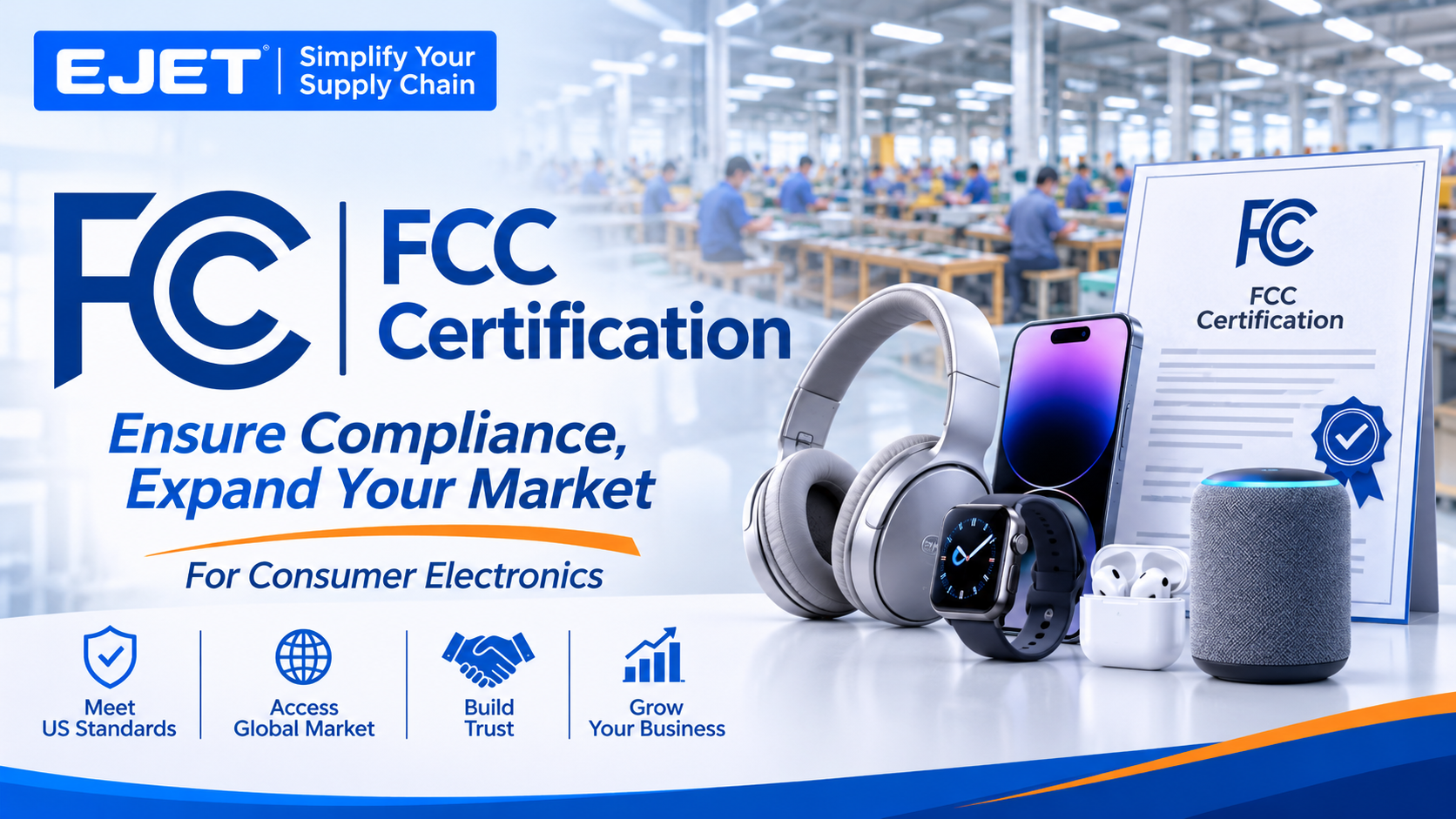
FCC certification is a U.S. equipment authorization process that uses testing and technical review to establish whether a radiofrequency device meets applicable Federal Communications Commission requirements.
Not every electronic product needs certification: some use Supplier’s Declaration of Conformity instead.
This guide explains how to identify the right route, prepare for FCC testing, budget the work, and maintain compliance after launch.
What is FCC certification, and which products need it?
FCC certification is an equipment authorization granted following review of an application and supporting compliance evidence by an FCC-recognized Telecommunication Certification Body, or TCB. Most intentional radiators operating under Part 15—devices designed to transmit radiofrequency energy—require certification before marketing, subject to specific exceptions.
Examples include many Bluetooth accessories, Wi-Fi devices, and wireless remote controls.
The key distinction is between certification, a particular authorization procedure, and FCC compliance, the broader obligation to meet applicable rules.
A product can require emissions testing without needing its own certification grant. Many digital devices use Supplier’s Declaration of Conformity, commonly abbreviated SDoC, although the correct procedure depends on the device category.
|
Authorization route |
Typical application |
How compliance is established |
|---|---|---|
|
Certification |
Most Part 15 intentional transmitters |
Testing by an FCC-recognized accredited laboratory, followed by TCB review and a grant |
|
Supplier’s Declaration of Conformity |
Many non-transmitting digital devices |
The responsible party establishes compliance, retains supporting evidence, and supplies required compliance information |
These are starting points, not universal classifications. Some receivers require certification, and products combining transmitters with digital circuitry can have multiple applicable obligations. Classify the complete product rather than assuming its wireless chip determines every requirement.
FCC approval is not a general safety endorsement
“FCC approval” is often used informally, but it should not suggest that the agency endorses a product’s quality or every aspect of its safety. Equipment authorization addresses the applicable FCC requirements, including relevant interference and RF exposure provisions. It does not establish compliance with matters outside those rules.
The rules and responsibilities behind authorization
Part 2 of the FCC regulations establishes equipment authorization procedures. Part 15 covers many unlicensed radiofrequency devices, while other equipment may fall under different rule parts. A useful first step is to document the product’s radios, operating frequencies, intended uses, and digital functions so the applicable requirements can be identified.
Treat FCC guidelines and laboratory checklists as aids to applying the rules, not replacements for them. Ask your laboratory or TCB to identify the applicable rule sections and measurement procedures in its proposed scope. FCC testing procedures incorporate specified standards, so a generic emissions test is not necessarily the right evidence for your application.
Certification applicants must also address administrative eligibility, including required statements concerning the Covered List and designation of a U.S.-located agent for service of process. An applicant located in the United States may designate itself. Screen eligibility early: passing technical tests does not override prohibitions on authorizing covered equipment.
How does the FCC certification process work?
The process moves from product classification and test planning to laboratory measurements, application preparation, and TCB review. Certification becomes effective only when the application is granted; a passing test report alone is not a certification grant. Plan the project around both the technical evidence and the authorization decision.
1. Define the product and authorization scope
Prepare a product description covering radio technologies, frequency bands, antennas, power sources, accessories, and intended operating configurations. Identify whether the product uses an already-certified module or a newly developed transmitter. Ask the laboratory to explain which functions require certification and which need separate supporting compliance work.
Avoid requesting a quote based only on a product name such as “smart speaker.” Instead, provide enough detail to distinguish a single-radio device from a product with several transmitters and operating modes. Your goal is a written scope that connects the actual design to the required evidence.
2. Select qualified testing and review partners
Testing used for certification must be performed by an FCC-recognized accredited testing laboratory. Confirm that the laboratory’s recognized scope covers your product’s technologies and relevant frequencies. The TCB evaluates the application and makes the certification decision; that role is distinct from performing measurements.
Before booking, ask who will coordinate questions between your engineers, the laboratory, and the reviewer. Request a list of required samples, accessories, software, and documents. Assign one internal owner to keep the tested configuration and application materials aligned.
3. Prepare representative samples and operating modes
Certification generally relies on testing a representative product sample, although additional samples may be requested when warranted. The application must accurately describe the equipment and include relevant technical material. Record the hardware and software versions supplied so your team can trace the results to the submitted design.
Consider a preliminary engineering review before formal testing. Use it to check whether the sample is complete, required operating modes are accessible, and the documentation reflects the build. Treat this preparation as a readiness check, not as a substitute for the required compliance measurements.
4. Complete testing and resolve findings
The laboratory performs the measurements applicable to the device and its operating rules. Certification submissions require test data and supporting descriptions, while RF devices must also address applicable RF exposure requirements. The precise test program depends on the product rather than a universal checklist.
Ask the laboratory to explain each finding in terms your design team can act on: the affected configuration, the measured issue, and the evidence needed after correction. Record any changes made during troubleshooting. Before proceeding, reconcile the final sample with the schematics, photographs, operating description, and report.
5. Submit the application and obtain the grant
The TCB reviews the required application information and supporting evidence against the applicable requirements. It may request clarification, additional information, or samples. Resolve those requests before treating the project as complete, and review any conditions attached to the resulting grant.
Keep a controlled copy of the final submission rather than scattered email attachments. Your engineering, manufacturing, and compliance teams should be able to identify the authorized configuration from the same records. This provides a practical reference for later production decisions.
Documentation and labeling essentials
Application requirements vary by equipment type, but preparing the core materials together makes the submission easier to review. For relevant certification applications, the FCC requires technical descriptions, diagrams, photographs, instructions, and measurement information. Confirm the exact exhibit list with the TCB before finalizing the package.
A practical preparation checklist includes:
- Product identity: Applicant details, model identification, and proposed FCC identification information.
- Design evidence: Schematics, block diagrams, operational descriptions, and internal and external photographs.
- Test evidence: Applicable reports, setup information, and RF exposure documentation.
- User information: Operating instructions and relevant installation restrictions.
- Administrative statements: Required applicant certifications and U.S. agent designation.
- Label materials: Proposed identification, placement, and any applicable electronic-labeling approach.
Certified equipment must meet applicable FCC identification requirements. Products authorized through SDoC instead need the prescribed compliance information, including identification of the product and the U.S. responsible party. Do not assume that adding an FCC logo satisfies either route’s obligations.
FCC certification requirements and costs for consumer electronics
A useful budget separates laboratory testing, certification review, documentation support, and possible corrective work. TCBs may charge for processing certification applications and other required tasks, but the regulations do not supply a universal all-inclusive project price. Request a product-specific quotation rather than treating a general estimate as a commitment.
Use the following categories to compare proposals. They are budgeting prompts, not fixed fees or requirements for every device:
|
Budget category |
What to clarify |
|---|---|
|
Classification and planning |
Which rule parts, radios, configurations, and models are included? |
|
Laboratory work |
Which measurements and RF exposure evaluations are covered? |
|
TCB review |
Is certification review included or quoted separately? |
|
Documentation support |
Who prepares exhibits, labels, manuals, and application statements? |
|
Corrective work |
How are troubleshooting, design changes, and repeat testing billed? |
|
Additional support |
Are U.S. agent services, sample shipping, or optional services separate? |
Ask each provider to list assumptions and exclusions. For example, clarify whether the quote assumes one antenna configuration, one representative model, or documentation supplied entirely by your team. Compare equivalent scopes before comparing totals.
Apply the same approach to timing. Request separate milestones for sample readiness, testing, report delivery, application review, and resolution of questions. Build your launch plan around completion criteria rather than an unsupported promise of approval within a fixed number of days.
Using a certified wireless module
A certified module can provide an existing transmitter authorization, but its integration is conditional. Modular approval includes requirements affecting matters such as antennas, labeling, installation, and RF exposure. Review the specific grant and integration instructions before assuming the module covers your proposed use.
Consider a hypothetical connected sensor using a certified radio module. Ask whether the selected antenna, installation arrangement, and user separation match the authorized conditions. Also identify the host product’s applicable digital-device obligations rather than treating module certification as authorization of every function in the finished product.
Before committing to a module, request its FCC ID, grant, integration instructions, and relevant restrictions. Have your compliance partner review any unclear conditions against the intended finished product. Make this a design-selection task, not a question postponed until packaging is complete.
Maintaining FCC compliance after certification
Certification does not mean every later design revision is automatically covered. FCC rules distinguish permissible changes and specify when supporting information or further approval is required. Changes affecting radio characteristics or compliance should therefore receive an authorization review before release.
Create a change-control checkpoint for antenna substitutions, RF circuitry revisions, enclosure changes, and firmware changes affecting transmitter behavior. Ask the responsible technical reviewer to document whether the existing authorization remains applicable. Keep that decision with the product’s compliance records rather than relying on an informal supplier assurance.
Post-market surveillance can include requests for equipment samples, and the FCC or TCB may investigate compliance concerns. Maintain access to the authorized design information and a clear process for responding. Compliance ownership should continue after the launch team moves to its next project.
Build authorization into the launch plan
Treat authorization as a release gate, not a final packaging exercise. FCC marketing rules generally restrict marketing unauthorized RF devices, with specific exceptions and conditions; do not assume that a pending application permits ordinary sales activity. Review any proposed pre-authorization promotion or distribution against the applicable rules.
Before launch, confirm the authorization route, final configuration, required grant or SDoC evidence, labeling, user information, and ongoing compliance owner. Start with classification, obtain a clearly scoped testing proposal, and keep design changes connected to their regulatory review. That creates a manageable process from prototype through production.
Frequently Asked Questions About FCC certification process
What is FCC certification, and why is it necessary for my product?
FCC certification is a mandatory equipment authorization process that ensures devices comply with Federal Communications Commission regulations. It is essential for devices that transmit radiofrequency energy, ensuring they operate within specified limits to prevent interference with other devices.
How long does the FCC certification process typically take?
The duration of the FCC certification process can vary depending on several factors, including the complexity of the device, the testing required, and the responsiveness of the involved parties. Generally, it may take several weeks to a few months to complete.
What costs are involved in obtaining FCC certification?
The costs associated with FCC certification can include laboratory testing fees, certification review fees charged by Telecommunication Certification Bodies (TCBs), and any necessary documentation preparation costs. It's advisable to request a detailed quote from your testing laboratory or TCB.
Do all electronic devices require FCC certification?
Not all electronic devices need FCC certification. Some may qualify for a Supplier's Declaration of Conformity (SDoC) instead. The specific requirements depend on the device's classification and function, particularly whether it transmits radiofrequency energy.
What should I do if my product design changes after it has been certified?
If your product undergoes design changes that affect its radio characteristics or compliance, you must review whether those changes require further approval or a new certification application. It is crucial to maintain documentation and ensure ongoing compliance with FCC regulations.