










Failed Quality Inspection in China: What Importers Should Do Next
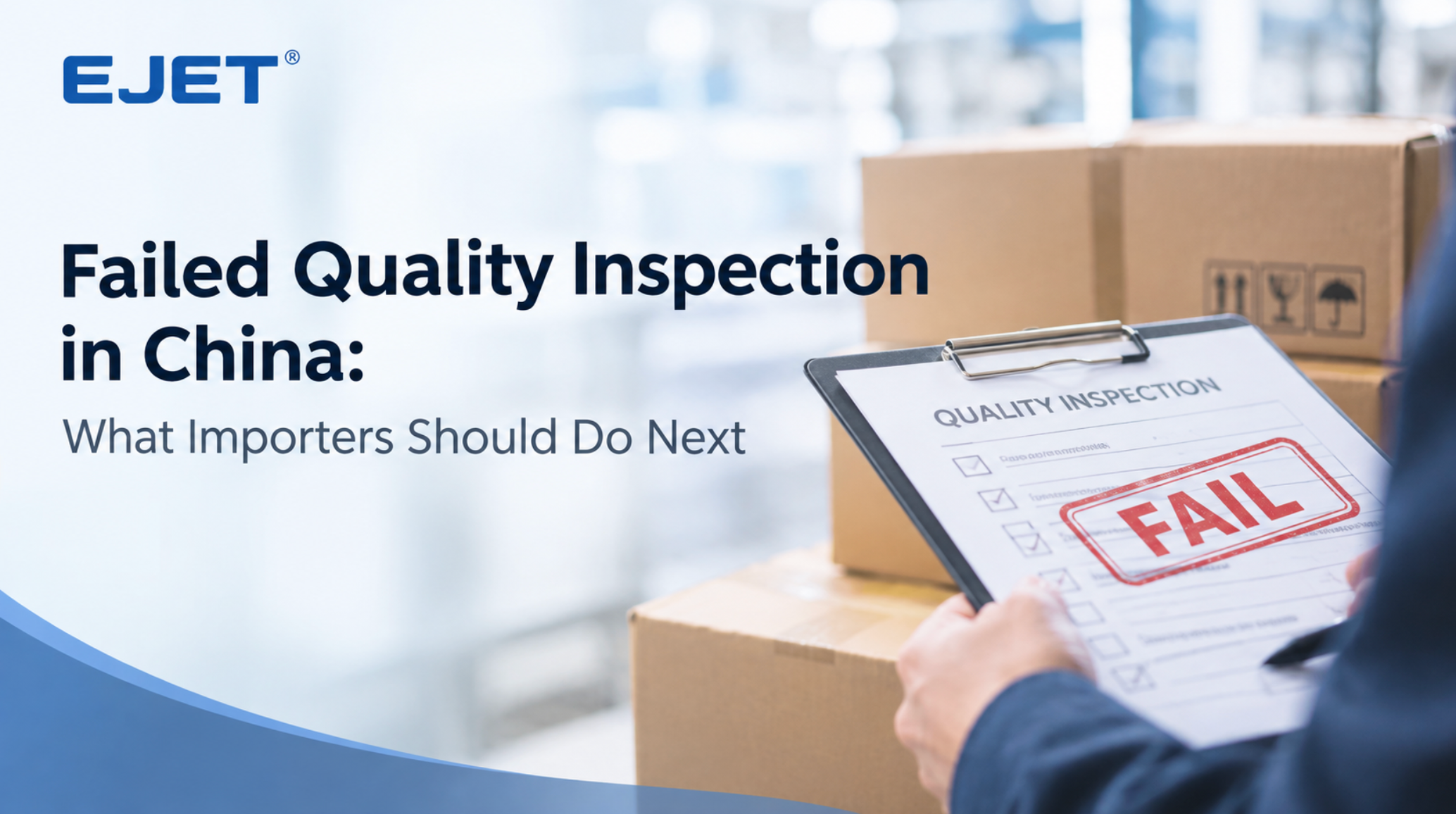
A quality inspection report arrives on Friday afternoon with one word the buyer did not want to see: FAIL.
The natural reaction is to ask whether the whole order should be rejected. In most cases, that is too early. A failed inspection tells you that the inspected lot did not meet the agreed acceptance criteria. It does not automatically tell you whether the right commercial response is sorting, rework, replacement, a controlled concession, or complete rejection.
The first job is to understand what failed and how much risk that failure creates.
This distinction matters because two inspection failures can look equally serious on the report but lead to very different decisions. Ten cartons with incorrect retail labels may be fixable in a day. A functional defect affecting product safety or compliance may require the shipment to remain on hold until the problem is fully understood.
EJET includes supplier follow-up, quality control, production coordination, and shipment management within its procurement services , which is useful when an inspection result needs to be turned into an operational decision rather than treated as an isolated report.
Start With the Defect, Not the Word “Fail”
Read the inspection report from the defect evidence outward.
What exactly did the inspector find? Which requirement did it violate? Was that requirement clearly stated in the product specification, approved sample, packaging file, or agreed inspection checklist? How many defects appeared in the sample, and how were they classified?
A buyer should be able to connect each material defect to a reference point.
That matters especially in categories where quality cannot be judged from a product photo. In tactile products, for example, seams, odor, rebound, filler leakage, age labeling, and physical sample feel can all matter. EJET Spark's article on squishy toy market trends and sourcing checks is a useful reminder that the commercial appeal of a product does not remove the need for sample-level and compliance-level verification.
If the supplier disputes the report, go back to the approved reference. A disagreement such as “the color is close enough” is not productive unless the buyer and supplier have a defined color standard. The same is true for dimensions, finish, assembly, labeling, and performance.
The clearer the original acceptance criteria, the faster the failed inspection can be resolved.
A Failed Inspection Usually Leads to One of Four Decisions
Most failed lots eventually move into one of four paths. The choice depends on severity, how widely the defect may exist, whether it can be corrected reliably, and how much time the buyer has.
| Situation | Likely commercial response | Main question before approval |
|---|---|---|
| Defect is easy to identify and separate | Sorting / containment | Can every affected unit be found reliably? |
| Defect can be corrected without damaging the product | Rework | Does the rework remove the cause rather than hide the symptom? |
| Defect cannot be corrected reliably | Replacement | Can replacement be produced and verified in time? |
| Issue is limited and commercially acceptable to buyer | Written concession | Is the affected quantity and risk clearly defined? |
There is a fifth category that should be treated more cautiously: serious safety, legal, or compliance risk. In those cases, the buyer should avoid casual commercial compromises and may need technical, customs, compliance, or legal advice depending on the product and market.
For importers managing repeat orders across several factories, this decision is easier when supplier communication and follow-up sit inside China sourcing support for importers workflow rather than being handled as an emergency.
A Simple Failed-Inspection Recovery Plan
When an inspection fails, reduce the issue to three decisions: what failed, what will be corrected, and what evidence is needed before release.
A compact corrective-action record only needs these fields:
| Item | What to record |
|---|---|
| Failed requirement | What did not match the approved standard |
| Affected scope | Which SKU, lot, cartons, or quantity may be affected |
| Corrective action | Sort, rework, replace, or approve a controlled concession |
| Evidence | Photos, measurements, labels, test results, or rework records |
| Release decision | Reinspect, approve, or continue holding |
This is enough to keep the supplier discussion tied to evidence without turning the article into a formal quality manual.
Before Reinspection
- Confirm the corrective action is finished.
- Ask for evidence that directly addresses the original defect.
- Keep release on hold until the agreed verification is complete.
Sorting Works Only When the Defect Is Truly Sortable
Suppliers often respond to a failed inspection by promising a “100% check.” Sometimes that is exactly the right response. Sometimes it simply sounds reassuring.
A meaningful sorting plan needs a defect that can be identified consistently. If the problem is an obviously incorrect barcode, missing accessory, visible stain, or measurable size issue, every unit may be checked against a clear standard.
But if the problem is intermittent function, hidden material variation, weak bonding, or another defect that is difficult to detect quickly, a promise to “check everything” may not provide enough confidence.
The buyer should ask what the sorting method actually is. What does the operator look for? What tool or test is used? How are failed units separated? How is the final quantity recorded?
If the supplier cannot explain the method, the phrase “100% inspection” has very little value.
Rework Is About Control, Not Just Speed
Rework can be the best outcome when the issue is fixable and the delivery deadline still matters.
Suppose an order fails because the retail packaging carries the wrong language sticker. The supplier may be able to remove and replace the labels quickly. That is very different from a molded product that is dimensionally wrong because the tooling is out of tolerance.
The buyer needs to know three things before approving rework: what will change, how many units are affected, and how the corrected units will be verified.
It is also worth asking whether the rework could create a new problem. Reopening sealed packaging, for example, may damage presentation. Replacing a component may introduce assembly marks. Reprinting cartons may create mismatched batch codes.
A fast fix is useful only if the finished goods still meet the original requirement.
When Replacement Is Safer Than Repair
Some defects are technically repairable but commercially not worth repairing.
If the product needs extensive disassembly, if the rework process may damage the goods, or if the supplier cannot reliably prove which units are affected, replacement can be a cleaner decision.
That does not mean the buyer should simply accept “we will remake it.” The replacement quantity, material availability, production date, and new inspection timing should be realistic enough to support the delivery plan.
Do Not Let Goods Move While the Decision Is Still Open
When a material failure is confirmed, the buyer should make sure the shipment does not move by default while everyone is still discussing the problem.
Exactly what the buyer can do about payment, cancellation, or supplier liability depends on the purchase agreement, inspection clause, payment terms, governing law, and facts of the order. Those rights should not be assumed.
Operationally, however, the status should be clear. Are the affected goods isolated? Is shipment release on hold? Has the supplier acknowledged the issue? Who can approve rework or a concession? What evidence is required before the status changes?
This prevents a common and expensive situation: the supplier ships because it has reached its planned dispatch date while the buyer believes the order is still under review.
“We Fixed It” Is Not the End of the Conversation
The next important question is evidence.
If the supplier says the defect has been corrected, what can the buyer see before paying for another inspection visit? Depending on the problem, that may be updated labels, photos, measurements, rework records, function-test results, revised packaging files, or a small set of corrected samples.
Evidence does not replace reinspection when reinspection is needed. It helps the buyer decide whether the supplier is genuinely ready for reinspection.
This is an important distinction. Booking an inspector too early can produce a second failed report simply because the supplier had not finished the corrective work.
Reinspection Should Match the Risk of the Original Failure
The supplier may ask the inspector to check only the reworked goods. That can be appropriate when the affected quantity is clearly isolated and the rest of the lot is unaffected.
In other cases, a broader random reinspection is more sensible. If the defect came from a process problem that may have affected the whole production run, checking only a small pile of repaired units gives an incomplete picture.
The buyer should ask whether the supplier can prove the affected scope. If not, the risk may be larger than the visible defect quantity.
For example, if a printing setup created incorrect labels across an entire batch, the problem may be broad but easy to identify. If a material supplier delivered inconsistent raw material, the scope may be harder to isolate.
The reinspection plan should reflect that difference.
The Best Corrective Action Is the One That Improves the Next Order
The immediate goal is to get the current order into an acceptable state. The longer-term goal is to stop the same defect returning.
This is where a failed inspection can actually improve a sourcing program.
If the defect happened because the specification was vague, rewrite the specification. If the supplier used the wrong packaging artwork, improve file control. If the mass-production material did not match the sample, add a pre-production material check. If a functional issue emerged late, consider whether an in-process test should move earlier in the production cycle.
That shift keeps the buyer focused on repeatability rather than blame.
Three Responses That Usually Make the Situation Worse
The first is accepting a verbal promise. “We checked again and everything is fine” should not be the only basis for shipment release after a material failure.
The second is rejecting the entire order before understanding the defect scope. A fixable labeling issue and a structural safety defect should not receive the same response.
The third is arguing about responsibility while the goods remain uncontrolled. Commercial responsibility matters, but containment and evidence should come first so the problem does not become more expensive.
A failed inspection becomes manageable when the buyer turns it into a clear sequence: understand the defect, contain the risk, choose the remedy, verify the correction, and update the control documents for the next order.
What a Good Recovery Looks Like
A good recovery does not necessarily mean the order passes immediately on the second inspection.
It means the buyer knows what failed, the supplier understands the acceptance standard, the affected goods are controlled, the corrective action is specific, and the next inspection is checking a shipment that is actually ready.
That is a much stronger position than rushing defective goods into shipment or demanding a full remake without understanding the real problem.
If you already have a failed inspection report and need help deciding whether the next move should be sorting, rework, replacement, or reinspection, contact EJET with the report, product specification, and supplier response.
FAQ
Does a failed inspection mean the entire order must be rejected?
No. It means the inspected lot did not meet the agreed acceptance criteria. The response depends on defect severity, scope, reworkability, delivery timing, and the buyer's contractual position.
Can a supplier simply do a 100% check after failure?
Only if the defect can be identified consistently and the checking method is clear. A “100% check” is not meaningful unless the supplier can explain what is being checked, how failed units are separated, and how completion is recorded.
Who pays for rework and reinspection?
There is no universal rule. Cost responsibility depends on the contract, quality terms, cause of the defect, and the commercial agreement between buyer and supplier.
Should reinspection cover only the repaired units?
Not always. If the original defect may affect the wider lot, a broader random reinspection may be more appropriate. The scope should match the risk and the supplier's ability to identify affected goods.
What should be changed after the order is recovered?
Update whichever control failed: the product specification, approved sample record, packaging file, inspection checklist, production checkpoint, or supplier corrective-action record. That is how one failed inspection becomes a lower-risk next order.

_1751507038923.png)