EXW shipping, short for Ex Works, is an arrangement in which a seller makes goods available at an agreed location and the buyer takes responsibility for collecting and moving them.
It gives buyers substantial control over transportation, but also places most logistics obligations on them. Understanding the handover point, excluded costs, and export arrangements is essential before accepting an EXW quote.
What does EXW mean in shipping?
EXW means the seller delivers by placing goods at the buyer’s disposal at a named location, without loading them onto the collecting vehicle. That location is often a factory or warehouse.
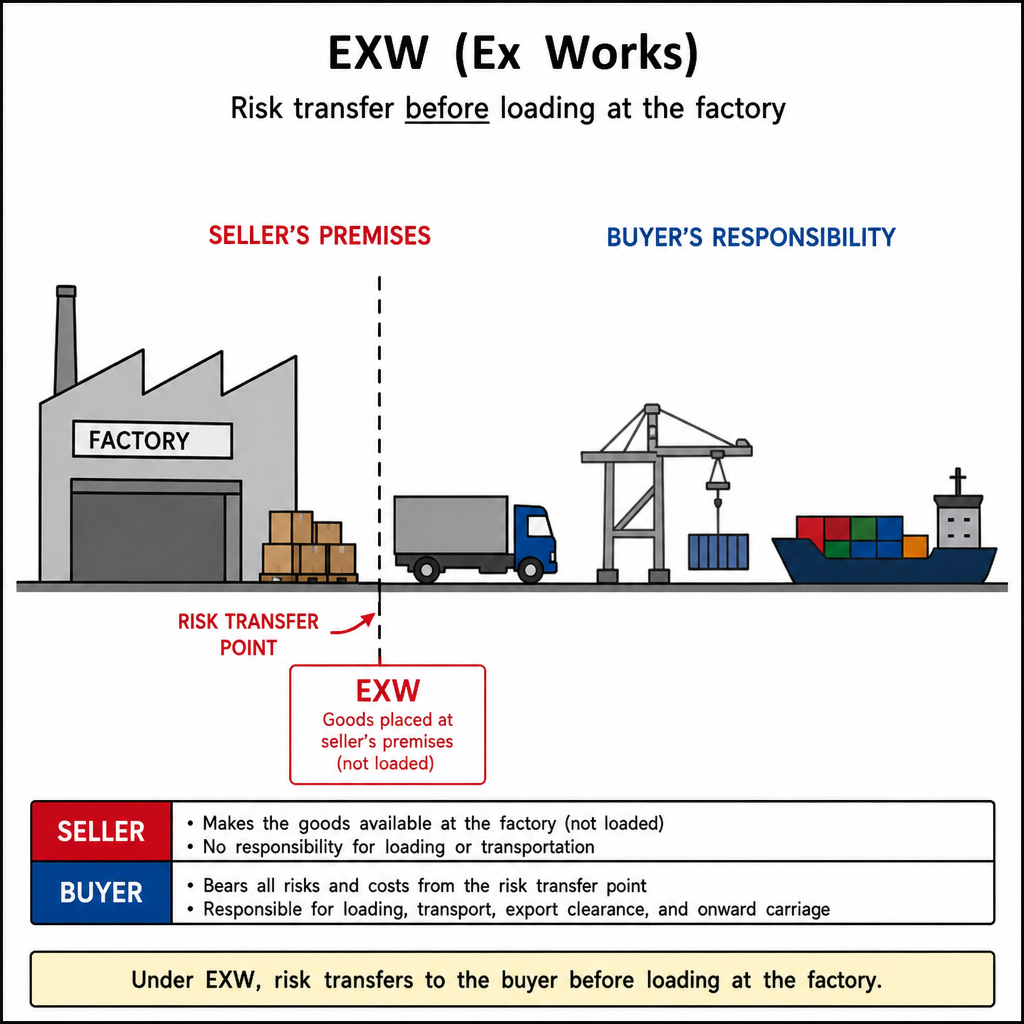
The buyer takes on the onward movement, and the transfer of risk occurs at this agreed handover point—not when the shipment reaches its destination.
The simplest Ex Works definition is therefore “goods made available for collection,” rather than “goods delivered to your door.” If you are looking for a shipping EXW definition, that distinction is the starting point: delivery under the sales agreement can happen before transportation begins. EXW can apply to road, rail, air, sea, or combined transport.
EXW is one of the International Chamber of Commerce’s Incoterms® rules. These rules allocate responsibilities, costs, and risks between buyers and sellers; they are not transportation services or complete sales contracts. References to “EXW Incoterms” mean using the Ex Works rule within that framework.
For a buyer, the practical question is not simply whether the supplier offers collection. It is whether you can organize everything that follows, including loading, transportation, documentation, and border formalities. Make that assessment before comparing the product price with another supplier’s delivered offer.
Responsibilities under EXW shipping terms
Under EXW terms, the seller still has meaningful obligations, even though its transport responsibilities are limited. The buyer should not interpret Ex Works as permission for the seller to provide unidentified, unpackaged, or undocumented goods regardless of the contract. The allocation includes the following duties.
|
Activity |
Seller’s responsibility |
Buyer’s responsibility |
|---|---|---|
|
Goods and invoice |
Supply goods and commercial invoice as agreed |
Pay the agreed purchase price |
|
Checking and packaging |
Perform necessary checks and provide appropriate packaging and marking, subject to applicable exceptions or agreement |
Communicate special requirements before contracting |
|
Collection |
Make goods available at the agreed place and time and provide necessary notice |
Arrange collection and loading |
|
Transportation |
No obligation to arrange carriage |
Arrange onward transportation |
|
Customs formalities |
Provide required assistance at the buyer’s request, risk, and cost |
Arrange and pay for applicable export, transit, and import clearance |
|
Delivery evidence |
Cooperate as required by the rule |
Provide appropriate evidence of taking delivery |
These responsibilities follow the EXW provisions of Incoterms® 2020. Neither party is required by EXW to purchase cargo insurance for the other. (library.iccwbo.org)
Turn this allocation into a working plan rather than leaving it inside a purchase order. Name the person booking collection, the party supplying loading equipment, and the broker checking customs arrangements. Ask each service provider to confirm its scope in writing so that an unassigned task does not become a shipment-day problem.
Risk transfers before the journey begins
The EXW meaning in shipping becomes especially important when goods are damaged during collection. Because delivery occurs when the seller properly makes the goods available, the buyer can bear transit-related risk before the truck leaves the premises. Loading is normally at the buyer’s risk and expense under EXW.
Consider a hypothetical collection of palletized equipment. Before dispatching a truck, ask who will operate the forklift, whether the vehicle can accommodate the pallets, and how the goods will be secured. Do not assume that a supplier’s offer to “help load” answers who bears the risk if something goes wrong.
If the seller will routinely load the collecting vehicle, consider FCA at the seller’s premises instead. Under that arrangement, the seller’s delivery obligation includes loading, making the contractual handover better aligned with the physical operation. ICC’s selection guidance specifically identifies this distinction.
For insurance planning, ask a broker or insurer to confirm when protection begins and whether collection and loading activities fall within the proposed cover. Describe the actual operation, including any supplier involvement. Avoid treating a policy described simply as “international cargo insurance” as confirmation that every stage is covered.
What does an EXW price include?
An EXW price applies to goods made available at the named origin point, rather than goods transported to the buyer’s destination. It should not be treated as a complete delivered cost. The onward expenses belong in a separate calculation before you decide whether the offer is competitive.
You may also see the phrase “ex work price” in supplier correspondence. Ask the supplier to confirm that it means Ex Works and to identify the named locati0n and applicable Incoterms® edition. Do not rely on informal wording when the purchasing decision depends on what is included.
Build a complete landed-cost estimate
Use this planning formula:
Estimated landed cost = EXW purchase price + applicable collection, transport, handling, insurance, clearance, duty, tax, and delivery costs.
The purpose is to compare offers on the same basis. The U.S. International Trade Administration describes landed cost as the final cost including shipping and taxes, and emphasizes clarifying responsibility for tariffs. (beta.trade.gov)
Ask your forwarder or broker to itemize:
- Origin services: collection, loading arrangements, inland movement, export processing, and origin handling.
- Main transportation: the proposed route, transport mode, freight charges, and any stated surcharges.
- Destination services: handling, customs brokerage, final delivery, and unloading where needed.
- Other exposure: insurance, storage, waiting time, inspections, or charges triggered by changes and delays.
- Government charges: applicable duties and taxes, with the assumptions used to estimate them.
Treat this as a quotation request checklist, not a promise that every shipment incurs every charge. Ask which items are fixed, estimated, excluded, or payable to another provider. Record the currency and validity period of each quote so your comparison remains useful when it is time to book.
Compare equivalent scopes, not headline prices
Put competing offers into a worksheet with the same final destination and service requirements. If one supplier quotes EXW and another includes transportation, add the missing services before comparing totals. Also compare the work your team must perform, not just the outside invoices.
For example, request separate EXW and FCA offers where appropriate. Then obtain forwarder quotations using the corresponding collection and clearance responsibilities. This exercise can reveal whether taking on additional coordination is worthwhile for your business without assuming that either term is automatically cheaper.
Export clearance deserves an early check
EXW assigns export formalities to the buyer, but that contractual allocation does not ensure a foreign buyer can complete them in the seller’s country. ICC warns that buyers anticipating difficulty with export clearance should consider FCA, under which export clearance is the seller’s obligation.
Before placing an international order, ask an origin-country broker to confirm whether your proposed arrangement is workable. Identify who will appear in required filings, who can authorize the broker, and what information the supplier must provide. Request this confirmation before production is complete, not after the goods are waiting for pickup.
Ask the seller about its documentation needs as well. Even under EXW, a seller may need evidence of export or movement for separate tax, regulatory, or accounting purposes. Those requirements arise outside the delivery rule, so the parties should agree how relevant evidence will be shared.
For U.S. transactions, remember that Incoterms do not determine the export transaction’s regulatory classification. The International Trade Administration explicitly distinguishes Incoterms from the requirements of U.S. Foreign Trade Regulations. Have the relevant parties verify their regulatory roles rather than inferring them from “EXW” alone.
When should you choose EXW instead of another term?
Choose EXW only when you can manage collection, loading, onward transportation, and any applicable customs formalities from the named locati0n. ICC describes EXW as primarily suitable for domestic trade and highlights its complications for international transactions. For cross-border purchases involving seller loading and export clearance, FCA is often the more practical alternative.
Evaluate the choice against your actual capabilities. A buyer with reliable origin-country support may value control over collection and carrier selection. A buyer without that support should first determine who will perform the required tasks, rather than accepting EXW because the product quote looks attractive.
Use these decision prompts:
- Consider EXW: Can your providers confirm a workable collection, loading, and clearance plan before you commit?
- Discuss FCA: Will the seller load at its premises and handle export clearance while you arrange the main transport?
- Request a destination-based alternative: Would you rather have the seller arrange the journey to a named destination? Ask for an explanation of the remaining buyer obligations.
For example, DAP places delivery at the named destination, ready for unloading, while import clearance remains with the buyer. DDP goes further by assigning import clearance to the seller, although practical restrictions can make that difficult. Neither should be treated as an interchangeable label for a broadly described “door-to-door” service.
Put precise collection details in writing
A useful EXW shipping agreement identifies the exact collection point, not merely a city or industrial area. Official guidance recommends specifying an address, and ICC guidance recommends identifying the intended edition of the rules. A clear format is EXW [full collection address and agreed collection point], Incoterms® 2020.
Before signing, work through this checklist with the supplier and logistics providers:
- Confirm cargo details. Request package counts, dimensions, weights, and handling instructions for transport planning.
- Identify the collection point. Specify the building, warehouse entrance, or staging area where appropriate.
- Agree on timing. Record readiness notifications, collection windows, booking procedures, and contacts.
- Document loading arrangements. Identify equipment, operators, access restrictions, and any agreed changes to the standard allocation.
- Confirm paperwork. List the commercial and customs information each participant must supply and when.
- Check costs and cover. Reconcile provider quotations and ask for written confirmation of intended insurance protection.
- Plan exceptions. Decide whom to contact if goods are not ready, cargo details change, or the vehicle cannot load safely.
Keep the sales contract separate from the operational checklist, but make sure they agree. Incoterms do not determine ownership transfer, payment timing, product specifications, or remedies for breach. Those matters require their own contractual provisions; choosing EXW does not resolve them.
The takeaway: evaluate the whole journey
Ex Works shipping starts with a limited seller handover, not a complete delivery service. Its suitability depends on your ability to manage the tasks and exposure that follow. The lowest quoted product price should therefore be the beginning of your assessment, not the conclusion.
Before accepting EXW shipping terms, confirm the collection point, test the export plan, and build a complete cost estimate. If the operational arrangements do not match the rule, discuss a better-fitting alternative before the order is finalized.
Frequently Asked Questions About EXW Shipping
What does EXW mean in shipping?
EXW, or Ex Works, refers to a shipping arrangement where the seller makes goods available for collection at their premises, and the buyer assumes full responsibility for transportation and related logistics.
What responsibilities does the buyer have under EXW terms?
Under EXW terms, the buyer is responsible for arranging collection, loading, onward transportation, customs formalities, and any applicable duties or taxes.
What costs are included in an EXW price?
An EXW price includes only the cost of the goods made available at the seller's locati0n. It does not cover transportation, customs fees, or delivery charges to the buyer's premises.
When should I choose EXW shipping instead of other Incoterms?
EXW is most suitable when the buyer has the capability to manage collection, loading, transportation, and customs clearance from the seller's locati0n. It is not recommended for buyers without reliable support in the seller's country.
What is the difference between EXW and FCA terms?
The primary difference is that under FCA (Free Carrier), the seller is responsible for loading the goods onto the collecting vehicle and handling export clearance, whereas under EXW, the seller's obligation is limited to making the goods available for collection.