












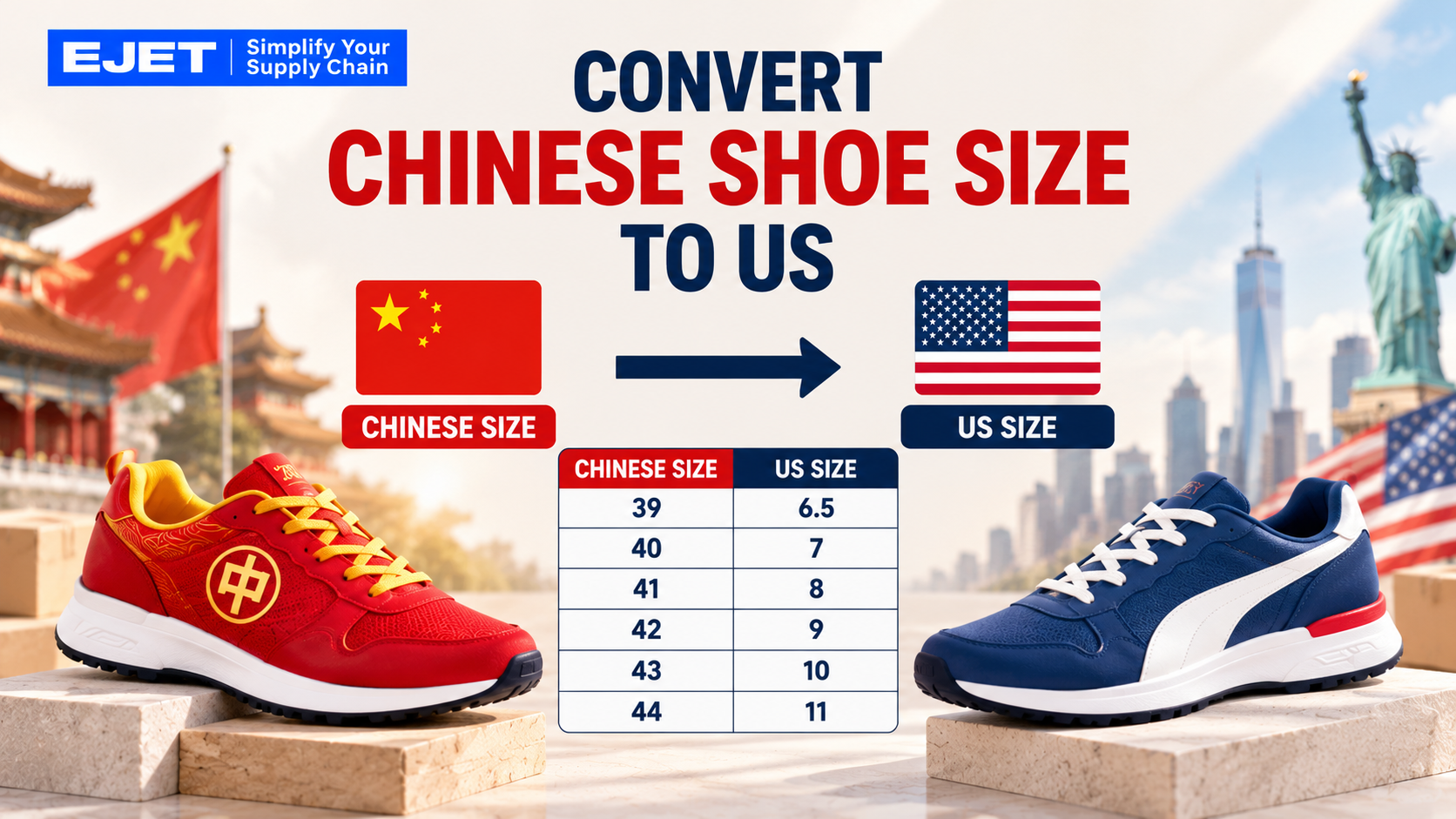
Chinese shoe sizes can look confusing because they may appear as millimeters, centimeters, or familiar-looking numbers that resemble European sizes.
The most reliable way to compare a Chinese shoe size to US sizing is to start with foot length, then use a size conversion chart as a practical guide rather than an absolute rule.
This shoe size guide explains the main systems, how to measure correctly, and how to convert Chinese shoe size to US for men, women, and kids.
What does Chinese shoe sizing mean?
Chinese shoe sizing usually points back to foot length, not just a regional label like “US 8” or “EU 39.” In formal sizing systems, China is included among systems that can be compared through measured foot length, and ISO’s footwear conversion standard describes foot length as the logical starting point for shoe size marking.
That matters because a Chinese to US shoe size conversion is most accurate when you compare the actual centimeter or millimeter measurement, not only the number printed on a tag.
In practice, shoppers may see several formats on Chinese product pages. A shoe might be listed as 245, meaning a foot length around 245 mm; as 24.5, meaning 24.5 cm; or as 39/40/41, which often looks like an EU-style number.
Some manufacturers in East Asia use Mondopoint-style millimeter labels without calling them Mondopoint, and some express the same idea in centimeters instead of millimeters.
That is why the phrase chinese shoe size to us can refer to more than one conversion. If the product page says “CN 245,” you are converting a foot-length size. If it says “CN 39,” you need to check whether the seller means an EU-style size, an older China-style size, or a brand-specific chart.
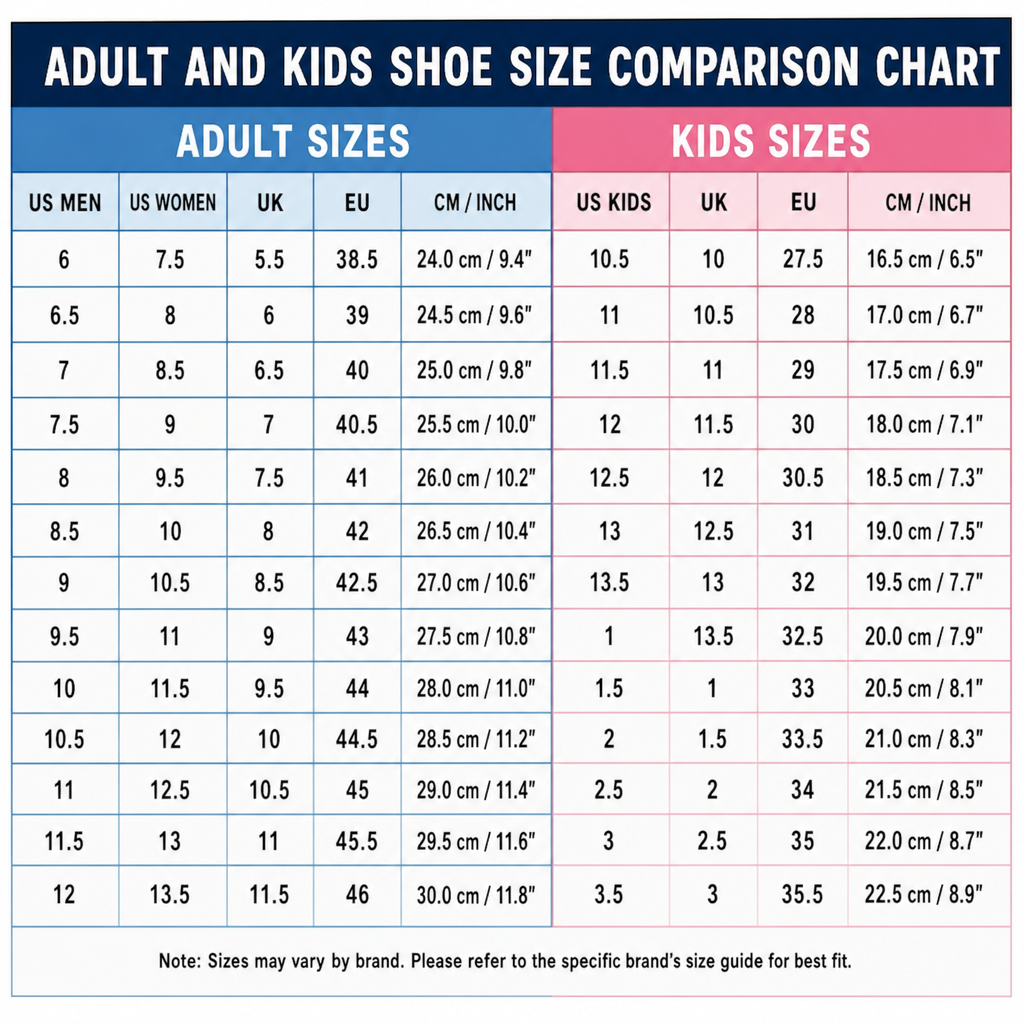
Chinese, US, and EU sizing systems at a glance
Shoe sizing systems are built differently, so direct one-to-one conversion is always approximate. US shoe sizes differ by gender and children’s categories, while Chinese metric sizing is more measurement-based. European-style numbers are common in international retail, but they are not the same thing as a measured foot length.
|
System |
Common format |
What it usually represents |
What to watch for |
|---|---|---|---|
|
Chinese metric / Mondopoint-style |
230, 245, 260 |
Foot length in millimeters |
Often the safest number to use |
|
Chinese centimeter style |
23.0, 24.5, 26.0 |
Foot length in centimeters |
Same idea as millimeters, just divided by 10 |
|
EU-style listing |
36, 39, 42 |
Regional shoe size |
Often appears on Chinese marketplaces, but fit varies |
|
US men’s |
7, 8.5, 10 |
US adult men’s sizing |
Not the same as US women’s |
|
US women’s |
6, 8, 9.5 |
US adult women’s sizing |
Usually about 1.5 sizes higher than comparable US men’s in many charts |
|
US kids |
C or Y sizes |
Child, toddler, or youth sizing |
Growth room and brand fit matter more |
A size conversion chart is useful because it puts these systems side by side. Still, it should be treated as a starting point. The final choice should also account for shoe style, toe shape, material, socks, and the seller’s own chart.
Measuring your foot before using a size conversion chart
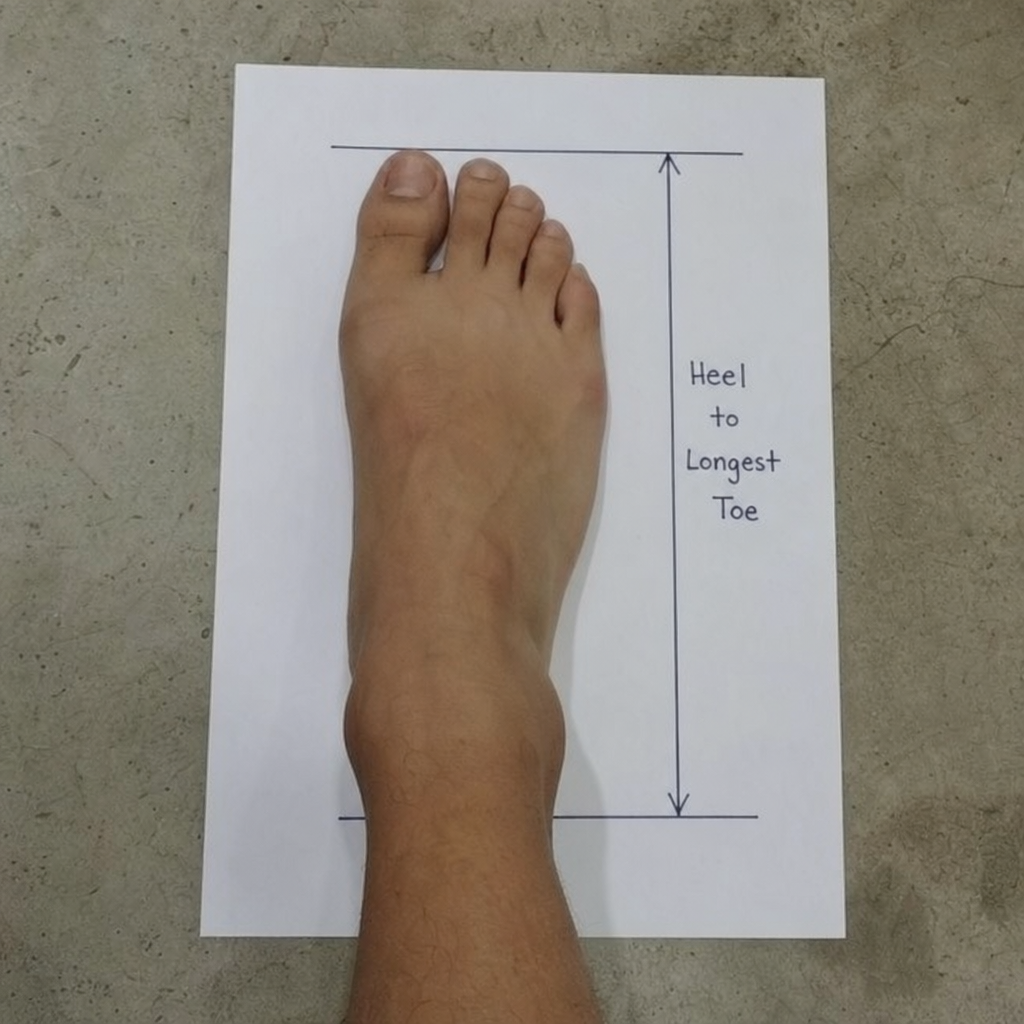
The best way to convert chinese shoe size to us is to measure both feet and match the longer foot to the seller’s foot-length column. The Chinese national shoe-size standard defines foot length as the horizontal distance from the most prominent toe to the heel, measured while standing with weight distributed on both feet. That standing measurement is important because feet can lengthen slightly under body weight.
Step-by-step measuring method
- Place paper on a hard floor. Avoid carpet, which can distort the outline.
- Stand naturally. Put your full weight on the foot you are measuring.
- Mark the heel and longest toe. The longest toe is not always the big toe.
- Measure in centimeters or millimeters. For example, 24.5 cm equals 245 mm.
- Repeat on the other foot. Use the larger measurement for sizing.
- Add fit allowance only if the chart asks for it. Some charts use foot length; others use insole length.
Foot length vs. insole length
Foot length and insole length are not interchangeable. Foot length is your body measurement. Insole length is the inside length of the shoe, which must be slightly longer than your foot so your toes can move.
If a seller lists 脚长, that usually means foot length. If a seller lists 内长, that usually means insole length. When in doubt, choose based on the chart label rather than guessing from the size number alone.
Chinese shoe size to US conversion chart
The chart below gives approximate adult conversions using foot length as the anchor. Because US sizing differs for men and women, the same Chinese metric size will map to different US labels. Use this shoe size comparison as a guide, then confirm with the brand’s chart if available.
|
Foot length |
Chinese metric size |
Common EU-style equivalent |
Approx. US men |
Approx. US women |
|---|---|---|---|---|
|
22.0 cm / 220 mm |
220 |
34 |
4 |
5.5 |
|
22.5 cm / 225 mm |
225 |
35 |
4.5 |
6 |
|
23.0 cm / 230 mm |
230 |
36 |
5.5 |
6.5 |
|
23.5 cm / 235 mm |
235 |
37 |
6 |
7.5 |
|
24.0 cm / 240 mm |
240 |
38 |
6.5 |
8 |
|
24.5 cm / 245 mm |
245 |
39 |
7 |
8.5 |
|
25.0 cm / 250 mm |
250 |
40 |
7.5 |
9 |
|
25.5 cm / 255 mm |
255 |
41 |
8 |
9.5 |
|
26.0 cm / 260 mm |
260 |
42 |
8.5 |
10 |
|
26.5 cm / 265 mm |
265 |
43 |
9.5 |
10.5 |
|
27.0 cm / 270 mm |
270 |
44 |
10 |
11 |
|
27.5 cm / 275 mm |
275 |
45 |
10.5 |
11.5 |
|
28.0 cm / 280 mm |
280 |
46 |
11 |
12 |
|
28.5 cm / 285 mm |
285 |
47 |
12 |
13 |
|
29.0 cm / 290 mm |
290 |
48 |
12.5 |
13.5 |
|
29.5 cm / 295 mm |
295 |
49 |
13 |
14 |
|
30.0 cm / 300 mm |
300 |
50 |
14 |
15 |
This us shoe size chart is intentionally approximate. ISO’s footwear conversion standard exists because different systems developed separately and require guideline tables rather than perfect mathematical equivalence.
How do you convert Chinese shoe size to US?
To convert Chinese shoe size to US, first identify whether the Chinese number is a foot-length measurement or an EU-style retail size. If the number is three digits, such as 245 or 260, treat it as millimeters and match it to a US men’s or women’s chart. If the number is two digits, such as 39 or 42, check the product page for a foot-length column before choosing the US equivalent.
Here is the simplest method:
- If you see 245: read it as 245 mm, or 24.5 cm.
- Find 24.5 cm on the chart: it is roughly US men’s 7 or US women’s 8.5.
- Check the shoe type: sneakers, boots, sandals, and pointed flats may fit differently.
- Read the seller notes: choose the chart that belongs to that exact product.
- Use your larger foot: do not average both feet.
Example 1: Chinese 240 to US
A Chinese size 240 usually means a foot length of about 240 mm, or 24.0 cm. In many adult conversion charts, that is near US men’s 6.5 or US women’s 8. If the shoe is narrow, stiff, or pointed, the wearer may need to compare width and insole length before ordering.
Example 2: Chinese 260 to US
A Chinese size 260 usually means a foot length of about 260 mm, or 26.0 cm. That often converts near US men’s 8.5 or US women’s 10. However, if a product page says “CN 42” and also lists 260 mm, the 260 mm measurement is more useful than the 42 alone.
Example 3: Chinese 39 to US
A two-digit size like 39 is less precise by itself. It often appears as an EU-style size and may correspond to about 24.5 cm, but you should not rely on that assumption without the seller’s chart. Look for foot length, insole length, or customer fit notes before deciding.
Men’s and women’s US sizing differences
The same foot length usually produces different US labels depending on whether the shoe is sold in men’s or women’s sizing. A 25.0 cm foot might land around a US men’s 7.5, while the women’s label may be around US women’s 9. That difference is one reason generic conversion tables can feel inconsistent.
US women’s shoes are also often built on different lasts than US men’s shoes. Width, heel shape, toe box volume, and arch placement can differ even when the foot length looks similar. If you are buying unisex sneakers from a Chinese seller, check whether the chart is labeled men, women, unisex, or simply foot length.
Quick adult conversion tips
- For men’s shoes, start with the foot length and use the US men’s column.
- For women’s shoes, use the US women’s column, not the men’s equivalent.
- For unisex shoes, the seller may show one chart based on foot length.
- For wide feet, prioritize width notes and reviews over the nominal size.
- For half sizes, choose based on the shoe shape and return policy.
Children’s Chinese to US shoe size guide
Kids’ shoe sizing is more sensitive because children grow quickly and shoe categories change from toddler to little kid to big kid. A Chinese metric size can still be helpful, but the US equivalent may vary more than adult conversions. Use the child’s current measured foot length, then allow reasonable growing room if the seller’s chart recommends it.
|
Foot length |
Chinese metric size |
Approx. US kids |
|---|---|---|
|
12.0 cm / 120 mm |
120 |
4C |
|
13.0 cm / 130 mm |
130 |
6C |
|
14.0 cm / 140 mm |
140 |
7C |
|
15.0 cm / 150 mm |
150 |
8C |
|
16.0 cm / 160 mm |
160 |
9.5C |
|
17.0 cm / 170 mm |
170 |
10.5C |
|
18.0 cm / 180 mm |
180 |
12C |
|
19.0 cm / 190 mm |
190 |
13C |
|
20.0 cm / 200 mm |
200 |
1Y |
|
21.0 cm / 210 mm |
210 |
2Y |
|
22.0 cm / 220 mm |
220 |
4Y |
|
23.0 cm / 230 mm |
230 |
5Y |
Children’s shoes should not be chosen only by age. Two children of the same age can have very different foot lengths, widths, and instep heights. If a brand provides an insole measurement, compare it carefully with the child’s foot length and the amount of room recommended for that shoe type.
Common reasons Chinese to US shoe size conversions go wrong
Most sizing mistakes happen because the shopper converts the wrong number. A three-digit Chinese metric size is fairly direct, but a two-digit marketplace size may not tell the whole story. The product may be labeled with EU-style sizing, brand-specific sizing, or a translated chart that mixes several systems.
The listing uses “CN” but shows EU-style numbers
Many online listings use “CN” to mean the seller’s regional option, not necessarily the official measurement-based size. A dropdown might show CN 39, CN 40, and CN 41 while the chart lists foot lengths beside them. In that case, the foot-length column is the most important part of the chart.
The seller lists insole length instead of foot length
If you choose a shoe based on insole length as though it were foot length, the shoe may arrive too small or too large. Insole length includes the shoe’s interior allowance. Foot length is your actual measurement from heel to toe.
The shoe style changes the fit
A running shoe, leather loafer, winter boot, and pointed heel can all fit differently in the same nominal size. Soft mesh uppers may feel more forgiving, while rigid leather or pointed toe boxes may require more space. A good size conversion chart gets you close, but shoe construction determines comfort.
The chart ignores width
Length is only one part of fit. The Mondopoint approach can include width, and footwear standards acknowledge that width systems vary by market. ISO 9407 notes that markets use different width designations, including numeric and letter-based approaches, so a length match does not guarantee the right width.
Seller-chart clues that help you choose the right size
Chinese product pages often include helpful clues if you know what to look for. Even if the page is machine-translated, the structure of the chart can tell you whether you are seeing foot length, insole length, EU size, or a general recommendation.
|
Term or clue |
Meaning |
How to use it |
|---|---|---|
|
脚长 |
Foot length |
Match this to your measured foot |
|
内长 |
Insole length |
Expect it to be longer than your foot |
|
鞋码 |
Shoe size |
Look for a measurement beside it |
|
中国码 |
China size |
Confirm whether it is metric or EU-style |
|
适合脚长 |
Suitable foot length |
Usually the best column for ordering |
|
cm / mm |
Centimeters / millimeters |
Convert 24.5 cm to 245 mm if needed |
When a chart includes both size and suitable foot length, trust the suitable foot length first. If a seller gives only a dropdown size with no measurement, check reviews, product Q&A, or brand information before ordering.
A practical buying checklist
Before buying shoes from a Chinese retailer or marketplace, run through this checklist. It can prevent most sizing errors and make any chinese shoe size to us conversion more reliable.
- Measure both feet at the end of the day. Feet can feel slightly fuller after standing or walking.
- Use millimeters when possible. Millimeters reduce rounding errors compared with inches.
- Match your larger foot to the chart. Never size from the smaller foot.
- Confirm whether the chart says foot length or insole length. This is the most common confusion point.
- Use the correct US gender column. US men’s and women’s labels are not interchangeable.
- Check shoe shape. Pointed toes, narrow lasts, and rigid uppers may need extra consideration.
- Read fit reviews. Look for comments such as “runs small,” “wide toe box,” or “narrow instep.”
- Review return rules. International returns can be inconvenient, so the chart matters more.
- Do not rely only on your usual US size. Your best US size in one brand may not match another.
Best practices for half sizes and between-size feet
If your measured foot falls between two Chinese metric sizes, start by checking whether the seller offers 5 mm increments. Mondopoint-style systems commonly use small length intervals, and ISO 9407 describes 5 mm as a normal grading interval for manufacturers using that system, though specialist footwear may differ.
For flexible sneakers, the smaller of two close sizes may work if the chart’s suitable foot length includes your measurement. For boots, hiking shoes, winter shoes, or anything worn with thick socks, the larger size may be more comfortable. For heels, loafers, and dress shoes, width and heel slip matter as much as length.
A simple rule is to size by fit purpose, not just by number. Everyday walking shoes need toe room. Dress shoes need secure hold. Children’s shoes need safe growth space without becoming loose enough to trip.
Key takeaways for Chinese shoe size comparison
Chinese shoe sizing is easiest to understand when you treat it as a measurement problem. The number on the label matters, but the foot length behind the number matters more.
- Chinese metric sizes such as 245 or 260 usually refer to millimeters.
- Centimeter labels such as 24.5 and millimeter labels such as 245 mean the same foot length.
- Two-digit sizes such as 39 or 42 need confirmation from the seller’s chart.
- US men’s and US women’s conversions are different.
- A size conversion chart is a guide, not a guarantee.
- The best conversion starts with measuring your foot while standing.
Final guidance for choosing confidently
The most dependable way to convert chinese shoe size to us is to measure your foot, identify the chart’s measurement column, and then compare that number with the appropriate US men’s, women’s, or kids’ equivalent. If you only remember one thing, remember this: foot length beats label size.
Use the size conversion chart as your starting point, then adjust for style, width, socks, and seller guidance. That approach gives you a clearer shoe size comparison and reduces the guesswork that often comes with international footwear shopping.
Frequently Asked Questions About Converting Chinese Shoe Sizes to US Sizes
How do I know if a Chinese shoe size is in centimeters or millimeters?
Chinese shoe sizes are often listed in millimeters or centimeters. If you see a three-digit number (e.g., 245 or 260), it usually represents millimeters. Two-digit sizes (e.g., 39 or 42) may be EU sizes, so it's essential to check the product description for clarification.
What’s the difference between foot length and insole length in shoe sizing?
Foot length is the actual measurement from heel to toe of your foot, while insole length is the inside length of the shoe, which is typically longer than your foot to allow for movement. Always use foot length for sizing when ordering shoes.
How do I measure my foot correctly for accurate size conversion?
To measure your foot, stand on a piece of paper on a hard surface, mark the heel and longest toe, then measure the distance in centimeters or millimeters. Use the longer measurement for sizing.
Why do Chinese shoe sizes sometimes differ from US sizes?
Shoe sizing systems vary by region, with differences in how sizes are defined and structured. China's metric system is based on foot length, while US sizes consider factors like gender and brand-specific sizing, leading to potential discrepancies.
What should I do if my foot measurement falls between two sizes?
If you're between sizes, it’s generally best to choose the larger size, especially for shoes that will be worn with thicker socks or if the design is narrow. Always check the seller’s specific sizing guidelines, as they may provide additional recommendations.