







China sourcing agent fees pay for help finding suppliers, coordinating purchases, and managing agreed parts of the sourcing process.
Agents may charge a commission, a fixed project fee, or a monthly management fee, so there is no single pricing structure to compare.
Understanding the calculation, service scope, and exclusions helps you judge a quote more accurately than looking at the headline percentage alone.
How much do China sourcing agents charge?
China sourcing agents charge according to their own pricing models and service packages; a published rate is useful as an example, not an industry-wide benchmark.
For instance, JingSourcing lists a Basic Plan service fee of 5% of product value, with a $100 minimum. Its Pro Plan instead includes service costs in the product unit price and lists no separate service fee.
These arrangements illustrate why apparently different fees need closer comparison.
Start by asking three questions: What amount is the fee calculated on? What work does it cover? What costs remain outside it?
A quote of 5% tells you little without those answers. You still need to establish whether the percentage applies only to goods, whether inspections are included, and whether repeat orders attract the same charge.
Treat China buying agent fees as one part of your purchasing budget rather than the entire cost of importing.
The International Trade Administration defines landed cost as the product price plus freight, insurance, tariffs, taxes, and other fees involved in getting it to the buyer. Comparing only the agent’s invoice leaves much of that picture out.
The main sourcing fee models
Commission, fixed-fee, and monthly management arrangements are recognized ways to compensate sourcing agents.
The useful distinction is what triggers payment: placing an order, completing a defined assignment, or retaining ongoing support.
Choose the structure around the work you need rather than assuming one model is always cheaper.
|
Pricing model |
How to evaluate it |
Main point to clarify |
|---|---|---|
|
Order commission |
Apply the percentage to the agreed chargeable amount |
Which invoice items enter the calculation |
|
Fixed project fee |
Compare the price with specific deliverables |
Revisions, completion criteria, and extra work |
|
Monthly retainer |
Match recurring cost to planned workload |
Capacity, reporting, and cancellation terms |
|
Hourly billing |
Review hours alongside completed tasks |
Spending limits and approval requirements |
|
Bundled product price |
Compare the complete product offer |
Included services and supplier visibility |
Commission on order value
A sourcing agent commission connects the service charge to an agreed purchasing amount. As a hypothetical example, a 5% commission on $20,000 of goods produces a $1,000 fee. If the same agreement includes another $4,000 of chargeable expenses, the fee becomes $1,200.
Ask for a worked calculation using your expected order. Include packaging, tooling, domestic transport, and any other substantial line items in the discussion. Agree on their treatment before approving the purchase, not when the final invoice arrives.
Fixed project fees
A fixed fee is easiest to assess when the assignment has a clear endpoint. You might request a supplier shortlist, comparable quotations, and a completed sample review. Write down what qualifies as completion and how unsuitable candidates will be handled.
Avoid defining the assignment only as “find a good factory.” Specify your product requirements, acceptable evidence, and decision criteria. A fixed price cannot provide much budget certainty if the underlying task remains open-ended.
Monthly retainers
A monthly arrangement deserves a workload plan. Ask which people or resources will be available, how many active projects the agreement covers, and what happens during quiet periods. Also establish whether orders generate additional commission.
Set a review point rather than letting the arrangement continue without evaluation. Use that review to compare completed work, unresolved issues, and upcoming needs. Renew based on the support you expect to use.
Hourly billing and bundled prices
Hourly pricing is another available approach: Zignify, for example, states that it charges for sourcing time without commissions or supplier-price markups. For this model, request task records, an initial estimate, and approval before spending exceeds an agreed ceiling. An hourly rate becomes meaningful when paired with visibility into the work performed.
For bundled pricing, ask what the product quote includes and whether supplier identities are available. JingSourcing’s Pro Plan illustrates the distinction: it includes service costs in product prices and says supplier details generally are not disclosed. That is a commercial structure to evaluate, not evidence that sourcing work costs nothing.
What should sourcing service fees include?
Sourcing service fees should cover the deliverables explicitly agreed in your proposal, with separate costs and responsibilities identified alongside them.
There is no reason to assume that supplier research, factory visits, laboratory testing, and shipment management all belong to the same package.
Flanders Investment & Trade’s sourcing guidance specifically distinguishes agent quality-control work from specialist tests and external certification.
Build your scope around outcomes you can review:
- Supplier research: Request a shortlist showing product capability, locati0n, minimum order requirements, and the evidence supporting each recommendation.
- Quotation comparison: Require quotes against the same materials, dimensions, quantities, packaging, and delivery assumptions.
- Sample coordination: Identify who orders samples, checks them against your specification, records revisions, and approves the reference sample.
- Production follow-up: Agree on update frequency, milestone tracking, and when delays or changes must be escalated.
- Inspection coordination: Specify who performs checks, what they examine, and what report you receive.
- Shipment support: List the bookings, documents, consolidation tasks, or handoffs the agent will manage.
Replace broad promises with observable outputs. Instead of accepting “regular updates,” ask for a reporting schedule and an issue log. Instead of “quality checked,” request the inspection checklist and reporting format before production starts.
Separate responsibility from assistance, too. If the agent coordinates a third-party service, identify who appoints that provider, approves its instructions, receives its report, and pays its invoice. This makes the service easier to manage when something needs attention.
What changes the sourcing agent cost?
The most useful way to assess sourcing agent cost is to examine your project’s workload and then ask the provider to explain its price against that workload. Prepare the same product brief for each candidate. Otherwise, differences in quotes may reflect different assumptions rather than better value.
Product complexity and development work
Separate buying an established item from developing a customized product in your request for quotation. List any drawings, material decisions, prototype rounds, packaging development, or performance requirements that remain unresolved. Ask the agent to price those activities explicitly.
Use approval gates for uncertain development work. For example, authorize supplier research first, then approve sample coordination after reviewing the shortlist. This approach gives you a decision point before committing to the next stage.
Order size and supplier count
Ask whether a minimum fee applies and whether it is assessed per order, supplier, shipment, or product. Then model your actual purchasing pattern. One consolidated order and several small releases should not be treated as equivalent without checking the terms.
Supplier count deserves its own discussion. Tell the agent how many factories may be involved and whether products need consolidation. Request separate pricing for additional suppliers so that expanding the project does not create an unexpected bill.
Service intensity and locati0n
Distinguish remote coordination from physical attendance. Identify factory visits, sample collection, warehouse handling, and on-site checks in the scope. Ask how travel, accommodation, and time away are approved and charged.
Be equally clear about urgency. If you need accelerated research or unusually frequent reporting, state that before requesting a quote. Compare offers against the same schedule instead of assuming every provider has priced your deadline.
How should you compare China sourcing agent fees per month?
Compare China sourcing agent fees per month by dividing the retainer into defined capacity, deliverables, and additional charges. A monthly figure alone does not show how much support you receive or whether purchasing activity creates further fees. Ask each provider to price the same expected workload and explain its limits.
For illustration only, suppose an agent proposes a $1,500 monthly retainer. Over three months, the retainer totals $4,500. If your goods purchases during that period total $60,000, the retainer represents 7.5% of purchasing value before any additional charges.
Now suppose purchases total $150,000 over the same period. The same retainer represents 3% of purchasing value. These hypothetical figures show how purchasing volume changes the comparison; they do not establish whether the workload is manageable or the service worthwhile.
Before accepting a retainer, request written answers covering:
- Available capacity: Define working hours, project limits, or another practical measure of support.
- Assigned responsibilities: Identify who handles research, negotiation, production updates, and escalation.
- Additional charges: List commissions, travel, inspections, and services outside the monthly scope.
- Quiet periods: Establish whether unused capacity expires, rolls over, or permits a temporary pause.
- Exit and handover: Request notice requirements and a list of records delivered when the arrangement ends.
Judge the monthly relationship against completed work, not availability alone. Review supplier comparisons, resolved issues, milestone updates, and handover records. If those outputs are hard to identify, clarify the reporting before renewing.
Calculate the fee and the purchasing budget separately
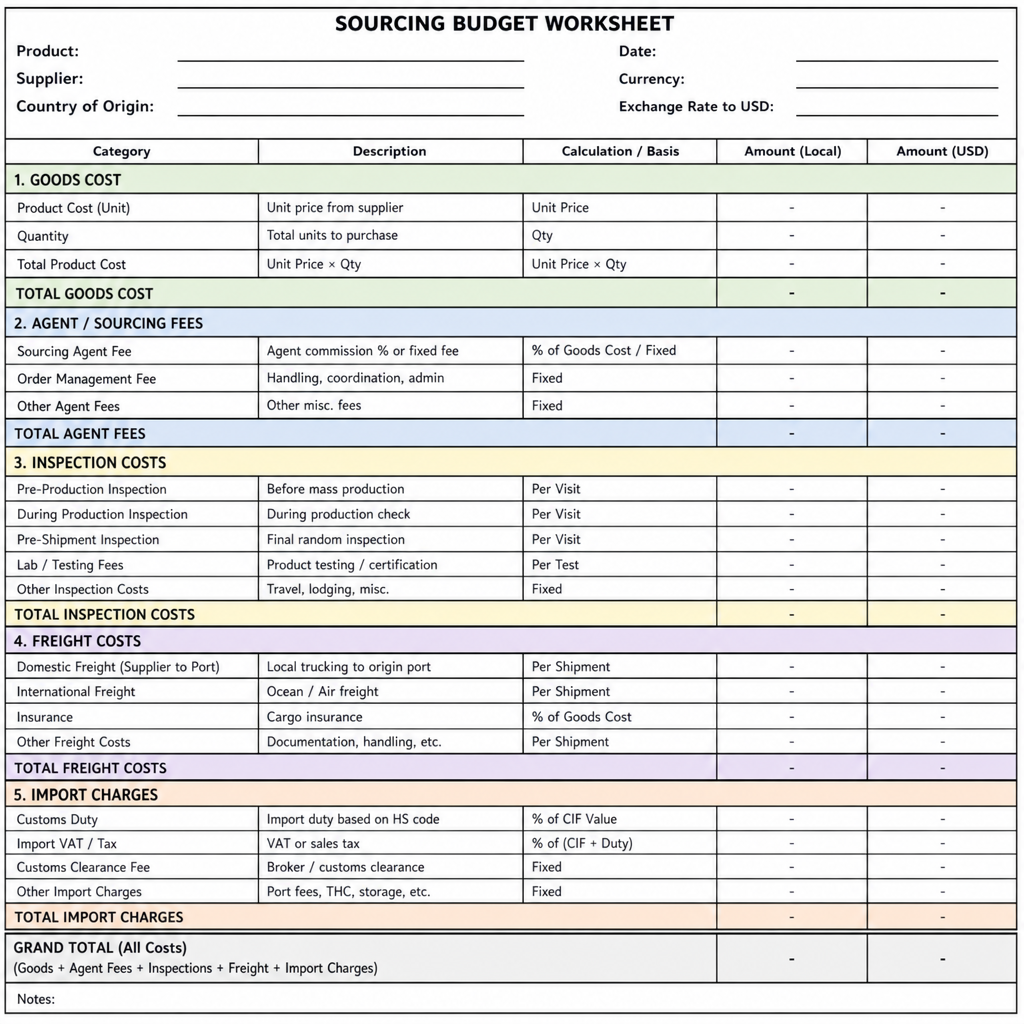
Keep two calculations in your comparison sheet: the agent’s compensation and the complete purchasing budget. This prevents a low service fee from overshadowing other expenses. It also makes it easier to identify whether a cost reduction comes from the goods, the service, or a changed delivery assumption.
Use these planning formulas:
Commission fee = agreed chargeable amount × commission rate
Budgeted purchase total = goods + agent fees + development and quality costs + logistics + applicable import charges
The second formula is a budgeting aid, not a customs valuation method. For U.S. imports, obtain product-specific guidance on classification, valuation, and applicable requirements from a qualified customs professional. CBP emphasizes that importers must exercise reasonable care when entering goods and providing the necessary information.
Consider this entirely hypothetical purchasing budget:
|
Budget item |
Illustrative amount |
|---|---|
|
Goods |
$20,000 |
|
Agent commission at 5% of goods value |
$1,000 |
|
Samples and courier charges |
$300 |
|
Separately quoted inspection |
$300 |
|
Freight and insurance |
$2,000 |
|
Subtotal before import charges and other destination costs |
$23,600 |
The service fee is $1,000, but the subtotal is $23,600. Do not describe that subtotal as fully landed when duties, taxes, brokerage, or final delivery remain unresolved. Landed-cost planning should account for the complete journey to the buyer, including applicable tariffs, taxes, and other fees.
Look closely at exclusions and payment terms
Request an exclusions schedule alongside the service proposal. Have the agent mark each expense as included, separately quoted, passed through at cost, or not provided. That format makes omissions easier to spot than a broad statement such as “full sourcing support.”
Samples, tooling, inspections, and storage
Ask who pays sample charges and whether any credit against a later order is confirmed in writing. For tooling, request an itemized quote and clarify ownership, access, maintenance, and transfer arrangements. Do not treat tooling as ordinary goods expenditure without discussing its separate commercial terms.
For inspections, establish the locati0n, timing, scope, reporting, and reinspection arrangements. Separately priced inspection services do exist: V-Trust publishes man-day pricing by coverage area. Use an actual inspection quote for your project rather than assuming a sourcing commission includes equivalent work.
Check cancellation and failed-visit provisions as well. V-Trust’s terms, for example, describe charges for late cancellations and inspections that cannot proceed because goods are not ready. Ask who approves readiness and who bears such costs under your arrangement.
Currency, transfers, and delivery assumptions
Request the invoice currency, conversion method, quote-validity period, and treatment of bank charges. Ask whether supplier payments and service fees go to different entities. Keep the payment schedule separate from the fee calculation so you can see both the total charge and when cash leaves your account.
For delivery, record the agreed Incoterm, named place, and version. Incoterms allocate specified transport-related tasks, costs, and risks between buyer and seller, but they do not determine payment timing or settle every contractual issue. Avoid comparing product quotations with different delivery assumptions as if they cover identical obligations.
Compare agent commission rates without losing context
Compare agent commission rates only after standardizing the scope and calculation basis. Give each provider the same specifications, quantities, supplier expectations, and delivery requirements. Then ask for the same cost breakdown.
Consider two hypothetical proposals for a $20,000 order. Agent A charges 4%, producing an $800 service fee, but separately quotes $400 for inspection and $250 for production follow-up. Agent B charges 6%, producing a $1,200 fee, and includes both activities at the required scope.
On those assumptions, Agent A totals $1,450 and Agent B totals $1,200. The lower commission is not the lower service cost. Change an inclusion, however, and the result could change—so preserve the assumptions beside the numbers.
Use a comparison checklist:
- Are the product specifications, quantities, and packaging identical?
- Does each commission apply to the same chargeable amount?
- Are minimum fees, tiers, and repeat-order terms shown?
- Are inspection activities equivalent in scope and reporting?
- Are travel, samples, storage, and third-party services accounted for?
- Are supplier access, records, and exit arrangements acceptable?
Do not award extra credit merely because a quote contains more services. Mark each item as necessary, optional, or irrelevant to your project. A larger package offers little advantage if it adds work you do not need while leaving a critical responsibility unclear.
Negotiate clarity before negotiating the percentage
Start negotiations with your purchasing forecast and required outputs. Ask the agent to separate initial setup or research from recurring order management. Then discuss whether repeat purchases, consolidated work, or a narrower scope justify different terms.
Where pricing uses tiers, request a worked example at each relevant threshold. Establish whether a lower rate applies to the whole order or only the portion above that threshold. Also ask how split shipments, order amendments, and cancellations affect the calculation.
Protect budget control with approval limits. Require written authorization before extra visits, sample rounds, testing, or other chargeable activities begin. Name the person who can approve those costs and specify how approvals will be recorded.
Finally, negotiate a usable handover. Request the specifications, approved samples, quality criteria, project records, and supplier information that your chosen commercial model permits. Resolve access before paying rather than assuming every relationship provides the same visibility.
Watch for unclear incentives and responsibilities
Ask the prospective China Sourcing Agent to explain its commercial role: independent purchasing representative, reseller, or another arrangement. Request disclosure of supplier-paid compensation, referral payments, and product-price margins where relevant. Evaluate the answer against the transparency your business requires.
Seek clarification if a proposal contains:
- A percentage with no defined calculation basis.
- A broad service promise without deliverables or exclusions.
- Unclear payment recipients or undocumented additional charges.
- Supplier access terms that conflict with your expectations.
- Quality or delivery guarantees without stated limits and remedies.
For U.S. buyers, do not treat sourcing support as a substitute for import-compliance planning. CBP states that importers must ensure merchandise meets applicable agency requirements and obtain required licenses or permits. Assign documentation and specialist-review tasks explicitly rather than assuming the agent’s fee transfers those obligations.
Choose a fee structure you can verify
The strongest fee proposal is one you can calculate, connect to deliverables, and compare with realistic alternatives. Before committing, request a written scope, worked fee example, exclusions schedule, payment milestones, and handover terms.
Compare the complete service cost and purchasing budget—not just the advertised percentage. When the numbers and responsibilities are clear, you can choose support that fits your workload without paying for assumptions you never agreed to.
Frequently Asked Questions Related About China Sourcing Agent Fees
What are the typical commission rates for China sourcing agents?
Commission rates for sourcing agents can vary widely but often range from 3% to 7% of the total product value, depending on the complexity of the sourcing task and the agent's service package.
How are sourcing agent fees structured?
Sourcing agent fees can be structured in different ways, including commission on order value, fixed project fees, monthly retainers, or hourly billing. It's essential to clarify what each fee covers and what additional costs may apply.
What costs are typically excluded from sourcing agent fees?
Common exclusions can include costs related to inspections, quality control testing, shipping, tariffs, and other logistics expenses. It's crucial to discuss and document what is included in the fee beforehand.
How can I evaluate different sourcing agent quotes?
To evaluate quotes, standardize your requirements and ask each agent for detailed breakdowns of services offered, including deliverables, exclusions, and payment terms. Comparing similar services will help you determine the most cost-effective option.
What should I do if I need to renegotiate my agent's fees or services?
If you need to renegotiate, approach the discussion with specific feedback about the services provided, changes in your project scope, or differing market conditions. Clearly articulate your needs and consider offering to adjust the scope in exchange for a more favorable fee arrangement.