







China procurement for wholesalers connects sourcing, negotiation & consolidation into one purchasing process: define what you need, qualify suppliers, agree on workable terms, and coordinate shipment.
This article explains how to organize that process around product quality, landed cost, and replenishment needs—not just the lowest quotation.
Use it to build a purchasing plan that supports your wholesale margins and delivery commitments.
What does China procurement involve for wholesalers?
China procurement involves selecting suitable suppliers, specifying products, negotiating commercial terms, managing quality, and arranging delivery into your destination market. It requires decisions about inventory, technical requirements, logistics, and supplier responsibility.
The China-Britain Business Council identifies these interconnected considerations as core elements of a sourcing strategy.
Treat procurement as a sequence of approval decisions rather than a single buying event. Before requesting prices, establish who can approve samples, authorize specification changes, release payments, and accept shipment. Keep those responsibilities visible in the purchasing record.
For a practical starting point, organize each order around five questions:
- Product: What materials, dimensions, functions, packaging, and labeling must the goods meet?
- Demand: What quantity can you sell, and when must stock reach your warehouse?
- Supplier: Who will manufacture the goods, invoice you, and handle corrective action?
- Cost: What will the order cost after freight, duties, handling, and delivery?
- Control: What evidence must be approved before production, payment, and dispatch?
Keep the answers in one sourcing brief. Use that same document when comparing suppliers, briefing inspectors, and checking the finished order.
Build a supplier shortlist around your buying requirements
Start your search with product specifications and the supplier capabilities you need. Canada's Trade Commissioner Service recommends preparing drawings and specifications, distinguishing manufacturers from intermediaries, and treating internet searches as preliminary research rather than completed supplier qualification.
Apply that approach across the china wholesale market. Whether you discover a contact through an online platform, an exhibition, or a referral, put it through the same evaluation process. Do not let the discovery channel substitute for evidence.
Write a quotation-ready sourcing brief
Give prospective suppliers enough information to quote the same requirement. Include product drawings or reference samples, material expectations, quantity by SKU, packaging instructions, delivery destination, and the requested quotation basis. Ask them to identify exclusions and proposed substitutions explicitly.
For wholesale sourcing in China, separate essential requirements from preferences. A required material grade belongs in the specification; an optional packaging color belongs in a separate quotation line. This makes it easier to assess alternatives without quietly changing the product you intend to sell.
Verify the business behind the offer
Ask shortlisted suppliers for their registered business details, production locati0n, relevant qualifications, and export references. Consider a factory visit or independent assessment where the order warrants it. Official sourcing guidance also recommends checking subcontracting arrangements and warns that an excellent sample does not eliminate the need for production quality control.
Build your china supplier network around documented capabilities rather than a long contact list. Record which products each supplier has been evaluated for, what remains unverified, and who approved the decision. Keep alternative candidates under review instead of assuming they are ready replacements.
Negotiate the whole order, not just the unit price
Approach negotiation with a prioritized list of outcomes. Set your target landed cost, acceptable order quantity, delivery requirement, and nonnegotiable quality conditions before discussing concessions. Landed cost includes the product price, freight, insurance, tariffs, taxes, and other applicable fees—not merely the supplier's invoice value.
For bulk purchasing in China, request separate quotations for realistic quantity options. Compare the cash commitment and inventory implications alongside the unit price. Avoid negotiating around a volume forecast you cannot responsibly support.
Use a comparison sheet to keep the conversation specific:
|
Negotiation point |
What to request |
What to evaluate |
|---|---|---|
|
Quantity |
Price breaks and minimum quantities by SKU |
Whether the discount justifies the stock commitment |
|
Packaging |
Separate standard and customized packaging prices |
Whether customization is commercially necessary |
|
Production |
Written milestones and dispatch readiness |
Whether the schedule fits your replenishment plan |
|
Quality |
Agreed criteria and corrective-action procedure |
How unacceptable goods will be handled |
|
Payment |
Defined amounts, milestones, and required evidence |
Whether payment timing matches your exposure |
|
Delivery |
Named locati0n and agreed trade rule |
Which costs and responsibilities remain yours |
Present trade-offs rather than demanding an unexplained discount. For example, ask the supplier to quote standard packaging alongside customized packaging, or a single production run alongside scheduled releases. Evaluate each proposal against the same specification.
Record the final agreement in the purchase documents. Include the product specification, approved sample reference, quantities, payment conditions, inspection arrangements, and procedure for resolving discrepancies. Have appropriate advisers review significant contractual commitments.
How does consolidation work when buying from multiple suppliers?
Consolidation brings goods from separate orders into a coordinated logistics movement, potentially through an origin warehouse before onward shipment. Logistics providers offer consolidation alongside warehousing and destination deconsolidation services.
For your order, define exactly which receiving, checking, storage, packing, and dispatch activities are included.
For wholesale buying in China, compare a consolidated plan with separate shipments using written, itemized quotations. Include collection, receiving, storage, repacking, export handling, freight, destination charges, and final delivery. Do not assume that combining goods automatically produces the lowest total cost.
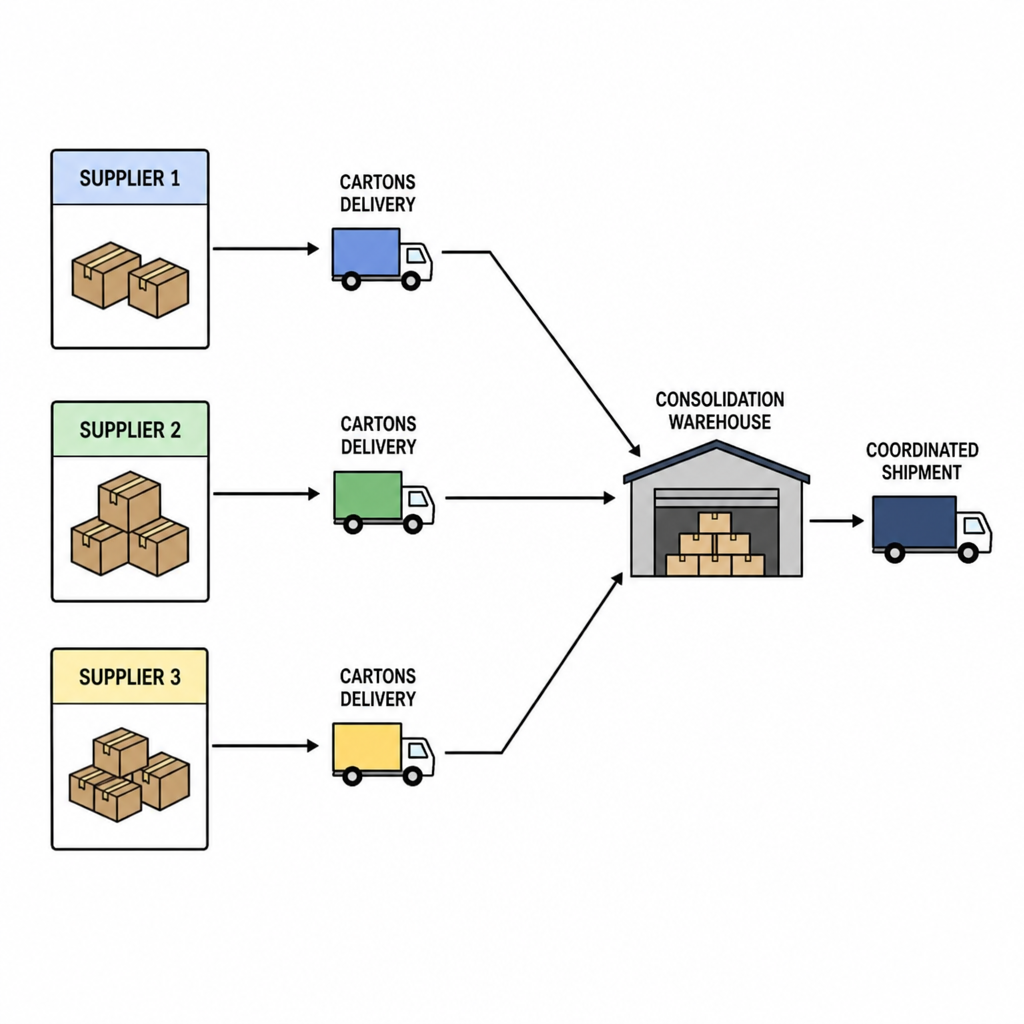
Give the warehouse a receiving plan before suppliers dispatch. Specify purchase-order references, expected carton counts, SKU identifiers, handling instructions, and the evidence required when deliveries arrive. Ask how discrepancies will be recorded and who has authority to resolve them.
A useful consolidation checklist should cover:
- Receiving: Match delivered cartons to supplier orders and record shortages or visible damage.
- Identification: Keep supplier, SKU, batch, and purchase-order references traceable.
- Handling: Confirm whether products can share the planned storage and transport arrangement.
- Release: Set a cutoff date and instructions for incomplete or rejected orders.
- Documents: Reconcile actual shipped quantities with packing lists and commercial records.
Distinguish warehouse receiving checks from product inspection in the service agreement. If you need functional testing, dimensional checks, or packaging verification, commission those tasks explicitly rather than assuming they are included.
Consider a hypothetical order combining storage containers, labels, and display accessories from three suppliers. Ask the coordinator to quote both waiting for every item and shipping available goods first. Make the decision using stock availability, customer commitments, and the additional quoted costs.
Protect quality and clarify shipping responsibilities
Approve a representative sample, then translate that approval into written acceptance criteria. Specify what inspectors should examine, how results should be recorded, and what happens when goods fail. Keep production checks in the plan: official sourcing guidance cautions against treating sample quality as proof of mass-production quality.
Among the most useful china sourcing tips is to replace subjective instructions with observable requirements. Instead of asking for “strong packaging,” define the packaging construction or test requirement appropriate to your product. Have a qualified specialist determine technical criteria where necessary.
Use trade terms precisely
Incoterms rules allocate specified delivery obligations, costs, and risk between buyer and seller. They do not replace a sales contract or settle matters such as product specifications, payment terms, ownership, and dispute resolution. State the chosen rule, named place or port, and applicable version clearly in the agreement.
Ask suppliers and freight providers to explain their quotations against that agreed basis. Identify excluded charges before comparing offers. Keep insurance arrangements and claims responsibilities explicit rather than relying on a general promise that shipping is “covered.”
Check destination requirements before committing
When importing from China into the United States, importers must ensure goods satisfy applicable agency requirements and obtain required permits or licenses. CBP also expects reasonable care over supply chains, including understanding where and how products are manufactured. A supplier's assurance alone should not replace your compliance review.
Before placing the order, ask your customs broker and relevant product specialist to review classification, admissibility, labeling, testing, and documentation requirements. Confirm the applicable duties and fees for the actual goods and transaction; tariff information and additional charges can change.
For import distribution, add your own receiving requirements to that review. Tell suppliers how your warehouse needs cartons labeled and how goods must be identified for allocation to customers. Keep those operational instructions separate from regulatory requirements so neither gets overlooked.
When should you use a wholesale sourcing agent?
Consider a wholesale sourcing agent when you need help with supplier research, communication, order coordination, or export arrangements and cannot manage those tasks effectively in-house. Agent capabilities vary, so confirm the exact service scope and retain oversight of commercial and technical decisions.
The China-Britain Business Council specifically cautions buyers to establish what an agent actually provides.
Evaluate wholesale procurement services against defined deliverables, not broad promises of access or savings. Ask candidates to walk through how they would handle a failed inspection, a late supplier, and an invoice discrepancy. Request sample reporting formats without asking them to disclose another client's confidential information.
Use these questions during selection:
- Who contracts with suppliers, and can you communicate with them directly?
- How are fees calculated, and are supplier commissions or rebates disclosed?
- Who approves samples, inspections, substitutions, and shipment release?
- What evidence accompanies progress reports and payment requests?
- Who retains specifications, supplier records, and order documents if the relationship ends?
Keep the responsibilities of the agent, inspector, freight forwarder, customs broker, and your purchasing team distinct in the engagement documents. If one provider performs several roles, identify each service and its limits. Assign an internal owner to resolve issues that cross those boundaries.
Turn each shipment into a better replenishment decision
After delivery, compare the order with the sourcing brief and approved budget. Review actual landed cost, quantities received, defects, delivery performance, and unresolved claims. Use the results to decide what needs changing before the next purchase rather than simply repeating the previous order.
For wholesale sourcing, China should be evaluated order by order and supplier by supplier. Maintain a scorecard with consistent definitions: record when goods were actually ready, which defects were found, and whether corrective actions were completed. Separate supplier performance from delays caused by your own approvals or changing instructions.
Bring purchasing, warehouse, and sales teams into the review. Ask whether the carton configuration worked, whether the SKU mix matched demand, and whether customers raised recurring concerns. Feed those findings into the next specification and quantity plan.
Effective China procurement is not a contest to secure the cheapest quotation. Build it around clear requirements, verified suppliers, documented negotiation, deliberate consolidation, and accountable release decisions. Start with one well-controlled order, learn from its outcome, and expand only when the process supports your business.
Frequently Asked Questions Related to China Procurement for Wholesalers
What is China procurement and why is it important for wholesalers?
China procurement involves sourcing products from Chinese suppliers, negotiating terms, and managing logistics. It's important for wholesalers to ensure product quality, cost efficiency, and timely delivery to meet market demands.
How do I identify and qualify suppliers in China?
Start by defining your product specifications and requirements. Use online platforms, trade shows, and referrals to find potential suppliers. Verify their qualifications, production capabilities, and past performance through documented evaluations.
What factors should I consider when negotiating with suppliers?
Focus on total landed cost (including production, freight, tariffs, and duties), order quantities, quality assurance conditions, packaging requirements, and delivery timelines. It’s essential to prepare a prioritized list of negotiation points before discussions.
What is the role of a wholesale sourcing agent?
A wholesale sourcing agent assists with supplier research, communication, and order coordination. They can help navigate complex procurement processes, but it’s crucial to maintain oversight of essential commercial decisions.
How can I ensure quality control during the procurement process?
Approve a representative sample and create clear acceptance criteria for inspections. Maintain quality checks throughout production and specify responsibilities in your contracts to ensure that defective goods are managed appropriately.