


Importing from China involves choosing a product, checking its manufacturer, agreeing on quality and delivery terms, and preparing for customs clearance.
This article explains how to approach China product sourcing, evaluate product ideas for the Philippines, and use South African trade data without confusing import volume with profit potential. Start with a manageable trial order and a documented buying process—not simply the lowest factory quote.
How do you source and import products from Chinese manufacturers?
To source and import products from Chinese manufacturers, define your requirements, verify potential suppliers, approve samples, calculate delivered costs, and confirm destination-country requirements before committing to production.
Treat sourcing and importing as one connected project: supplier checks address business legitimacy, while customs preparation addresses whether and how your shipment can enter its destination. Both deserve attention before payment.
Begin with a buying brief that names your intended customer and describes the product in measurable terms. Replace “good quality storage bag” with material, dimensions, closure type, stitching requirements, packaging, and intended use. Send the same brief to each supplier so differences in quotations are easier to investigate.
Set your limits before negotiating: maximum trial-order budget, acceptable delivery window, and required documentation. Those boundaries give you a reason to reject an attractive quote that does not fit your business.
What are the best products to import from China to the Philippines in 2026?
The best products to import from China to the Philippines in 2026 are the ones that pass your own demand, cost, quality, and compliance checks. Use the following categories as research candidates, not a verified bestseller ranking or a promise of profitability. For a first shortlist, consider products whose function and quality you can assess clearly from samples.
|
Product candidate |
Possible customer need |
What to validate before ordering |
|---|---|---|
|
Drawer dividers and organizers |
Better use of limited storage space |
Dimensions, material strength, and packed size |
|
Travel pouches and fabric bags |
Sorting belongings for work or travel |
Zippers, seams, lining, and usable capacity |
|
Desk organizers and document holders |
Tidier workspaces |
Stability, finish, and packaging protection |
|
Cushion covers and other home textiles |
Affordable room updates |
Fabric composition, sizing, and wash performance |
|
Non-powered stands and cable organizers |
More convenient device storage |
Fit, stability, and material durability |
If your research began with the best products to import from China to the Philippines in 2025, treat that shortlist as historical input. Recheck customer interest, competing offers, and supplier quotations before placing a 2026 order.
Do not assume a simple-looking product is exempt from regulation. Philippine Customs identifies food, drugs, electrical appliances, and telecommunications equipment among regulated categories; applicable permits and clearances must be checked before importation.
Find suppliers, then verify the business behind the quotation
Use supplier directories, trade-show contacts, referrals, or sourcing agents to build your initial contact list. Ask each candidate whether it manufactures the product, trades goods made elsewhere, or combines both roles. Your aim is to understand who will produce your order and who will be contractually responsible for it.
For verification, Canada's Trade Commissioner Service recommends checking Chinese business registration through the National Enterprise Credit Information Publicity System.
Its guidance covers the registered company name, address, business scope, license validity, and the authority of the person negotiating. It also recommends reviewing intellectual property, litigation, and relevant compliance risks.
Turn those checks into questions for your supplier shortlist:
- Identity: Which legal entity will sign the order and issue the invoice?
- Production: Where will the goods be made, and which processes will be subcontracted?
- Capability: Can the supplier demonstrate the materials and processes your specification requires?
- Accountability: Who approves changes and handles nonconforming goods?
If you use a sourcing agent, request a written scope covering supplier selection, fees, inspections, and communication. Decide which approvals remain yours rather than assuming the agent will make every decision.
Make samples and quality requirements part of the order
Order samples before authorizing your commercial batch. Write down the checks you will perform, record the results, and retain an approved reference sample. Ask the supplier to confirm that production will follow the agreed specification rather than a general description such as “same quality.”
For example, evaluate a fabric organizer's seams, zipper operation, dimensions, and performance under its intended load. Record acceptable tolerances and unacceptable defects in the purchase specification. Make packaging part of that review, including carton strength, internal protection, and labels.
Arrange a pre-shipment inspection appropriate to the order and product risk. UNIDO's quality guidance distinguishes buyer-requested inspection from inspections required by exporting or destination-country rules; one should not be treated as a substitute for the other.
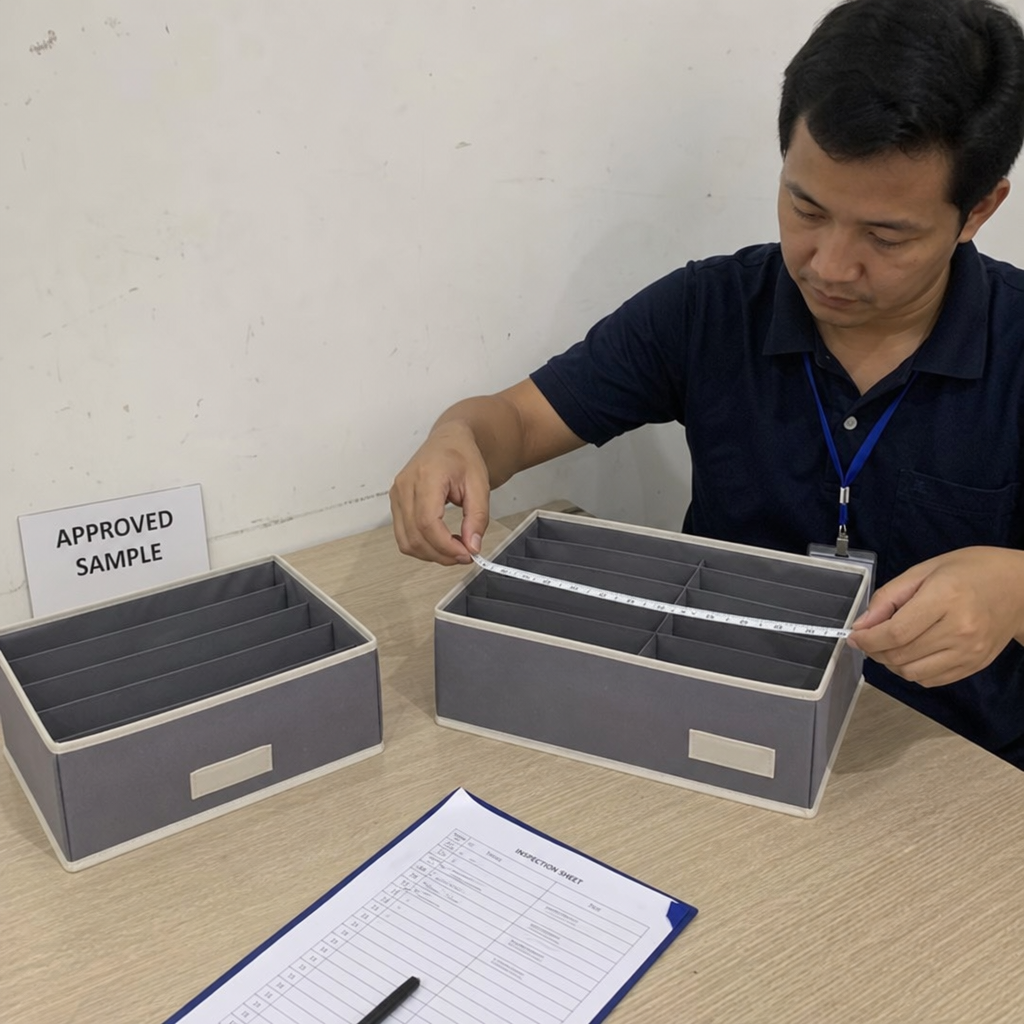
Agree in advance on what happens if inspection identifies a problem. Specify who authorizes rework, how corrections will be checked, and whether shipment must wait for written approval.
How do you calculate the real cost of a China import?
Calculate your China import cost by combining the purchase price with the applicable transport, insurance, customs, tax, and delivery costs. International Trade Administration guidance describes landed cost as the total price of getting a shipment to the buyer, including foreign tariffs and taxes. Use that total—not the factory price—as your starting point for evaluating an order.
Build a quotation worksheet with separate lines for:
- Goods: Unit prices, packaging, and agreed customization charges.
- Origin services: Collection, handling, inspection, and export-related charges where applicable.
- Transport: Freight, insurance, and quoted surcharges.
- Destination costs: Brokerage, applicable duties and taxes, handling, and final delivery.
- Selling expenses: Storage, marketplace fees, returns, and customer delivery, tracked separately from landed inventory cost.
Ask your forwarder and customs broker to identify exclusions instead of relying on an unexplained “all-in” figure. In the Philippines, classification and origin affect tariff treatment, and preferential rates depend on meeting applicable rules and documentation requirements.
Check the Philippine Tariff Finder rather than assuming Chinese origin automatically means duty-free entry.
Before approving the order, stress-test your worksheet with a higher freight quotation, fewer saleable units, and a slower selling period. Set a minimum acceptable margin and cash reserve for your own business. If the order only works under the most optimistic assumptions, revise the quantity, specification, or selling proposition before proceeding.
Put shipping responsibilities and documents in writing
Specify the Incoterms rule, named place or port, and version in your agreement. Incoterms allocate delivery tasks, costs, and risks, but they do not replace the full sales contract or determine payment timing, ownership transfer, and dispute resolution. Address those subjects separately in the written order.
Ask your logistics provider to compare transport options against your actual shipment dimensions, delivery target, and budget. Request a breakdown of origin and destination charges, plus an explanation of what happens if cargo is delayed. Make responsibility for arranging insurance explicit.
Prepare customs information before dispatch. Philippine Customs lists a goods declaration and supporting documents such as invoices, packing lists, bills of lading, permits, and certificates where applicable. Have your broker review the shipment description and documentation requirements before the goods leave China.
Use South Africa's 2025 import statistics to narrow research
For research into South Africa import statistics for China products in 2025, start with bilateral data that identifies the reporting country, year, and product classification.
ITC Trade Map's 2025 South Africa–China table, based on SARS statistics, lists electrical machinery and equipment and mechanical machinery among the largest import chapters. These are broad categories, not individual product recommendations.
Use the chapter totals to choose an area for deeper investigation, then examine narrower product codes and local buyer requirements. Do not treat a large national import value as evidence that your particular item will sell. Your purchasing decision still needs a customer, a workable delivered cost, and a realistic route to market.
Record the date you retrieve the figures. SARS notes that its bilateral and commodity reports are revised, while monthly merchandise trade PDF reports remain static. Keep the reporting period and source consistent when comparing results.
Start small and make the next order evidence-led
Successful sourcing from China starts with a clear specification and a buying decision you can explain. Before committing, assemble your supplier checks, approved sample, cost worksheet, inspection plan, and shipping agreement. Review them together rather than approving each in isolation.
Use the first shipment to assess actual quality, delivery costs, customer response, and cash requirements. Reorder because those results support expansion—not merely because a supplier offers a lower price for a larger quantity.
Frequently Asked Questions About Sourcing & Importing Products from Chinese Manufacturers
What are the steps involved in sourcing products from China?
Sourcing products involves defining your requirements, finding potential suppliers, verifying their legitimacy, ordering samples, negotiating terms, and preparing for shipping and customs clearance.
How do I identify the best products to import from China for the Philippines?
Research market demand, assess quality through samples, verify costs, and consider compliance with local regulations. Categories may include storage solutions, travel accessories, home textiles, and more.
What should I consider when negotiating with Chinese suppliers?
Set clear boundaries for your trial order, including budget, delivery times, and documentation requirements. Ensure you have a detailed buying brief that outlines product specifications for comparison.
How do I calculate the true cost of importing from China?
The real cost involves not just the purchase price but also transport, insurance, customs duties, taxes, and any additional fees. A comprehensive cost worksheet is essential for accurate calculations.
What documentation is required for importing goods into the Philippines?
Key documents include a goods declaration, invoices, packing lists, bills of lading, permits, and certificates. It's important to ensure all documentation is accurate and compliant with Philippine customs regulations.