A China buying agent helps an overseas buyer find suppliers, coordinate purchases, and oversee agreed parts of the sourcing process.
Depending on the service agreement, that support may include supplier checks, sample coordination, production follow-up, inspections, and shipping arrangements.
The key is understanding which tasks you are delegating, what they cost, and which decisions you still need to control.
This article explains how to evaluate that support, compare it with buying directly from a factory, and build a purchasing process that fits your products, budget, and experience.
What does a China buying agent actually do?
A China buying agent acts as an intermediary between a buyer and suppliers in China, performing purchasing-related tasks within an agreed scope. Some focus on placing orders with suppliers the buyer already knows; others offer broader support, including finding factories, negotiating requirements, checking orders, and coordinating dispatch.
Do not assume that every provider includes every service.
The labels can overlap. Rather than choosing by job title, ask the provider to describe exactly what happens before, during, and after an order.
For clarity, use these working distinctions when requesting proposals:
- China sourcing agent: Ask this provider to identify and compare potential suppliers against your product requirements.
- China purchasing agent: Define whether the assignment covers ordering, payment coordination, and follow-up with suppliers you have selected.
- Buying agent: Establish whether the service combines supplier discovery with ongoing purchasing management.
- Freight forwarder: Treat transportation and shipment coordination as a separate scope, even if your agent arranges the introduction.
An agent may offer both sourcing and purchasing services, but the assignment still needs boundaries. One provider, for example, explicitly separates purchasing from an existing supplier from broader factory comparison and negotiation services.
Think of the relationship as delegated work, not delegated judgment. You should still approve the specification, supplier selection criteria, spending limits, and conditions for accepting goods. That gives the agent something concrete to manage and gives you a basis for assessing performance.
Build the sourcing process around clear approval points
Before buying from China, prepare a brief that makes your expectations visible. Include the product’s intended use, materials, dimensions, quantity, customization, packaging, destination market, and required timing. Alibaba’s own quotation guidance emphasizes these details because comparable supplier responses depend on a sufficiently defined request.
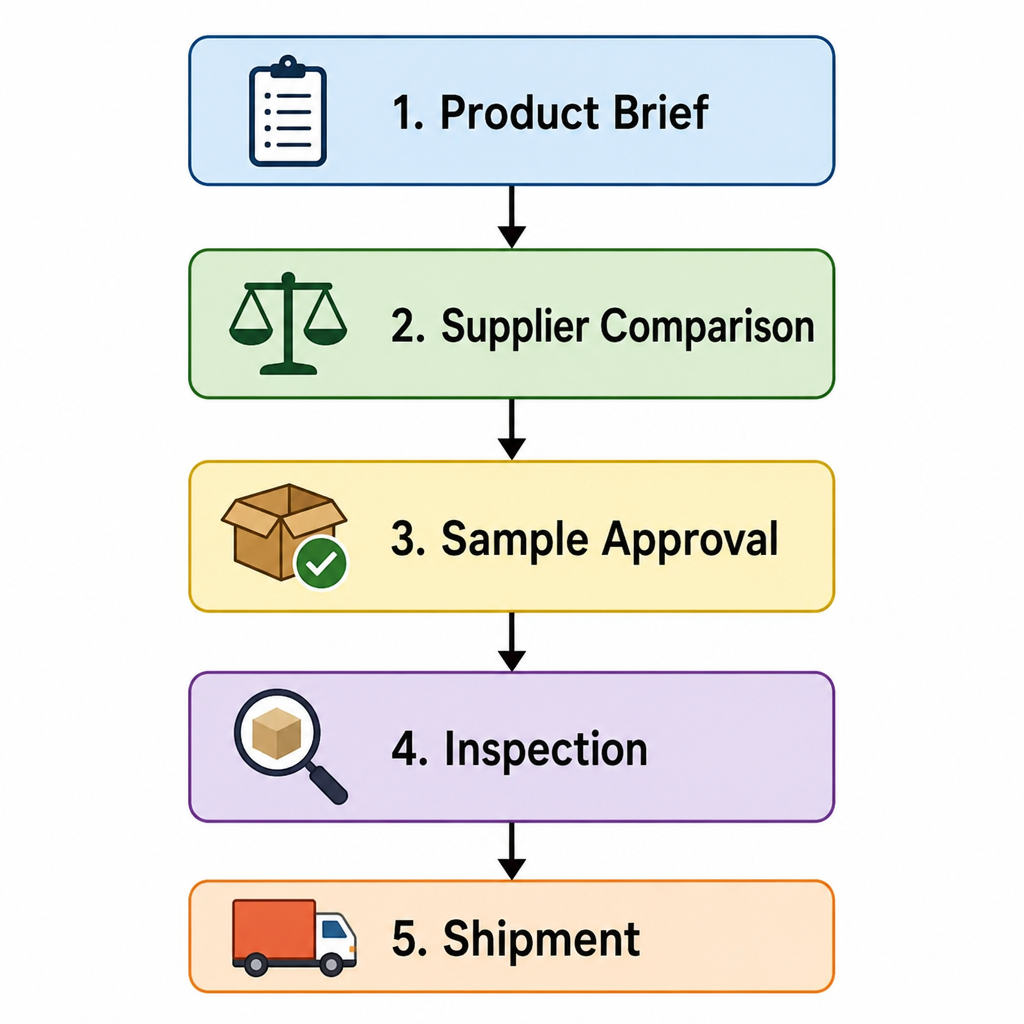
Then divide the assignment into stages rather than authorizing an open-ended search:
- Define the requirement. Give the agent a specification and identify which features are essential, negotiable, or still undecided.
- Compare candidates. Request supplier identities, comparable quotations, capacity information, and explanations for meaningful differences.
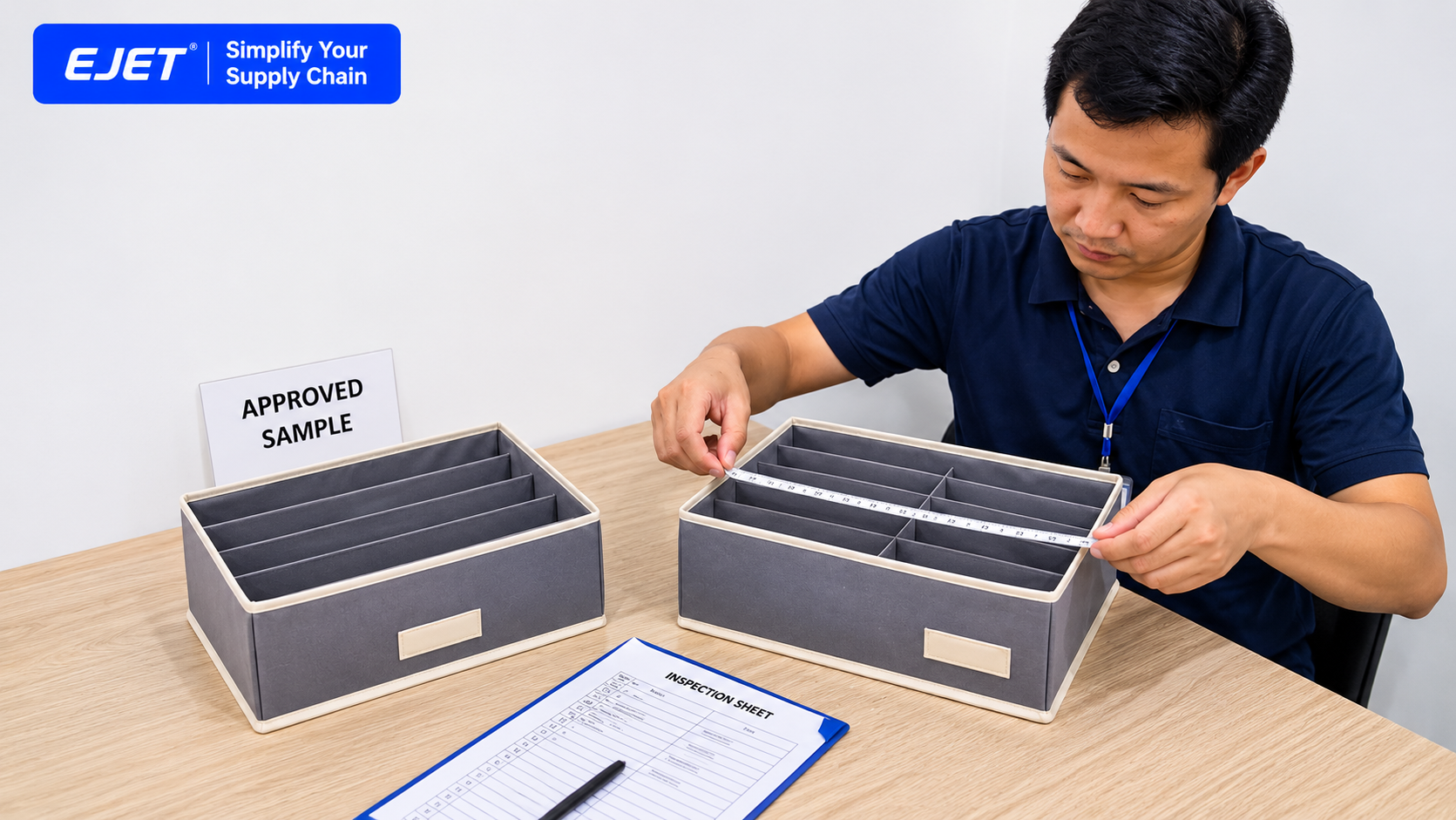
- Review samples. Assess the proposed product against your requirements, documenting changes before approving a production reference.
- Confirm the order. Approve quantities, packaging, delivery terms, payment milestones, and responsibility for resolving nonconforming goods.
- Review production and inspection evidence. Require updates and reports at the checkpoints written into your agreement.
- Authorize dispatch. Confirm that outstanding issues are resolved and that shipment documents match the approved order.
Keep decisions at these checkpoints explicit. A message saying “looks fine” should not leave uncertainty about whether you approved the color, the packaging, or the entire production specification.
For custom products, maintain a revision history. Give each drawing, artwork file, and specification an identifiable version, then require the purchase order to reference the approved version. If you change a component after sampling, ask for written confirmation of the effect on price, timing, and acceptance criteria.
This structure also makes proposals easier to compare. Instead of asking who offers “full service,” ask what evidence each provider will deliver at every stage. A supplier shortlist without supporting comparisons is a different deliverable from a documented recommendation.
How much does a China buying agent cost?
There is no single fee that represents every China buying agent. Published provider examples include percentage-based charges, minimum fees, fixed project prices, and separately priced services such as supplier verification or inspection. The useful comparison is therefore the complete scope and total expected expenditure, not the headline commission alone.
Request a written breakdown before committing. If a fee is calculated as a percentage, ask which amount it applies to: goods only, goods plus packaging, or another stated base. If the provider gives an all-in product price, ask what supporting cost information you will receive.
Use a comparison sheet with these lines:
|
Cost category |
What to clarify |
|---|---|
|
Agent service |
Included tasks, calculation basis, minimum charges, and repeat-order terms |
|
Samples and development |
Sample purchases, revisions, tooling, and delivery |
|
Quality checks |
Inspection scope, reporting, testing, and reinspection |
|
Origin handling |
Collection, receiving, storage, repacking, and consolidation |
|
Transportation |
Freight, insurance, destination handling, and final delivery |
|
Import expenses |
Duties, applicable taxes, brokerage, and required compliance work |
Do not treat blank entries as zero. Ask whether they are included, excluded, or awaiting a separate quote. Also confirm the quotation currency, validity period, payment charges, and process for approving additional spending.
Keep delivery terms consistent when comparing suppliers. Incoterms allocate specified transport costs, risks, and customs responsibilities between buyer and seller, so quotations using different terms may cover different obligations. Specify the rule, named location, and applicable version rather than relying on a loose phrase such as “shipping included.”
Finally, evaluate costs against the work you would otherwise perform. Compare the agent’s proposal with your realistic alternative: internal staff time, independent inspections, logistics coordination, and supplier follow-up. Do not assume either route is automatically cheaper.
Treat MOQ as a planning constraint
MOQ means minimum order quantity: the smallest quantity a supplier agrees to accept for a particular offer. It needs to be discussed alongside customization, packaging, lead time, and price rather than as an isolated number. Alibaba’s sourcing guidance specifically notes that custom colors and packaging can affect minimum-order discussions.
Ask your agent to clarify the level at which each minimum applies. A quotation should distinguish the total order quantity from any minimum per model, size, color, or packaging design. Otherwise, an apparently manageable order may turn into a larger inventory commitment once you select variations.
For an initial purchase, ask suppliers to quote alternatives:
- A standard product with existing packaging.
- The same product with limited branding changes.
- A fully customized version.
- A smaller trial order, if available, with its actual unit price.
Compare the cash commitment and usefulness of each option, not just the unit price. A lower price does little for your business if it requires quantities you cannot confidently use or sell.
Avoid asking an agent to promise future volume that you have not approved. Instead, explain your genuine testing plan and request terms that work for the first order on its own. Treat any later reduction in price or MOQ as a separate negotiation, not a guaranteed outcome.
Make supplier communication specific and traceable
Use supplier communication to establish shared instructions, not merely maintain friendly contact. Ask your agent to turn each important discussion into a written action, decision, or unresolved question. This is especially useful when comparing quotations, where missing specifications can prevent a fair comparison.
Replace broad instructions with observable requirements. Instead of “use strong packaging,” specify the packaging design you want reviewed and the checks you expect. Instead of “match the sample,” identify the approved sample and the characteristics that must match.
Set a reporting format that includes:
- The current order stage and next milestone.
- Decisions needed from you and their deadlines.
- Any proposed change to materials, packaging, quantity, or timing.
- The responsible person and expected resolution for each open issue.
Require approval before substitutions. Give the agent authority to chase answers and propose solutions, but reserve decisions that change the product, commercial commitment, or delivery promise.
For example, if a supplier proposes a different finish, ask for the reason, supporting sample or evidence, revised specification, and effect on the order. Your response should approve or reject that particular change rather than leave the agent to interpret silence.
Keep approved documents and decisions in a shared order file. The aim is not to produce paperwork for its own sake; it is to make the latest instruction easy to find when someone needs to act.
Keep quality checks separate from sales assurances
An agent’s promise to “check quality” needs a definition. Independent pre-shipment inspection can cover quality, quantity, marking, packaging, and loading against specified requirements, but you should confirm the actual inspection scope before relying on the report. SGS describes these as distinct elements of its inspection service.
Ask who performs the work, what instructions they receive, and what evidence you get. Distinguish between photographs taken during a warehouse receipt check and an inspection conducted against an agreed checklist. If independent verification matters to your order, make that requirement explicit.
Prepare acceptance criteria before production. Include relevant dimensions, appearance requirements, functional checks, packaging details, and examples of unacceptable defects. Ask the inspector to identify the order, product version, and quantities examined in the report.
Also agree on the response to a failed check. Decide who can authorize rework, who pays for reinspection, and whether dispatch remains on hold while a dispute is unresolved. Without those decisions, discovering a problem may not produce a clear next step.
For U.S. imports, purchasing support does not remove the need to address import requirements. CBP states that the importer of record must exercise reasonable care in classification, valuation, and providing information needed to assess duties and applicable requirements.
Seek product-specific advice from an appropriate specialist rather than treating the agent as a substitute for compliance expertise.
Plan carefully when handling multiple factories
Handling multiple factories requires more than collecting several quotations. Build one master schedule showing each supplier’s production milestone, inspection date, collection window, and shipment allocation. Give every supplier and product a clear identifier so receiving records can be matched to purchase orders.
Consolidation is an option worth evaluating: DHL describes inbound consolidation as collecting goods from several sources into one shipment delivered to the buyer’s warehouse. However, whether it suits your order depends on the proposed service and your priorities.
Before authorizing a shared shipment, decide:
- Receiving: Who checks incoming cartons, quantities, labels, and visible damage?
- Storage: What allowance applies, and how are additional days charged?
- Identification: How will cartons remain traceable to each supplier and order?
- Exceptions: What happens if one supplier is late or fails inspection?
- Release: Who approves partial dispatch or holding the entire shipment?
Use a hypothetical mixed order to test the plan. If your main product is ready but its custom packaging is delayed, should the agent hold everything, arrange separate dispatch, or seek another approved solution? Set the decision criteria before the problem occurs.
Ask for separate quotations for consolidation and individual dispatch where practical. Judge them against your required arrival dates and operational needs, not an assumption that combining cargo must be the better option.
Buying agent vs factory: when should you use each approach?
Choose direct factory purchasing when you are prepared to manage supplier selection, specifications, communication, quality verification, and logistics yourself. Consider an agent when you want to delegate clearly defined parts of that work and can justify the service expense. A hybrid approach lets you retain the supplier relationship while purchasing only the outside support you need.
Use the following as a decision framework, not a universal ranking:
|
Approach |
Consider it when |
Keep control of |
|---|---|---|
|
Direct factory |
You have a defined product and resources to manage the relationship |
Specifications, supplier checks, inspections, and shipping coordination |
|
Buying agent |
You need coordinated help across several purchasing stages |
Scope, supplier approval, spending, and acceptance decisions |
|
Hybrid |
You want direct purchasing with selected external services |
Boundaries between the factory, agent, inspector, and forwarder |
Direct purchasing with targeted support
For a repeat order from a supplier you have already evaluated, request a direct quotation and separately price any inspection or logistics assistance you need. This lets you compare the work involved without assuming that every reorder requires a complete sourcing assignment. Review any changes to specifications or terms rather than treating the previous order as automatic approval.
Agent-led purchasing with retained oversight
For a project involving unfamiliar suppliers or several product categories, request a staged proposal. Start with supplier research or sample coordination before authorizing production management. Require the agent to explain recommendations and surface unresolved issues rather than simply present a preferred factory.
The choice can change between orders. Reassess when product complexity, purchasing volume, internal staffing, or the number of suppliers changes. Decide when to use each approach based on the work required now, not on loyalty to one purchasing model.
Weigh the benefits and disadvantages honestly
The potential benefits of an agent should be tied to specific tasks. If your problem is inconsistent follow-up, ask for a reporting commitment. If it is comparing suppliers, ask for a documented comparison. If it is coordinating collections, define receiving and dispatch responsibilities.
Likewise, assess disadvantages through the proposed arrangement rather than broad claims about intermediaries:
- Additional expense: Identify what the fee buys and whether you need the full scope.
- Limited visibility: Establish which supplier identities, quotations, and records you can access.
- Conflicting incentives: Ask about supplier commissions, rebates, ownership links, and other compensation.
- Dependency: Confirm how you receive order history, approved files, and supplier contacts when the engagement ends.
Treat these points as contract discussions, not accusations. A provider may have legitimate commercial boundaries, but you need to understand them before purchasing.
The strongest arrangement is one you can evaluate. Define deliverables and review whether they arrived, were useful, and supported the decisions you needed to make. That is more informative than judging the relationship only by whether the agent appears responsive.
Check the agent before committing the order
Apply due diligence to the agent as well as the factory. Government guidance on evaluating Chinese business partners recommends checking registration, verifying supplied information, and investigating warning signs rather than relying solely on representations.
Request the contracting entity’s legal name, business details, service agreement, and payment instructions. Ask the provider to explain any difference between the entity on the contract, invoice, and receiving bank account. Do not proceed while material inconsistencies remain unresolved.
Then test the proposed service with practical requests:
- Ask for a redacted example of a supplier comparison or inspection report.
- Discuss experience relevant to your product’s production requirements.
- Identify which tasks are performed internally and which are subcontracted.
- Confirm escalation contacts and spending-approval rules.
- Establish who owns samples, tooling, artwork, and purchasing records.
Consider a limited first assignment with a defined endpoint. Use it to assess whether the provider asks useful questions, documents decisions, and flags uncertainty. Avoid treating a polished proposal as proof that the working process will meet your expectations.
Evaluate shipping recommendations separately
For a useful China buying agent or shipping forwarder recommendation, start with your shipment requirements rather than a provider’s popularity. Ask candidates to quote against the same origin, destination, cargo description, packaging dimensions, weight, timing, and delivery scope.
Use product- and route-specific experience as an evaluation criterion, consistent with government guidance on selecting forwarders.
If your agent recommends its logistics partner, request a separate explanation of responsibilities and charges. Compare another suitable quotation where practical. Ask who handles booking, documentation, customs coordination, insurance arrangements, and claims communication.
Check exclusions carefully, including storage, inspections, destination handling, and delivery appointments. Require approval for changes that create additional charges. Finally, identify the handoff point between purchasing and transportation so neither provider assumes the other is resolving an outstanding issue.
Choose support that makes your purchasing process clearer
Effective China product sourcing starts with a defined requirement and accountable decisions. Use a China buying agent where the proposed work addresses a genuine gap, compare complete costs, and retain approval over specifications, spending, and acceptance.
Whether you choose an agent, a factory relationship, or a hybrid, sourcing from China should leave you with clearer records and responsibilities—not less visibility into your own order.
Frequently Asked Questions About China Buying Agents
What is a China buying agent and what services do they provide?
A China buying agent acts as an intermediary between overseas buyers and suppliers in China, assisting with tasks such as supplier sourcing, order placement, quality inspection, and shipping logistics. Their services can vary widely, so it’s essential to clarify what specific tasks they will handle as part of the agreement.
How do I determine the cost of using a China buying agent?
The costs associated with a China buying agent can vary based on their fee structure, which may include percentage-based charges, fixed fees, or additional costs for specific services like inspections and supplier verifications. It's crucial to request a written breakdown of all potential costs before committing.
What are the advantages and disadvantages of using a buying agent versus purchasing directly from a factory?
Using a buying agent can provide expertise and support with complex sourcing processes, saving time and reducing risks. However, it may incur additional costs and potentially less control over certain purchasing aspects. Purchasing directly from a factory can be cheaper and offer more control but may require more internal resources to manage the relationship effectively.
What does MOQ mean and how does it affect my purchasing decisions?
MOQ stands for Minimum Order Quantity, which is the smallest quantity a supplier is willing to sell. It's an important consideration as it can influence costs, inventory management, and negotiation with suppliers. Understanding the MOQ in the context of your production needs is crucial for effective sourcing.
How can I ensure quality when sourcing products from China?
Ensuring quality involves setting clear specifications, using independent inspections, and maintaining thorough communication with suppliers. It's important to establish acceptance criteria before production and have a clear process for addressing any quality issues that arise during or after the production phase.