







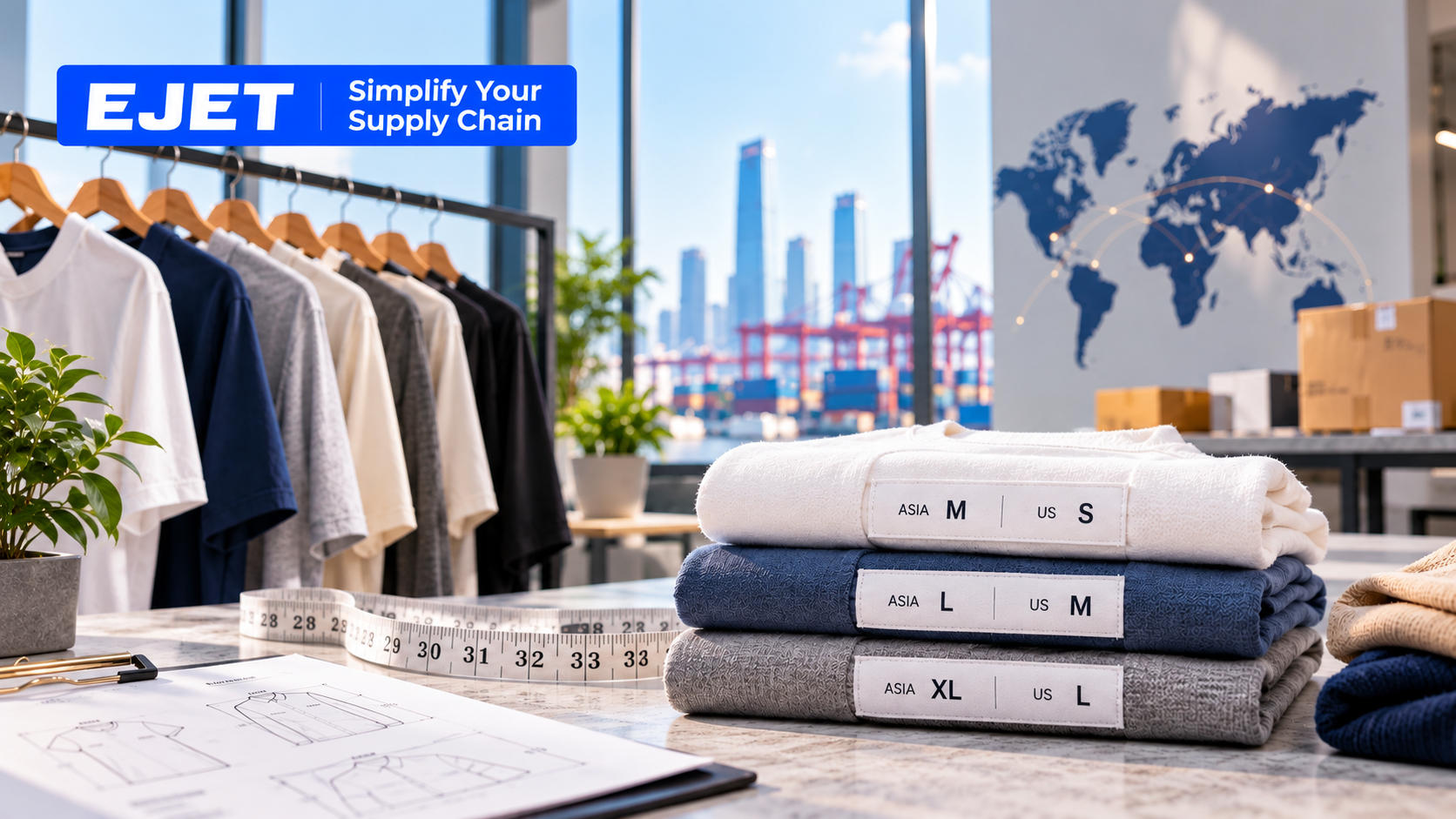
Asian clothing sizes are not standardized across all manufacturers. Always prioritize the supplier's measurements over general conversion charts. This approach helps reduce sizing errors, unnecessary returns, and the risk of receiving garments that are too tight or excessively loose.
Shopping for clothes internationally can be challenging, especially when comparing Asian size vs US size. A shirt labeled large (L) in an Asian clothing store may fit very differently from a large shirt sold by an American retailer.
Understanding these differences is essential for selecting comfortable, properly fitting clothing and avoiding unnecessary returns.
In general, Asian clothing sizes tend to run smaller than US sizes, although the difference varies significantly by country, brand, garment type, and manufacturer. An Asian XL, for example, may fit similarly to a US medium or large in some brands, but this is not a universal conversion.
In this comprehensive guide, we explain the differences between Asian and American clothing sizes, provide practical size conversion charts, and show how to choose the correct fit when purchasing shirts, dresses, jackets, pants, and shoes.
Asian Size vs US Size: What Is the Main Difference?
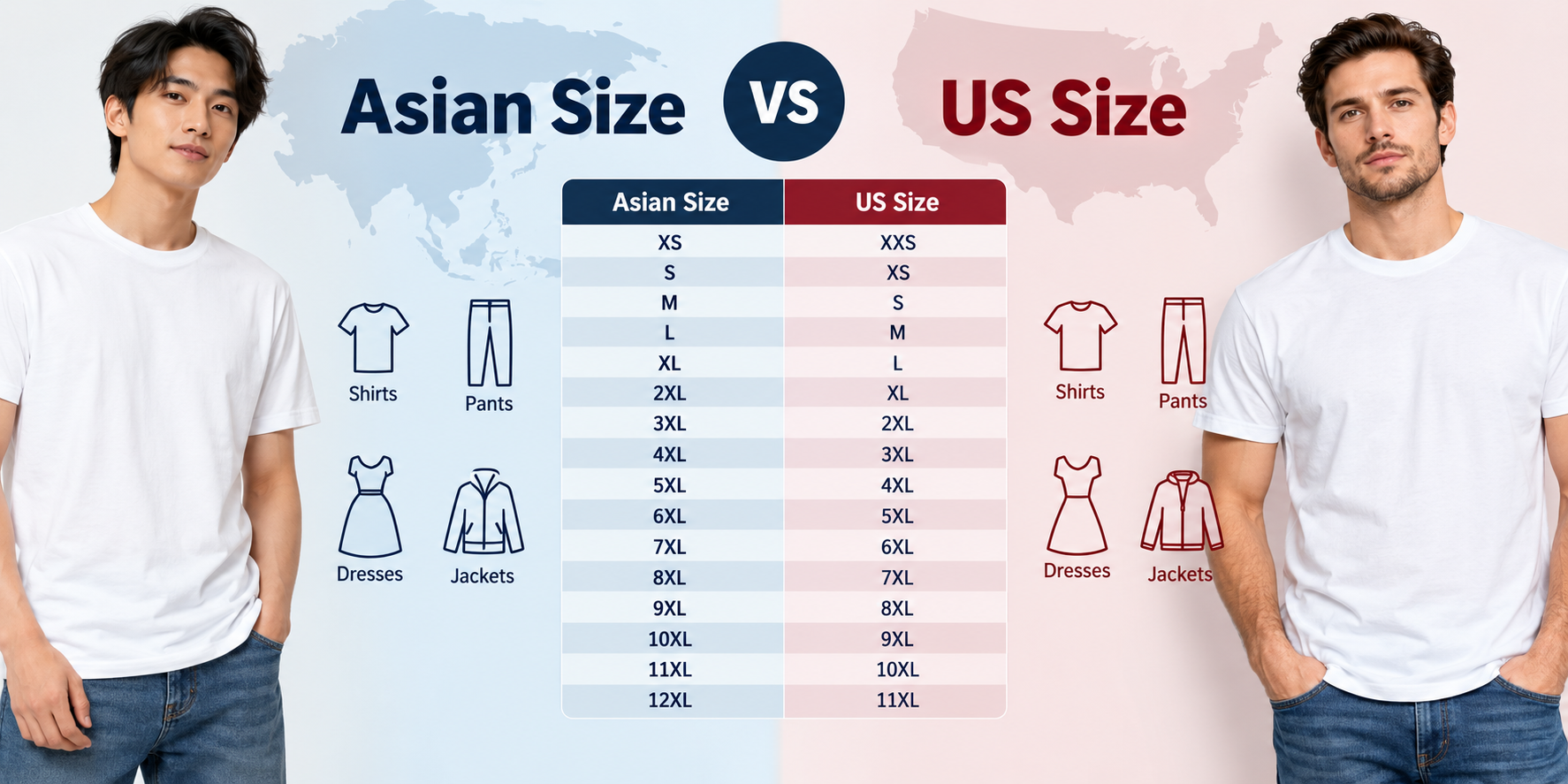
The primary difference between Asian and US clothing sizes is the body measurements and fit standards used by manufacturers.
American clothing brands often design garments around sizing systems and fit expectations common in the United States. Asian manufacturers may use different measurement standards, garment proportions, and labeling conventions.
For example, some Asian clothing brands produce garments with narrower shoulders, shorter sleeves, smaller chest measurements, or shorter overall lengths than comparable American garments.
However, Asia does not have one standardized clothing size system. Chinese, Japanese, Korean, and other Asian clothing brands may follow different sizing conventions.
Key Differences Between Asian and US Clothing Sizes
|
Feature |
Asian Clothing Sizes |
US Clothing Sizes |
|---|---|---|
|
General fit |
Often smaller or slimmer |
Often roomier |
|
Size labels |
S, M, L, XL, XXL, or numerical sizes |
XS, S, M, L, XL, XXL, or numerical sizes |
|
Shoulder width |
May be narrower |
May be broader |
|
Sleeve length |
May be shorter |
May be longer |
|
Garment length |
Often shorter in some brands |
Often longer in some brands |
|
Size consistency |
Varies by country and manufacturer |
Varies by brand and clothing category |
|
Best conversion method |
Actual body and garment measurements |
Actual body and garment measurements |
Important: These are general tendencies, not guaranteed sizing rules. We recommend using each manufacturer's size chart instead of relying exclusively on letter sizes.
Asian Size to US Size Conversion Chart
One of the most common questions shoppers ask is: What is my Asian size if I normally wear a US size?
There is no universal conversion chart that applies to every Asian clothing brand. Nevertheless, an approximate comparison can help shoppers identify which sizes to investigate.
General Asian Size vs US Size Chart
The following chart illustrates a possible conversion for Asian brands that use relatively small-fitting letter sizes.
|
US Size |
Possible Asian Size |
|---|---|
|
XS |
S or M |
|
S |
M or L |
|
M |
L or XL |
|
L |
XL or XXL |
|
XL |
XXL or 3XL |
|
XXL |
3XL or 4XL |
|
3XL |
4XL or 5XL |
These conversions are illustrative starting points only. Some Asian brands use sizing equivalent to international standards, while others differ by several sizes.
For example, a shopper who normally wears a US medium might find that an Asian large fits comfortably in one brand, while an Asian XL or XXL is necessary in another.
The most reliable approach is to compare chest, waist, hip, and garment measurements.
Asian Size vs US Size for Men
Men's clothing sizes can differ considerably between Asian and American manufacturers.
When selecting men's clothing, we recommend paying particular attention to chest circumference, shoulder width, sleeve length, waist circumference, and inseam.
Men's Asian to US Shirt Size Chart
The following table provides typical US body-chest reference ranges and potential Asian labels for smaller-fitting brands.
|
US Shirt Size |
Body Chest Measurement |
Possible Asian Size |
|---|---|---|
|
XS |
33–35 inches |
S–M |
|
S |
35–37 inches |
M–L |
|
M |
38–40 inches |
L–XL |
|
L |
41–43 inches |
XL–XXL |
|
XL |
44–46 inches |
XXL–3XL |
|
XXL |
47–49 inches |
3XL–4XL |
These chest ranges are approximate and do not represent a universal US sizing standard.
For instance, a man with a 40-inch chest who normally purchases US medium shirts should not automatically order Asian XL. Instead, he should locate the manufacturer's chart and check whether the garment provides sufficient room around the chest and shoulders.
How to Choose the Right Asian Shirt Size for Men
We recommend measuring the following areas:
-
Chest: Measure around the fullest part of the chest while keeping the tape horizontal.
-
Shoulders: Measure across the back from one shoulder point to the other.
-
Sleeves: Measure from the shoulder point to the wrist.
-
Shirt length: Compare the desired garment length with a shirt that already fits comfortably.
-
Waist: Check the waist measurement for fitted or tailored shirts.
For casual clothing, additional room may be desirable. For formal shirts, shoulder alignment and sleeve length are especially important.
Asian Size vs US Size for Women
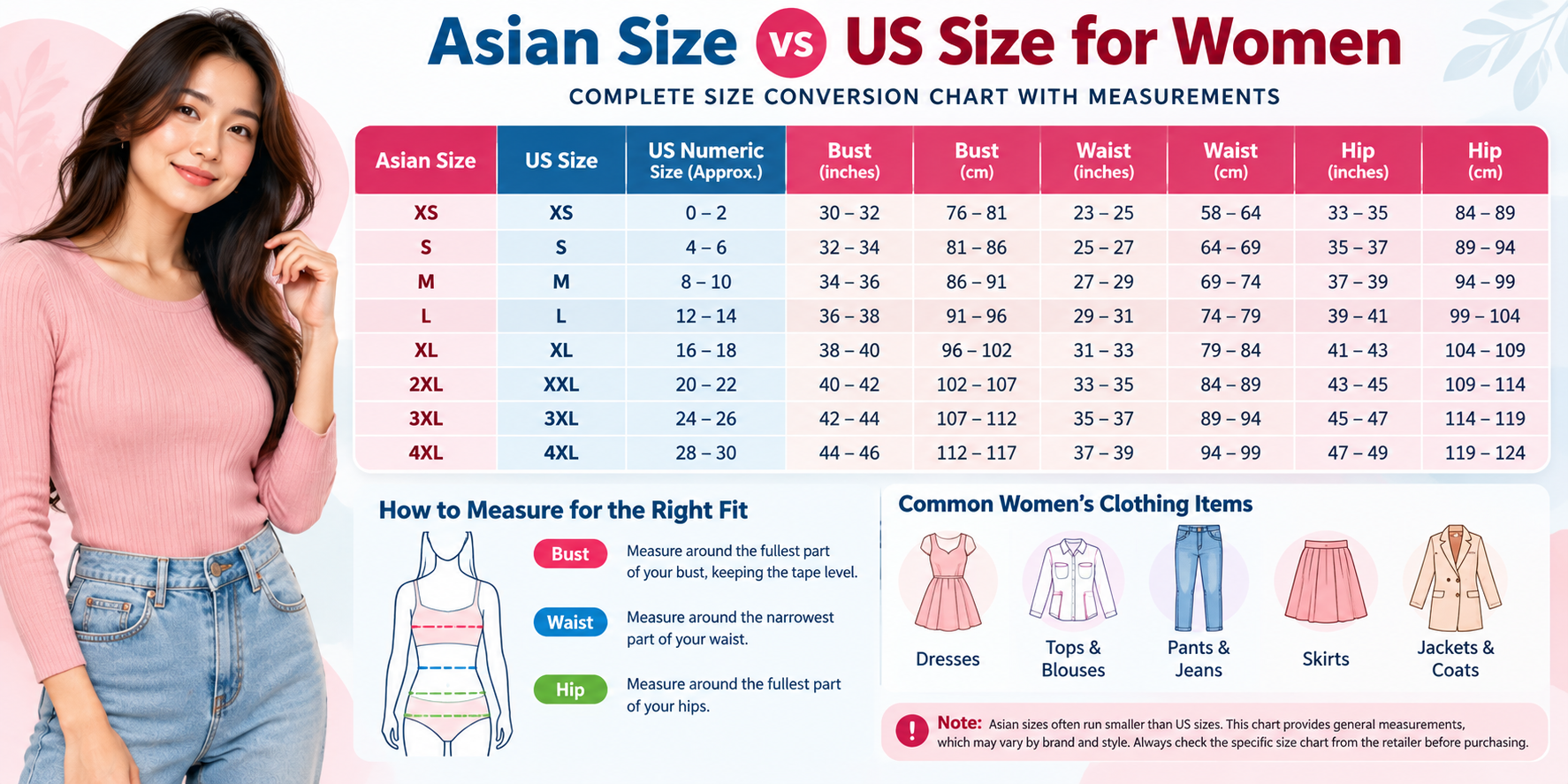
Women's clothing sizes are particularly challenging because manufacturers may use different combinations of numerical sizes, letter sizes, and body measurements.
A US size 8 dress, for example, cannot be reliably converted into one specific Asian size without knowing the brand's measurements.
Women's Asian to US Size Conversion Chart
The following chart shows possible equivalents for Asian brands that run smaller than typical US letter sizing.
|
US Size |
US Numerical Size (Approx.) |
Possible Asian Size |
|
XS |
0–2 |
S–M |
|
S |
4–6 |
M–L |
|
M |
8–10 |
L–XL |
|
L |
12–14 |
XL–XXL |
|
XL |
16–18 |
XXL–3XL |
|
XXL |
20–22 |
3XL–4XL |
US numerical and letter-size relationships also vary by retailer, so this chart should be treated as a general reference rather than a definitive conversion.
Important Measurements for Women's Clothing
When purchasing women's clothing from Asian retailers, we recommend considering three primary measurements.
Bust circumference: Measure around the fullest part of the bust without pulling the tape too tightly.
Waist circumference: Measure around the natural waistline, usually near the narrowest part of the torso.
Hip circumference: Measure around the fullest part of the hips and buttocks.
For dresses, additional measurements such as shoulder width, torso length, and overall garment length can significantly affect the fit.
A dress that fits correctly around the bust may still be too tight around the hips. Therefore, we recommend choosing the size that accommodates the largest relevant body measurement, then evaluating whether alterations are necessary.
Asian Pants Size vs US Pants Size
Pants and jeans require careful sizing because waist measurements alone do not determine comfort.
Asian and American pants may differ in waist circumference, hip width, thigh room, rise, and inseam length.
Understanding Waist Measurements
Many US men's pants use waist and inseam measurements in inches.
For example, pants labeled 32 × 30 generally indicate:
-
A nominal 32-inch waist.
-
A nominal 30-inch inseam.
However, the actual garment dimensions may differ from the label because of manufacturing tolerances, styling, and vanity sizing.
Asian retailers may list waist measurements in centimeters or use numerical size codes.
Waist Measurement Conversion Chart
|
Waist in Inches |
Waist in Centimeters |
|---|---|
|
26 |
66.0 |
|
28 |
71.1 |
|
30 |
76.2 |
|
32 |
81.3 |
|
34 |
86.4 |
|
36 |
91.4 |
|
38 |
96.5 |
|
40 |
101.6 |
We recommend checking whether the manufacturer's waist measurement refers to the wearer's body or the actual garment.
This distinction matters because a garment's waistband may be designed with additional ease or stretch.
How to Select Asian Jeans and Trousers
For jeans, we should compare waist, hip, thigh, rise, and inseam measurements.
For example, two pairs of pants may both have a 32-inch waist but fit differently because one has a slim thigh and low rise while the other has a relaxed cut and higher rise.
Stretch denim may also feel different from rigid denim, even when the listed measurements are identical.
Asian Shoe Size vs US Shoe Size
Shoe sizing differs from clothing sizing because several Asian countries use numerical systems based on centimeters, millimeters, or regional conventions.
Japanese shoe sizes commonly correspond to foot length in centimeters, while Korean footwear frequently uses millimeter-based labels.
Chinese shoe sizing may follow different conventions depending on the manufacturer and market.
Approximate Women's Shoe Size Conversion Chart
|
US Women's Size |
Approximate Foot Length |
Japan Size |
|---|---|---|
|
5 |
22 cm |
22 |
|
6 |
23 cm |
23 |
|
7 |
24 cm |
24 |
|
8 |
25 cm |
25 |
|
9 |
26 cm |
26 |
|
10 |
27 cm |
27 |
Approximate Men's Shoe Size Conversion Chart
|
US Men's Size |
Approximate Foot Length |
Japan Size |
|---|---|---|
|
6 |
24 cm |
24 |
|
7 |
25 cm |
25 |
|
8 |
26 cm |
26 |
|
9 |
27 cm |
27 |
|
10 |
28 cm |
28 |
|
11 |
29 cm |
29 |
These are simplified references. Actual shoe-size conversions differ among brands, and Japanese size labels should be checked against the specific manufacturer's chart.
We recommend measuring both feet while standing and using the measurement of the longer foot. Foot width, toe-box shape, and intended footwear use should also influence the final selection.
Chinese Size vs US Size
Chinese clothing sizes can be confusing because some retailers use international letter sizes while others use numerical codes.
For example, a Chinese garment may be labeled 170/88A.
In a commonly used Chinese sizing convention, this generally indicates:
-
170: Reference body height in centimeters.
-
88: Reference chest or waist circumference in centimeters, depending on the garment.
-
A: A body-type classification.
This labeling system provides more useful information than a simple S, M, or L designation.
However, a size code does not describe every dimension of a garment. We still need to examine the manufacturer's detailed measurements.
When purchasing clothing from Chinese marketplaces, we recommend checking whether the product chart provides body measurements or finished garment dimensions.
Japanese Size vs US Size
Japanese clothing sizes may use letter sizes, numerical sizes, or measurements in centimeters.
Some Japanese brands produce clothing with relatively compact proportions, particularly in shoulder width, sleeve length, and garment length.
However, many international Japanese retailers also provide standardized regional size conversions.
For example, a Japanese medium may fit similarly to a US small in some collections, while other Japanese brands may use nearly equivalent international sizing.
We recommend checking the brand's official conversion chart rather than assuming that every Japanese size is one size smaller than its American counterpart.
Korean Size vs US Size
Korean clothing sizes often use numerical labels such as 44, 55, 66, 77, and 88, especially for women's clothing.
These labels are commonly associated with approximate size categories, but the relationship varies by brand.
Approximate Korean Women's Clothing Size Chart
|
Korean Size |
Common Approximate US Equivalent |
|---|---|
|
44 |
XS |
|
55 |
S |
|
66 |
M |
|
77 |
L |
|
88 |
XL |
This chart is only a starting point. Individual Korean brands may use different measurements, and some garments are intentionally oversized.
Korean fashion frequently includes relaxed silhouettes, oversized shirts, loose-fitting trousers, and one-size garments.
Consequently, a product labeled free size or one size should never be assumed to fit everyone.
We recommend reviewing the exact bust, shoulder, waist, and length measurements before ordering.
How to Convert Asian Size to US Size Accurately
The most dependable way to convert Asian sizes into US sizes is to use actual measurements rather than fixed letter-size substitutions.
Clothing measurement converter
Convert your body measurements between inches and centimeters before comparing them with a retailer's size chart.
Clothing Measurement Conversion Chart: Inches to Centimeters
|
Inches |
Centimeters (cm) |
|---|---|
|
24 |
60.96 |
|
26 |
66.04 |
|
28 |
71.12 |
|
30 |
76.20 |
|
32 |
81.28 |
|
34 |
86.36 |
|
36 |
91.44 |
|
38 |
96.52 |
|
40 |
101.60 |
|
42 |
106.68 |
|
44 |
111.76 |
|
46 |
116.84 |
|
48 |
121.92 |
|
50 |
127.00 |
|
52 |
132.08 |
|
54 |
137.16 |
Step 1: Measure Your Body
Use a flexible measuring tape to record your chest or bust, waist, hips, shoulders, and other relevant dimensions.
We recommend measuring while wearing lightweight clothing and keeping the tape comfortably snug.
Step 2: Find the Seller's Size Chart
Locate the specific size chart for the product rather than relying on a general Asian-to-US conversion table.
If the seller lists garment measurements, compare them with similar clothing that already fits well.
Step 3: Convert Inches to Centimeters
Many Asian retailers provide measurements in centimeters.
The conversion formula is:
Centimeters = Inches × 2.54
For example:
-
36 inches = 91.44 centimeters.
-
38 inches = 96.52 centimeters.
-
40 inches = 101.60 centimeters.
-
42 inches = 106.68 centimeters.
This simple calculation allows us to compare measurements accurately across different systems.
Step 4: Consider the Desired Fit
Different garments require different amounts of room.
A slim-fit shirt should follow the body's shape without restricting movement. A relaxed-fit shirt requires more ease, while an oversized garment is intentionally designed with additional width.
We recommend considering the intended silhouette before selecting a size.
Step 5: Review Customer Feedback
Customer reviews can provide useful information about sizing consistency, garment length, fabric stretch, and whether an item runs small or large.
Reviews from customers who share their body measurements are particularly helpful.
Nevertheless, personal fit preferences differ, so reviews should supplement rather than replace accurate measurements.
Why Are Asian Clothing Sizes Often Smaller Than US Sizes?
Several factors contribute to differences between Asian and American clothing sizes.
1. Different Sizing Traditions
Clothing manufacturers develop sizing systems around their target customers and established market conventions.
These conventions can differ between countries and brands.
2. Garment Proportions
Some Asian clothing collections feature shorter sleeves, narrower shoulders, and shorter garment lengths than comparable American collections.
These differences can influence comfort even when chest or waist measurements appear similar.
3. Fashion Preferences
Clothing design trends affect garment sizing.
For example, slim-fitting shirts, structured jackets, and tailored trousers may have less ease than casual American-style clothing.
However, oversized Asian streetwear can be substantially roomier than traditional fitted garments.
4. Inconsistent International Standards
There is no single universal clothing size chart followed by every manufacturer worldwide.
As a result, two brands may assign different size labels to garments with nearly identical measurements.
5. Manufacturing and Fabric Differences
Fabric composition, stretch, garment construction, and production tolerances can all influence how clothing fits.
A cotton shirt with minimal stretch may require a different fit allowance from a shirt containing elastane.
Should You Order One or Two Sizes Up in Asian Clothing?
A common recommendation is to purchase Asian clothing one or two sizes larger than your normal US size.
Although this approach sometimes works, ordering one or two sizes up is not a reliable universal rule.
For example, a shopper who wears US medium might need Asian large in one brand, Asian XXL in another, or the same medium size in a brand that follows international sizing.
Finding the right fit is easier when you focus on actual measurements rather than relying solely on size labels. Follow these five steps to make a more confident purchasing decision.
01. Start With Your Usual US Size
Use your regular US clothing size as a starting point, not an exact conversion.
02. Review the Manufacturer's Size Chart
Check both body measurements and garment dimensions, especially the chest, waist, hips, shoulders, and length.
03. Compare With Clothing You Already Own
Measure a well-fitting garment and compare its dimensions with the seller's specifications.
04. Consider Fit and Fabric
Account for whether the garment is slim, regular, or oversized, and whether the fabric stretches or has a rigid structure.
05. Select Your Size Based on Measurements
Choose a larger size only when the garment dimensions and your preferred fit indicate that additional room is needed.
Common Mistakes When Comparing Asian Size and US Size
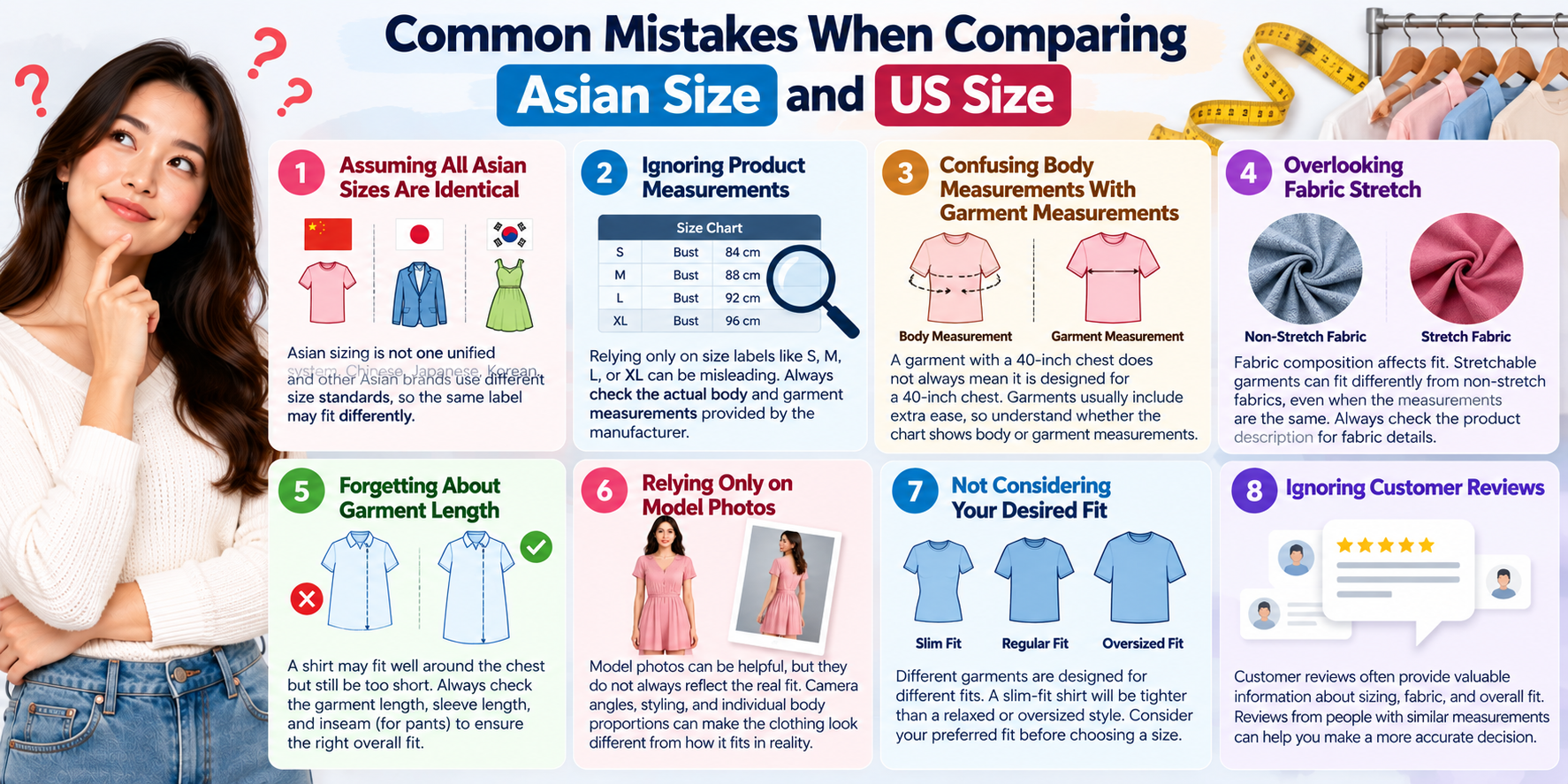
Several avoidable mistakes contribute to incorrect online clothing purchases.
Assuming All Asian Sizes Are Identical
Asian sizing is not one unified system. Chinese, Japanese, Korean, and other manufacturers may use different standards.
Ignoring Product Measurements
A size label provides limited information. Actual measurements offer a more dependable basis for comparison.
Confusing Body Measurements With Garment Measurements
A shirt with a 40-inch chest circumference is not necessarily intended for someone with a 40-inch chest.
The garment may require additional ease for comfortable movement.
Overlooking Fabric Stretch
Stretchable garments can fit differently from rigid fabrics.
We recommend examining the fabric composition before choosing between sizes.
Forgetting About Garment Length
A shirt may fit around the chest but still be too short.
Similarly, trousers may fit around the waist but have an unsuitable inseam or rise.
Relying Exclusively on Customer Photos
Customer photographs can help illustrate the garment's appearance, but camera angles, posture, styling, and individual proportions can make fit difficult to judge.
Tips for Buying Asian Clothing Online
When shopping through international fashion retailers or marketplaces, we recommend adopting a consistent sizing process.
First, measure your body accurately and keep the measurements available for future purchases.
Second, read the product description carefully. Look for information about fabric composition, stretch, fit, and garment dimensions.
Third, check the size chart for the exact item. Different products from the same retailer may have different measurements.
Fourth, compare the garment with an item you already own. This is especially helpful for jackets, shirts, jeans, and dresses.
Fifth, review the return and exchange policy before purchasing. International returns can involve shipping fees, customs procedures, and longer processing times.
Finally, avoid selecting a size based solely on the model's height or weight. Two people with similar heights and weights may have very different body proportions.
Asian Size vs US Size: Frequently Asked Questions
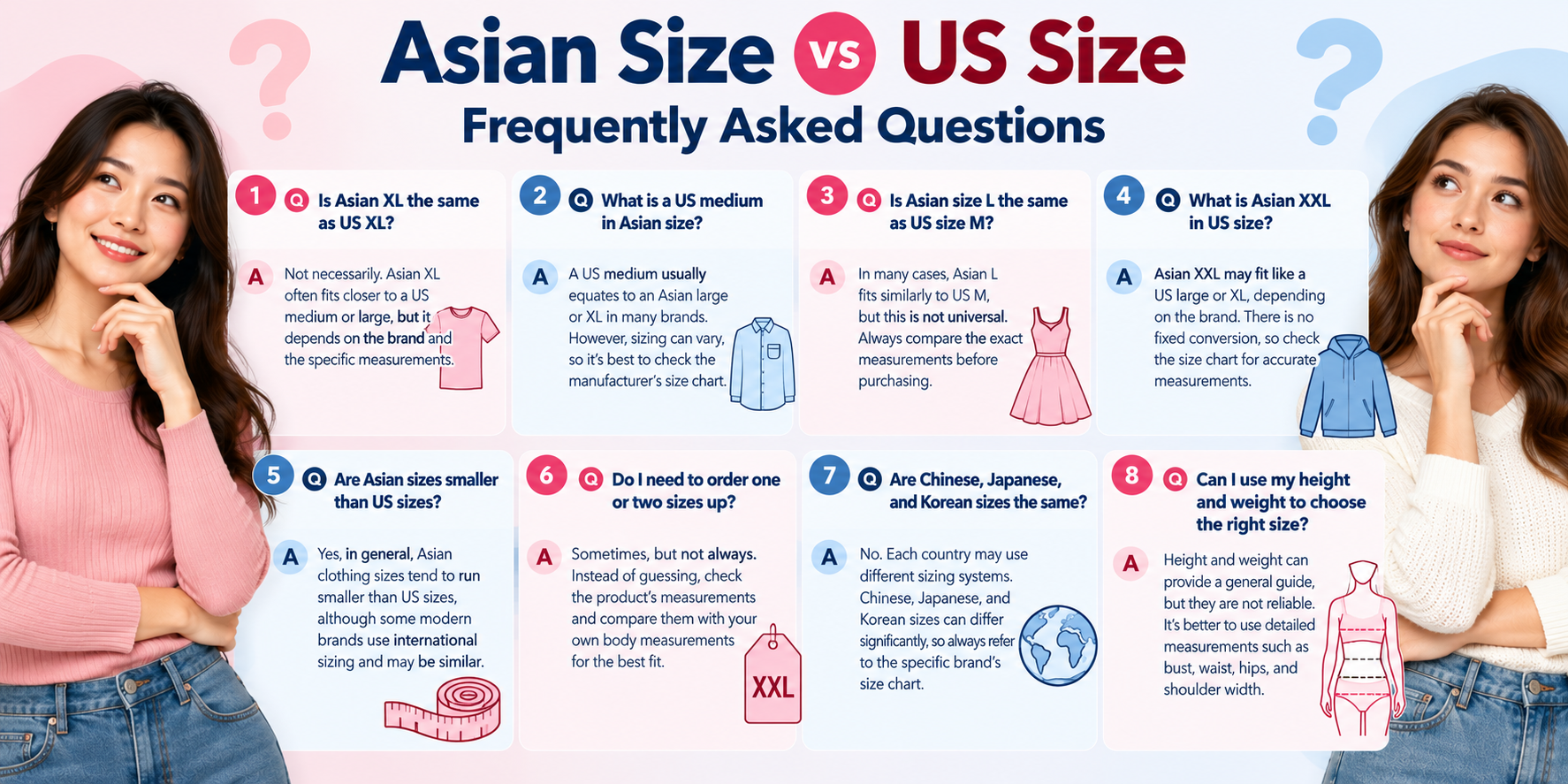
Is Asian XL the Same as US XL?
Not necessarily. In some Asian brands, XL may fit closer to a US medium or large. Other manufacturers use international sizing systems where the measurements are similar. Always compare the manufacturer's chart.
What Is a US Medium in Asian Size?
A US medium may correspond to an Asian large, XL, or XXL in smaller-fitting brands. However, some brands use equivalent medium sizing. Chest, waist, and hip measurements are more reliable than letter-size conversions.
Is Asian Size L the Same as US Size M?
Sometimes. Certain Asian large garments fit similarly to American medium garments, but this is not guaranteed. The correct comparison depends on the garment's dimensions.
What Is Asian XXL in US Size?
An Asian XXL may fit similarly to a US medium, large, or XL, depending on the manufacturer. There is no fixed international equivalent.
Are Chinese Sizes Smaller Than American Sizes?
Many Chinese fashion products use smaller-fitting size charts than typical US clothing, but not all Chinese brands do. Manufacturers serving international markets may use different standards.
Are Japanese Sizes Smaller Than US Sizes?
Some Japanese clothing brands have smaller or shorter proportions than comparable American brands. However, Japanese sizing varies by retailer and garment category.
Is Korean Free Size the Same as One Size Fits All?
Korean free size generally means the garment is offered in one size rather than multiple size options. It does not guarantee that the garment will fit every body type.
How Do We Know Which Asian Size to Buy?
We recommend measuring the body, checking the product's size chart, comparing garment dimensions, and accounting for fabric stretch and preferred fit.
Can We Convert Asian Sizes to US Sizes Using Height and Weight?
Height and weight can provide general context, but they cannot reliably determine clothing size. Chest, waist, hip, shoulder, and inseam measurements are much more useful.
Should We Size Up When Buying Asian Shoes?
Not automatically. We recommend measuring foot length and width and following the footwear brand's size chart. Sizing up unnecessarily can cause heel slipping and poor support.
Final Verdict: Asian Size vs US Size — Which One Should You Choose?
Choosing between Asian and US clothing sizes is not about determining which sizing system is better. The goal is to find clothing that matches individual body measurements and fit preferences.
Asian clothing sizes often run smaller than US sizes, but the difference is not consistent across brands, countries, or garment categories.
For the most accurate results, we recommend using three essential references: body measurements, garment measurements, and the manufacturer's official size chart.
A shopper who normally wears US medium should not assume that every Asian XL will fit correctly. Similarly, someone who wears US large should not automatically purchase Asian XXL without checking the actual dimensions.
By measuring carefully, understanding regional sizing differences, and evaluating the garment's intended fit, we can make more confident purchasing decisions, reduce unnecessary returns, and find comfortable clothing from international retailers.
Ultimately, the right size is the one that fits your measurements and desired style—not simply the size printed on the label.