An Amazon FBA sourcing agent helps you find suppliers and coordinate purchasing, with services that may extend to samples, inspections, and shipping arrangements.
Choosing the right partner means checking their capabilities and commercial terms—not simply accepting the lowest quotation.
Use this guide to define the support you need, compare candidates, and test a working relationship before committing to a large order.
What does an Amazon FBA sourcing agent do?
An Amazon FBA sourcing agent acts as an intermediary between your business and potential suppliers. Their responsibilities depend on the agreement: some focus on supplier introductions, while others coordinate production and logistics.
Do not assume that hiring an agent transfers the overall commercial or technical risk away from your business. The China-Britain Business Council specifically advises buyers to verify an agent’s capabilities and service scope.
When interviewing candidates, separate the work into clear deliverables:
- Supplier research: Identify suitable manufacturers and explain why each belongs on the shortlist.
- Quotation management: Obtain comparable offers against the same specifications and quantities.
- Sample coordination: Track revisions, costs, approvals, and delivery.
- Production oversight: Report progress and escalate deviations for your decision.
- Inspection and shipment coordination: Arrange agreed checks and hand over accurate shipment information.
Ask who performs each task, what evidence you receive, and which services cost extra. An introduction-only assignment needs a different agreement from ongoing production management.
Do you need an agent or direct supplier contact?
Consider an agent when you need supplier-side coordination that you cannot reliably manage yourself. Direct purchasing may suit you better when you already know the supplier, understand the product, and have time to supervise the order. Treat the decision as a choice about responsibilities rather than a requirement for selling through Amazon FBA.
Start by writing down where you need help. Is the difficult part finding manufacturers, translating technical feedback, comparing quotations, or checking production? Request proposals for those specific tasks instead of buying an undefined “full-service” package.
For established supplier relationships, consider a narrower assignment, such as an independent inspection or shipment-preparation review. For a new custom product, ask candidates to explain their development and revision process. The aim is to purchase useful oversight without paying for duplicated work.
Build a sourcing brief before requesting quotes
Give every candidate the same written brief. Include product drawings or reference images, intended materials, dimensions, finish, packaging, order quantity, and destination marketplace.
Detailed specifications and samples are central to supplier evaluation; a good sample does not remove the need for production quality control.
For effective FBA product sourcing, distinguish mandatory requirements from preferences. A required material should not appear alongside an optional color with no indication of priority. Ask the agent to identify missing information before approaching suppliers.
Your brief should also specify:
- Commercial boundaries: Target quantity, acceptable minimum order quantity, and budget constraints.
- Customization: Branding, inserts, tooling, artwork, and packaging requirements.
- Acceptance criteria: What must be measured, tested, photographed, or compared with an approved sample.
- Schedule: Sample approval, production, inspection, and dispatch milestones.
- Documentation: Records you expect to receive and retain.
Ask candidates to list exclusions and assumptions beside their proposals. That makes a cheaper offer easier to evaluate: you can see whether it reflects better value or simply less work.
Evaluate experience through evidence
Ask an Amazon FBA supplier sourcing agent to demonstrate how they would manage your product, not just describe their network. Request an anonymized supplier comparison, sample-tracking sheet, or inspection report. Look for specific findings, documented decisions, and clear responsibility for follow-up.
Category knowledge and supplier verification
Ask candidates which manufacturing processes matter for your item and how they would assess a factory’s suitability. Request their approach to verifying the business, reviewing production capabilities, checking references, and identifying subcontracting.
Government sourcing guidance recommends supplier due diligence, reference checks, and assessing whether a manufacturer fits the buyer’s order size.
If you are looking for an Amazon FBA sourcing agent in China, ask where the proposed factories are located and who would visit them. Request a separate explanation of what a visit covers. Photographs, a business-registration check, and a production-capability assessment should not be treated as interchangeable deliverables.
Communication and problem-solving
Use the proposal stage as a small working test. Send a specification with one unresolved detail and ask how the candidate would clarify it. Assess whether they identify the issue, document an assumption, or quietly proceed.
Then ask for their escalation process. You should know who contacts you about delays, which changes require approval, and how decisions are recorded. Prefer clear explanations of limitations over promises that every problem will be handled without your involvement.
Compare fees and incentives transparently
Request a written explanation of every way the Sourcing Agent will be paid. Ask about project fees, commissions, supplier-funded payments, product markups, and charges for additional services. Do not assume that a quotation describes the complete compensation arrangement.
Use a comparison table rather than judging proposals by one headline number:
|
Item to clarify |
What to request |
|---|---|
|
Service scope |
Tasks, deliverables, exclusions, and revision limits |
|
Commission basis |
The amount used to calculate commission and when it becomes payable |
|
Supplier payments |
Disclosure of rebates, referral fees, or other compensation |
|
Additional services |
Separate prices for visits, samples, inspections, storage, and coordination |
|
Reorders |
Ongoing charges and the work included with repeat purchases |
|
Ending the relationship |
Handover arrangements for records, supplier details, and unfinished work |
Ask how recommendations would change if two suppliers offered similar products but different compensation to the agent. You are not looking for a rehearsed assurance of independence. You are looking for a transparent process you can document and evaluate.
How should you compare supplier quotations?
Compare supplier quotations against identical specifications, quantities, packaging, and delivery assumptions. Then build a budget that includes the additional services and transportation you expect to purchase.
Ask a freight forwarder to clarify shipping responsibilities and costs before treating an offer as complete; government sourcing guidance highlights the importance of shipment terms and logistics planning.
For your amazon supplier sourcing comparison, request separate entries for the product, retail packaging, tooling, samples, inspection, and agent services. Ask which amounts are estimates and which remain subject to confirmation. Keep Amazon selling and fulfillment expenses visible in a separate profitability worksheet.
For example, suppose one proposal includes retail boxes and another includes only the product. Request a revised quotation before comparing totals. Likewise, do not compare a factory-collection offer with a delivered offer until the transport scope is clear.
Avoid rewarding unsupported precision. If carton dimensions or shipment weight are not yet confirmed, ask for the assumptions behind the estimate and a date for updating it.
Set quality checkpoints before production
Agree on acceptance criteria before authorizing production, and retain an approved reference sample. The China-Britain Business Council’s sourcing guidance recommends documented inspection and testing specifications, along with retained approved samples for future comparisons.
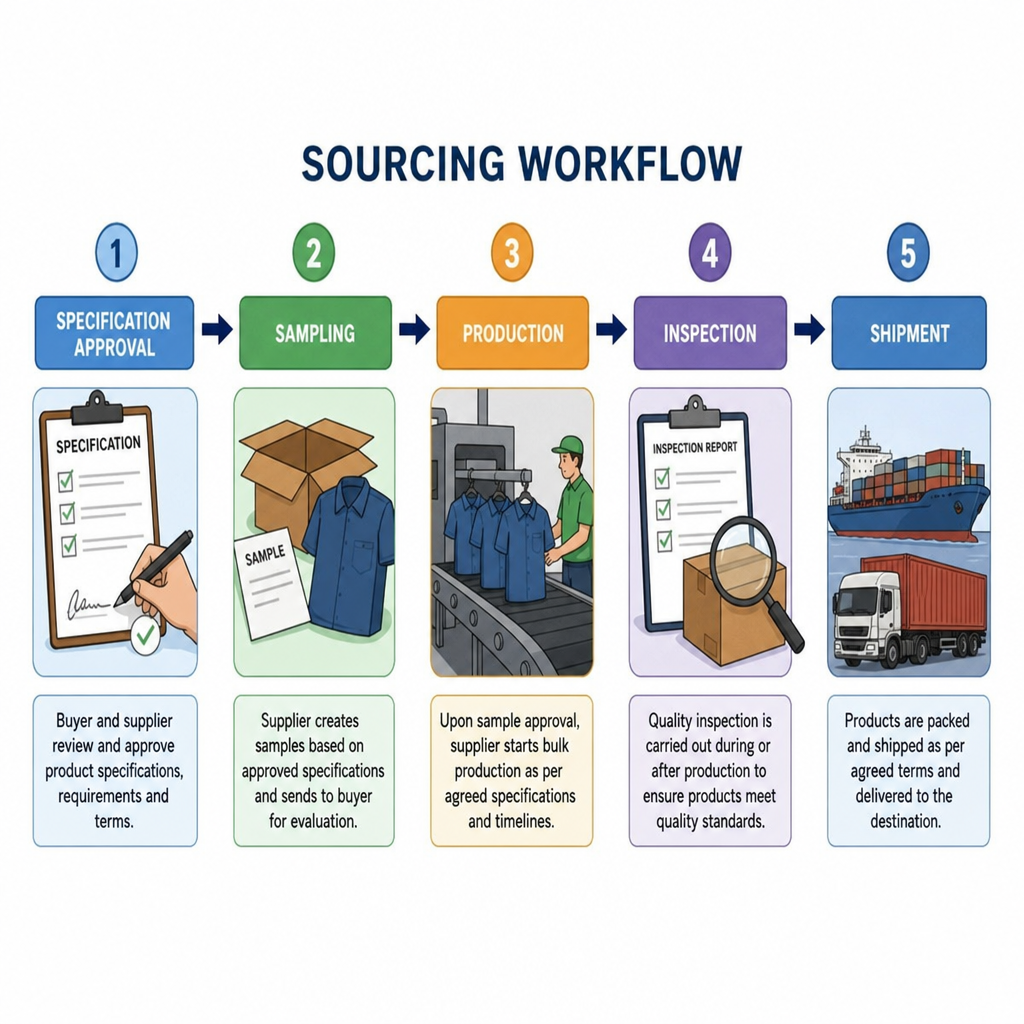
Translate “good quality” into observable requirements. For a storage organizer, your checklist might address dimensions, material, surface finish, fit, and included components. For a printed package, specify the approved artwork version and what the reviewer should compare.
Ask the agent to propose checkpoints appropriate to the product and order. Require the inspection plan to state what will be checked, how results will be reported, and who decides whether the goods can ship. Keep inspection findings separate from your shipment authorization.
Document the response to a failed check as well. Request a process for corrections, reinspection, added costs, and revised timing. Do not leave the first serious quality problem as the moment when everyone discovers they understood the agreement differently.
Keep Amazon preparation and documentation in scope
Amazon requires appropriate packaging and preparation for inventory entering its fulfillment network. Non-compliant packaging can lead to refused inventory or other consequences at the seller’s expense.
Ask your agent to work from the current requirements for your marketplace and product rather than relying on a generic claim that goods are “FBA ready.”
Before dispatch, request evidence of the agreed preparation work:
- Photographs showing finished units and protective packaging.
- Confirmation that the correct product and shipment labels have been applied.
- A check that sets, variations, and carton quantities match your instructions.
- A packing list consistent with the shipment information you approved.
- Written identification of unresolved preparation issues.
Review the applicable barcode and labeling instructions in Seller Central before approving the final layout. Amazon’s preparation guidance distinguishes product identification, packaging, and product-specific preparation, so avoid treating one label check as approval of the entire shipment.
Keep purchasing records organized too. Amazon’s responsible-sourcing documentation requirements can include evidence tracing products to the original manufacturer, along with supplier and manufacturer contact details. Ask the agent how that information will remain accessible after the order closes.
Finally, verify relevant product safety and compliance requirements before ordering. Amazon advises sellers to research applicable requirements and ensure internationally sourced goods comply in their destination country. Seek qualified product-specific advice where needed rather than accepting an agent’s general assurance.
Test the relationship before scaling
Among the most useful FBA sourcing tips is to make the first assignment a controlled test. Start with a defined brief, agreed deliverables, and a spending limit. Evaluate both the output and the way the agent handles uncertainty.
Use these steps to structure your decision:
- Compare shortlisted candidates. Give them the same brief and record differences in scope, assumptions, and fees.
- Verify supporting evidence. Review relevant examples, references, and the proposed supplier-checking process.
- Complete sampling. Track feedback and approvals in writing rather than relying on chat history alone.
- Authorize a manageable initial order. Choose an exposure your business can tolerate while assessing execution.
- Review the outcome. Compare actual costs, timing, quality findings, and documentation with the original commitments.
Treat pressure to skip verification, unexplained payment changes, refusal to disclose compensation, or resistance to independent inspection as reasons to pause. Ask for clarification and supporting records before sending more money.
After delivery, hold a short review rather than immediately repeating the order. Record what went well, what changed, and which corrections must appear in the next purchase instructions. Judge the agent on whether they make that review clearer and more useful—not just whether they can place another order.
Choose a partner you can hold accountable
The right Amazon FBA sourcing agent is the one whose work you can define, verify, and evaluate against your business needs. Prioritize transparent compensation, relevant product knowledge, clear quality checkpoints, and accessible records over a persuasive sales pitch.
Of all the Amazon FBA tips to carry into supplier selection, keep this one central: retain control of specifications, approvals, and spending decisions. Build a clear brief, compare evidence, and test the relationship before expanding it. Your next step is not necessarily a large purchase order; it is a better set of questions for the candidates on your shortlist.
Frequently Asked Questions About Amazon FBA Sourcing Agent
What is the role of an Amazon FBA sourcing agent?
An Amazon FBA sourcing agent acts as an intermediary between your business and suppliers, helping you find manufacturers, manage quotations, oversee production, and coordinate shipping and inspections. Their specific responsibilities can vary based on your agreement.
How do I know if I need a sourcing agent or can source directly from suppliers?
If you need assistance with supplier management, technical communication, or logistics that you can't handle alone, a sourcing agent is beneficial. However, if you're familiar with the supplier and can manage the purchasing process, buying directly may be more suitable.
What should I include in my sourcing brief when approaching agents?
Your sourcing brief should contain detailed product specifications (drawings, materials, dimensions), commercial boundaries (order quantity, budget), customization requirements, acceptance criteria, and a clear schedule for production and inspections.
How can I evaluate a sourcing agent's experience and capabilities?
Request evidence of their past work, such as anonymized supplier comparisons, sample-tracking sheets, and inspection reports. Ask specific questions about their processes for assessing supplier quality and handling issues.
What should I compare when reviewing supplier quotations?
Compare quotations on identical specifications, quantities, and delivery terms. Keep track of additional services offered, transportation costs, and any exclusions. It’s important to have a clear understanding of what each quote includes to evaluate them accurately.