









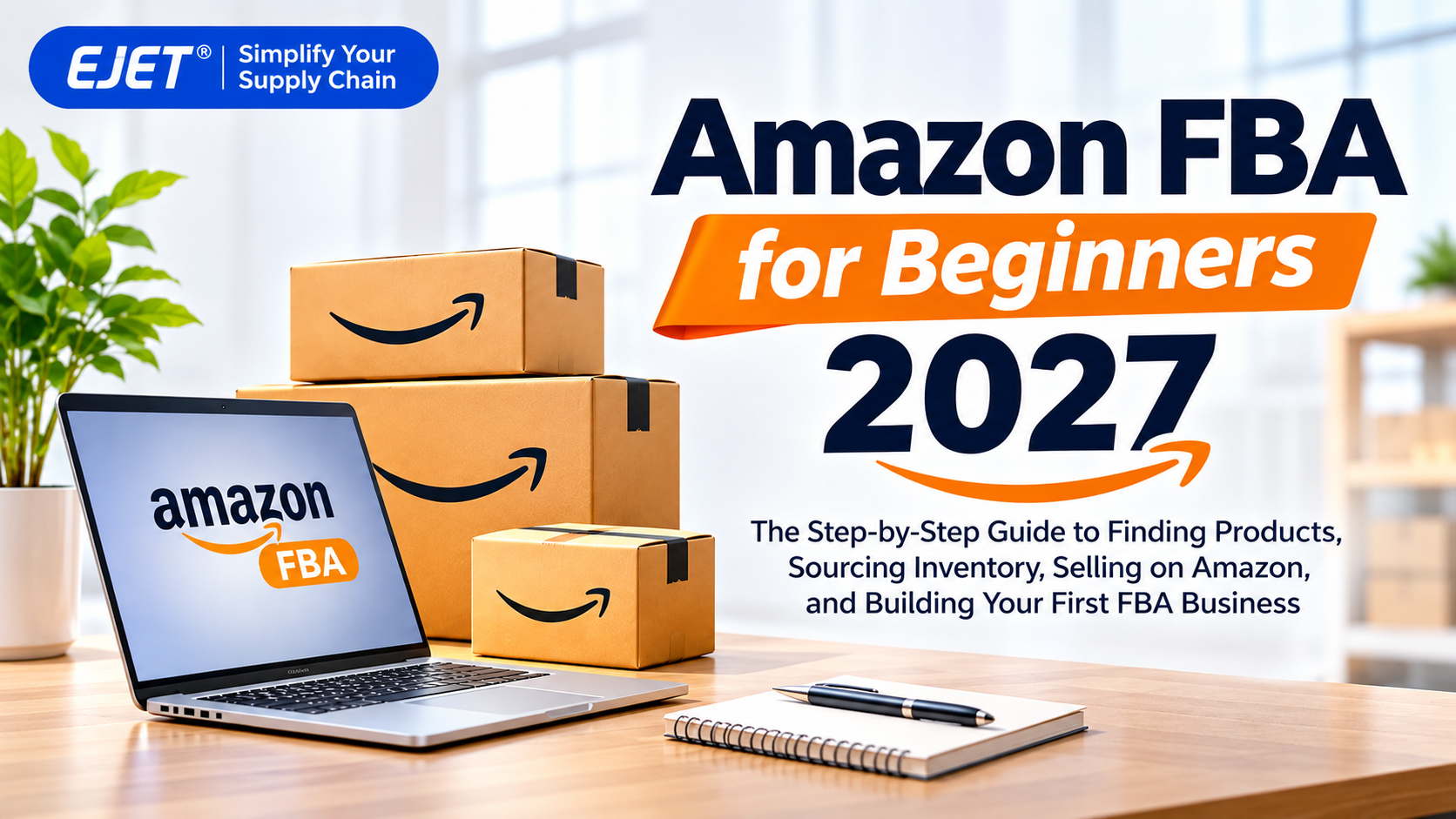
Amazon FBA lets you send eligible inventory to Amazon, which handles picking, packing, shipping, customer service, and returns.
This Amazon FBA for Beginners guide explains how to source products for a 2027 launch: choose a sourcing model, validate demand, check eligibility, compare suppliers, and test before scaling.
The goal is a repeatable buying process—not a rushed purchase.
Planning note: This guide was researched in November 2026. Treat it as preparation for 2027, not confirmation of future fees or policies; verify the requirements in Seller Central before committing money.
How can beginners source products for Amazon FBA quickly?
To source products quickly, narrow your search to one product category and one sourcing method, then evaluate every candidate against the same checklist.
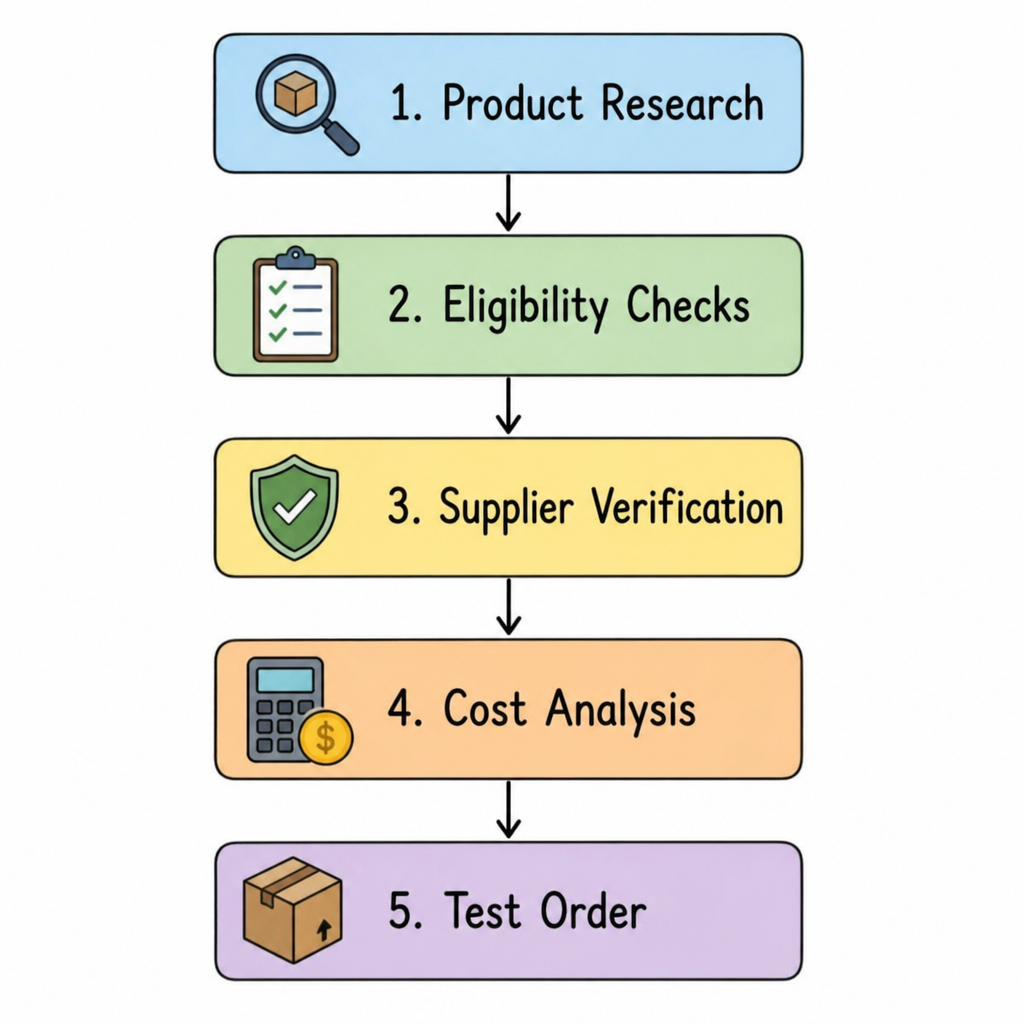
Confirm selling eligibility, investigate demand, calculate costs, and verify the supplier before ordering. Amazon recommends researching suppliers, checking authenticity and quality, and retaining transaction records.
Start by defining your buying boundaries. Decide how much cash you can risk, how much inspection work you can handle, and whether you want to resell existing brands or develop your own product. Use those decisions to reject unsuitable opportunities early.
Build a spreadsheet with columns for:
- Product identity: ASIN, brand, model, variation, and pack count.
- Eligibility: Selling approval and FBA suitability.
- Economics: Purchase cost, estimated fees, transport, and expected contribution.
- Supply: Supplier, minimum order, availability, and replenishment time.
- Decision: Reject, investigate, sample, or test.
Record why you rejected each candidate. That simple habit prevents tomorrow’s research session from repeating today’s dead ends.
Compare product sourcing methods before shopping
Different product sourcing methods involve different purchasing commitments. Amazon describes manufacturer sourcing as a route to customization, often with larger minimum orders and longer lead times, while wholesale involves buying inventory from suppliers stocking manufacturers’ goods. Reselling can also involve buying existing products from retail sources.
|
Method |
What you buy |
What to investigate first |
|---|---|---|
|
Wholesale |
Existing branded products from a brand or distributor |
Supplier legitimacy, resale terms, invoices, and replenishment |
|
Retail or online arbitrage |
Products purchased from physical or online retailers for resale |
Exact listing match, condition, documentation, and availability |
|
Private label |
Products manufactured for sale under your brand |
Samples, specifications, compliance, differentiation, and production timing |
For your first research cycle, consider investigating ready-to-ship wholesale inventory rather than starting with custom manufacturing. Ask whether a supplier accepts a modest opening order and whether the same products will remain available for reorders. Treat both answers as facts to verify, not assumptions.
Arbitrage deserves extra attention to documentation. Before purchasing, check the evidence Amazon requires for the particular approval or authenticity request; do not assume any purchase document will suffice. Amazon may require invoices or additional supply-chain documentation.
If your objective is building a differentiated brand, private label may fit better. Set a realistic schedule around samples, product development, and production rather than forcing a manufacturing project into a fast-resale timetable.
Use focused FBA product research to build a shortlist
Make your FBA product research answer three questions: Is there evidence of demand? Can your offer compete? Can you supply the product profitably? Amazon’s Product Opportunity Explorer provides information about search behavior, purchasing trends, competition, reviews, and returns, but Amazon explicitly warns that these insights do not guarantee sales.
Investigate demand in context
Look beyond a bestseller badge or a single promising search result. Use available trend data to examine whether interest is steady, seasonal, or concentrated around an event. Product Opportunity Explorer can help investigate sales, pricing, and seasonality; its Seller Central documentation currently specifies access for Professional sellers.
For each shortlisted product, write a brief demand explanation. “Useful for organizing small kitchen drawers” is a customer need; “looks popular” is not enough to support a buying decision.
Understand the offer you would compete with
Record competing prices, delivery promises, product variations, and visible differences between offers. Read critical reviews for recurring complaints and check whether your proposed product actually addresses them. Amazon’s research tools include review and return insights that can inform product development and listing decisions.
For resale, compare the physical item with the listing carefully: brand, model, size, color, quantity, and included accessories. Amazon allows sellers to match products to existing listings, but researching authenticity, quality, and intellectual-property policies remains important.
Keep the shortlist small enough to investigate thoroughly. A handful of well-documented candidates is a more useful next step than an enormous list with unanswered questions.
Check selling eligibility before contacting suppliers
Amazon selling eligibility and FBA eligibility are separate checks. Some categories require approval, and products offered through FBA must also satisfy FBA-specific restrictions. Review both before purchasing inventory. (sellercentral.amazon.com)
Open the relevant product in Seller Central and investigate the requirements shown for your account. If approval is necessary, read the requested evidence before placing an order. Approval processes can apply at category, brand, or product level, so another seller’s active offer does not establish your eligibility.
Treat compliance as part of sourcing, not a task for shipment day. Amazon’s sourcing guidance recommends investigating product safety testing and compliance requirements and keeping purchase records. If you cannot establish what documentation a candidate needs, pause that candidate and investigate another.
A low purchase price should never override an unresolved eligibility question.
How do you verify an FBA supplier before ordering?
Verify a supplier by investigating its business identity, confirming product authenticity, inspecting samples, and checking whether its transaction records meet your sourcing needs. Amazon recommends researching suppliers, checking quality, and retaining purchase orders and invoices. Documentation may need to trace products through the supply chain to the original manufacturer.
Use one outreach template so quotes arrive in a comparable format:
Hello, I’m evaluating suppliers for an Amazon retail business. Please confirm whether you supply this product, your minimum order, available quantities, pricing, dispatch timing, and reorder availability. Please also explain your Amazon resale terms, invoice process, product documentation, and procedure for damaged or incorrect goods.
Follow up on vague answers. “Available soon” is not a confirmed dispatch date, and a product photograph is not a sample inspection. Ask who handles preparation and shipping, then request a written breakdown before comparing the final cost.
For branded products, investigate the supplier’s relationship with the brand and request relevant supporting documentation. Keep original records organized by supplier, product, and order rather than assembling them only after a problem arises. Amazon may contact suppliers or manufacturers to verify sourcing documents.
Calculate the full cost before choosing a winner
Use Amazon’s Revenue Calculator to estimate the applicable Amazon fees for the product and marketplace. Enter accurate product information, then add your own purchasing and operating assumptions. The calculator provides estimates, and some expenses require separate allowance or entry as miscellaneous costs.
Your worksheet should account for:
- Acquisition: Product price and transport to your preparation locati0n.
- Preparation: Inspection, labeling, packaging, and any paid handling.
- Inbound movement: Shipping to Amazon and applicable inbound charges.
- Selling and fulfillment: Referral fees, FBA fulfillment, and storage.
- Risk allowances: Returns, damaged inventory, discounts, and advertising where relevant.
Use current Amazon estimates for applicable fees and supplier quotes for purchasing expenses. FBA costs depend on the products and services involved, while storage charges reflect the space inventory occupies.
For a hypothetical example, suppose a product sells for $30. If acquisition costs $8, estimated Amazon charges total $9, preparation and inbound transport cost $3, and you reserve $5 for advertising, returns, and other variable costs, the remaining contribution is $5. These are illustrative assumptions, not Amazon fee quotes or a profit forecast.
That contribution is not necessarily business profit: overhead and other obligations still need consideration. Recalculate using a lower selling price and higher transport expense. Set your own minimum acceptable contribution before reviewing deals, rather than changing the threshold to justify an appealing product.
Turn sourcing strategies into a repeatable work cycle
Use a staged work cycle instead of browsing whenever you have spare time. These amazon FBA product sourcing strategies are a suggested operating routine, not a promise that stock will become available within a particular deadline.
- Define the brief. Choose a category, sourcing model, spending ceiling, and reasons to reject a candidate.
- Build the shortlist. Research customer demand and competing offers, then record exact product identities.
- Clear the buying gates. Check eligibility, request comparable quotes, and identify missing documentation.
- Validate the physical product. Obtain samples or inspect a small order before committing to volume.
- Review the economics. Update costs using confirmed quotes and decide whether to test, negotiate, or reject.
Batch similar tasks together. Send supplier inquiries in one session, compare replies in another, and reserve a separate block for cost analysis. Use a written stopping rule: if essential information remains unavailable, move the candidate out of the active queue.
You can also maintain a separate “later” list. A promising product with an unresolved approval or unavailable supplier need not interrupt work on candidates that are ready for evaluation.
How much inventory should you buy for your first test?
Buy an amount you can afford to hold or lose, limited by plausible demand, supplier terms, and replenishment timing. There is no universal first-order quantity: Amazon’s inventory guidance emphasizes balancing customer demand against overstock and stockouts. Use a test to gather evidence before expanding the commitment.
Separate the supplier’s minimum order from the quantity you actually want. If the minimum exceeds your test budget, ask about a smaller opening order or investigate a different supplier. Do not increase the purchase merely to unlock a lower unit price.
Build FBA inventory management into the test from the beginning. Amazon’s inventory tools include inventory-age tracking, stranded-inventory support, restock recommendations, and inventory-performance information. Review these alongside your actual sales and costs.
Track three dates: when you pay, when the supplier dispatches, and when inventory becomes available for sale. Use your observed replenishment experience when planning subsequent orders. Keep some cash uncommitted so the next purchase can reflect what you learn rather than what you originally hoped would sell.
Make the next sourcing decision easier
Effective sourcing for FBA starts with a clear buying process. Choose one method, research a manageable shortlist, resolve eligibility questions, verify the supplier, and test the economics before expanding your order.
For your 2027 launch, start by building the worksheet and writing your rejection criteria. The strongest sourcing strategies should help you make both decisions faster: which products deserve a careful test, and which ones deserve a confident no.
Frequently Asked Questions About Amazon FBA and Product Sourcing for Beginners
What is Amazon FBA and how does it work?
Amazon FBA (Fulfillment by Amazon) allows sellers to store their products in Amazon's fulfillment centers. Amazon then takes care of storage, packaging, shipping, and customer service. Sellers simply need to send their inventory to Amazon, and they handle the rest.
How can beginners quickly source products for Amazon FBA?
Beginners can quickly source products by narrowing their focus to one product category and one sourcing method. They should create a checklist to evaluate potential products, confirming selling eligibility, investigating demand, calculating costs, and verifying suppliers before placing an order.
What are the different product sourcing methods for Amazon FBA?
Common product sourcing methods include wholesale (buying existing branded products), retail or online arbitrage (purchasing products from retailers for resale), and private label (manufacturing products under your own brand). Each method comes with its own advantages and considerations.
How can I verify a supplier for my FBA products?
To verify a supplier, investigate their business identity, confirm the authenticity of their products, request samples, and check their transaction records. It’s important to ask relevant questions, such as minimum order quantities and their process for handling damaged goods.
What costs should I consider when sourcing products for Amazon FBA?
When sourcing products, you should consider costs such as product acquisition (purchase price and shipping), preparation costs (inspection, labeling, packaging), inbound shipping to Amazon, selling fees (referral fees and fulfillment charges), and risk allowances for returns and advertising.