Alibaba and AliExpress are both part of the wider Chinese ecommerce ecosystem, but they serve different buying missions. Alibaba.com is built for business sourcing, bulk purchasing, supplier negotiation, product customization, and trade-style transactions.
AliExpress is built for retail-style online shopping, smaller quantities, ready-made products, and direct-to-consumer checkout. If you are comparing alibaba vs aliexpress, the fastest answer is this: choose Alibaba when you want suppliers and scalable sourcing; choose AliExpress when you want individual items with simpler ordering.
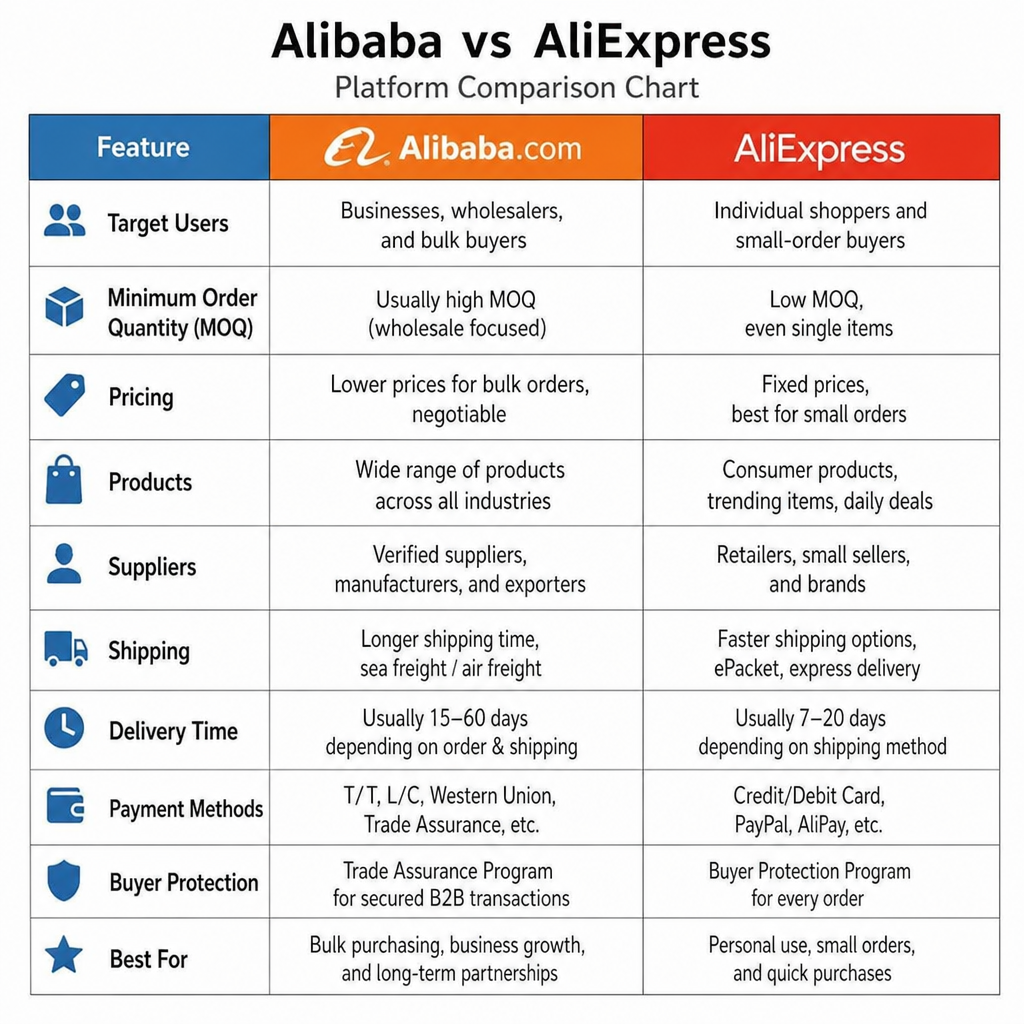
Which platform is better for your buying goal?
Alibaba is usually better for businesses, resellers, private-label brands, and buyers who need to communicate with suppliers before ordering. Alibaba.com encourages buyers to search suppliers, send a Request for Quotation, assess seller badges, and use Trade Assurance where available for eligible order protection.
AliExpress is usually better for shoppers or small testers who want to buy one or a few finished products without negotiating a manufacturing order. In a practical aliexpress review, the main appeal is convenience, product variety, and low-friction checkout; the tradeoff is that quality, delivery experience, and after-sales support can vary by seller and listing.
Alibaba vs AliExpress at a glance
|
Decision factor |
Alibaba.com |
AliExpress |
|---|---|---|
|
Best for |
B2B sourcing, wholesale, manufacturing, private label |
Retail purchases, samples, gadgets, accessories, small orders |
|
Typical buyer |
Importers, ecommerce sellers, brands, procurement teams |
Individual shoppers, hobbyists, bargain hunters, product testers |
|
Order size |
Often bulk or sample-first, depending on supplier MOQ |
Usually single-unit or low-quantity orders |
|
Customization |
Strong fit for logos, packaging, materials, and specifications |
Limited; mostly ready-made products |
|
Pricing style |
Often negotiated with supplier based on quantity and terms |
Listed product prices at checkout |
|
Supplier relationship |
Direct conversation matters |
Less relationship-driven; more like a marketplace purchase |
|
Shipping style |
Freight, express, air, sea, or supplier-arranged options |
Parcel delivery, platform/seller shipping options, sometimes consolidated orders |
|
Protection model |
Trade Assurance on eligible orders and platform payment workflows |
Buyer Protection and refund/return processes on eligible orders |
|
Learning curve |
Higher, because sourcing terms and quality control matter |
Lower, because the buying flow feels familiar |
|
Main risk |
Miscommunication, poor specifications, wrong supplier fit |
Product mismatch, slow shipping, inconsistent seller support |
The platforms are similar, but not interchangeable
The biggest mistake buyers make is treating AliExpress as “small Alibaba” or Alibaba as “cheap AliExpress.” They are connected by a broader marketplace heritage, but the buying logic is different.
Alibaba.com is about sourcing capability: Can this supplier make the product, meet the quality requirement, handle the order size, and ship under the right terms? AliExpress is about consumer-style purchasing: Is this listing clear, is the seller reputable, will the parcel arrive, and does the final price still make sense after shipping?
This is why the aliexpress vs alibaba decision should start with intent, not with the homepage you prefer. If you want five phone cases for personal use, Alibaba may feel slow and unnecessarily formal. If you want 5,000 custom phone cases with packaging, AliExpress will usually be the wrong tool because you need supplier qualification, specifications, samples, and production communication.
Sourcing, negotiation, and customization favor Alibaba
Alibaba.com is designed around supplier discovery. Buyers can search by product or supplier, narrow choices, send RFQs, review seller badges, and communicate before placing an order.
Alibaba’s own sourcing guidance describes steps such as finding suppliers, connecting with sellers, placing protected orders, paying through the platform, and arranging shipment.That structure helps when your purchase depends on dimensions, materials, certifications, packaging, lead time, or recurring supply.
For businesses, this extra work is not friction for its own sake. It is the process that reduces expensive mistakes. A vague order can lead to the wrong material, wrong plug type, weak packaging, missing barcode, or a product that looks acceptable online but fails your actual use case.
On Alibaba, the buyer should ask questions, request samples when appropriate, confirm specifications in writing, and avoid moving important details into informal channels.
Alibaba is stronger when you need:
- Supplier comparison: You can contact multiple suppliers and compare quotes, capabilities, communication quality, and order terms.
- Custom production: You can discuss logos, colors, packaging, molds, materials, and product changes.
- Wholesale economics: Unit pricing may become more attractive when volume increases, though no price should be assumed before supplier confirmation.
- Repeat purchasing: A good supplier relationship can support future orders, improvements, and replenishment planning.
- Formal sourcing workflows: RFQs, samples, purchase terms, production timelines, and inspection planning fit better here.
Retail convenience and small orders favor AliExpress
AliExpress is easier for shoppers who want to browse, compare listings, add items to a cart, and check out without supplier negotiation. That makes it useful for personal purchases, low-risk accessories, replacement parts, craft supplies, electronics add-ons, novelty items, and early product testing.
You can buy one item instead of opening a sourcing conversation, and you can often see photos, reviews, size charts, seller ratings, and estimated delivery information before purchase.
The convenience comes with a responsibility to read carefully. Product images may look similar across many sellers, but descriptions, included accessories, measurements, variants, and shipping options can differ.
A strong aliexpress review should not judge the platform only by low prices; it should also consider whether the listing is specific, whether reviews mention the same variant you plan to buy, and whether the seller’s communication looks reliable.
AliExpress is stronger when you need:
- One-off purchases: You do not need a business account, negotiation process, or supplier quote.
- Quick product exploration: You can test product ideas before committing to wholesale sourcing.
- Visible marketplace signals: Reviews, ratings, photos, and order history can help screen listings.
- Simple checkout: The buying experience is closer to standard retail ecommerce.
- Low commitment: You can experiment with small orders before deciding whether a product category is worth deeper sourcing.
Which option is cheaper in the long run?
Alibaba can be cheaper per unit for bulk and repeat orders, but only after you account for minimum quantities, samples, shipping, duties, packaging, payment terms, quality control, and possible inspection costs.
AliExpress can be cheaper for a single item because you avoid bulk commitments, but the per-unit cost may be higher if you are buying repeatedly for resale. The cheaper platform is therefore not universal; it depends on order size, logistics, and how costly a mistake would be.
|
Cost factor |
Alibaba.com implication |
AliExpress implication |
|---|---|---|
|
Unit price |
Often negotiable, especially with volume |
Usually fixed at listing level |
|
Quantity commitment |
May require MOQ or supplier-specific start order |
Often supports single-item purchases |
|
Samples |
Common and useful, but may cost more per unit |
A retail order can act as an informal sample |
|
Shipping |
Can be complex but scalable for bulk |
Simpler parcel shipping, but not always fastest or cheapest |
|
Quality risk |
Lower when specs, samples, and inspections are handled well |
Depends heavily on listing accuracy and seller reliability |
|
Time investment |
Higher upfront sourcing effort |
Lower upfront effort |
For a side hustle or new product idea, AliExpress may be the smarter first step because it lets you learn cheaply. For a brand planning repeat inventory, Alibaba becomes more relevant once demand is proven and the buyer is ready to manage sourcing properly.
How does AliExpress shipping compare with Alibaba shipping?
AliExpress shipping is generally more straightforward for small parcels because the buyer chooses from the shipping options shown at checkout and waits for delivery.
Alibaba shipping is more flexible but more complex, because orders may involve supplier-arranged logistics, freight forwarders, air freight, sea freight, express courier, customs paperwork, and delivery terms. In simple terms, AliExpress is easier for small parcels; Alibaba is more suitable when shipping becomes part of a serious sourcing plan.
AliExpress delivery estimates vary by seller, product, destination, shipping method, and local carrier performance. Official AliExpress materials refer to delivery-condition windows and refund eligibility in certain non-delivery scenarios, while separate after-sales materials refer to refund or replacement requests for defective or not-as-described products within a stated period after receipt.
Buyers should still check the exact listing, protection terms, and local return process before ordering because marketplace policies and seller handling can affect the experience.
Alibaba shipping requires more planning. A supplier may quote product cost separately from shipping, or offer several logistics choices. The buyer should clarify who handles export documents, import duties, insurance, delivery address limitations, and what happens if goods arrive damaged or late. For large or valuable orders, a freight forwarder and inspection step can be worth considering.
Risk, protection, and quality control work differently
Both platforms offer forms of buyer protection, but protection is not the same as prevention. Alibaba.com highlights Trade Assurance as a way to support eligible orders placed through the platform, and its sourcing guidance encourages buyers to filter for suppliers who support Trade Assurance.
AliExpress has Buyer Protection and after-sales processes, but the practical outcome still depends on documentation, timing, seller conduct, platform review, and the specific issue.
For Alibaba, the best protection begins before payment. Write clear specifications, confirm packaging, request photos or samples, keep communication on-platform when possible, and make sure the order details match what was agreed.
For AliExpress, the best protection begins before checkout. Read negative reviews, confirm variant selection, save screenshots of the listing, record package opening for higher-risk items, and act within the platform’s dispute or return window.
Best use cases for each platform
|
Use case |
Better fit |
Why |
|---|---|---|
|
Buying one phone charger |
AliExpress |
Simple checkout and small quantity |
|
Finding a factory for private-label goods |
Alibaba |
Supplier communication and customization |
|
Testing a trending product idea |
AliExpress first, then Alibaba |
Low-risk test before wholesale sourcing |
|
Ordering branded packaging |
Alibaba |
Custom specifications matter |
|
Buying hobby components |
AliExpress |
Small parts and low quantities are easier |
|
Building a long-term import supply chain |
Alibaba |
Relationship, quality control, and freight planning matter |
|
Comparing finished retail items |
AliExpress |
Reviews and listing-level comparison help |
|
Requesting quotes from multiple suppliers |
Alibaba |
RFQ and supplier outreach are built for this |
Decision summary
Choose Alibaba if you are sourcing for a business, need bulk quantities, want customization, or plan to build a supplier relationship. Choose AliExpress if you want a simple retail purchase, a small test order, or a low-commitment way to compare finished products.
When comparing alibaba vs aliexpress, the right answer is not which platform is “better,” but which buying model matches your risk, order size, and patience.
A practical path is to start small on AliExpress when you are validating a product category, then move to Alibaba when you need consistent supply, better control, and negotiated terms.
Search phrases like 1364 chinese market alibaba vs aliexpress vs 1 vs or 1364 chinese market alibaba vs aliexpress vs 1 may lead buyers to broad marketplace comparisons, but the real decision is simpler: retail convenience versus business sourcing depth.
Pick the platform that matches the job, document everything, and avoid judging a supplier or product by price alone.
Frequently Asked Questions About Alibaba and AliExpress
What is the primary difference between Alibaba and AliExpress?
Alibaba is designed for B2B transactions, focusing on bulk sourcing, supplier negotiation, and customization, while AliExpress caters to retail shoppers seeking single items and easier purchases without negotiations.
Which platform is better for small quantity purchases?
AliExpress is better for small quantity purchases, as it allows buyers to purchase single items or small orders without needing to negotiate with suppliers.
How does shipping differ between Alibaba and AliExpress?
Shipping on AliExpress is typically simpler for small parcels, offering direct shipping options at checkout. In contrast, Alibaba's shipping can be more complex, involving various logistics options and supplier arrangements.
What kind of buyer protection do each platform offer?
Alibaba provides Trade Assurance on eligible orders, focusing on pre-payment protections through careful specification of orders. AliExpress offers Buyer Protection and after-sales processes, but the outcome heavily depends on the specifics of each transaction.
Can I use both Alibaba and AliExpress for the same product?
Yes, you can use both platforms. Many buyers start with AliExpress for a low-risk test order of a product before deciding to source bulk orders through Alibaba once they are ready for consistent supply and better pricing.