
China furniture sourcing agents help buyers find suppliers, coordinate production, inspect orders, and arrange shipment.
This shortlist compares 15 providers for homeowners, designers, retailers, and commercial procurement teams, with practical questions to help you choose between them.
It is a 2027 planning guide based on information reviewed on November 4, 2026, not a claim about future performance or an independently audited ranking.
The right partner depends on your order. Furnishing one villa calls for different support than developing a repeatable dining-chair collection or procuring furniture for a hotel opening. Use the profiles below to build a shortlist, then compare written proposals against the same specifications.
What makes a China furniture sourcing agent worth hiring?
A furniture sourcing agent is worth considering when its agreed responsibilities address work you cannot confidently manage yourself: supplier evaluation, technical communication, production follow-up, inspection, or shipment coordination.
Providers on this list advertise different combinations of these services, so do not assume that “full service” means the same thing everywhere.
For this shortlist, the selection criteria were publicly described furniture involvement, relevant sourcing services, and a distinguishable buyer use case. Furniture-focused businesses appear alongside broader procurement companies. Inclusion reflects their published service offerings, not independently verified customer outcomes; the suggested fits are editorial judgments rather than performance awards.
Before comparing sourcing agents in China, define the support your project actually needs:
Whole-home purchasing: Request room-by-room schedules, finish coordination, dimension approvals, and mixed-supplier consolidation.
Retail collections: Prioritize repeatable specifications, packaging development, reorder controls, and replacement components.
Hospitality procurement: Ask for sample-room approvals, item tracking, commercial-use requirements, and delivery sequencing.
Custom manufacturing: Require drawing control, prototype approval, material traceability, and documented change management.
Existing supplier oversight: Consider a limited assignment covering factory checks, production monitoring, or final inspection.
Treat the proposal as the first working sample. A useful response should identify missing information, distinguish assumptions from confirmed requirements, and name the person responsible for resolving technical questions. An attractive catalog alone does not answer those operational questions.
Which China furniture sourcing agents should you shortlist for 2027?
The following 15 providers cover different purchasing models, from local furniture selection to structured international procurement. The numbering is for navigation, not a universal quality ranking. Start with the firms whose published scope resembles your project, and request recent, relevant evidence before appointing one.
1. EJET Procurement — Multi-category purchasing programs

EJET Procurement publishes an end-to-end workflow covering sourcing, sampling, supplier coordination, production tracking, quality inspection, warehousing, consolidation, and shipping. Its stated categories include home decor and garden or outdoor furniture, within a broader procurement offering for retailers, importers, brands, and other business buyers.
It is a candidate when furniture forms part of a wider assortment rather than the entire purchasing program. A retailer sourcing outdoor furniture alongside garden accessories could evaluate whether one managed workflow fits the buying plan.
Ask for evidence specific to your furniture category, especially if materials or construction are unfamiliar to your team. Request the inspection plan, reporting format, and proposed corrective-action process before ordering.
Establish how suppliers with different completion dates will be coordinated and whether consolidation creates storage charges. For ongoing programs, ask how reorder specifications, supplier changes, and discontinued components are communicated. Keep claims procedures and deadlines visible in the commercial proposal.
2. Asiaction Furniture — Commercial furniture procurement
Asiaction Furniture is the furniture division of Asiaction Sourcing. Its published offering covers hotels, restaurants, senior residences, offices, events, retailers, and furniture brands. The furniture procurement process includes product selection, quotations, sample orders and checks, production, and delivery; the wider group also describes supplier audits and production inspections.
That breadth makes it a sensible starting point for a commercial buyer assembling several furniture categories rather than buying one isolated product. For example, a restaurant brief could combine dining chairs, tables, lighting, and decorative items within a coordinated purchasing schedule.
Ask how responsibilities are divided between furniture specialists, inspectors, and logistics coordinators. For a project with repeated rooms or outlets, request an example of item-level tracking and a proposed approval sequence.
Confirm whether custom development, testing coordination, storage, and installation support are included or separately contracted. Your proposal should distinguish procurement management from services performed at the destination.
3. Foshan Sourcing — Furniture and building-material packages
Foshan Sourcing presents itself as a furniture and building-material sourcing business based in Foshan. Its published categories include sofas, beds, dining furniture, kitchen cabinets, doors, windows, lighting, tiles, and sanitary ware. It also advertises purchasing tours and customized furniture for residential and commercial projects.
Consider it when your purchasing list extends beyond loose furniture. A homeowner or developer comparing cabinetry, dining furniture, and bathroom products could evaluate whether one coordination team simplifies the overall assignment.
Keep the technical requirements separate, however. Ask who approves cabinet drawings, who verifies site dimensions, and how materials from different factories are identified in storage.
Request an itemized proposal showing product costs, sourcing charges, inspection scope, and delivery exclusions. Before planning a buying trip, send your room list and reference images so the proposed itinerary reflects actual requirements rather than a general showroom tour. Also clarify how unfinished selections will be handled after you leave China.
4. Riwick — Furniture sourcing with materials and accessories coverage
Riwick describes a furniture sourcing business in Longjiang, Foshan, alongside a supply business for furniture materials, accessories, hardware, and parts. Its sourcing coverage extends to residential and commercial furnishing, building materials, lighting, doors, windows, and related products. Riwick also states that it shares supplier information and reports product costs and inspection details.
Its combined sourcing and component offering makes it worth investigating for buyers concerned with what goes into a piece of furniture, not just its appearance. A retailer developing seating, for instance, could ask about frame construction, upholstery inputs, hardware, and replacement parts.
Because Riwick describes both sourcing and supply activities, clarify its role on every quotation. Is it acting as your agent, selling the goods, or providing materials itself?
Ask how those arrangements affect factory disclosure, warranties, pricing transparency, and claims. For customized products, request a materials schedule tied to the approved sample and purchase order.
5. HomeBridge — Whole-home furnishing coordination
HomeBridge focuses on helping overseas homeowners source whole-home products from China. Its published scope includes furniture, custom joinery, cabinets, doors, curtains, rugs, lighting, and fixtures. The company describes factory matching, production follow-up, quality inspection, packaging, logistics, and final-delivery coordination as parts of its project service.
This is a relevant option for a homeowner who wants a coordinated purchasing project rather than a collection of unrelated supplier transactions. It may also suit a designer seeking support translating room plans and visual references into sourcing requirements.
Begin with floor plans, access restrictions, preferred materials, and a realistic delivered budget. Ask HomeBridge to identify which dimensions require local professional verification before manufacturing starts. Distinguish factory customization from interior design and installation responsibilities.
Your agreement should also specify who handles missing components, damaged goods, and replacement shipments after delivery, rather than leaving after-sales support as an undefined promise. Request a clear approval record for each custom item.
6. Guangzhou Sourcing — Hospitality and fit-out procurement
Guangzhou Sourcing describes an international procurement office focused on residential and commercial building projects. Its services include furniture, fixtures and equipment, operating supplies, lighting, sanitary ware, and building materials.
Published capabilities cover tender support, supplier evaluation, purchasing, quality control, shipping coordination, and an integrated design-and-procurement offering.
Its project-oriented scope makes it a useful candidate for architects, developers, and hospitality operators comparing procurement partners. The relevant question is whether its proposed workflow can connect your design approvals with purchasing decisions and production deadlines.
For a hotel or serviced-apartment project, submit a bill of quantities with item codes, drawings, finishes, and required delivery phases. Ask for an example procurement tracker and a written substitution procedure.
Clarify who approves alternatives when a specified fabric, finish, or component becomes unavailable. Also establish whether deliveries will be organized by room, floor, installation phase, or supplier, and who maintains that identification through consolidation.
7. Easy Imex — Furniture product development and packaging
Easy Imex publishes a dedicated furniture sourcing service for e-commerce sellers, retail stores, furniture warehouses, and home-staging businesses. Its furniture page highlights bill-of-materials analysis, product development, packaging engineering, drop testing, quality reports, factory audits, and freight management.
Those stated capabilities make it worth evaluating when the assignment involves a furniture product line rather than simply selecting showroom stock. A retailer introducing a flat-pack table, for example, could ask for coordinated development of the product, assembly instructions, hardware pack, and shipping carton.
Request a development plan that separates prototype approval from packaging approval. Ask which tests are proposed, who performs them, and what happens if either the furniture or its packaging fails.
Confirm ownership of drawings, tooling, artwork, and approved samples. For repeat orders, require a documented process for controlling material changes and checking that later production matches the agreed specification. Include replacement-part identification in the initial brief.
8. Plus Sourcing — Furniture and lighting collections
Plus Sourcing positions itself around furniture and contemporary lighting for importers in Europe and North America. Its published furniture coverage includes indoor and outdoor products, while its service descriptions identify factory audits, sampling, production follow-up, and piece-by-piece quality inspection.
It is a candidate for importers seeking a focused furniture-and-lighting relationship rather than broad general merchandise sourcing. A boutique retailer building coordinated living, dining, and outdoor collections could use an initial discussion to assess category knowledge and collection consistency.
Ask for examples relevant to your target price point and order structure. Confirm whether the proposed inspection covers every unit, selected characteristics, or a sampling plan, and obtain the inspection criteria in writing.
If lighting is included, treat electrical documentation and destination-market requirements as a separate workstream. Also ask how packaging, spare shades, replacement hardware, and repeat availability will be managed across a collection rather than individual purchase orders.
9. JingSourcing — Broad furniture-category sourcing
JingSourcing publishes a dedicated furniture offering covering home, office, outdoor, bedroom, bathroom, and children’s furniture. It advertises both stock and customized products, including OEM and ODM options. This gives buyers a clear furniture-specific starting point within a broader sourcing business.
Consider it when you want to compare several product categories under one sourcing relationship. An online retailer, for example, could investigate whether the team can support a coordinated assortment of desks, shelving, and small occasional furniture.
Do not assume that category coverage establishes expertise in every material or use case. Ask who will manage your assignment and request relevant inspection examples.
For furniture requiring assembly, include hardware completeness, instruction quality, and assembled-product checks in the scope. For children’s products, request a product-specific compliance review rather than accepting a general statement that certificates are available. Confirm whether customization changes minimum quantities, sampling costs, or the approval process before committing to development.
10. LeelineSourcing — General sourcing and fulfillment support
LeelineSourcing presents a broad China sourcing service covering supplier selection, design, manufacturing, quality assurance, warehousing, shipping, and order fulfillment. Its published positioning includes small businesses, direct-to-consumer brands, and dropshipping sellers, rather than a furniture-only procurement model.
It belongs on a furniture shortlist when broader sourcing and fulfillment support matter to your business model. Treat its suitability for your exact furniture category as something to establish during qualification, not as a conclusion based on its general service range.
Ask for recent examples involving products similar in size, construction, packaging, and delivery channel to yours. If you sell bulky furniture online, request a workflow showing inspection, storage, dispatch, and damage-claim responsibilities.
Distinguish fulfillment capability from furniture product engineering. Before comparing prices, confirm whether the proposal includes protective repacking, palletization where needed, labeling, spare components, and destination delivery arrangements. Ask what happens operationally when a customer reports a missing part.
11. Supplyia — Modular procurement and consolidation services
Supplyia describes sourcing, purchasing, inspection, consolidation, and shipping services for small and medium-sized buyers. Its published strengths include multi-category hospitality and retail sourcing, purchasing through Chinese e-commerce platforms, light customization, and combining goods from multiple suppliers. It also offers individual services such as factory audits and inspection.
This modular structure is worth considering if you already have some suppliers and do not need a complete sourcing assignment. You might request help purchasing selected items, checking orders, and consolidating furniture with other hospitality or retail products.
Define the boundary between warehouse receiving and technical furniture inspection. A quantity check should not be treated as approval of construction, finish, assembly, or performance.
Ask Supplyia to identify the services and specialists needed for your particular products. Confirm storage conditions, identification methods, repacking options, and responsibility for goods arriving damaged from a supplier. For repeat purchasing, agree on how specifications and approved samples will be retained.
12. SourcingArts — Supplier verification and order oversight
SourcingArts markets supplier verification, supplier development, and order management, and describes itself as a furniture sourcing partner. Its published services include supplier reports, manufacturer matching, purchasing follow-up, and customized product support. These offerings provide a starting point for buyers wanting help qualifying suppliers or overseeing an order.
Consider a clearly scoped initial assignment if you already have potential China furniture suppliers but need additional information before selecting one. For example, you could request verification of production capabilities and a comparison against your technical brief.
Ask what the verification report actually contains and distinguish document review from an on-site factory audit. Specify whether you need photographs of production equipment, checks on subcontracting, or confirmation of material-handling capabilities.
If you proceed to order management, name the production milestones and inspection responsibilities separately. Request a sample report so you can judge whether the evidence is detailed enough to support a purchasing decision.
13. Landen Sourcing — Furniture selection and mixed-order coordination
Landen Sourcing describes a Foshan-based service covering furniture and building materials. Its published workflow includes supplier matching, negotiation, ordering, samples, quality control, consolidation, and shipping. Its displayed product focus includes modern, vintage-inspired, American-style, and French-style furniture, together with lighting.
It is worth investigating when the brief involves selecting coordinated pieces from several suppliers. A residential designer comparing upholstered seating, dining furniture, and decorative lighting could use the initial consultation to assess how the team handles visual and technical consistency.
Translate style references into measurable requirements before asking for quotations. Request material descriptions, dimensions, finish samples, upholstery references, and a precise list of included pieces.
Ask how showroom selections are connected to the actual manufacturing supplier and purchase order. For mixed orders, confirm whether inspection happens at each factory, at consolidation, or both, and how rejected pieces are handled without losing track of the rest of the shipment.
14. Source Foshan — Specification-led sourcing and consolidation
Source Foshan publishes furniture, cabinetry, and building-material sourcing services for whole homes, designer projects, and hospitality procurement. Its described workflow includes factory and showroom comparisons, supplier coordination, custom manufacturing support, inspection, consolidation, and shipping. It also states that quality-control scope is agreed in writing.
This makes it a candidate for buyers who want to begin with a written specification and keep several suppliers within one coordination process. A designer managing furniture alongside custom cabinetry could investigate how the team documents approvals and outstanding decisions.
Submit a room schedule or bill of quantities rather than relying only on inspiration images. Ask for a sample comparison sheet showing differences in materials, dimensions, exclusions, and delivery assumptions.
Confirm who approves shop drawings and how revisions reach the factory. Since inspection scope is central to the offering, request explicit acceptance criteria, reporting requirements, and the procedure for reinspection after corrective work.
15. Dragon Sourcing — Structured supplier research and qualification

Dragon Sourcing publishes furniture-related case studies, including a project identifying furniture wood-part suppliers in China and Mexico.
That case describes supplier databases, scorecards, requests for information and quotations, supplier profiles, and recommendations. It provides evidence of a structured sourcing approach rather than a showroom-guidance service.
Consider it when the assignment involves supplier qualification, component sourcing, or comparing production options across markets. A furniture manufacturer evaluating alternative suppliers for wooden components could have different needs from a homeowner selecting finished sofas and tables.
Define the decision you need the research to support: supplier selection, competitive benchmarking, diversification, or production transfer. Ask which deliverables lead to factory visits, samples, and final qualification.
Keep research and execution responsibilities distinct in the proposal. If your requirement includes ongoing production oversight or finished-furniture logistics, confirm those services explicitly rather than assuming they follow automatically from the supplier-search assignment.
How much do China furniture sourcing agents charge?
China furniture sourcing agents use different pricing structures, so a percentage alone does not provide a complete comparison.
Published examples include separate service fees, percentage-based sourcing plans, and individually available audit, inspection, or consolidation services. Obtain a current written quotation for your project rather than treating advertised terms as guaranteed 2027 pricing.
When comparing China sourcing services, ask each candidate to price the same scope. A proposal covering supplier research and purchasing should not be compared directly with one that also includes product development, repeated inspections, storage, and export coordination.
Use this commercial checklist:
- Fee basis: What amount is the percentage applied to, and are minimum charges involved?
- Supplier relationships: Does the agent receive supplier commissions, rebates, or other compensation?
- Included work: How many samples, inspections, revisions, and supplier visits are covered?
- Additional charges: What triggers storage, repacking, testing, reinspection, or travel fees?
- Payment flow: Who receives deposits and balances, and who approves payment release?
- Claims: Who pays for corrective work, replacement parts, and replacement freight?
Build your comparison around a complete delivered-cost worksheet. Include products, services, packaging, inland transport, international freight, insurance, destination handling, customs-related costs, and final delivery. Ask the provider to label estimates separately from confirmed quotations and identify who will update them.
For US imports, have a licensed customs broker review classification and applicable duties before approving the budget. The USITC explains that additional tariffs on Chinese products are identified through relevant tariff provisions; do not assume a generic furniture duty rate covers your shipment.
Make furniture quality control specific
For furniture sourcing in China, ask for an inspection plan written around your products rather than a generic promise of “strict QC.” Easy Imex, Asiaction, and other providers publish inspection or quality-management services, but you still need to agree on what your assignment covers.
Build the checklist from the approved specification. For upholstered seating, request confirmation of frame materials, upholstery references, seam appearance, dimensions, and visible finish.
For tables and cabinets, specify checks for alignment, hardware operation, surface defects, assembly, and the agreed materials. Where performance testing is needed, identify the test method and qualified testing provider separately.
Ask the inspector to document:
- Product codes, quantities checked, and the basis for selecting units.
- Measurements against approved drawings and agreed tolerances.
- Defects with clear photographs and item identification.
- Assembly components, instructions, labels, and packaging condition.
- Corrective actions, responsible parties, and any required reinspection.
Do not leave rejection decisions until goods are ready to load. Agree beforehand on which defects require correction, what can be accepted with written approval, and who authorizes shipment. Request a final report that distinguishes observed facts from items not checked.
For a custom piece, retain an approved reference sample or a sufficiently detailed approval record. Make clear that a photograph approving color does not also approve dimensions, construction, packaging, or every other characteristic. Each approval should state its scope.
Turn the shortlist into a controlled purchasing process
The next step is not contacting all 15 companies with “send your best price.” Choose two or three whose published scope matches your assignment, then give them the same information. This makes the proposals easier to compare and reveals which team asks useful questions.
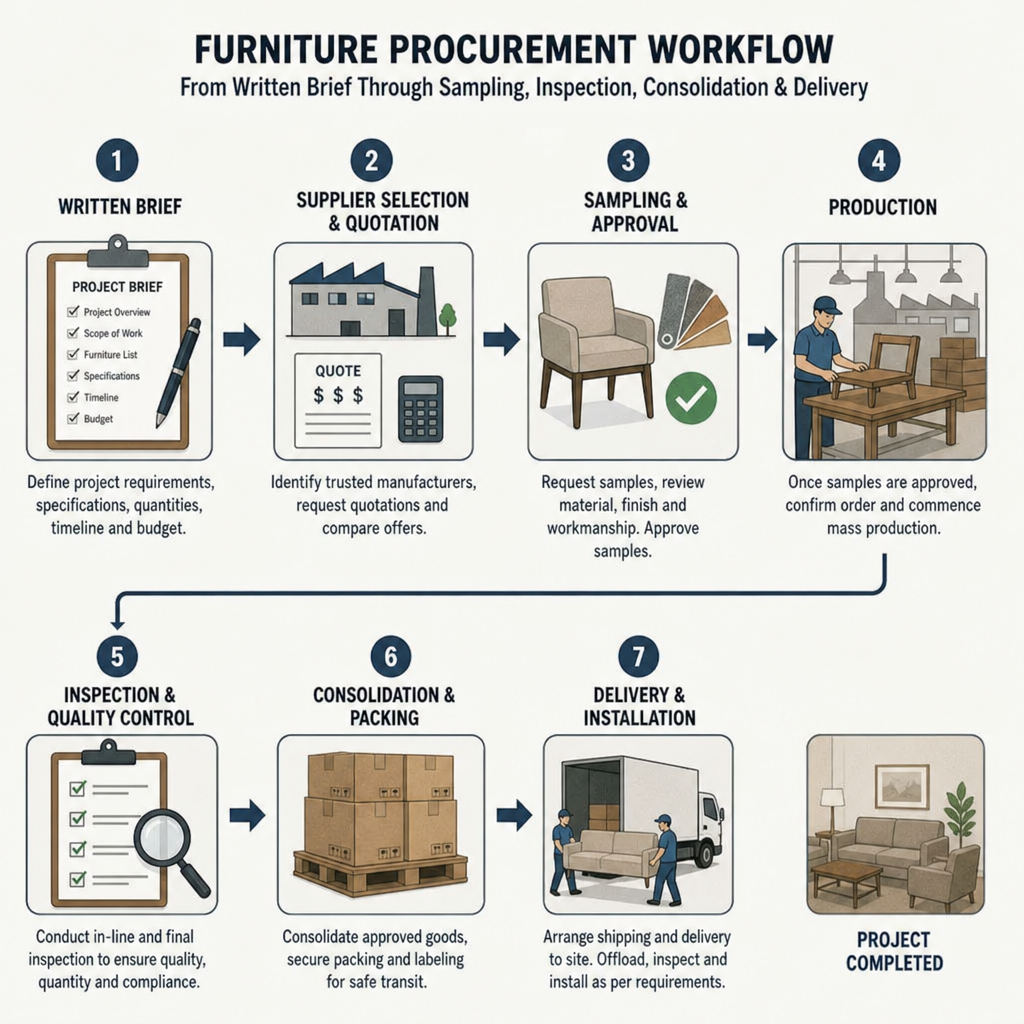
- Prepare the brief. Include item codes, quantities, reference images, drawings, materials, destination, budget boundaries, and target dates. Mark decisions that remain open rather than allowing suppliers to guess.
- Compare proposed workflows. Ask each candidate to explain supplier selection, sample approvals, inspection, payment handling, and shipping handoff. Identify exclusions before evaluating the final fee.
- Approve specifications and samples. Record dimensions, finishes, materials, hardware, packaging, and any required testing. Give revisions dates or version numbers so production does not rely on an outdated drawing.
- Set production checkpoints. Request a schedule with named approvals and reporting milestones. Establish what happens when materials, quantities, or completion dates change.
- Review inspection and shipment documents. Resolve outstanding defects and confirm quantities before authorizing release. Check that product identification carries through the packing list and consolidation records.
- Plan receipt and claims. Arrange delivery access, unloading, inspection on arrival, and a documented reporting process. Confirm where spare parts and supporting records will be kept.
If you are buying wholesale furniture from China for resale, add reorder requirements to the first brief. Ask how the team will preserve specifications, communicate component changes, and identify replacement parts. A successful first shipment is useful; a purchasing process you can repeat is the stronger commercial objective.
Keep US compliance separate from sourcing promises
China import agents can assist with documentation and coordination, but importers must ensure their merchandise meets applicable agency requirements. CBP recommends seeking appropriate specialist guidance, including from licensed customs brokers, for importing questions. Identify the importer of record and responsibility for compliance before placing orders.
For covered upholstered furniture, CPSC guidance describes federal flammability requirements under 16 CFR Part 1640, including applicable testing and permanent labeling. Ask for documentation relevant to the actual construction being purchased, not an unrelated product or fabric.
Furniture containing regulated composite wood products can also raise TSCA Title VI requirements. EPA guidance addresses hardwood plywood, medium-density fiberboard, particleboard, and relevant supply-chain responsibilities. Have an appropriate specialist identify the documentation needed for your products and transaction.
These are starting points, not a complete compliance checklist. Arrange a product-specific review before production, and recheck applicable requirements for your 2027 shipment. Keep compliance approvals separate from visual quality approvals so neither is mistaken for the other.
Choose the partner whose process you can verify
The best agent for your project is not necessarily the largest company or the lowest-fee bidder. Shortlist by project fit, then evaluate written scope, relevant evidence, communication, and accountability.
Send the same detailed brief to your leading candidates. Ask for an itemized proposal, a sample inspection report, and a clear explanation of who handles problems after payment. Choose the team that makes responsibilities easier to understand—and puts those responsibilities in writing before you commit.
Frequently Asked Questions About Sourcing Furniture from China
What is a furniture sourcing agent, and why do I need one?
A furniture sourcing agent is a professional who helps businesses find reliable suppliers in China, coordinates production, inspects products, and manages shipping. Hiring a sourcing agent can save you time, reduce risks, and ensure better communication with suppliers, allowing you to focus on other aspects of your business.
How do I choose the right sourcing agent for my project?
To choose the right sourcing agent, consider the specific needs of your project, such as product categories, order volume, and desired services (e.g., inspection, logistics). Research potential agents’ experience, client reviews, and service offerings, then request quotes and proposals to evaluate their fit for your requirements.
What should I expect in terms of costs when hiring a sourcing agent?
Costs can vary widely among sourcing agents, with pricing structures often including fixed service fees, commission-based charges, or a combination of both. Always request a detailed quote that includes all potential costs related to your project, including inspections, shipping, and any additional services.
How can I ensure product quality when sourcing furniture from China?
To ensure product quality, work with your sourcing agent to create a detailed inspection plan tailored to your specific products. This plan should define acceptable quality standards, specific checks to be performed, and a clear documentation process for any defects or issues.
What legal considerations should I be aware of when importing furniture from China?
When importing furniture from China, it's essential to understand compliance with regulations such as flammability requirements and TSCA regulations related to composite wood products. Consult with legal or customs experts to ensure that your products meet all necessary standards and regulations in your target market.